
 Computer Science
Textbook
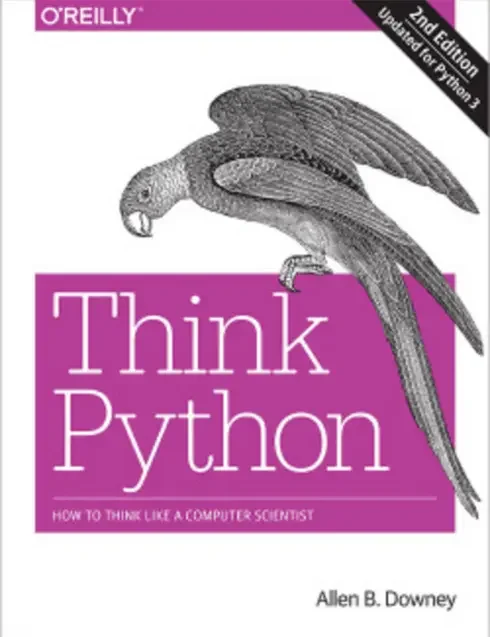
Think Python: How to Think Like a Computer Scientist
Not rated yetRate this bookThink Python: How to Think Like a Computer Scientist by Allen B. Downey introduces programming through small, cumulative steps in problem solving, abstraction, and debugging. The linked source is the second edition for Python 3, and the downloaded PDF identifies itself as Version 2.4.1 with a 2015 copyright. This guide follows all nineteen chapters plus the debugging and algorithm-analysis appendices. It does not mix in the third edition's different presentation. Beginners move from expressions and functions through control flow, data structures, files, classes, and inheritance. The emphasis is learning to predict, test, and explain program behavior rather than copying completed code. Some historical links need the publisher's replacement-domain guidance, which is noted in the study instructions.
Read on the publisher’s website. Opens in a new tab.
 Free
About this book
Think Python: How to Think Like a Computer Scientist by Allen B. Downey introduces programming through small, cumulative steps in problem solving, abstraction, and debugging. The linked source is the second edition for Python 3, and the downloaded PDF identifies itself as Version 2.4.1 with a 2015 copyright. This guide follows all nineteen chapters plus the debugging and algorithm-analysis appendices. It does not mix in the third edition's different presentation. Beginners move from expressions and functions through control flow, data structures, files, classes, and inheritance. The emphasis is learning to predict, test, and explain program behavior rather than copying completed code. Some historical links need the publisher's replacement-domain guidance, which is noted in the study instructions.
Book summary
About this book
Think Python: How to Think Like a Computer Scientist by Allen B. Downey introduces programming through small, cumulative steps in problem solving, abstraction, and debugging. The linked source is the second edition for Python 3, and the downloaded PDF identifies itself as Version 2.4.1 with a 2015 copyright. This guide follows all nineteen chapters plus the debugging and algorithm-analysis appendices. It does not mix in the third edition's different presentation. Beginners move from expressions and functions through control flow, data structures, files, classes, and inheritance. The emphasis is learning to predict, test, and explain program behavior rather than copying completed code. Some historical links need the publisher's replacement-domain guidance, which is noted in the study instructions.
Chapter-by-chapter study guide
Chapter 1: The Way of the Program
Programs express computations through a precise language and execute in an environment that reports results or errors. The chapter introduces values, types, operators, expressions, and the distinction between interactive use and scripts. Syntax rules govern valid form, while meaning depends on what an expression does. Programming also involves decomposition and testing rather than writing a complete solution in one attempt. Errors supply evidence about the program and should be read as information, not simply as a sign of failure. Establishing a small working environment makes later experiments easier.
Study application: Evaluate several arithmetic expressions by hand before running them. Deliberately introduce one syntax error, read the message, and explain the correction in terms of the language rule involved.
Chapter 2: Variables, Expressions and Statements
Variables name values, assignment changes a binding, and expressions produce values that statements can use. An assignment is not an algebraic assertion that remains permanently true. Names, comments, operator precedence, and the difference between displaying and storing a result affect program behavior. Updating a variable uses its prior value to compute a new one. Clear names communicate purpose, while comments should explain intent or a nonobvious decision rather than repeat every line. Small tracing exercises help build an accurate mental model of execution.
Study application: Trace a sequence of assignments on paper, recording each name's value after every statement. Compare the trace with execution and explain how swapping two statements changes the outcome.
Chapter 3: Functions
Functions package a sequence of operations behind a name and parameters. A call supplies arguments, and execution moves into the function before returning to its caller. Parameters and local variables belong to a call's environment, which can be represented with a stack diagram. Defining a function does not execute its body immediately. Composition lets one function call another and supports reusable building blocks. Incremental development makes the program easier to test because each new piece can be checked before more complexity is added.
Study application: Write a small function with two parameters, call it with different arguments, and trace its local variables. Refactor a repeated calculation into a function and explain what the function name communicates.
Chapter 4: Case Study — Interface Design
The turtle-based case study develops reusable drawing functions and uses them to explore encapsulation, generalization, and interface design. A function's interface states how to use it; implementation details describe how it performs the work. Parameters make a drawing more general, but excessive or unclear parameters can make an interface harder to understand. Refactoring improves a working program's organization while preserving its intended behavior. Geometric reasoning supports the code rather than merely decorating it. The chapter models how a simple example can evolve through successive improvements.
Study application: Start with a fixed polygon-drawing routine, then generalize side count and length. Write a short description of allowed inputs and compare the old and new interfaces for a caller.
Chapter 5: Conditionals and Recursion
Boolean expressions and conditional execution let a program choose among actions. Logical operators combine tests, and nested conditionals need clear attention to which statements belong to each branch. Recursion solves a problem through smaller calls, requiring a base case and progress toward it. Stack diagrams reveal separate local environments for recursive calls. Infinite recursion results when termination is missing or unreachable. Input conversion and error handling begin to expose the gap between an assumed input and what a user actually supplies.
Study application: Trace a recursive countdown and identify its base case. Modify it incorrectly so progress stops, then explain why the revised version fails to terminate before restoring it.
Chapter 6: Fruitful Functions
Fruitful functions return values that callers can use in further computation. Returning differs from printing: a displayed result does not automatically become a useful return value. Incremental development helps construct calculations through small tested stages. Boolean functions can clarify conditions, while recursive functions can return results built from smaller subproblems. A function should have an understandable input–output contract and handle the cases expected by that contract. Debugging requires checking whether the return path exists for every relevant branch.
Study application: Implement a numerical function in stages, testing an intermediate result before combining operations. Show the difference between a function that prints a value and one that returns it for another calculation.
Chapter 7: Iteration
Iteration repeats work through assignment updates and loop control. A while loop depends on a condition and on changes that eventually make the condition false when termination is intended. Break statements create another exit path and should be understood in the surrounding logic. The chapter uses numerical approximation to connect algorithms with stopping criteria. Equality of floating-point results is not always a suitable termination test, so a tolerance and a meaningful error measure may be needed. Tracing the state across iterations is a reliable way to locate off-by-one or nontermination errors.
Study application: Write an iterative approximation with a stated tolerance and maximum iteration count. Record several intermediate values and explain why the stopping condition is appropriate for the quantity being estimated.
Chapter 8: Strings
Strings are sequences of characters with indexing, slicing, traversal, searching, comparison, and methods. Indices identify positions, while a slice uses endpoint conventions that differ from an inclusive list of positions. Strings are immutable, so changing apparent content means constructing a new string rather than modifying a character in place. Traversal can examine each character or position depending on the task. Empty strings and boundary indices expose mistakes that ordinary examples may miss. Understanding sequence operations here prepares for lists and other containers.
Study application: Write a character-counting function and test an empty string, repeated characters, and a target absent from the input. Predict the result of several slices before running them.
Chapter 9: Case Study — Word Play
The word-list case study turns text requirements into explicit predicates and search procedures. Questions about forbidden letters, required letters, or ordering become functions that return a Boolean result. Breaking a problem into helpers improves testing and reuse. Reading a file line by line requires handling line endings and the actual form of the data. Search strategies should be checked against examples that satisfy and violate the condition. The chapter demonstrates that short programs can support systematic exploration when the question and data are well defined.
Study application: Create a predicate for a letter constraint and design passing, failing, empty, and boundary cases. Use it to filter a small local word list and inspect several results manually.
Chapter 10: Lists
Lists are mutable sequences supporting indexing, slicing, traversal, and methods that may change the object. Aliasing occurs when two names refer to the same list, so a change through one name can be visible through the other. Equality of contents differs from identity of objects. A function may mutate a list argument or return a new list, and callers need to know which behavior is intended. Mapping, filtering, and reducing organize common operations. Distinguishing mutation from rebinding prevents many confusing bugs.
Study application: Create two aliases to one list and a separate copied list. Mutate each in turn and predict which names show the change. Document whether a helper function modifies its input.
Chapter 11: Dictionaries
A dictionary maps keys to values and supports lookup by key rather than sequence position. Keys must meet hashability requirements, while values can be more general. Histograms, reverse lookup, and memoization illustrate practical uses. A missing key needs an intentional response rather than an accidental failure. Dictionary iteration and membership tests should be interpreted according to what they examine. Choosing a dictionary depends on the operations required; it is especially useful when the relationship is naturally key-to-value. Performance claims belong with assumptions about the operation and data.
Study application: Build a frequency table from a short text, test missing and repeated keys, and compare it with a list-based search. Explain why a dictionary is a better fit for the lookup task.
Chapter 12: Tuples
Tuples are immutable sequences useful for grouping related values, returning multiple results, and serving as dictionary keys when their elements are suitable. Tuple assignment and unpacking make relationships between values explicit. Zip connects parallel sequences, and variable-length arguments support flexible interfaces. A tuple's immutability does not imply that every object referenced inside it is itself immutable. Choosing between a tuple and a list should reflect the intended meaning and operations rather than a superficial notation preference.
Study application: Return a minimum–maximum pair from a function and unpack it at the call site. Build a dictionary with tuple keys and explain why an equivalent list key would not work.
Chapter 13: Case Study — Data Structure Selection
The case study combines text processing, frequency analysis, random selection, and structured relationships to show how representation affects an algorithm. Lists, dictionaries, and tuples support different operations and can be combined. A suitable structure makes common operations clear and efficient; a poorly matched structure produces repeated searching or awkward updates. Random behavior needs carefully chosen tests because a single run does not establish correctness. The chapter encourages developing a working version, inspecting intermediate results, and then refining the representation.
Study application: Design a small text-analysis pipeline and state which structure stores words, frequencies, and grouped results. Justify each choice using the operations performed rather than saying one container is universally best.
Chapter 14: Files
Files preserve information beyond one program run and introduce paths, reading, writing, formatting, and exceptions. A program must distinguish an absent file, unexpected content, and a logic error. Serialization and stored representations need to match the data and intended use. The chapter also introduces modules and organizing reusable code. File operations have effects outside the immediate calculation, so experiments should use disposable local files and verify what was written. Clear assumptions about encoding, line endings, and data format make failures easier to diagnose.
Study application: Write and read a small data file in a temporary exercise directory. Test a missing path and malformed line, and make the error response explain the problem without silently inventing valid data.
Chapter 15: Classes and Objects
Classes define new types, and instances hold attributes that describe particular objects. The chapter uses geometric objects to connect an abstract definition with concrete state. Attribute access differs from ordinary local names, while aliasing and copying still matter for mutable objects. Shallow copies preserve references to nested objects, so they may not create complete independence. A class is useful when it gives a coherent model of state and operations, not merely because object-oriented code appears more advanced.
Study application: Create a simple point-like object, then compare an alias, a shallow copy, and a copy involving nested mutable state. Explain which later changes are shared.
Chapter 16: Classes and Functions
Functions can operate on objects while following either a pure-function style or a modifier style. A pure function returns a new result without changing the supplied object, whereas a modifier changes existing state. The chapter develops representation, prototyping, and more deliberate design using a time example. Invariants describe conditions that should remain true for valid objects. Clear contracts and consistency matter more than selecting one style for every task. Tests should check both the result and whether inputs were unexpectedly changed.
Study application: Implement two versions of a time-update operation: one returning a new object and one modifying its argument. Test boundary values and verify the chosen representation's invariant.
Chapter 17: Classes and Methods
Methods associate behavior with a class and receive the instance through the method-call mechanism. Initialization establishes valid starting state, while special methods support readable representations and selected operator behavior. Operator overloading should preserve an understandable meaning rather than surprise callers. The chapter connects method syntax with familiar function calls so the new notation remains explainable. Polymorphism allows code to work with objects supporting the needed operations, but compatible names alone do not guarantee compatible semantics.
Study application: Convert an object-handling function into a method and trace the implicit instance argument. Add a readable representation and test that initialization rejects or clearly handles invalid state.
Chapter 18: Inheritance
Inheritance defines a class in relation to another class, allowing reuse and specialization of behavior. The card and deck examples combine state, methods, comparisons, and collections. A subclass should preserve the expectations established by the parent interface; inheritance is not simply a shortcut for copying code. Composition offers another way to assemble behavior and may fit some relationships better. Debugging an inherited method requires knowing where the implementation is found and which object's state it uses.
Study application: Design a small card or inventory example with a parent and specialized class. Explain which behavior is inherited, which is overridden, and whether composition would express the relationship more clearly.
Chapter 19: The Goodies
The final chapter introduces concise language features such as conditional expressions, comprehensions, generator expressions, and other useful tools. Concision is valuable when it preserves clarity; a dense one-liner is not automatically an improvement. Iteration and lazy generation can change memory use and when work occurs, while container operations still need attention to semantics. These features build on the earlier understanding of functions, sequences, and data structures. Readability, explicit assumptions, and testable behavior remain the criteria for choosing a form.
Study application: Rewrite one loop as a comprehension and another as a generator-based calculation. Explain what becomes clearer, when values are produced, and when the original loop remains easier to understand.
Appendix A: Debugging
The debugging appendix organizes strategies for syntax, runtime, and semantic errors. Syntax errors concern valid program form, runtime errors interrupt execution, and semantic errors produce unintended behavior without necessarily stopping. Reducing the problem, examining state, testing assumptions, and changing one thing at a time make investigation more informative. A minimal reproducible example isolates the cause from unrelated code. Debugging is a reasoning process supported by evidence rather than repeated unstructured edits. An error message often points to where a problem surfaced, which may differ from where it began.
Study application: Choose a faulty function, classify its failure, reduce it to the smallest example that still fails, and record the evidence supporting the final correction.
Appendix B: Analysis of Algorithms
Algorithm analysis examines how resource use grows with input size rather than relying only on one timing measurement. Orders of growth help compare search and other operations under stated assumptions. Constant factors still matter in practice, and average, best, or worst cases need to be distinguished. Selecting a data structure changes the cost of the operations an algorithm performs repeatedly. Empirical timing can complement analysis, but small inputs or unrelated overhead can obscure the trend. Explain the input size and counted work before assigning a complexity label.
Study application: Compare a repeated linear search with a dictionary-based lookup pipeline. Count the major operations as input grows and design a timing experiment that separates setup from repeated lookup.
Study instructions
- Use Python 3 with the second-edition examples. The linked source is Version 2.4.1, not the third edition.
- Predict the output or state change before running a program, then explain any difference between prediction and observation.
- Develop in small steps with a known working version. Test normal, empty, boundary, and invalid inputs that are relevant to the function's contract.
- Draw stack diagrams for calls and recursion, and object diagrams for aliasing, mutation, and copying.
- Write functions with clear inputs, return values, side effects, and assumptions. Distinguish printing, returning, mutating, and rebinding.
- Attempt exercises before reading solutions. Keep a debugging journal stating the symptom, hypothesis, experiment, and evidence for the correction.
- The publisher notes that many thinkpython2.com links no longer work and recommends replacing that domain with thinkpython.com. Use the publisher's second-edition HTML, PDF, and code links when an older embedded link fails.
- Build a small final project that reads data, chooses suitable structures, uses tested functions, and provides useful error messages before adding classes or concise language features.
Questions for reflection
- Why is returning a value different from printing it?
- How can two names refer to the same mutable object?
- What guarantees that a recursive function eventually stops?
- When is a dictionary a better representation than a list?
- How can a minimal example make a difficult bug easier to explain?
- Why can an algorithm with a better growth rate still be slower on a tiny input?
Sources and edition coverage
Coverage follows Think Python, second edition, Version 2.4.1, including all nineteen chapters and Appendices A–B. The PDF copyright is 2015; the catalog's older 2012 field is not the edition date used here. The publisher explicitly distinguishes this Python 3 edition from earlier Python 2 material and the third edition. The original second-edition O’Reilly catalog cover is used. This is an original study guide. Read the linked textbook for its full explanations, evidence, worked examples, exercises, and references. The study applications above are new practice suggestions, not quoted textbook exercises.
About access & copyright
This page provides book information and study material. Full-text access is provided by the original publisher or authorised source; a listing does not grant permission to republish the book.
Read our Library Access & Copyright policyExplore the contents
Check the chapters covered in this edition.
Visit the official source
See reading, preview or purchase options.
Save for later
Keep this textbook in your saved collection.
Reader ratings & reviews
Share your thoughts
Your review helps other students choose the right resources.
KEEP LEARNING
Your next great read
Computer Science Computer Science
Physical Modeling in MATLAB
View Physical Modeling in MATLAB — book Computer Science
Open Data Structures: An Introduction
View Open Data Structures: An Introduction — book Computer Science
Foundations of Computation
View Foundations of Computation — book Computer Science
Think Bayes: Bayesian Statistics Made Simple
View Think Bayes: Bayesian Statistics Made Simple — book Computer Science
Python for Everybody: Exploring Data Using Python 3
View Python for Everybody: Exploring Data Using Python 3 — book Computer Science
An Introduction to Computer Networks
View An Introduction to Computer Networks — book Computer Science
Introduction to Computer Graphics
View Introduction to Computer Graphics — book Computer Science
Introduction to Programming Using Java
View Introduction to Programming Using Java — book Computer Science



