
 Music
ArtsTextbook
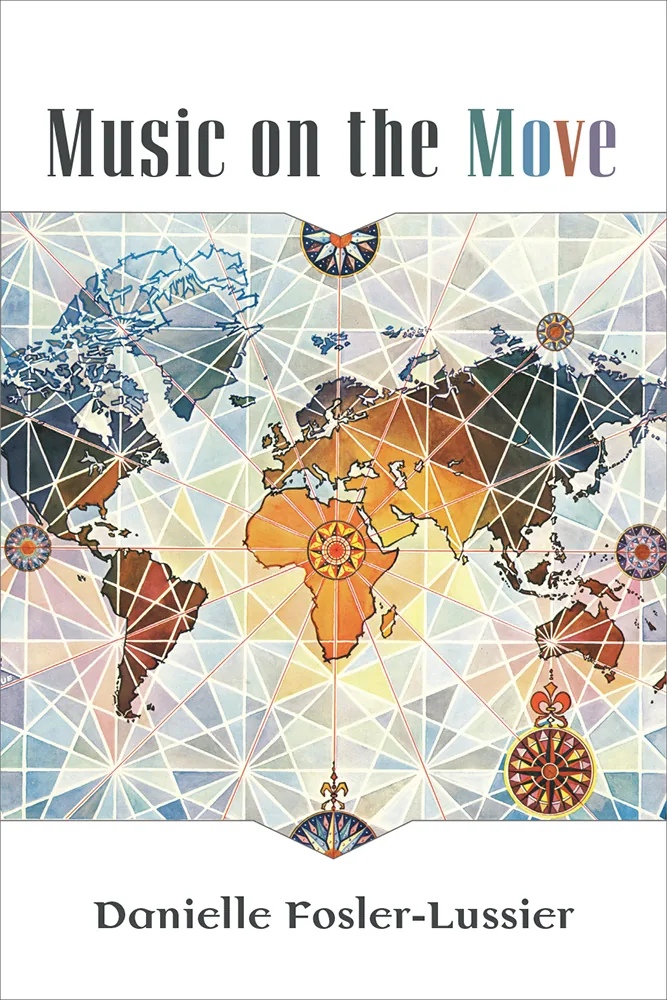
Music on the Move
Not rated yetRate this bookDanielle Fosler-Lussier’s Music on the Move explains musical change through the movement of people, the work of media, and individual choices within unequal social relationships. Its 2020 edition combines historical discussion with listening examples and maps. This guide includes all three parts—Migration, Mediation, and Mashup—the eight main chapters, their framing sections, and the conclusion. Read with the source’s audiovisual materials whenever possible: the argument depends on hearing how musical practices are transformed, represented, and given new meanings.
Read on the publisher’s website. Opens in a new tab.
 Free
About this book
Danielle Fosler-Lussier’s Music on the Move explains musical change through the movement of people, the work of media, and individual choices within unequal social relationships. Its 2020 edition combines historical discussion with listening examples and maps. This guide includes all three parts—Migration, Mediation, and Mashup—the eight main chapters, their framing sections, and the conclusion. Read with the source’s audiovisual materials whenever possible: the argument depends on hearing how musical practices are transformed, represented, and given new meanings.
Book summary
Danielle Fosler-Lussier’s Music on the Move explains musical change through the movement of people, the work of media, and individual choices within unequal social relationships. Its 2020 edition combines historical discussion with listening examples and maps. This guide includes all three parts—Migration, Mediation, and Mashup—the eight main chapters, their framing sections, and the conclusion. Read with the source’s audiovisual materials whenever possible: the argument depends on hearing how musical practices are transformed, represented, and given new meanings.
Chapter-by-chapter summaries
Introduction — Music, Movement, and Human Relationships
The introduction asks readers to hear music as something made and used by people in changing relationships. Movement may be voluntary or forced, while encounters can involve curiosity, exclusion, domination, and exchange. This approach challenges the idea that every musical practice belongs inside a stable national or cultural container. Begin a listening journal with three separate observations: what you hear, what you know about the circumstances, and what you are assuming. The distinctions help prevent an unfamiliar sound from becoming evidence for an unsupported cultural stereotype.
Part I — Migration: Framing the Cases
Migration directs attention to people who carry musical knowledge, encounter other practices, and work under new conditions. The framing makes room for both change and continuity: maintaining a practice and transforming it can be equally meaningful responses to displacement. Compare the conditions of movement in the following three chapters instead of treating every encounter as a free exchange among equals. Ask who can travel, who is compelled to move, who controls performance opportunities, and how those relationships affect what listeners come to recognize as a tradition.
Chapter 1 — Colonialism in Indonesia
The Indonesian case connects musical encounters with colonial domination, trade, tourism, and changing political conditions. The account of Balinese kecak shows why a performance presented as traditional can also have a history of adaptation, collaboration, and standardization. Tourism creates opportunities but can give intermediaries considerable influence over what is performed and how. Follow the relationship among local performers, outside observers, audiences, and commercial institutions. Explain how recognizing change can deepen understanding of a tradition rather than discrediting it as inauthentic. Keep the different historical periods and sources of authority distinct.
Chapter 2 — The Romani Diaspora in Europe
Romani musical life illustrates how people can sustain connections across borders while being represented as outsiders within the societies where they live. The chapter examines varied practices and the influence of stereotypes on European imagination and musical consumption. Its Eurovision discussion makes representation visible in a contemporary performance setting, including the tension between ethnic identity and national representation. Compare what performers choose to communicate with what publicity emphasizes about them. Distinguish the diversity of Romani communities from an externally imposed single image, and ask who benefits when a musical style is treated as an exotic symbol.
Chapter 3 — The African Diaspora in the United States
Forced migration, slavery, racial hierarchy, and changing opportunities shape the account of African American musical life. The chapter connects musical transformation with appropriation, authenticity, and assimilation, including blues and spirituals. The Fisk Jubilee Singers illustrate how concert presentation could create resources and recognition while adapting music to expectations shaped by unequal power. Compare a folk or community context with a concert arrangement without assuming one automatically cancels the value of the other. Analyze who receives credit, compensation, and authority to define the meaning of the performance.
Part II — Mediation: Framing the Cases
Mediation concerns the people, technologies, institutions, and conventions through which music reaches others. A recording is an obvious medium, but the idea also extends to instruments, notation, language, and performance practices. The framing encourages readers to notice layers that ordinarily disappear into the listening experience. Choose one piece of music and map its path from creation to your headphones, naming performers, recording decisions, distributors, and presentation contexts. Then consider how each layer might influence what is available and how you understand it.
Chapter 4 — Sound Recording and the Mediation of Music
Recording changes the relationship among sound, performer, place, and listener. It allows music to travel without the original performers while also making selection, editing, reuse, and new forms of performance possible. The chapter’s examples include constructed sound worlds and DJ mixing, showing that mediation is creative rather than simply a transparent delivery mechanism. Compare a recording with the idea of a live event: what can be repeated, rearranged, or heard outside its initial setting? Describe a transition in a mix and explain how its effect depends on time, memory, and the listener’s recognition.
Chapter 5 — Music and Media in the Service of the State
States use music and media to represent themselves, build solidarity, and influence audiences across borders. The chapter distinguishes political administration from the imagined community of a nation and examines how official and unofficial music can interact. Cases involving Paul Robeson and rock during the Cold War complicate a simple opposition between propaganda and artistic freedom. The discussion of Cui Jian shows how ambiguous words and contrasting sounds can acquire political meanings through context. Compare the intentions of state institutions, performers, and listeners rather than assuming they all hear the same message.
Part III — Mashup: Framing the Cases
The final part brings musical combination into a world of extensive media circulation and uneven access. Mashup is a way to think about how people draw together materials, identities, and experiences, while acknowledging that mixture does not erase history or power. Revisit examples from the earlier parts and identify what is newly possible through mediated access and what remains constrained. Ask whether a description centered only on cultures blending together overlooks the actual people making choices, negotiating pressures, or claiming the right to be heard.
Chapter 6 — Composing the Mediated Self
Mediated experiences provide materials through which individuals imagine and present themselves. The chapter engages theories of media and selfhood while showing that composers and listeners can bring different reference points to the same work. Its discussion of Janani, for example, connects musical sounds with more than one possible listening history, including Indian practices and jazz or concert associations. Do not reduce a musician to a representative of one origin. Compare two interpretations and identify the listening experience each assumes. The chapter makes identity a process of situated choices rather than a fixed property audible in every note.
Chapter 7 — Copyright, Surveillance, and the Ownership of Music
Musical circulation raises questions about ownership, reuse, compensation, and the systems that monitor access or copying. Copyright rules and technological infrastructures influence which acts of combination are possible and whose claims receive recognition. The chapter connects these matters with broader relationships among creators, institutions, and audiences. Distinguish an ethical question about fair recognition from a legal question about a specific right, and read legal examples in their publication context. Map the stakeholders in a reused recording, including people whose contributions may be obscured by the way an institution defines ownership.
Chapter 8 — Localizations
Localization shows how individuals make circulating music meaningful in particular settings. Rather than imagining globalization as a single force that makes everything alike, the chapter follows choices within classical networks, traditional music, and hip-hop. Its discussions of artists such as Yugen Blakrok and Soultana illustrate different uses of a shared musical form for identity, critique, and participation. Compare the possibilities offered by an international musical connection with the constraints of local institutions and expectations. Explain what is selected, transformed, or resisted in a specific example instead of treating borrowing as an automatic process.
Conclusion — Violence, Difference, and Peacemaking
The conclusion considers how musical relationships can contribute to exclusion or solidarity. Shared artistic experience may help people imagine alternatives and recognize one another, but music alone cannot secure political rights or prevent harm. The distinction between feeling represented and possessing meaningful institutional representation is especially important. Return to a case from each part and identify the concrete social relationship at stake. Ask what music makes possible, what it leaves unresolved, and what other forms of action would be needed for a more inclusive outcome.
Notes, Bibliography, Index, and Multimedia Resources
The book’s notes and selected bibliography support deeper inquiry into the historical cases and theoretical concepts. Its index allows themes such as appropriation, diaspora, mediation, and identity to be followed across chapters rather than in isolation. The accompanying audio, video, and maps should be treated as evidence to analyze, not background entertainment. For a final project, compare two examples through a focused question and cite the exact recording or passage used. Explain the limits of your comparison and what additional context would strengthen it.
Study instructions
- Read the introduction and each part’s framing before its cases; keep a glossary of migration, diaspora, mediation, appropriation, and localization.
- Listen to each assigned example more than once: first describe sound, then investigate context, then connect it with the chapter’s claim.
- Map people and institutions involved in a case, identifying who controls resources, circulation, credit, and representation.
- Compare two cases without assuming that voluntary travel, forced displacement, colonialism, and digital access create equivalent conditions.
- Write a final evidence-based listening essay that links a specific musical detail with a documented social relationship.
Questions for reflection
- How can a practice be both traditional and historically changeable?
- Who has the power to label a performance authentic or representative?
- What changes when a recording travels without its performers?
- How can musical recognition support inclusion while leaving political inequalities unresolved?
Sources and coverage
This original reading guide follows the linked source edition’s chapter, module, unit, or lesson structure. Consult the source for full arguments, cases, worked examples, exercises, illustrations, and references. Chapter structure follows the 2020 University of Michigan Press edition. The public LibreTexts reproduction was used to review the chapter text; consult the publisher edition for integrated media and maps. Read the source edition.
About access & copyright
This page provides book information and study material. Full-text access is provided by the original publisher or authorised source; a listing does not grant permission to republish the book.
Read our Library Access & Copyright policyExplore the contents
Check the chapters covered in this edition.
Visit the official source
See reading, preview or purchase options.
Save for later
Keep this textbook in your saved collection.
Reader ratings & reviews
Share your thoughts
Your review helps other students choose the right resources.
KEEP LEARNING
Your next great read
Music Ethics
Ethical Explorations: Moral Dilemmas in a Universe of Possibilities
View Ethical Explorations: Moral Dilemmas in a Universe of Possibilities — book Humanities
Introduction to Humanities
View Introduction to Humanities — book Chinese
Learning Chinese: A Foundation Course in Mandarin
View Learning Chinese: A Foundation Course in Mandarin — book Cognitive Science
Transcribing Prosodic Structure of Spoken Utterances with ToBI
View Transcribing Prosodic Structure of Spoken Utterances with ToBI — book Humanities
How to Think Critically
View How to Think Critically — book General and Comparative Literary Studies and Linguistics
Beginning Japanese for Professionals, Book 2
View Beginning Japanese for Professionals, Book 2 — book General and Comparative Literary Studies and Linguistics
Beginning Japanese for Professionals, Book 1
View Beginning Japanese for Professionals, Book 1 — book History
 of Applied Science & Technology
View History of Applied Science & Technology — book General and Comparative Literary Studies and Linguistics



