
 New Media Journalism
Textbook
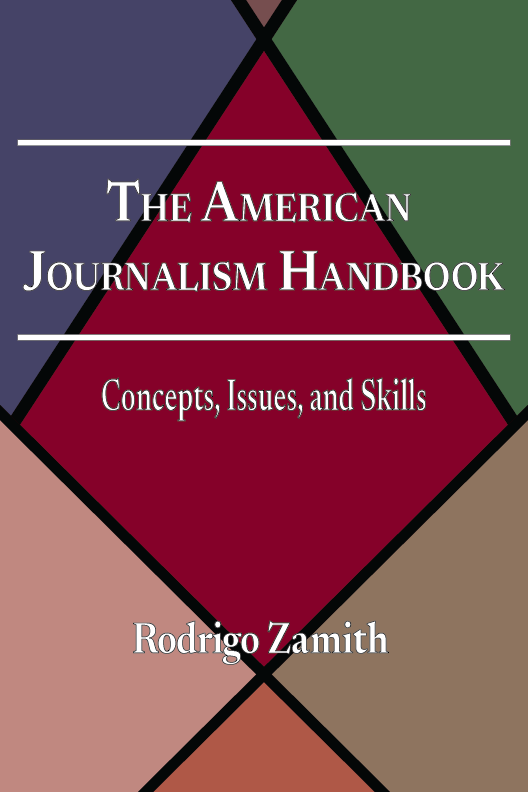
The American Journalism Handbook: Concepts, Issues, and Skills
Not rated yetRate this bookRodrigo Zamith’s handbook examines the concepts, institutions, and practical activities of U.S. journalism. The reviewed introduction and first two chapters ask how news is selected, how journalism is defined, and why those definitions affect authority and public expectations.
Read on the publisher’s website. Opens in a new tab.
 Free
About this book
Rodrigo Zamith’s The American Journalism Handbook connects concepts, institutions, history, and practical reporting skills. Its eleven units contain 54 short chapters, so this guide covers each chapter individually rather than summarize only the unit headings. The sequence moves from news and media effects through economics, audiences, history, law and ethics, reporting, writing, and technological change. Legal and platform examples belong to the reviewed edition’s context. The guide emphasizes the reasoning behind journalistic choices: what makes information newsworthy, how it is verified and represented, and how organizational conditions shape the work presented to audiences.
The detailed guide below follows the book’s chapter, unit, or section structure. Read it alongside the study instructions and the complete official text.
Book summary
Chapter-by-chapter summaries
Chapter 1: News
News involves selection and interpretation of information about recent affairs. The chapter distinguishes the existence of an event from its construction as a news account. Readers should identify what is new, why it matters, and to whom. This establishes a basis for examining newsworthiness without treating published stories as a complete or neutral inventory of everything that happened.
Chapter 2: Journalism
Journalism is examined as a set of practices and social purposes rather than only a job title or medium. Gathering, evaluating, organizing, and communicating information involve choices and standards. Readers should distinguish the activity from any single organization producing it. The chapter prepares a broader analysis of how journalism’s public claims relate to its actual processes and conditions.
Chapter 3: Social actors
Journalistic work involves people and organizations with different roles, resources, and interests. Reporters are important, but editors, owners, sources, audiences, and others also shape outcomes. Readers should map those relationships rather than explain a story entirely through the personality of its named author. This makes influence a question about interaction and power as well as individual choice.
Chapter 4: Technological actants
Tools and systems can enable, constrain, or reorganize journalistic action. A publishing system, interface, or distribution mechanism affects which options are available. The chapter does not require imagining technology as having human intentions. Its analytical contribution is to make technical conditions visible within a story’s production, rather than assume they merely transmit decisions made elsewhere.
Chapter 5: Audiences
Audiences are interpreted through needs, behavior, identities, and relationships with news. They are not one uniform public or a passive destination for content. The chapter encourages attention to how journalists imagine the people they serve and how those assumptions influence decisions. A measured audience and an intended community can differ, making the definition important for later economic and ethical analysis.
Chapter 6: Journalistic activities
The chapter identifies the range of work involved in journalism, extending beyond the final act of writing or broadcasting. Selection, sourcing, verification, production, and circulation depend on one another. Readers should examine how a choice at one stage shapes later possibilities. This process view helps explain why improving a finished sentence cannot repair every problem in the underlying reporting.
Chapter 7: Media dependency theory
Media dependency connects influence with the role media play in meeting people’s goals and information needs. The relationship varies with circumstances rather than imply a fixed effect on everyone. Readers should ask what an audience relies on a source to do and which alternatives are available. This makes dependence a contextual relationship, not simply a count of hours spent consuming news.
Chapter 8: Framing theory
Framing concerns the organization of a story through selection, emphasis, and interpretation. A frame can shape what seems to be the problem, its cause, and a possible response. Readers should identify the textual or visual choices supporting a frame rather than infer it from a topic alone. Comparing accounts of the same event can make those choices especially visible.
Chapter 9: Agenda-setting theory
Repeated and prominent coverage can influence which issues audiences regard as important. The chapter distinguishes issue salience from a claim that media dictate every opinion about an issue. Readers should examine both the pattern of attention and the evidence linking it with audience priorities. The distinction helps prevent a general theory from being used as an explanation of every individual response.
Chapter 10: Priming theory
Priming examines how accessible considerations can influence the standards people use in later judgments. It is related to attention and framing but asks a different question. Readers should identify which evaluative criterion becomes more available and how that might affect a decision. The chapter encourages separating a plausible mechanism from proof that it operated in a particular case.
Chapter 11: News avoidance and fatigue
People may reduce news consumption because of preference, distress, overload, distrust, or other circumstances. The chapter distinguishes disengagement from a simple lack of available content. Readers should avoid treating every person who consumes less news as having the same motive. Understanding the reason matters for evaluating journalism’s public role and for judging proposed responses to declining attention.
Chapter 12: Hierarchy of influences
The model organizes influences at several levels, connecting individuals with routines, organizations, institutions, and wider systems. A single explanation rarely accounts for every feature of a story. Readers should identify evidence for the level being discussed and consider interactions among levels. The model supplies a structure for analysis rather than a formula that automatically determines which influence was decisive.
Chapter 13: U.S. journalistic culture
The chapter examines professional values and expectations associated with United States journalism. Such norms can shape decisions even when practitioners differ politically or personally. Readers should distinguish a profession’s self-description from evidence of consistent practice. The chapter also encourages recognizing the context of those values rather than assume they define journalism everywhere or have remained unchanged throughout American history.
Chapter 14: News values
News values guide judgments about which potential stories deserve attention. They make selection intelligible but are not natural properties that remove human choice. Readers can examine how relevance, conflict, prominence, or other considerations are applied and whose experiences become visible. A useful analysis compares the reasons for inclusion with what is omitted, while recognizing organizational constraints on what can be covered.
Chapter 15: Truth, bias, and neutrality
The chapter separates several ideas often collapsed into a demand for unbiased news. Accuracy, fair treatment, neutrality, and the interpretation of evidence are related but different. Readers should identify the actual alleged distortion rather than use bias as a label for an unwelcome conclusion. The central task is to examine methods and support, including whether a presentation creates misleading equivalence among unequal claims.
Chapter 16: Gender and racial gaps
Representation concerns who works in journalism, who appears as a source, and how groups are portrayed. The chapter connects historical exclusion with continuing questions about newsroom practice. Readers should distinguish numerical presence from influence over decisions and from the quality of representation. The discussion encourages examining routines and institutional conditions rather than reduce every gap to one individual’s intention.
Chapter 17: Partisan and geographic biases
The chapter considers patterns of political and geographic attention. A claim of partisan imbalance and a claim that some places receive inadequate coverage require different evidence. Readers should specify the comparison and avoid inferencing a complete media pattern from one story. The chapter also connects representation with resources and location, showing how coverage can be uneven for reasons beyond an explicit ideological preference.
Chapter 18: Commodification of news
News can be organized as a product for sale within a market. The chapter examines how that arrangement influences production and public-service goals. Revenue needs do not explain every choice, but they shape the conditions under which choices are made. Readers should identify what is being sold, to whom, and how the business model rewards particular forms of content or attention.
Chapter 19: Audience measurement and bundling
Metrics describe selected aspects of audience behavior and support commercial or editorial decisions. They are not direct measures of every public value a story creates. Bundling connects different content within a product or service. Readers should ask what the metric actually captures and what an apparent success means under the chosen model. The chapter encourages interpretation rather than automatic obedience to a dashboard.
Chapter 20: Third-party platforms
External platforms can mediate discovery, distribution, advertising, and audience relationships. Their rules and interfaces affect journalism without necessarily sharing a newsroom’s priorities. The chapter examines dependence and changing power relationships. Readers should distinguish access to a large audience from control over the conditions of reaching it. Platform examples should be read within the edition’s context rather than treated as current operational guidance.
Chapter 21: Nonprofit journalism
Nonprofit models can support public-service work or address market gaps, but they still need resources and governance. The chapter examines a different set of incentives rather than present the absence of profit distribution as freedom from influence. Readers should ask how funding is obtained, what mission guides selection, and how independence is maintained. The model changes the questions without eliminating them.
Chapter 22: State-supported journalism
Public support can take different institutional forms, with different relationships between funding and editorial authority. The chapter distinguishes arrangements that cannot be understood through the funding source alone. Readers should examine governance, safeguards, and actual practice. State-supported and state-controlled are not interchangeable descriptions. The analytical task is to explain the particular relationship rather than infer independence or propaganda from one label.
Chapter 23: Audience fragmentation
Media choice can divide large shared audiences into smaller groups with different habits and interests. The chapter connects this pattern with the changing news environment. Fragmentation does not establish that every group is isolated or that all shared attention disappears. Readers should identify which audience, medium, and comparison are being discussed. The concept supports questions about economic viability, public connection, and unequal access to useful information.
Chapter 24: User-generated content
Material created by users can supply evidence, perspectives, or participation, but it requires editorial judgment. Availability does not establish authenticity, permission, or appropriate context. The chapter examines how such material enters journalistic work. Readers should distinguish using a contribution from adopting its interpretation. Verification and attribution remain necessary even when a post appears to document an event directly.
Chapter 25: Crowdsourcing and ambient journalism
Audiences can contribute information and participate in stages of reporting, while an ongoing flow of updates changes how news is encountered. The chapter examines these relationships beyond the model of a solitary reporter. Readers should ask how contributions are solicited, checked, and integrated. Participation can broaden evidence while also creating coordination and verification responsibilities that do not disappear because many people contributed.
Chapter 26: Violence against journalists
Threats and attacks affect individual safety and the information available to the public. The chapter connects violence with efforts to constrain scrutiny or silence accounts. Readers should consider effects on sources, colleagues, and future coverage as well as the immediate victim. Its educational purpose is to make these working conditions visible, not to treat danger as proof of a story’s quality or a romantic expectation of the profession.
Chapter 27: Early U.S. journalism
The historical opening examines news practices before contemporary professional conventions were established. Political, social, and technical conditions shaped what could circulate and who could participate. Readers should avoid judging the period as merely an incomplete version of today’s newsroom. Comparing purposes and institutions helps explain both later change and continuities that remain visible in modern arguments about journalism.
Chapter 28: Nineteenth-century journalism
Economic growth, technology, literacy, and political change altered the organization and reach of news. The chapter connects developments in production with changing audiences and commercial arrangements. Readers should examine how these factors interact instead of credit one invention with every transformation. The period provides evidence that journalistic practices develop within institutions and markets rather than emerge as timeless professional rules.
Chapter 29: Early twentieth-century journalism
The chapter examines continuities and changes involving corporate power, professionalization, and influential forms of reporting. Investigative work illustrates how sustained evidence gathering can support public scrutiny. Readers should connect celebrated examples with the labor and institutions that made them possible. A historical success story becomes more informative when its methods, audience, and consequences are examined rather than treated only as a heroic anecdote.
Chapter 30: Journalism after the early twentieth century
Technological and industrial change altered the production and circulation of news, but did not erase every earlier practice. The chapter examines that relationship between change and continuity. Readers should distinguish a new medium from a complete transformation of journalism’s social purposes. Historical comparison can reveal which pressures recur and which depend on particular institutions, business models, or forms of distribution.
Chapter 31: The First Amendment
The chapter introduces the constitutional setting of press freedom in the United States. It provides a foundation for understanding later legal issues, not an unrestricted guarantee that every journalistic action is lawful. Readers should distinguish a general protection from the specific circumstances of a case. Because legal application changes and varies by issue, the source belongs to its publication context and cannot replace current authoritative guidance.
Chapter 32: Access, anonymity, and privacy
Reporting can involve competing interests in obtaining information, protecting sources, and respecting privacy. The chapter examines these questions within the edition’s legal setting. Readers should distinguish legal permission from ethical judgment and identify the actual setting and parties involved. A general desire to report does not settle every access question. The educational task is to recognize the issue before acting on an unsupported assumption.
Chapter 33: Censorship, copyright, and incitement
The chapter separates several legal concepts that affect publication. A restriction, a reuse question, and speech linked with unlawful action involve different analyses. Readers should avoid treating freedom of the press as a complete answer to all three. The examples develop issue recognition within the source’s context. An actual decision about publication or reuse requires current law, the specific material, and the circumstances.
Chapter 34: Libel
Defamation-related questions involve a statement, its publication, the person concerned, and additional legal conditions. The chapter introduces these distinctions through the U.S. framework discussed in the edition. Readers should not equate an offensive or disputed statement automatically with actionable libel. The broader reporting lesson is to examine support, wording, attribution, and foreseeable implications carefully while recognizing that a legal conclusion requires the applicable current standard.
Chapter 35: Professional codes of ethics
Codes express professional commitments and provide a vocabulary for difficult decisions. The chapter examines their role without treating them as algorithms that remove judgment. Accuracy, independence, accountability, and harm considerations can create tensions in practice. Readers should explain the competing responsibilities and the evidence behind a choice. Invoking a code is more useful when the reasoning is visible than when it functions as a slogan.
Chapter 36: Types of journalism
The umbrella term journalism includes different forms, purposes, and conventions. The chapter compares these rather than assume every story should follow one format. Readers should identify what the work is trying to accomplish and how its methods support that purpose. Distinguishing genres also helps audiences understand what kind of account they are encountering and what claims it makes about evidence, interpretation, or opinion.
Chapter 37: Opinion-based journalism
Opinion work has a place in journalistic institutions while making a different relationship between evidence and argument explicit. The chapter examines its purposes and forms. A declared perspective does not remove obligations to accuracy or fair representation. Readers should distinguish reasoned interpretation from an unsupported assertion and examine how the piece connects its judgment with reported facts and a clearly communicated purpose.
Chapter 38: Story ideas
Finding a story involves identifying a question or development that matters to an audience and can be investigated. The chapter connects ideas with observation, sources, and feasibility. A broad topic is not yet a focused reporting plan. Readers should state what they need to find out, why it matters, and what evidence could answer it. This makes selection a process of inquiry rather than inspiration alone.
Chapter 39: Misinformation and disinformation
The chapter distinguishes inaccurate information from misleading activity involving intention, while examining broader problems in circulation and interpretation. A suspicious claim needs investigation, not merely a dismissive label. Readers should separate the content’s accuracy, its context, and what can actually be established about motive. This supports verification that corrects an error without overstating knowledge of the person or process that produced it.
Chapter 40: News sources
Sources include people, organizations, documents, and other objects that provide information. The chapter asks readers to think beyond the interview as the only form of evidence. A source can be useful for one question and unsuitable for another. The reporting task is to establish what it can support, how the information was obtained, and what limitations or interests need consideration.
Chapter 41: Identifying appropriate sources
Relevance, knowledge, proximity to an event, and diversity of perspective affect source selection. The chapter encourages matching a source with the claim being investigated rather than rely on accessibility or prestige alone. Several sources repeating one underlying account do not necessarily provide independent corroboration. Readers should map both the evidence and its origins to see what remains missing.
Chapter 42: Contacting sources and arranging interviews
Preparation and clear communication help establish the purpose and practical conditions of an interview. The chapter connects professional contact with the information needed for the story. Readers should distinguish requesting participation from assuming consent to every later use. A well-organized approach respects time and clarifies expectations while leaving room for substantive follow-up. The relationship begins before the first formal question.
Chapter 43: Good interview questions
Questions should invite relevant information without unnecessarily steering the answer. The chapter examines clarity, openness, and the effects of leading wording. Readers should connect each question with a reporting need and consider what kind of response it makes possible. A prepared list supports the interview but should not prevent listening. The goal is evidence and understanding, not confirmation of the interviewer’s preferred account.
Chapter 44: Conducting interviews
An interview requires attentive listening, follow-up, and an accurate record. The chapter connects preparation with responsiveness to what the source actually says. Readers should distinguish a source’s assertion from a verified fact and notice when a term or chronology needs clarification. The conversation’s apparent fluency does not guarantee complete information. Effective interviewing makes uncertainty and gaps available for further reporting.
Chapter 45: Verifying information
Verification examines claims through evidence, provenance, corroboration, and context. The chapter treats it as a reporting practice rather than a final spellcheck. Readers should ask how they know each consequential assertion and whether sources are genuinely independent. A plausible detail can still be wrong. Recording unresolved uncertainty supports transparent decisions about further work, qualification, or exclusion from the final story.
Chapter 46: Leads and nut grafs
The opening of a story establishes attention and direction, while a nut graf explains the larger point where the form requires it. The chapter connects these choices with audience and story purpose. A dramatic lead should not misrepresent the evidence. Readers should examine whether the opening gives a fair route into the subject and whether the significance becomes clear without unnecessary delay or repetition.
Chapter 47: Story structures
Different structures organize information for different purposes. The chapter connects sequence with comprehension rather than present one arrangement as appropriate for every piece. Readers should identify the main point, supporting evidence, and transitions before judging the order. A coherent structure helps the audience understand relationships among facts. It cannot compensate for reporting that has not established those relationships in the first place.
Chapter 48: Quotes and attribution
Quotation and attribution communicate both wording and the source of information. The chapter examines selection and integration so that a quote serves the story without distorting context. Readers should distinguish a direct quotation from paraphrase and avoid using quotation marks to evade verification. Attribution explains who says something; it does not automatically establish that the statement is true or that its inclusion is justified.
Chapter 49: Quantitative information
Numbers need units, denominators, time frames, and suitable comparisons to communicate meaning. The chapter connects quantitative evidence with understandable reporting. Readers should distinguish a count from a rate and a relative change from an absolute difference. A precise number can still mislead through selection or presentation. The goal is to make the relationship clear enough that the audience can assess its significance.
Chapter 50: Solutions journalism
Solutions journalism examines responses to problems rather than offer praise or promotion for a favored initiative. Evidence about effectiveness, limits, and context remains important. Readers should ask what the response attempts, how it works, and what supports the claimed outcome. A compelling example is not automatically transferable. The chapter connects constructive reporting with scrutiny rather than treat attention to solutions as an exception to verification.
Chapter 51: Social media and news production
Social platforms can supply leads, sources, interaction, and material for reporting while introducing verification and professional-boundary questions. The chapter examines their role in the production process. Readers should distinguish finding a claim from establishing it and consider how platform design affects what becomes visible. The examples belong to the edition’s context; the durable issue is how a newsroom uses an external information environment responsibly.
Chapter 52: Social media and distribution
Distribution choices affect who encounters a story and how it is framed outside the original publication. The chapter connects sharing with platform relationships, audience behavior, and professional expectations. Readers should examine whether a short promotional element fairly represents the full account. Reach is one outcome among several, not proof of public value. Changes in platform rules also make dependence an ongoing strategic question.
Chapter 53: Computational journalism
Computing and computational thinking can support gathering, analysis, production, and distribution. The chapter connects technical methods with journalistic purposes rather than equate computation with automation alone. Readers should identify the data, assumptions, and checks behind a result. A program can reproduce an error efficiently, so transparency and validation matter. The method should make the reporting more defensible, not conceal judgment behind a technical output.
Chapter 54: Artificial intelligence and automation
The final chapter examines the place of automated and AI-supported processes in journalism. Delegating a task changes how work is performed but does not eliminate responsibility for accuracy and consequences. Readers should distinguish a tool’s output from verified evidence and ask which decisions remain human obligations. The source’s examples provide a historical starting point, while current systems require their own evaluation of capabilities, limitations, and accountability.
Study instructions
Select two reports about the same event. Record what each emphasizes, what it leaves outside its scope, and whose statements it treats as authoritative. Separate your observations about those choices from an explanation that still needs evidence.
Then identify which definition of journalism you are using to assess each report. Are you relying on the organization’s reputation, the process used to gather evidence, the finished format, or its stated public purpose? Explain how a different definition could change the assessment.
Keep an evidence notebook that distinguishes a reported claim, the source supporting it, and your own interpretation. Read the relevant later chapters directly before applying a specialized technique. Historical legal or platform examples should be checked against current authoritative sources when an assignment requires present-day accuracy.
Study across the full book
- Pair each conceptual or media-effects chapter with a dated news example. Separate a definition, an observed feature, and a claim about an audience effect; do not infer that an effect occurred simply because a story uses a particular frame.
- Carry a reporting idea through the skills chapters: develop an angle, identify varied sources, prepare interview questions, verify claims, and draft a lead and structure. Keep an attribution and verification log for facts and quotations.
- Use the law, ethics, economics, and technology chapters to audit the draft's choices. Explain how sources, incentives, audience measures, and distribution shape the work; preserve the distinction between the source's historical discussion and a current legal or technical claim.
Questions for reflection
- Who decides which developments become the central news of the day?
- Which definition of journalism underlies your assessment of an example?
- What evidence would support an explanation of a difference between two reports?
The study suggestions and reflection questions are independent Academic Master editorial material.
Sources and coverage
All 54 short chapters within eleven units are covered. Legal, platform, and AI examples belong to the edition reviewed. These original summaries draw on review of the source text, including chapter or section introductions and selected explanations, examples, exercises, and concluding or review material. They are condensed study guides, not a page-by-page account or a replacement for the complete resource. Supplementary study discussions are identified separately.
About access & copyright
This page provides book information and study material. Full-text access is provided by the original publisher or authorised source; a listing does not grant permission to republish the book.
Read our Library Access & Copyright policySelection
Examine how significance shapes a news account.
Definitions
Distinguish products, people, practices, and purposes.
Authority
Connect recognition with expectations and resources.
Comparison
Separate observed differences from explanations requiring evidence.
Reader ratings & reviews
Share your thoughts
Your review helps other students choose the right resources.
KEEP LEARNING
Your next great read
New Media Journalism Psychology
Interpersonal Communication: A Mindful Approach to Relationships
View Interpersonal Communication: A Mindful Approach to Relationships — book Computer Science
How to Think Like a Computer Scientist: C++ Version
View How to Think Like a Computer Scientist: C++ Version — book Computer Science
Think Data Structures: Algorithms and Information Retrieval in Java
View Think Data Structures: Algorithms and Information Retrieval in Java — book Computer Science
Think DSP: Digital Signal Processing in Python
View Think DSP: Digital Signal Processing in Python — book Computer Science
Think Complexity: Exploring Complexity Science with Python
View Think Complexity: Exploring Complexity Science with Python — book Computer Science
Think Stats: Probability and Statistics for Programmers
View Think Stats: Probability and Statistics for Programmers — book Computer Science
The Little Book of Semaphores
View The Little Book of Semaphores — book Computer Science
Think Java: How To Think Like a Computer Scientist
View Think Java: How To Think Like a Computer Scientist — book Psychology



