
 Psychology
BusinessTextbook
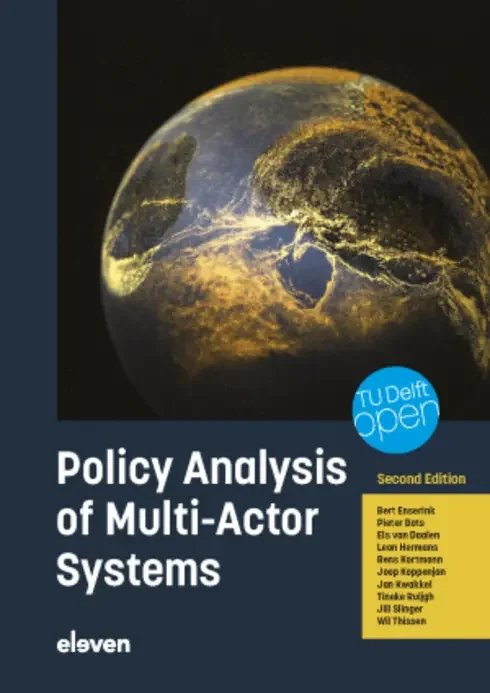
Policy Analysis of Multi-Actor Systems
Not rated yetRate this bookPolicy Analysis of Multi-Actor Systems teaches problem structuring where no single organization can impose a complete solution. The second edition combines systems analysis, actor analysis, exploration of uncertain futures, synthesis, research planning, and an issue paper. Eight chapters move from conflicting problem definitions toward a justified plan for further analytical and collective work. The full title and ten-author list are restored from the linked 2022 title page; the imported record named only three people and used the singular System. The guide follows the actual second-edition sequence, including its expanded synthesis chapter, rather than treating policy analysis as a search for one technically optimal answer.
Read on the publisher’s website. Opens in a new tab.
 Free
About this book
Overview
Policy Analysis of Multi-Actor Systems teaches problem structuring where no single organization can impose a complete solution. The second edition combines systems analysis, actor analysis, exploration of uncertain futures, synthesis, research planning, and an issue paper. Eight chapters move from conflicting problem definitions toward a justified plan for further analytical and collective work. The full title and ten-author list are restored from the linked 2022 title page; the imported record named only three people and used the singular System. The guide follows the actual second-edition sequence, including its expanded synthesis chapter, rather than treating policy analysis as a search for one technically optimal answer.
How to study this book
Choose a policy issue with several interdependent actors and maintain a working dossier. Begin with competing problem formulations before drawing a system diagram. Record evidence separately from assumptions about interests, power, causality, and future developments. Revise the diagrams when actor analysis or scenario work reveals a weakness. Use the synthesis chapter to connect the analyses into a rich problem description, then specify what further research or action is justified. An issue paper should make uncertainty and disagreement understandable to a commissioner rather than conceal them behind confident recommendations.
Chapter and section study guide
Chapter 1 — Introduction
Multi-actor policy problems involve interdependence, disagreement, uncertainty, and limited ability to act unilaterally. The analyst’s task is not only to calculate an answer but to support a better understanding of the problem and possible next steps. Different actors may disagree about facts, values, priorities, and the appropriate decision arena. The chapter introduces problem structuring as a response to these conditions. Distinguish a situation from a perceived gap and identify whose objectives define that gap. A useful analysis begins by asking whether the problem has been framed appropriately.
Study application: Write two different actors’ problem statements for the same situation and identify why neither can solve it alone.
Chapter 2 — Problem Formulation in Complex Environments
Complexity has technical, social, institutional, and normative dimensions. Problem definitions are shaped through framing, interests, perceptions, arenas, and policy processes rather than discovered as neutral labels. A proposed solution can influence how a problem is described, creating a risk of solving the wrong problem efficiently. The chapter compares ways of understanding policy processes and identifies points of intervention. Examine how a formulation includes certain consequences and excludes others. Treat initial boundaries as provisional and make the role of values and institutional setting explicit.
Study application: Reframe an issue using technical, institutional, social, and normative dimensions, explaining what each version makes visible.
Chapter 3 — Systems Analysis
Systems analysis connects objectives, criteria, means, external influences, and causal relationships in an explicit representation. Means-ends analysis and objective trees help clarify what is sought and how success might be assessed. A system diagram then organizes the relevant mechanisms and boundaries. The representation is an analytical model, not the complete reality, and should be checked for consistency and omitted feedbacks. Distinguish an actor’s controllable means from contextual factors outside that actor’s influence. A useful diagram supports questions and tests rather than merely displaying many connected boxes.
Study application: Construct a system diagram for your issue and label objectives, instruments, external factors, and one uncertain causal relationship.
Chapter 4 — Actor Analysis
Actor analysis identifies participants, institutions, interests, resources, perceptions, and interdependencies. It begins from a problem formulation and decision arena but can reveal reasons to revise both. Formal relations and practical influence should be distinguished, and information about actors needs trustworthy sources. An inventory is only a start: the analysis should explain who depends on whom and why cooperation or conflict may arise. Actors and relationships can change over time. Avoid treating a provisional map as a fixed classification or assuming a stated organizational goal captures every relevant interest.
Study application: Create an actor table with interests, resources, dependencies, evidence sources, and assumptions requiring verification.
Chapter 5 — Exploring the Future
Future exploration distinguishes kinds of uncertainty and selects methods suited to the analytical question. Formal models, expert judgment, and scenarios offer different contributions and limitations. Scenarios are structured possibilities used to examine choices, not disguised predictions with unwarranted precision. The chapter develops a process for identifying contextual factors, driving forces, key uncertainties, scenario logic, and implications. Consistency and relevance matter more than dramatic storytelling. Compare how a proposed action performs across futures and identify vulnerabilities or conditions that would require adaptation.
Study application: Develop two contrasting but coherent scenarios and test whether the same policy option remains attractive under both.
Chapter 6 — From Synthesis to Plan of Action
Synthesis combines the analyses into a coherent problem description and a justified direction for further work. It requires checking diagrams, reconciling inconsistencies, characterizing the problem, and identifying knowledge gaps. The second edition emphasizes this link between analysis and action. The analyst’s role also matters: different situations call for different blends of research, facilitation, clarification, and support. A recommendation should follow from the evidence and problem character rather than appear as an unrelated final preference. Explain what remains contested and what follow-on activity could make progress possible.
Study application: Write a synthesis paragraph linking system mechanisms, actor dependencies, future uncertainty, and one justified next step.
Chapter 7 — The Research Plan
A research plan translates an identified knowledge need into questions, methods, evidence, activities, and a feasible organization of work. The central issue is fit: data and methods must answer the question that matters to the policy problem. Distinguish a broad objective from an operational research question and from the tasks used to investigate it. Feasibility involves time, access, resources, and analytical limitations. A good plan explains how findings will inform subsequent choices and what uncertainty will remain. Avoid proposing data collection simply because it is available or impressive.
Study application: Prepare a research plan for one knowledge gap, linking question, evidence, method, access, schedule, and intended decision use.
Chapter 8 — Preparing an Issue Paper
An issue paper communicates a structured understanding of the problem and a reasoned proposal for follow-up. It should be readable to a potential commissioner while retaining the logic connecting evidence, analysis, uncertainty, and recommendations. Selectivity is essential: include what helps the reader understand the issue and the case for further work. Distinguish established findings from assumptions and make actor perspectives visible without losing coherence. The chapter brings analytical craftsmanship and writing together. A persuasive paper enables informed judgment rather than overwhelming the reader with every diagram produced.
Study application: Draft an issue-paper outline with a problem statement, analytical synthesis, knowledge gaps, proposed work, and a clear request for a decision.
Reflection and review
- How did actor analysis change the boundary of your original system diagram?
- What makes a scenario useful without making it a prediction?
- Which follow-up activity is justified by your synthesis, and which attractive activity is not?
Source and edition notes
Second edition, 2022; eight chapters, 190 PDF pages. Author spelling and the plural Systems follow the second-edition title page. The publication is a method text; its examples are learning cases rather than current policy prescriptions.
Book summary
Overview
Policy Analysis of Multi-Actor Systems teaches problem structuring where no single organization can impose a complete solution. The second edition combines systems analysis, actor analysis, exploration of uncertain futures, synthesis, research planning, and an issue paper. Eight chapters move from conflicting problem definitions toward a justified plan for further analytical and collective work. The full title and ten-author list are restored from the linked 2022 title page; the imported record named only three people and used the singular System. The guide follows the actual second-edition sequence, including its expanded synthesis chapter, rather than treating policy analysis as a search for one technically optimal answer.
How to study this book
Choose a policy issue with several interdependent actors and maintain a working dossier. Begin with competing problem formulations before drawing a system diagram. Record evidence separately from assumptions about interests, power, causality, and future developments. Revise the diagrams when actor analysis or scenario work reveals a weakness. Use the synthesis chapter to connect the analyses into a rich problem description, then specify what further research or action is justified. An issue paper should make uncertainty and disagreement understandable to a commissioner rather than conceal them behind confident recommendations.
Chapter and section study guide
Chapter 1 — Introduction
Multi-actor policy problems involve interdependence, disagreement, uncertainty, and limited ability to act unilaterally. The analyst’s task is not only to calculate an answer but to support a better understanding of the problem and possible next steps. Different actors may disagree about facts, values, priorities, and the appropriate decision arena. The chapter introduces problem structuring as a response to these conditions. Distinguish a situation from a perceived gap and identify whose objectives define that gap. A useful analysis begins by asking whether the problem has been framed appropriately.
Study application: Write two different actors’ problem statements for the same situation and identify why neither can solve it alone.
Chapter 2 — Problem Formulation in Complex Environments
Complexity has technical, social, institutional, and normative dimensions. Problem definitions are shaped through framing, interests, perceptions, arenas, and policy processes rather than discovered as neutral labels. A proposed solution can influence how a problem is described, creating a risk of solving the wrong problem efficiently. The chapter compares ways of understanding policy processes and identifies points of intervention. Examine how a formulation includes certain consequences and excludes others. Treat initial boundaries as provisional and make the role of values and institutional setting explicit.
Study application: Reframe an issue using technical, institutional, social, and normative dimensions, explaining what each version makes visible.
Chapter 3 — Systems Analysis
Systems analysis connects objectives, criteria, means, external influences, and causal relationships in an explicit representation. Means-ends analysis and objective trees help clarify what is sought and how success might be assessed. A system diagram then organizes the relevant mechanisms and boundaries. The representation is an analytical model, not the complete reality, and should be checked for consistency and omitted feedbacks. Distinguish an actor’s controllable means from contextual factors outside that actor’s influence. A useful diagram supports questions and tests rather than merely displaying many connected boxes.
Study application: Construct a system diagram for your issue and label objectives, instruments, external factors, and one uncertain causal relationship.
Chapter 4 — Actor Analysis
Actor analysis identifies participants, institutions, interests, resources, perceptions, and interdependencies. It begins from a problem formulation and decision arena but can reveal reasons to revise both. Formal relations and practical influence should be distinguished, and information about actors needs trustworthy sources. An inventory is only a start: the analysis should explain who depends on whom and why cooperation or conflict may arise. Actors and relationships can change over time. Avoid treating a provisional map as a fixed classification or assuming a stated organizational goal captures every relevant interest.
Study application: Create an actor table with interests, resources, dependencies, evidence sources, and assumptions requiring verification.
Chapter 5 — Exploring the Future
Future exploration distinguishes kinds of uncertainty and selects methods suited to the analytical question. Formal models, expert judgment, and scenarios offer different contributions and limitations. Scenarios are structured possibilities used to examine choices, not disguised predictions with unwarranted precision. The chapter develops a process for identifying contextual factors, driving forces, key uncertainties, scenario logic, and implications. Consistency and relevance matter more than dramatic storytelling. Compare how a proposed action performs across futures and identify vulnerabilities or conditions that would require adaptation.
Study application: Develop two contrasting but coherent scenarios and test whether the same policy option remains attractive under both.
Chapter 6 — From Synthesis to Plan of Action
Synthesis combines the analyses into a coherent problem description and a justified direction for further work. It requires checking diagrams, reconciling inconsistencies, characterizing the problem, and identifying knowledge gaps. The second edition emphasizes this link between analysis and action. The analyst’s role also matters: different situations call for different blends of research, facilitation, clarification, and support. A recommendation should follow from the evidence and problem character rather than appear as an unrelated final preference. Explain what remains contested and what follow-on activity could make progress possible.
Study application: Write a synthesis paragraph linking system mechanisms, actor dependencies, future uncertainty, and one justified next step.
Chapter 7 — The Research Plan
A research plan translates an identified knowledge need into questions, methods, evidence, activities, and a feasible organization of work. The central issue is fit: data and methods must answer the question that matters to the policy problem. Distinguish a broad objective from an operational research question and from the tasks used to investigate it. Feasibility involves time, access, resources, and analytical limitations. A good plan explains how findings will inform subsequent choices and what uncertainty will remain. Avoid proposing data collection simply because it is available or impressive.
Study application: Prepare a research plan for one knowledge gap, linking question, evidence, method, access, schedule, and intended decision use.
Chapter 8 — Preparing an Issue Paper
An issue paper communicates a structured understanding of the problem and a reasoned proposal for follow-up. It should be readable to a potential commissioner while retaining the logic connecting evidence, analysis, uncertainty, and recommendations. Selectivity is essential: include what helps the reader understand the issue and the case for further work. Distinguish established findings from assumptions and make actor perspectives visible without losing coherence. The chapter brings analytical craftsmanship and writing together. A persuasive paper enables informed judgment rather than overwhelming the reader with every diagram produced.
Study application: Draft an issue-paper outline with a problem statement, analytical synthesis, knowledge gaps, proposed work, and a clear request for a decision.
Reflection and review
- How did actor analysis change the boundary of your original system diagram?
- What makes a scenario useful without making it a prediction?
- Which follow-up activity is justified by your synthesis, and which attractive activity is not?
Source and edition notes
Second edition, 2022; eight chapters, 190 PDF pages. Author spelling and the plural Systems follow the second-edition title page. The publication is a method text; its examples are learning cases rather than current policy prescriptions.
About access & copyright
This page provides book information and study material. Full-text access is provided by the original publisher or authorised source; a listing does not grant permission to republish the book.
Read our Library Access & Copyright policyExplore the contents
Check the chapters covered in this edition.
Visit the official source
See reading, preview or purchase options.
Save for later
Keep this textbook in your saved collection.
Reader ratings & reviews
Share your thoughts
Your review helps other students choose the right resources.
KEEP LEARNING
Your next great read
Psychology Political Science
American Government and Politics in the Information Age
View American Government and Politics in the Information Age — book Political Science
Social Problems - Continuity and Change
View Social Problems - Continuity and Change — book Cultural & Ethnic Studies
Language and Culture in Context - A Primer on Intercultural Communication
View Language and Culture in Context - A Primer on Intercultural Communication — book Business
Digital Marketing Strategy
View Digital Marketing Strategy — book Cultural & Ethnic Studies
Pacific Food Systems for Children's Healthy Living
View Pacific Food Systems for Children's Healthy Living — book Accounting
 in the Finance World
View Accounting in the Finance World — book Business
International Finance: Theory and Policy
View International Finance: Theory and Policy — book Business
Exploring Business
View Exploring Business — book Business



