
Stability of Ships and Other Bodies
Engineering & TechnologyTextbook
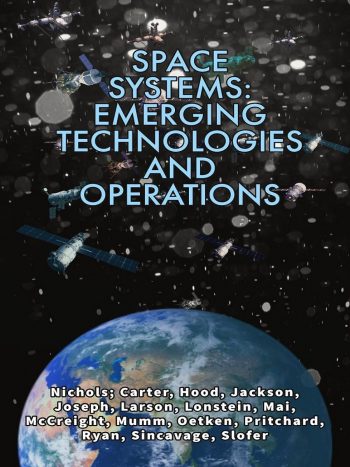
Space Systems: Emerging Technologies and Operations
Not rated yetRate this bookThis edited volume examines technologies and operations associated with space and the upper-air environment. Its introductory framework links technical possibilities with operational challenges and humanitarian applications.
Read on the publisher’s website. Opens in a new tab.
 Free
About this book
About this book
Space Systems: Emerging Technologies and Operations brings together twelve chapters on space operations, security, manufacturing, infrastructure, debris, simulation, agriculture, and humanitarian applications. The edited volume connects technical systems with the services and institutions that rely on them. The guide follows each contributed chapter and emphasizes evidence, dependencies, and limitations rather than treating forecasts as established capabilities. The source’s historical examples, policy discussions, product references, and descriptions of ongoing programs are time-bound. Its broader value is a systems perspective on how space-based information and infrastructure affect activity on Earth.
The detailed guide below follows the book’s chapter, unit, or section structure. Read it alongside the study instructions and the complete official text.
Book summary
Chapter-by-chapter summaries
Chapter 1: Current State of Space Operations
The opening chapter introduces terminology, history, relationships among types of operations, and the functions needed to support a space system. A satellite is part of a larger arrangement involving ground infrastructure, communication, software, people, and mission goals. The discussion of emerging tools includes questions about integration and the reliability of automated judgments. Readers should distinguish an individual component's capability from the performance of the full mission. The chapter establishes the vocabulary for later contributions while its description of the current state remains the state described by the source edition.
Chapter 2: Satellite Killers and Hypersonic Drones
The chapter examines satellites, orbital settings, and threats in a strategic context. It connects the value of space services with their exposure to disruption and discusses the consequences of destructive events, including debris. The educational question is how technical vulnerability and strategic incentives interact, not which weapon should be deployed. Historical events and proposed capabilities require different levels of confidence. A critical reading asks what evidence is supplied for a claim and whether a change that affects one spacecraft also creates broader risks for other users of the orbital environment.
Chapter 3: Space Electronic Warfare and Signal-Related Threats
Space services depend on electromagnetic links for information and control. The chapter surveys interception, interference, deception, and related concepts at a systems level. These categories differ in the property affected: confidentiality, availability, or trust in information. The consequences depend on the architecture and the role of the affected link. The guide does not reproduce signal parameters or interference procedures. Its learning focus is to identify dependencies and evaluate resilience claims, distinguishing an observed communications problem from a confidently attributed hostile action.
Chapter 4: Manufacturing in Space
Manufacturing beyond Earth introduces different environments, logistics, energy needs, and economic constraints. The chapter examines possibilities on Earth, in orbital facilities, and in other space settings. Microgravity or vacuum may enable some processes while making others harder, and a promising material result is not the same as a viable production system. Supply, quality control, maintenance, transport, and demand affect feasibility. The chapter encourages separating technical experiments, development prospects, and established operations. The value of a proposed activity depends on the complete process and its purpose, not simply on being performed in space.
Chapter 5: Space Platforms and Critical Infrastructure Vulnerability
Many terrestrial services depend on space-derived timing, communication, positioning, or observation. The chapter examines those connections and the possibility of cascading effects when a service fails. Dependence can be indirect and therefore difficult for an organization to recognize. A threat assessment should identify which function is required, what alternatives exist, and how a disruption would be detected and managed. The author's scenarios are analytical possibilities rather than verified predictions. The chapter's strongest systems lesson is to examine the chain of services between an orbital asset and a consequential activity on Earth.
Chapter 6: Space Debris Collection and Tracking
Debris creates a shared environmental problem because objects can remain in orbit and threaten other spacecraft. The chapter reviews its origins, tracking, possible mitigation or removal approaches, and policy questions. Finding an object, predicting its path, and removing it are different technical achievements. Uncertainty, ownership, responsibility, and coordination complicate the response. Destructive events can create effects beyond the original target, making prevention important alongside cleanup. The legal discussion belongs to the source context; the conceptual issue is how individual activities affect the long-term usability of a common orbital environment.
Chapter 7: Disaster Risk Reduction and Management
Space-based observation, communication, and positioning can support understanding hazards, exposure, and response needs. The chapter connects satellite information with mapping, assessment, and coordination before and after disasters. A useful product must reach decision-makers in a usable form and appropriate time. Resolution, revisit timing, clouds where relevant, and interpretation limit what an image can establish. Disaster risk also depends on social and structural vulnerability, not just the physical hazard. The chapter therefore treats space information as part of a broader decision system rather than a technology that independently prevents disasters.
Chapter 8: Biological Threats to Agriculture and Space-Based Responses
The chapter connects agricultural vulnerability with observation and information services. Space-derived data can help identify patterns or environmental conditions relevant to agricultural health, but a remotely observed anomaly does not by itself identify a specific pathogen or cause. Ground observations, specialist interpretation, and coordinated response remain important. The source also discusses threat concepts and examples that should be read critically in their publication context. This summary focuses on surveillance, evidence, and resilience at a general level rather than harmful biological procedures. The learning goal is to understand what remote information can contribute and what requires independent confirmation.
Chapter 9: Modeling, Simulation, and Extended Reality
Models represent selected features of a system, simulations explore their behavior, and extended-reality tools can provide immersive ways to interact with representations. The chapter examines uses and limitations, including user experience and motion-related considerations. A realistic appearance does not guarantee a valid model. Fidelity should be judged against the task: training, design review, or analytical prediction may require different features. Assumptions, validation, and human factors remain necessary. The chapter encourages evaluating what a representation enables users to learn or decide rather than equating visual sophistication with evidence.
Chapter 10: Drones and Precision Agricultural Mapping
The chapter connects aerial and space assets with agricultural information and management. Mapping can reveal variation within a field, but a useful decision requires relating a measured signal to an agronomic question. Scale, timing, calibration, processing, and ground confirmation influence that relationship. Automation may reduce some burdens while creating needs for data management and expertise. The source's examples illustrate possibilities from its period rather than current product recommendations. The systems lesson is to assess whether the resulting information improves a defined decision, not merely whether a platform can produce a detailed map.
Chapter 11: Environmental Monitoring, Wildlife Tracking, and Fire Risk
Civilian space applications support repeated observation across areas difficult to monitor from the ground alone. The chapter surveys environmental, land-use, wildlife, and fire-related examples. Different questions require different spatial, temporal, and spectral information. A proxy measurement needs validation before it is interpreted as a direct indicator of a species, environmental condition, or risk. The information must also be integrated with local knowledge and management capacity. The chapter shows the breadth of applications while encouraging attention to uncertainty and the distinction between identifying a pattern and explaining its cause.
Chapter 12: Food Supply and Cattle Management
The final chapter examines how space technologies can contribute to agriculture and livestock systems through information, tracking, and resource management. The humanitarian goal is not established merely by adopting a technology; benefits depend on access, affordability, usability, and the decisions made from the data. A detailed observation can be valuable when it supports a feasible action and may be less useful when resources or infrastructure are missing. The chapter connects technical capability with stewardship and food-system needs, completing the volume's movement from space operations toward consequences for people on Earth.
Supplementary synthesis: From a satellite signal to a public benefit
Trace the chain from observation or communication through processing, interpretation, delivery, decision, and action. Each stage can introduce uncertainty or exclude an intended user. A humanitarian application should be evaluated through that full chain rather than the performance of a sensor alone. Likewise, infrastructure resilience requires identifying dependencies and alternatives before a disruption. This additional synthesis connects the volume's security and civilian chapters and helps readers ask what evidence would establish that a space service is achieving its stated purpose.
Study instructions
Create a reading map with columns for technology, problem or purpose, and evidence. Add a chapter’s date and operating assumptions before comparing it with another contribution. Use the author’s definition of a broad term rather than assuming it has a standard meaning elsewhere.
Choose one chapter relevant to your course and read its methods and references. Separate demonstrated capability from projection. For a current operating or policy question, consult contemporary authoritative sources independently of this historical overview.
Questions for reflection
- How does a chapter’s purpose affect the evidence it needs?
- Which claims demonstrate a capability and which propose one?
- What changes when a technology is considered for humanitarian use?
The study suggestions and questions are independent Academic Master editorial material.
Sources and coverage
Coverage follows all twelve contributed chapters. Descriptions of current programs, regulations, products, and strategic conditions are treated as features of the source edition. These original summaries draw on the source text, including chapter or section introductions and selected explanations, examples, exercises, and review material. They are condensed study guides, not a page-by-page account or a replacement for the complete resource. Additional synthesis sections are identified separately.
About access & copyright
This page provides book information and study material. Full-text access is provided by the original publisher or authorised source; a listing does not grant permission to republish the book.
Read our Library Access & Copyright policyScope
Connect technologies with purposes and institutions.
Organization
Distinguish the three thematic sections.
Evidence
Separate demonstration from projection.
Terminology
Use the author’s stated framework.
Reader ratings & reviews
Share your thoughts
Your review helps other students choose the right resources.
KEEP LEARNING
Your next great read
Engineering & Technology
Engineering Statics: Open and Interactive
Engineering Statics: Open and Interactive
View Engineering Statics: Open and Interactive — bookThe Primacy of the Public
The Primacy of the Public
View The Primacy of the Public — bookOpen Signals and Systems Laboratory Exercises
Open Signals and Systems Laboratory Exercises
View Open Signals and Systems Laboratory Exercises — bookIntroduction to Drafting and AutoCAD 2D
Introduction to Drafting and AutoCAD 2D
View Introduction to Drafting and AutoCAD 2D — bookIntroduction to Drafting and AutoCAD 3D
Introduction to Drafting and AutoCAD 3D
View Introduction to Drafting and AutoCAD 3D — book Engineering & Technology
Petroleum Reservoir Dynamics
View Petroleum Reservoir Dynamics — book Engineering & Technology
Ethics in Technology
View Ethics in Technology — book Civil Engineering
The Design of the Built Environment: The University of Illinois Urbana-Champaign Campus and Its Context
View The Design of the Built Environment: The University of Illinois Urbana-Champaign Campus and Its Context — book Contract Law



