
 Earth Sciences
Textbook
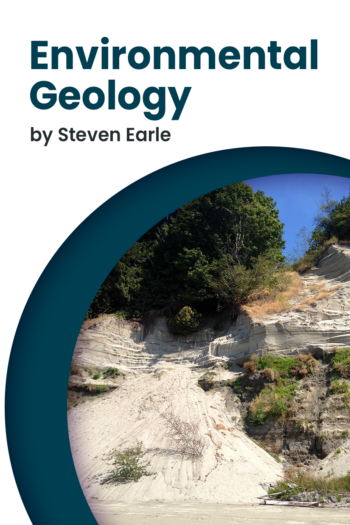
Environmental Geology
Not rated yetRate this bookSteve Earle’s Environmental Geology introduces Earth science through the interactions among physical environments, living systems, and human activity. Its opening develops a systems perspective for studying environmental change, geological processes, hazards, and resources.
Read on the publisher’s website. Opens in a new tab.
 Free
About this book
Environmental Geology is a college-level textbook published by TRU Open Learning at Thompson Rivers University. The official publication date is December 1, 2021. It combines explanatory text, illustrations, and embedded exercises, with some interactive material available through the online edition. The downloaded edition contains 640 PDF sheets, including preliminary matter; this figure describes the file rather than the final printed page number.
The author’s introduction identifies Earth systems, climate and glaciation, geological hazards, and resources as major teaching areas. Readers can use the official contents to locate those subjects without treating the brief study overview here as a substitute for reading individual chapters. The opening’s examples connect geological observations with processes acting across water, air, rock, and living organisms.
Book summary
Steve Earle’s Environmental Geology connects Earth processes with hazards, resources, water, waste, and climate. Fifteen chapters move from a physical-geology foundation to the consequences of human choices and environmental change. The text encourages explaining processes and evidence, not only identifying a hazard or resource by name. The answer appendices support review after an independent attempt at the chapter questions.
Chapter-by-chapter summaries
Chapter 1: Earth Systems and Environmental Geology
Earth-system thinking connects processes that operate across different places and time scales. Environmental geology applies that understanding to relationships between people and the physical environment. The chapter establishes a habit of tracing interactions and consequences rather than treating a problem as if it belonged to one isolated component of the planet.
Chapter 2: Physical Geology Review
Minerals, rocks, tectonic processes, and geological interpretation provide foundations for later topics. The review helps explain why a material or landscape behaves as it does. Recognizing a rock type is useful when connected with its origin, properties, and the processes that can change it.
Chapter 3: Past Climate Change
Evidence of earlier climates gives context for interpreting change. The chapter connects records, mechanisms, and time scales. A meaningful comparison needs more than identifying that climate has changed before: it requires asking how the change is known, what drove it, and how its rate and circumstances relate to the question being examined.
Chapter 4: Glaciation
Glaciers form and move under particular conditions and reshape landscapes through erosion and deposition. Their effects extend beyond the visible ice to sediments, water, and landforms. The chapter connects evidence in a landscape with the processes that produced it and the consequences of changing ice conditions.
Chapter 5: Mass Wasting
Slope movement depends on materials, forces, water, and conditions that affect stability. Different movement types require different explanations. The chapter encourages distinguishing a trigger from the longer-term conditions that made failure possible, a useful foundation for assessing risk and evaluating a proposed response.
Chapter 6: Earthquakes
Earthquakes connect deformation and fault movement with shaking and associated hazards. The effects of an event depend on location, materials, structures, and exposure as well as its size. The chapter develops a process-based interpretation rather than assuming one numerical descriptor fully predicts damage.
Chapter 7: Volcanism
Volcanic activity varies with magma and geological setting, producing different forms and hazards. The chapter relates processes to their surface expression. Understanding the type of activity and evidence of past events helps explain why volcanic risk cannot be reduced to the presence of a volcano on a map.
Chapter 8: Geological Resources
Resources arise through geological processes and become useful through extraction and use. The chapter connects occurrence, concentration, and environmental consequences. A resource decision therefore involves more than establishing that a material exists; its accessibility, processing, and effects are also part of the analysis.
Chapter 9: Energy Resources
Energy choices connect geological supply with extraction, use, and environmental effects. Comparing options requires attention to the system and time horizon considered. The chapter supports evaluating benefits and costs through their mechanisms rather than treating a familiar resource or a favorable label as a complete argument.
Chapter 10: Weathering, Soil, and Clay Minerals
Weathering transforms materials and contributes to soil development. Clay minerals and other products affect how Earth materials interact with water and other conditions. The chapter connects small-scale changes with properties important to landscapes, resource use, and environmental problems.
Chapter 11: Water Resources
Water moves through interconnected surface and subsurface settings. Understanding supply and quality requires knowing those pathways and the materials involved. The chapter links human use with storage, movement, and the consequences of changing a system, rather than treating groundwater or surface water as an unlimited separate container.
Chapter 12: Karst and Caves
Karst develops through dissolution and produces distinctive drainage and landforms. These features affect how water and contaminants move and how the ground behaves. The chapter shows why a familiar surface appearance may not reveal the subsurface conditions relevant to planning or environmental interpretation.
Chapter 13: Flooding
Flooding connects precipitation, drainage, channel behavior, land use, and exposure. A flood's consequences depend on both the physical event and the places people occupy. The chapter encourages examining how a response changes the wider system, including whether it transfers a problem rather than simply eliminating it.
Chapter 14: Waste Disposal
Waste-disposal decisions depend on materials, pathways, containment, and the time over which effects matter. Geological knowledge helps explain where substances may move and what conditions affect them. The chapter makes the connection between a chosen site or method and the evidence needed to assess its suitability.
Chapter 15: Geological Implications of Climate Change
The final chapter connects climate change with the geological processes developed throughout the book. Effects can interact across water, slopes, coasts, ice, and other systems. The cumulative perspective helps explain why an environmental problem may require several kinds of evidence and a response that recognizes linked consequences.
Study instructions
- Choose a local landscape and explain the processes that shaped it before identifying a hazard.
- For a risk example, separate physical process, trigger, exposure, and consequence.
- Compare two management choices by how each changes the system and what it leaves unresolved.
- Attempt review questions before consulting the appendices, then explain the reasoning behind a corrected answer.
Sources and coverage
This original study guide follows the linked source edition and its chapters or explicitly identified sections. It condenses the main ideas and their relationships; examples and practice directions are for study alongside the complete text. Complete source edition.
About access & copyright
This page provides book information and study material. Full-text access is provided by the original publisher or authorised source; a listing does not grant permission to republish the book.
Read our Library Access & Copyright policySystems thinking
Connect Earth’s interacting physical and biological components.
Matter and energy
Distinguish material exchanges from energy flows.
Landscape interpretation
Explain processes as well as identifying features.
Evidence and timescale
Match environmental explanations to observations and duration.
Reader ratings & reviews
Share your thoughts
Your review helps other students choose the right resources.
KEEP LEARNING
Your next great read
Earth Sciences Engineering & Technology
Building with Nature & Beyond: Principles for designing nature based engineering solutions
View Building with Nature & Beyond: Principles for designing nature based engineering solutions — book Chemistry
The Basics of General, Organic, and Biological Chemistry
View The Basics of General, Organic, and Biological Chemistry — book Computer Science
Essentials of Geographic Information Systems
View Essentials of Geographic Information Systems — book Earth Sciences
World Regional Geography - People, Places and Globalization
View World Regional Geography - People, Places and Globalization — book Natural Sciences
The Adventure of Physics - Vol. I: Fall, Flow, and Heat
View The Adventure of Physics - Vol. I: Fall, Flow, and Heat — book Natural Sciences
The Adventure of Physics - Vol. VI: The Strand Model - A Speculation on Unification
View The Adventure of Physics - Vol. VI: The Strand Model - A Speculation on Unification — book Natural Sciences
Mind, Body, World: Foundations of Cognitive Science
View Mind, Body, World: Foundations of Cognitive Science — book Biology
Anatomy and Physiology of Animals
View Anatomy and Physiology of Animals — book Biology



