
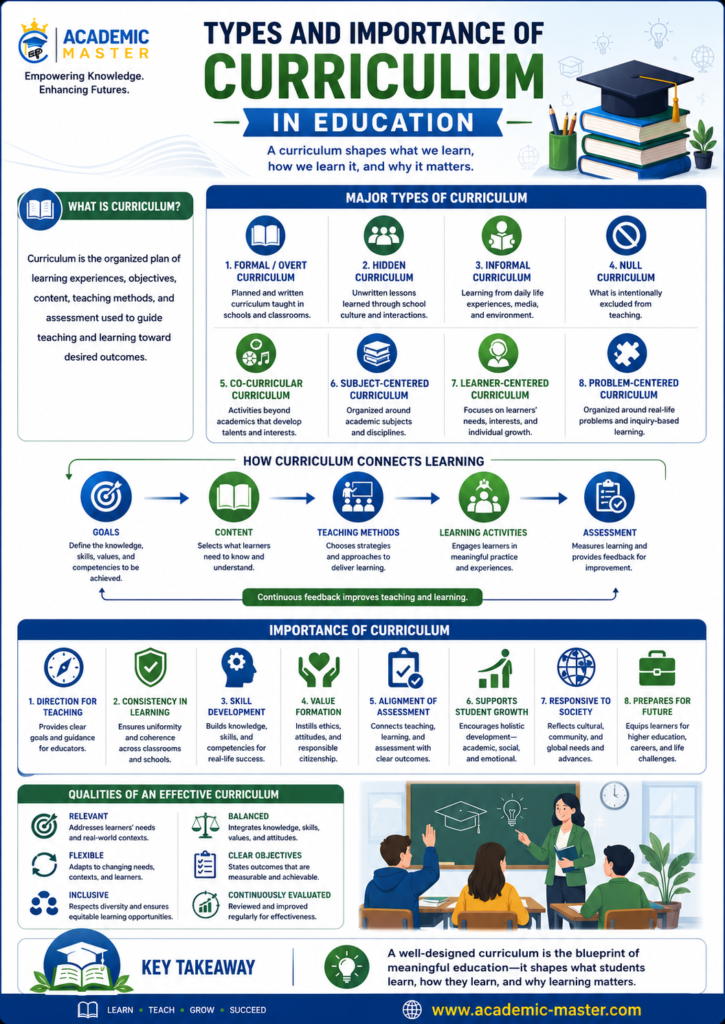
What is meant by the term curriculum? [100 words]
The curriculum is the total guided educational system that is designed to simplify learners so that they can learn for launching an excellent connection between what is learned in the school and what functions outside the school. The curriculum is the combination of many training courses that are arranged in a specific sequence. It is an integrated course that teaches academic studies. It is the method of continuous reconstruction of the organized body of trust that we usually call studies. There are various studies that are concerned. The curriculum is also defined as the aggregate of the courses that are given in the school for study (Slattery, 2012).
What is the difference between the intended, implemented and experienced curriculum? Why are these differences important? Explain why an understanding of each of these is critical in any discussion of ‘curriculum’ [400 words]
An intended curriculum is referred to as the set of goals that are set at the starting of any curricular strategy. The intended curriculum launches the objective, the explicit determinations, and the instant goals that are needed to be completed. It has the solution to everything that the curriculum wants him to make. Certain indicators exist that are used to measure the intended curriculum. There are liberal queries that can be responded to by applying the intended curriculum (Danesh, 2008).
Implemented curriculum entails putting the official syllabus course for studies and subjects. This process is also involved in learning and helping the attained information and knowledge or experience. A learner is needed for implemented curriculum to take place. The learner is the main figure in the implementation of the curriculum. Implementation occurs with the help of the leader who has a plan and intended knowledge experience. Ideas, skills, and attitudes aim to enable the learner to perform effectively in the social community. Curriculum implementation has also reached the stage where an educational program is being put into effect. An implementation agent is also required for operations. To achieve the goals, the teaching material, personality, and teaching environment should interact with the learner. Curriculum implementation is hence defined as the smooth and formally planned progression in which the curriculum is interpreted by the instructor into arrangements and instructions so that they can be distributed to the learner (Parkay, Anctil, & Hass, 2014).
The experienced curriculum is defined as how the student replies to, is involved in, or acquires from the actions, persons, resources, and public or expressive atmosphere of the teaching space. The idea of a skilled curriculum is not identical to any student-focused curriculum or instructor-focused curriculum. Reflection of the qualified curriculum as an amount for learner education needs that the full, skilled sense that classroom contribution has for students is firm and then appraised in contradiction of the implication of that skill regarding its instructive assessment. The skilled curriculum may be prejudiced by aligning with the scheduled or planned curriculum as scheduled by the instructor or forced by other exterior forces. It varies from other stages of the curriculum (including instructed, official, and capable) (Lund & Tannehill, 2010).
The large influences on curriculum include many factors. These may be political (power, ideology, government), economic (financial gain), or cultural transmission and or cultural transformation. Select TWO of these influences and explain using specific examples how they impact a curriculum. [600 words]
Several factors can affect curriculum growth in meeting the requirements of the modern era. Factors affecting curriculum growth include management guidelines, which bring other significant issues into development. Legal curriculum development necessitates mindfulness of the variety of the board public informally, economically and emotionally. Factors affecting curriculum growth include government curriculum extensions and government directions, which result in bringing other issues into the guidelines. Legal curriculum growth also needs development. Curriculum development requires mindfulness of the uniformity of goals (Pinar, 2013).
Two of the factors are explained below.
Technological Factor
Technology-determined curriculum growth is the custom of the modern era. The computerized expertise of the modern era is influencing curriculum growth at all levels of education. Educational hubs and teaching spaces progressively offer computers as necessary communication for education amongst learners. Hi-tech programs use inspiration learning objectives and education involvements amongst learners. Technology has always contributed significantly to the curriculum of the modern world. The use of technology is changing and improving the standards for designing curricula.
Technological alteration is defined not only by how to communicate effectively but also by how we need to educate ourselves and the nation. The prepared readiness of info has pointed to the requirement for a curriculum that is instructor concentrated and engrained in the goal to formulate people for a manufacturing civilization. The growth of logical expertise and advanced thinking is an increasingly significant focus of the modern syllabus. The participants and concerned individuals in this course are several and diverse, with the burden for alteration and improvement carried by instructors, institutes and institute councils, administration establishments, manufacturers and learners themselves. All of them have contradictory viewpoints on the best curriculum preparation models to deal with this change (Shawer, 2010).
Example
Undergraduate and graduate degrees in computer technology are increasing in popularity. These degrees change with the modern era. The technological factor is always involved in the computer science degree. In addition to this, new and advanced programming software is used over time.
Diversity
Curriculum growth influenced by diversity unlocks learning opportunities. Community diversity, comprising faith, art, music, literature, and community groups, improves curriculum development because these features influence the categories of subjects and approaches to training material. The rising applicable curriculum takes into account civilization’s potential, accepting group civilizations and endorsing equal opportunity.
Economic factors
Economics greatly impacts curriculum growth. The curriculum established for community exercises in organizations emphasizes cultivating staff for upgrades that yield improved revenues. Nations financing instruction expect a financial return from educated learners and their contributions to the nation’s economy through globally competitive skills in practical fields. If a nation spends more funds on education, it results in the betterment of its economy. It is a time-consuming process, but it is a guaranteed method for the long-term prosperity of the nation as a whole. If a country doesn’t spend much of its resources on the curriculum of the country, then the country will never grow and prosper in the long term (Pinar, 2013).
Example
Nations sponsoring education expect a financial return from educated learners contributing to the nation’s economy with globally competitive skills in technical fields. Nationally sponsored education expects spending on the curriculum to return up to eight times the initial investment. Every country in the world spends at least 4% of its GDP (gross domestic product) on its curriculum and expects this to return in financial and economic growth; once learners are educated, they will support the economy of the country.
Do we need a curriculum? For what purpose(s)? Who and what should a curriculum serve? Who benefits? Who loses? [900 words].
Yes, curriculum is very important for our education system. Curriculum expansion must be observed as a procedure through which gathering student requirements results in the enhancement of learners’ learning. Curriculum makers should collect as much data as they can collect. This data should also comprise the anticipated results or outlooks of a great superiority platform. The role of this assessment is the present position of learner success and definite platform content. The data should also reflect the worries and arrogances of trainers, managers, parents, and learners. The statistics should also contain models of valuations, educations from lecturers, tasks, notches on national uniform examinations, workbooks presently used, learner awareness and response from parents (Svensson & Wihlborg, 2010).
The curriculum is sometimes viewed as a program that may limit the preparation of lecturers to the content or body of information they need to convey, a list of topics to be taught, or both. In other words, only transporting topic information is inadequate for an active curriculum. It must propose much more than a declaration about the knowledge contained in the direction to be a creative curriculum.
To accomplish this, the clarifications of the curriculum motivate me to reflect on what kind of instructor I would become in the future. Being an instructor is not just about assigning topic information to learners. He or she has the duty to let the learner study in a daily setting. Teachers should not restrain themselves to the curriculum, but take the initiative to teach as much as they can. I believe that if instructors communicate with students enthusiastically, they will recall what they have learned and translate it into skills that may be valuable in their everyday lives.
Equipped with an agreement of understandings that rises from the documentation of matters and movements, a curriculum growth group is intelligent enough to conduct a requirements assessment to best determine the observations, fears, and needs of all of the participants in the procedure. Observing this information cautiously may disclose key matters that should impact the curriculum project. For example:
- Instructors may be disappointed with older courses and methods with the arrival of the latest research;
- Examination scores may be deteriorating or lower than expected in many or all areas;
- Instructors may not have resources or may not know how to use these resources to improve their considerations;
- Instructors may want to make better use of technology to improve knowledge;
- Instructors and others may request to narrate the content of the platform more carefully to modern difficulties and matters;
- Instructors may be observing for methods to raise the quantity of inter-disciplinary effort in which learners are involved;
- Learners may express a necessity for different and augmented curricular prospects;
- Parents and other family members may have worries about the implementation of these programs (Ryder & Banner, 2011).
Who benefits from the curriculum?
It saves time.
Dozens of people have invested thousands of hours in scripting a set of Essential Meetings that takes around four years to go through if you view it endwise. All the documents and contributions are permitted for taking online.
It’s supportive for new instructors.
Additionally, it’s supportive for new instructors. With a reliable curriculum, you can be more assured in the content than if a new instructor organized an example from the start.
Moreover, instructing a convenient moral is a much less frightening duty for a new instructor than ending up with forty-five minutes’ worth of course material themselves. It is a lot more relaxed for most of the instructors to study the subjects of a document or message than to make them.
Thus, the curriculum could be a great instrument for working out with new instructors. Educating a convenient course can be a valuable stepping stone into a more stimulating place (Jenkins & Pfeifer, 2012).
It can produce more attention from the audience.
Third, the curriculum can attract more attention from the audience. The curriculum opens the door to distinct, time-restricted, honestly short-lived courses. Both the shorter promotional time and their often up-to-date emphasis generate more interest (Jenkins & Pfeifer, 2012).
Who loses from the curriculum?
Normally, teachers who are teaching this curriculum lose their jobs when the whole curriculum is changed with the coming of new technology. Teachers have to update themselves with the latest technology so that the new curriculum won’t hit them hard. The change of curriculum also hits the students or learners as they have a new methodology of being taught. The losses caused by the curriculum are not severe or damaging. There could be some loss of the individuals only. Sometimes the new curriculum is not made according to students’ understanding, and students are unable to become familiar with the curriculum. This causes huge problems for the students, and their mental abilities are disturbed by this, causing a loss in terms of education for the students.
References
Lund, J., & Tannehill, D. (2010). Standards-based physical education curriculum development. Jones & Bartlett Learning.
Parkay, F. W., Anctil, E. J., & Hass, G. (2014). Curriculum leadership: Readings for developing quality educational programs. Prentice Hall.
Pinar, W. F. (2013). International handbook of curriculum research. Routledge.
Ryder, J., & Banner, I. (2011). Multiple aims in the development of a major reform of the national curriculum for science in England. International Journal of Science Education, 33(5), 709–725.
Shawer, S. (2010). Classroom‐level teacher professional development and satisfaction: teachers learn in the context of classroom‐level curriculum development. Professional Development in Education, 36(4), 597–620.
Slattery, P. (2012). Curriculum development in the postmodern era: Teaching and learning in an age of accountability. Routledge.
Svensson, L., & Wihlborg, M. (2010). Internationalising the content of higher education: the need for a curriculum perspective. Higher Education, 60(6), 595–613.
Jenkins, J., & Pfeifer, R. S. (2012). The Principal as Curriculum Leader. Principal Leadership, 12(5), 30–34.
Danesh, H. B. (2008). The education for peace integrative curriculum: Concepts, contents and efficacy. Journal of Peace Education, 5(2), 157–173.
Pinar, W. F. (2013). International handbook of curriculum research. Routledge.
Cite This Work
To export a reference to this article please select a referencing stye below:

Academic Master Education Team is a group of academic editors and subject specialists responsible for producing structured, research-backed essays across multiple disciplines. Each article is developed following Academic Master’s Editorial Policy and supported by credible academic references. The team ensures clarity, citation accuracy, and adherence to ethical academic writing standards
Content reviewed under Academic Master Editorial Policy.





