
COMS 246: Interpersonal Communication
LawTextbook
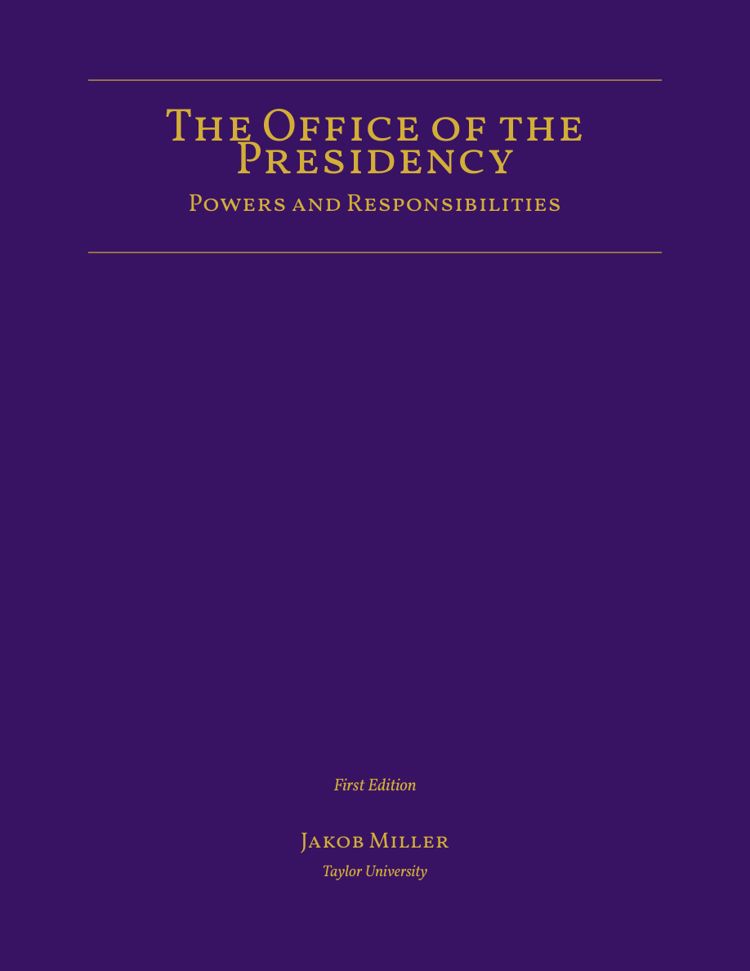
The Office of the Presidency: Powers and Responsibilities
Not rated yetRate this bookJakob Miller introduces the American presidency by examining the relationship between public expectations and the powers of the office. This concise undergraduate textbook focuses on institutions, constraints, and the ways presidents pursue their goals within them.
Free reading is available at the official source. Opens in a new tab.
 Free
About this book
The Office of the Presidency: Powers and Responsibilities is Jakob Miller’s 2025 first-edition introduction for undergraduate political science students. Its organising concern is the difference between the achievements people expect from a president and the authority available to that office. Miller uses an accessible, conversational approach to make institutional questions approachable.
The edition contains ten chapters. Its verified contents move from the formation of the presidency through elections, campaigns, taking office, relations with Congress and the courts, public opinion, media, and foreign affairs. An annotated Constitution, glossary, and further-reading recommendations provide routes into closer study.
Miller explains that the book is deliberately selective. It introduces important principles rather than offering a comprehensive history, a sequence of presidential biographies, or an exhaustive account of the research literature. It can therefore serve as a starting point for class discussion and additional reading.
The author’s official download contains 221 PDF pages. The source is freely available under CC BY-NC 4.0; Academic Master links to that edition externally. The study material below covers the introductory chapter and retains the edition’s 2025 context.
Book summary
Jakob Miller’s The Office of the Presidency: Powers and Responsibilities studies the U.S. presidency as an institution. Ten chapters connect its origins and electoral path with executive organization, Congress, courts, public opinion, media, and foreign policy. The guide follows the 2025 first edition and its political-science questions. Historical and legal examples are understood within that source, with the central distinction between an officeholder's ambitions, formal authority, practical influence, and actual control over outcomes.
Chapter-by-chapter summaries
Chapter 1: Introduction
Miller challenges the familiar picture of a decisive individual who can solve a public problem through a simple command. The leadership dilemma arises when public expectations exceed presidential capacity. Constraints do not make the office unimportant; they make its operation a subject for investigation. The chapter also explains the book's introductory scope. It offers a manageable institutional framework rather than a complete history, biography collection, reference database, or account of every specialist debate. Supplementary reading is part of using that framework well.
Chapter 2: Creation and Change
The presidency emerged from decisions about unity, selection, tenure, independence, powers, and limits. The chapter connects these founding choices with the office's later development. Ambiguity, congressional action, precedent, tradition, and public expectations create opportunities for change without making the institution a blank slate for each officeholder. A useful explanation distinguishes the constitutional starting point from the practices and relationships that developed around it. The chapter establishes why both original design and later institutional history matter when assessing a claim about presidential power.
Chapter 3: Nominations and Elections
Formal eligibility is only the beginning of becoming president. Nomination procedures, primaries, the general election, the Electoral College, and participation shape the route to office. The chapter connects institutional rules with political strategy and interpretation of a result. Winning an election does not automatically establish one unambiguous mandate on every policy question. Students should ask which voters and processes a claim represents and distinguish the mechanism selecting an officeholder from a broader assertion about what the whole public wants.
Chapter 4: The Presidential Campaign
Campaigns combine fundraising, spending, debates, advertising, earned media, personal contact, allies, and strategic choices. Activities matter within an electoral environment that also includes broader political conditions. The chapter therefore asks not only what campaigns do but how their influence can be assessed. An observed result cannot be attributed to a memorable event merely because the event preceded it. Strategy also depends on the rules of the contest, including the importance of particular states and choices about the vice-presidential candidate.
Chapter 5: Taking Office
Entering office places the president within a large executive organization. The Executive Office of the President, cabinet departments, other agencies, and enduring administrative structures have different roles. Size, complexity, procedural requirements, permanence, and outside influence complicate control. Appointments, removal, and executive orders are examined as tools within that setting rather than evidence of unlimited command. The chapter returns to the leadership dilemma: understanding presidential action requires asking how authority is translated through an institution whose members, responsibilities, and constraints cannot be reduced to one person's wishes.
Chapter 6: The President and Congress
Congress makes legislation, while presidents face expectations to advance an agenda. The difficult legislative process creates a need for persuasion and coordination alongside formal tools such as the veto and budget role. Signing statements and congressional influence add further relationships. The chapter shows why a policy promise does not establish the ability to enact it. A useful analysis identifies the decision points and actors involved, distinguishing an officeholder's preferred outcome from the institutional path needed to achieve it.
Chapter 7: The President and the Courts
Courts can constrain executive action, but the relationship is not a simple contest in which one branch always controls the other. Speed, reactivity, enforcement, deference, and restraint affect judicial influence. Presidents also participate through appointments and other powers examined in the chapter. The central lesson is relational: selecting a judge does not make that judge an interchangeable extension of the appointing president. Students need to explain the institutional mechanism and circumstances behind an outcome rather than infer it from an assumed personal loyalty.
Chapter 8: The President and the Public
The public is both an audience to be led and a source of democratic expectations. The chapter examines how public opinion is understood, why knowledge and plurality matter, and how approval ratings relate to factors such as party, events, and the economy. Attempts to lead opinion encounter limits. A useful interpretation distinguishes the public image of the presidency, a measured response to a particular question, and actual support for an action. A poll's existence does not resolve questions about what it measures or whom it represents.
Chapter 9: The President and the Media
Most people encounter the presidency through mediated communication rather than direct contact. The modern media environment, direct channels, and White House communication institutions shape how information reaches audiences. The chapter also examines limits on control. Sending a message does not guarantee its selection, interpretation, or acceptance, and access to a platform does not eliminate competing voices. Analysis should connect a communication strategy with the information environment and audience response rather than equate visibility with persuasive success.
Chapter 10: War and Foreign Policy
Foreign affairs present a setting that differs from domestic policy, while still involving constitutional authority, institutions, and constraints. The chapter examines diplomacy, recognition, treaties, war, congressional grants, and claims of inherent power within the changing U.S. global position. It does not make every foreign-policy outcome the product of a single actor. Students should distinguish a formal source of authority from the practical conditions affecting its use and examine how presidential and congressional roles interact in the particular issue under discussion.
Appendix A and Reference Material
The annotated Constitution, glossary, further-reading lists, and other reference material support the institutional account. They help trace the relationship between a constitutional provision and the political-science questions raised in a chapter. A constitutional text, a judicial interpretation, and an observed political practice are different kinds of evidence. Using the appendix alongside the chapters helps keep them distinct instead of treating one quotation as a complete explanation of how an institution operates.
Study instructions
- For a presidential action, map the claimed authority, other decision-makers, practical resources, and constraints before assessing its result.
- Compare the institution-centered explanation with a leader-centered account and identify what evidence each would require.
- Use a chapter's further reading to investigate one qualification omitted by the concise introduction.
- Evaluate an election or poll claim by its mechanism, population, wording, and limits rather than treating it as a universal mandate.
- Read the annotated Constitution beside an institutional example, distinguishing text, interpretation, and political practice.
Questions for reflection
- When does formal authority fail to produce practical control?
- How could the same outcome support more than one explanation of presidential influence?
- What would you need to know before concluding that a campaign event or presidential message changed public behavior?
Sources and coverage
This original study guide follows the complete linked source edition and all of its substantive chapters or named teaching sections. It condenses their main ideas and relationships; the study tasks are guidance for reading alongside the complete resource. It does not reproduce the source exercises or answer key. Book source; Complete source PDF.
About access & copyright
This page provides book information and study material. Full-text access is provided by the original publisher or authorised source; a listing does not grant permission to republish the book.
Read our Library Access & Copyright policyExpectations gap
Explain Miller’s distinction between public demands and presidential capacity.
Institutional focus
Distinguish the presidency from individual presidential biographies.
Limits and influence
Frame questions about what enables or constrains executive action.
Further inquiry
Recognise the limits of a concise introductory treatment.
Reader ratings & reviews
Share your thoughts
Your review helps other students choose the right resources.



