
Recent Advances in Mathematics Textbook Research and Development
Key Stage 3Textbook
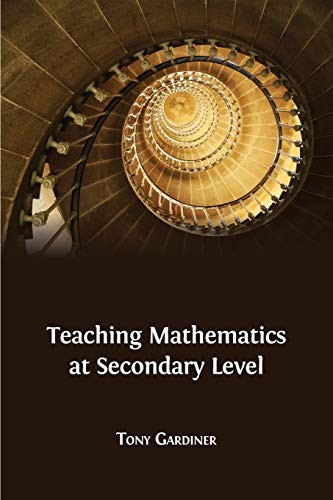
Teaching Mathematics at Secondary Level
Not rated yetRate this bookTeaching Mathematics at Secondary Level is Tony Gardiner's examination of the mathematical foundations of lower secondary education. Written in response to England's curriculum, the 2016 book asks how fluency, reasoning and connected knowledge develop over time. This guide covers its four main parts and key subject strands, with tasks for teachers and curriculum teams.
Free reading is available at the official source. Opens in a new tab.
 Free
About this book
Teaching Mathematics at Secondary Level is Tony Gardiner's examination of the mathematical foundations of lower secondary education. Written in response to England's curriculum, the 2016 book asks how fluency, reasoning and connected knowledge develop over time. This guide covers its four main parts and key subject strands, with tasks for teachers and curriculum teams.
Reading approach
This is a professional and mathematical discussion for teachers, teacher educators and curriculum planners. It is not a set of scripted lessons or a current statement of statutory requirements. Keep pencil and paper nearby, tackle the book's calculations before reading on and draw the diagrams it describes. Begin with Part I, work through Part II, then select subject sections in Part III according to your needs before comparing the sample curriculum in Part IV.
Part-wise summaries
Part I: Background — Why focus on Key Stage 3?
The opening part explains why lower secondary mathematics deserves deliberate attention rather than being treated as a waiting period before examinations. For pupils aged roughly eleven to fourteen, familiar primary-school procedures must develop into tools that support more formal and abstract mathematics. Gardiner argues that an official list of requirements does not by itself provide the necessary connections, sequencing or explanation of prerequisites. His discussion uses the English curriculum and inspection evidence available when the book was written in 2016; those historical observations should not be presented as a current inspection report. The enduring question is how a scheme of work helps pupils build knowledge they can use later, rather than briefly reproduce in a test. Curriculum review therefore begins by examining the mathematical relationships between topics and the readiness pupils need to progress. Teachers should ask what a learner must understand before a new method makes sense and what subsequent work that method will enable.
Study task: Take a familiar Year 7 or Year 8 topic. Identify two prerequisites and two later uses, then check whether your existing scheme of work makes those relationships explicit.
Part II: The general advice in the Key Stage 3 programme of study
This part examines the curriculum's broad aims and its account of working mathematically. Gardiner treats fluency, reasoning and problem solving as connected achievements that require sustained development. A pupil who can follow an immediately supplied procedure may still struggle when asked to select a method, work backwards or combine two familiar ideas. The distinction between direct and inverse operations is particularly useful: expanding brackets prepares for factorising, just as carrying out a calculation prepares for recovering an unknown input. The discussion also distinguishes methods that produce an immediate answer from methods that prepare pupils for later mathematics. Practical work, mental and oral activity, written calculation and deductive justification each have a role, but should contribute to a coherent progression. The aim is to develop reliable knowledge and increasingly independent decisions, with exercises that vary in structure and demand rather than repeat one identical template.
Study task: Choose one routine calculation. Create a direct question, an inverse question and a short multi-step problem using the same mathematical relationship. Explain what additional decisions each version requires.
Part III: The listed subject content for Key Stage 3
The largest part interprets subject requirements through four connected strands: number with ratio and proportion, algebra, geometry and measures, and probability and statistics. Read it selectively after establishing the broader principles in Parts I and II. Gardiner's aim is to unpack the mathematical work hidden inside compressed curriculum statements, not to offer a ready-made lesson script. The number and algebra discussions show how later competence depends on robust structural arithmetic, fractions and flexible use of equality. Subject connections matter: proportional reasoning also supports scale and similarity, while symbolic expressions describe numerical and geometric relationships. Teachers should look for points where a topic is apparently covered but not secure enough to support subsequent work. Record both the immediate learning goal and the mathematical habit being developed. Revisit relevant sections after examining pupils' work, so that a general curriculum principle can be tested against actual reasoning and misconceptions.
Study task: Audit one unit against three questions: what knowledge is assumed, what connections are developed, and what later mathematics depends on it? Add a diagnostic question for any assumption that seems uncertain.
Part IV: A sample curriculum for all — written from a humane mathematical viewpoint
The final part offers a sample curriculum in very brief and brief versions. Gardiner presents it as a basis for consideration, not an ideal model that every school must adopt unchanged. Its value lies in making progression and relationships visible across time. The introduction to the book explains the emphasis on securing foundational knowledge, including multiplication tables and fractions, while allowing adequate preparation rather than assuming every concept should be introduced as early as possible. A humane curriculum combines ambition with an account of the steps and time learners need. Compare the proposed sequence with your own by looking for differences in prerequisites, consolidation and opportunities to connect ideas. Resist judging a curriculum solely by how quickly advanced labels appear. Ask instead whether pupils develop knowledge they can remember, explain and apply when familiar cues are absent.
Study task: Compare the sample curriculum with one year of your school's plan. Identify one topic that may need more consolidation and one connection that could be made explicit without adding new content.
Closer study of the main sections
Part II study focus: Aims
Fluency includes knowing facts and procedures well enough to use them flexibly, while reasoning requires explaining why a step or claim is justified. Problem solving requires recognizing which knowledge is relevant in a situation. These aims should influence the design of ordinary practice, not be confined to separate enrichment sessions. Use a sequence of related examples to expose structure, then remove some of the cues that tell pupils which method to choose. Ask whether success depends on understanding the relationship or merely recognizing the worksheet pattern.
Application task: Adapt an exercise set so that the final questions require choosing a method. Specify what would count as evidence of reasoning in the written answers.
Part II study focus: Working mathematically
The book draws attention to the progression from observation and exploration toward exact, deductive explanation. A measured diagram can suggest a relationship but does not prove it for every case. Equally, a polished written solution differs from the exploratory work used to discover it. Help learners distinguish these purposes. When reviewing a solution, look for the chain connecting known facts to the conclusion and for the point at which a claim needs justification. Oral questions can make these decisions visible before a formal proof is written.
Application task: Present a geometric conjecture supported by several drawings. Ask what the measurements establish and what would still be needed for a proof.
Part III study focus: Number, ratio and proportion
Number knowledge is a bridge between earlier arithmetic and later algebra. Place value, factors, multiples and fractions should support flexible calculation, not remain isolated facts. Gardiner gives particular attention to fractions as a unifying theme connecting decimals, percentages, ratios and proportional reasoning. Repeated work with inverse variations matters: finding a percentage of an amount is different from recovering the original amount after a change. Use examples with non-integer answers where appropriate so that later work does not quietly avoid the very skills pupils need to develop.
Application task: Design a short sequence connecting fraction equivalence, a percentage change and a reverse-percentage question. Explain the common multiplicative structure.
Part III study focus: Algebra
Algebra builds on recognizing and expressing numerical structure. Distinguish an expression, an equation, a formula and an identity because each has a different purpose. The equality sign connects equal quantities; it is more than an instruction to write an answer. Translating a verbal procedure into an expression is itself a skill and should not be hidden inside a more complicated modelling task. Coordinate work also needs relationships among points and equations, rather than only plotting isolated locations. Keep attention on meaning while developing fluency in symbolic transformations.
Application task: Write a short verbal procedure as an expression. Add a condition that turns it into an equation, solve it, and explain the meaning of the solution.
Part III study focus: Geometry and measures
Use this strand to examine the transition from recognizing shapes and measuring particular examples to reasoning from properties. Drawings, constructions and accurate terminology make geometric relationships discussable. A diagram should support an argument without becoming its only justification: an angle that looks equal to another still needs a reason. Connect measurement with the units and quantities involved, and distinguish a practical approximation from an exact mathematical statement. When planning lessons, identify which properties are established and which are being used to derive a new result.
Application task: Choose a familiar angle result. Draw an illustrative diagram, list the facts a proof would use and distinguish those facts from features that merely appear true in the picture.
Part III study focus: Probability and Statistics
Read the statistical strand with attention to the question being investigated and the meaning of each representation or numerical summary. A calculation of a centre or spread is useful only when connected with the data and the comparison it is intended to support. Probability reasoning likewise requires a clear statement of outcomes and assumptions. For curriculum discussion, examine how pupils move between words, tables, diagrams and numerical statements. The task below is an original planning exercise, intended to help apply the book's wider emphasis on interpretation and connected understanding.
Application task: Prepare two small datasets with the same mean but different spreads. Ask pupils to describe the difference and explain why reporting only the mean loses relevant information.
Part IV study focus: Very Brief and Brief versions
Use the two levels of detail together. The shorter outline helps reveal the overall direction, while the fuller version supports discussion of what progression would involve. Compare sequences by following a single idea across stages rather than counting the number of topics listed in a year. Consider where the plan introduces a concept, where it consolidates it and where it expects independent use. Record a proposed adaptation with a mathematical reason and a way to check its effect on learning.
Application task: Trace fractions or proportional reasoning across the sample curriculum. Mark introduction, consolidation and later application, then compare that trajectory with your own plan.
Suggested professional study sequence
- Read and diagnose: Use Part I to identify one weakness in progression that you can investigate through pupils' actual work.
- Test a principle: Read Part II and redesign a small exercise sequence to connect direct and inverse questions.
- Follow a strand: Select the relevant Part III section and record prerequisites, representations, common errors and later uses.
- Review the curriculum: Compare the sample in Part IV with your existing sequence. Make one reasoned change and identify how its effect could be evaluated.
- Return to the evidence: Revisit the original diagnostic questions after teaching. Examine explanations as well as correct answers.
Questions for departmental discussion
- Which methods in our teaching prepare pupils for later mathematics, and which mainly provide an immediate answer?
- Where do pupils practise inverse questions and combine two familiar ideas without a supplied method?
- How do we distinguish the evidence of a drawing or experiment from a deductive argument?
- Do high-attaining pupils receive deeper work before moving on, and do other pupils have enough structured consolidation?
- Which apparent topic boundaries obscure relationships among fractions, percentages, proportion, geometry and algebra?
Source and historical context
Source: Tony Gardiner, Teaching Mathematics at Secondary Level, Open Book Publishers, 2016, DOI 10.11647/OBP.0071, CC BY 4.0. Consult the publisher's edition and contents and the open-access book. This original companion follows the four-part organization and verified subject headings, drawing on the book's introduction and mathematical discussions. The strand-focused tasks are original study suggestions, not claims that every example appears in the source. Curriculum and inspection references belong to the book's 2016 context.
About access & copyright
This page provides book information and study material. Full-text access is provided by the original publisher or authorised source; a listing does not grant permission to republish the book.
Read our Library Access & Copyright policyExplore the contents
Check the chapters covered in this edition.
Visit the official source
See reading, preview or purchase options.
Save for later
Keep this textbook in your saved collection.
Reader ratings & reviews
Share your thoughts
Your review helps other students choose the right resources.
KEEP LEARNING
Your next great read
Challenges and roles for textbooks in a pandemic context
 Abelian number fields
Number Fields
View Number Fields — book Algebra
Intermediate Algebra
View Intermediate Algebra — book Mathematics
Book of Proof
View Book of Proof — book Algebra
College Algebra
View College Algebra — book Applied
Introduction to Probability
View Introduction to Probability — book Calculus
Precalculus (Version 3, Corrected 2013 Edition)
View Precalculus (Version 3, Corrected 2013 Edition) — book Geometry and Trigonometry
College Trigonometry
View College Trigonometry — book Calculus
Whitman Calculus
View Whitman Calculus — book Calculus



