
Open Data Structures: An Introduction
Computer ScienceTextbook
Python for Everybody: Exploring Data Using Python 3
Not rated yetRate this bookCharles R. Severance’s Python for Everybody: Exploring Data Using Python 3 introduces programming through practical data tasks. Sixteen chapters build from execution and expressions to control flow, functions, collections, files, regular expressions, networked data, objects, databases, and visualization. This guide follows the English January 2024 update, which includes Python 3.12 examples and revised database material. It also replaces the catalog’s Polish download with the complete English PDF. The progression emphasizes tracing what a program does before extending it to larger data workflows.
Read on the publisher’s website. Opens in a new tab.
 Free
About this book
Charles R. Severance’s Python for Everybody: Exploring Data Using Python 3 introduces programming through practical data tasks. Sixteen chapters build from execution and expressions to control flow, functions, collections, files, regular expressions, networked data, objects, databases, and visualization. This guide follows the English January 2024 update, which includes Python 3.12 examples and revised database material. It also replaces the catalog’s Polish download with the complete English PDF. The progression emphasizes tracing what a program does before extending it to larger data workflows.
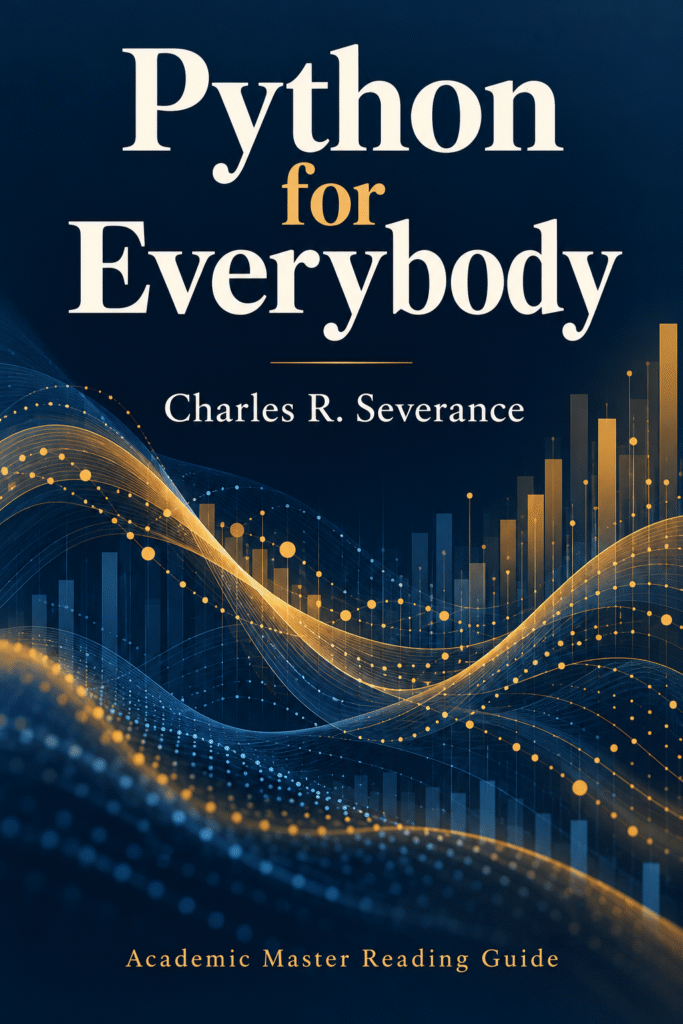
Cover: original Academic Master reading-guide design. The linked textbook remains the source edition described above.
Book summary
About this book
Charles R. Severance’s Python for Everybody: Exploring Data Using Python 3 introduces programming through practical data tasks. Sixteen chapters build from execution and expressions to control flow, functions, collections, files, regular expressions, networked data, objects, databases, and visualization. This guide follows the English January 2024 update, which includes Python 3.12 examples and revised database material. It also replaces the catalog’s Polish download with the complete English PDF. The progression emphasizes tracing what a program does before extending it to larger data workflows.
Chapter-by-chapter summaries
1. Why Learn to Write Programs?
Programs automate repeatable work by expressing instructions a computer can execute. The chapter introduces execution, language, and the relationship between a human problem and a precise procedure. Distinguish a syntax problem from an incorrect algorithm. Begin with a small task whose steps you can explain. Programming is presented as a way to handle information rather than an exercise in memorizing commands without purpose.
2. Variables, Expressions, and Statements
Values and types interact through expressions, assignment, and input. A variable name refers to a value; assignment is an action, not a permanent algebraic equality. Trace changing bindings line by line. Convert input deliberately and explain why an operation has the resulting type. The chapter establishes the state model needed for later conditions, loops, and data structures.
3. Conditional Execution
Branching chooses actions using Boolean expressions and control structures. Compare independent conditions with an if-elif chain and explain which paths can execute. Include boundary values when tracing. Exception handling addresses a different route through a program when an operation cannot proceed normally. The important skill is predicting execution from the actual structure rather than reading conditions as informal English wishes.
4. Functions
Functions organize a computation through arguments, local work, return values, and calls. Distinguish printing a value from returning it to the caller. Trace the flow into and out of a function and identify which names belong to which scope. A useful function has a clear purpose and interface. Reuse becomes reliable when assumptions and outputs are understood rather than copied mechanically.
5. Iteration
Loops repeat work through a changing state and a termination condition. Counters, totals, searches, and maximum or minimum patterns require different initial values and updates. Trace an empty input and a one-item input before a normal case. Explain what remains true after each iteration. This exposes off-by-one errors and assumptions hidden by testing only a convenient example.
6. Strings
Strings represent sequences of characters with indexing, slicing, searching, comparison, and methods. A string’s immutability changes what an operation can modify. Separate the original value from a newly produced value. Practise extracting a field from text and state the assumptions about delimiters and positions. A method’s familiar name does not remove the need to understand what it returns.
7. Files
File processing connects opening, reading, iteration, filtering, and error handling. A file handle is different from the file’s entire contents. Trace a program one line at a time and explain newline handling. Test a missing file and an input containing unexpected data. The chapter makes persistent text a source of manageable records rather than assuming all data can be inspected manually before processing.
8. Lists
Lists collect ordered values and support mutation, traversal, and transformations. Distinguish changing a list through an alias from assigning a new list to a name. Draw two references to the same object and predict a modification. Compare methods that alter an object with expressions that create another. This chapter introduces a more careful model of data ownership and state than scalar examples alone require.
9. Dictionaries
Key-value mappings support counting, lookup, and aggregation. A dictionary is not an ordered position-based replacement for every list. Identify the key that represents the problem’s category and the value being accumulated. Handle an absent key deliberately. Word-frequency examples connect parsing with an appropriate data structure and show how representation can make a repeated task simpler and more direct.
10. Tuples
Tuples provide fixed sequences and support unpacking and comparison patterns. The chapter connects them with sorting and dictionary items. Distinguish immutability from a claim that every object reachable through a tuple is itself immutable. Trace a decorate-sort-style transformation and identify the field controlling order. Tuples are useful when their role in a data pipeline is explicit rather than selected merely because their syntax is short.
11. Regular Expressions
Patterns combine matching and extraction in compact descriptions of text. Explain each component and test positive, negative, and boundary cases. A pattern that matches one sample may be too broad or too narrow for the task. Compare a regular expression with simpler string methods. The chapter encourages choosing a tool whose assumptions are understood rather than treating dense punctuation as evidence of sophistication.
12. Networked Programs
Network programs communicate through protocols and retrieve data beyond local files. The chapter connects sockets, HTTP, and higher-level retrieval with the structure of requests and responses. Separate transport, protocol, and content interpretation. A successful connection does not establish that the desired data were returned. Use the source examples in an appropriate learning environment and verify current endpoints where services have changed.
13. Web Services
Structured exchange formats and APIs turn remote data into values a program can process. Parsing XML or JSON differs from understanding the meaning and reliability of fields. Identify the request, response structure, and required validation. Test missing or unexpected values. The chapter extends earlier data-processing habits to external systems whose availability and interfaces are outside the program’s direct control.
14. Object-Oriented Programming
Objects connect state with behavior through classes and instances. Distinguish defining a class from creating an object and calling its methods. Trace how an instance’s attributes change. The chapter introduces a vocabulary for using libraries and organizing programs, not a requirement to turn every small script into a hierarchy. A clear model of instance state matters more than memorizing terminology alone.
15. Databases and SQL
Persistent relational data supports queries, relationships, and organized updates. Tables, keys, and joins connect records without duplicating every fact. Design a small schema before writing SQL and explain what each row represents. Separate query results from changes to stored data. The revised chapter links programming with database operations so that a data workflow can be repeated and inspected over time.
16. Visualizing Data
The final chapter brings retrieval, storage, processing, and presentation into complete examples. A visualization should answer a defined question and reflect the data’s meaning and limits. Trace the pipeline from original source to displayed result. Identify where filtering or transformation changes the interpretation. The conclusion shows that a visible output is only as reliable as the collection and processing stages that produced it.
Study instructions
- Run small source examples and predict their outputs before execution.
- Keep a trace table for variables and distinguish mutation from rebinding.
- Use empty, malformed, boundary, and normal inputs to investigate assumptions.
- Complete one end-to-end project that reads or retrieves data, validates it, stores results, and explains a visualization.
- Use the English edition and check current API documentation before adapting remote-service examples.
Questions for reflection
- How does returning differ from printing?
- When can two names refer to the same mutable object?
- Why does a correct parser not guarantee meaningful data?
- Which pipeline step most affects the conclusion of a visualization?
Sources and coverage
This original study guide covers all main chapters of the linked edition, or all instructional sections where the work has no numbered chapters. The explanations and suggested practice are written for study; consult the full source for cases, worked examples, illustrations, exercises, and references. English January 2024 update. Service endpoints and interfaces may change after publication. Read the source edition.
About access & copyright
This page provides book information and study material. Full-text access is provided by the original publisher or authorised source; a listing does not grant permission to republish the book.
Read our Library Access & Copyright policyExplore the contents
Check the chapters covered in this edition.
Visit the official source
See reading, preview or purchase options.
Save for later
Keep this textbook in your saved collection.
Reader ratings & reviews
Share your thoughts
Your review helps other students choose the right resources.
KEEP LEARNING
Your next great read
Computer Science
Foundations of Computation
Foundations of Computation
View Foundations of Computation — bookThink Bayes: Bayesian Statistics Made Simple
Think Bayes: Bayesian Statistics Made Simple
View Think Bayes: Bayesian Statistics Made Simple — book Computer Science
An Introduction to Computer Networks
View An Introduction to Computer Networks — book Computer Science
Introduction to Computer Graphics
View Introduction to Computer Graphics — book Computer Science
Introduction to Programming Using Java
View Introduction to Programming Using Java — book Computer Science
Nature of Geographic Information
View Nature of Geographic Information — book Computer Science
Java with BlueJ Part 2
View Java with BlueJ Part 2 — book Computer Science
Java with BlueJ
View Java with BlueJ — book Computer Science



