
 Medicine
Textbook
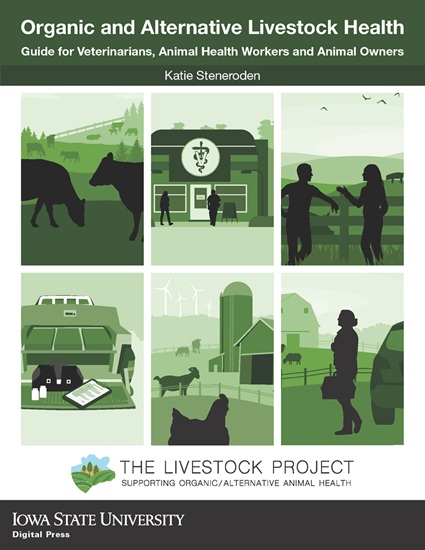
Organic and Alternative Livestock Health: A Guide for Veterinarians, Animal Health Workers and Animal Owners
Not rated yetRate this bookThis guide introduces the context of organic and alternative livestock health for veterinarians, animal health workers, and owners. It connects producer perspectives, prevention, communication, and veterinary practice within an educational resource developed from continuing-education material.
Read on the publisher’s website. Opens in a new tab.
 Free
About this book
Organic and Alternative Livestock Health is a 2026 Iowa State University Digital Press publication credited to Katie Steneroden, Jenna Bjork, and Delaine Quaresma. It developed from an earlier online continuing-education course and was revised for book publication.
The official PDF contains 216 pages. Six main sections address background, rules and regulations, preventive approaches, treatments and modalities, communication, and veterinary practice management. The verified contents show the breadth of the resource without establishing that every approach discussed has the same evidential support.
The reviewed background uses organic agriculture within a United States context, including the USDA framework. That edition-specific context matters when reading certification and labelling material. It should not be treated as a statement of the requirements applying in every country.
The source is CC BY-NC-SA 4.0 with exceptions. The overview below is limited to introductory context and does not provide clinical treatment, dosing, certification, or regulatory instructions. The full official edition remains available externally.
Book summary
Study overview of the reviewed opening
The introduction describes a resource that began as continuing education and became an openly accessible book. It acknowledges contributions from veterinary, educational, technical, and advisory participants. This background helps explain the intended audience: people seeking to understand how animal-health work relates to organic and alternative production settings.
The reviewed background section introduces organic agriculture as a practice with a history and an evolving institutional setting. Its opening connects changes in farming practices with the development of certification and standards. The educational emphasis is on understanding context before approaching the more detailed chapters.
The section also distinguishes an organic framework from the wider range of claims that can appear around food and farming. It encourages attention to what a term means and how a claim is supported. Within the text, organic is tied to the USDA National Organic Program rather than being used as a general synonym for every alternative approach.
A further theme is the relationship between producers and veterinary professionals. The opening learning goals include understanding producer motives and different perspectives on working together. Reading this as a contextual introduction helps keep those social and organisational questions visible alongside the technical topics announced in the contents.
The reviewed material establishes a vocabulary and a setting. It does not establish the efficacy of a treatment or supply the current rules for certification. Those matters require examination of the relevant chapters, evidence, and applicable professional or official sources.
Independent study suggestions
Academic Master editorial guidance:
When discussing a claim about production or animal health, record the precise term used, the context, and the evidence being offered. Keep a description of a practice separate from a claim about its effects. This independent reading exercise is intended to support critical discussion and does not direct the care of an animal.
Questions for discussion
These are Academic Master’s original discussion prompts.
- Why is it important to define a label before comparing claims made under it?
- How could producer and veterinary perspectives shape the questions asked about a practice?
- What additional evidence would be needed to evaluate an asserted benefit?
Book contents and further reading
Consult the complete official contents. The contents are linked rather than reproduced here.
Sources and coverage
Reviewed: title, copyright, contents, introduction (PDF page 10), and background on printed pages 3–5 (PDF pages 14–16). Clinical, prevention, treatment, and detailed regulatory chapters have not been summarised. The guide describes the source edition’s U.S. context.
Sources: official source and official PDF.
About access & copyright
This page provides book information and study material. Full-text access is provided by the original publisher or authorised source; a listing does not grant permission to republish the book.
Read our Library Access & Copyright policyTerminology
Ask how the source defines organic and alternative production.
Context
Recognise the U.S. framework used in the reviewed background.
Perspectives
Identify why communication between producers and professionals matters.
Evidence
Distinguish describing a practice from establishing its effects.
Reader ratings & reviews
Share your thoughts
Your review helps other students choose the right resources.
KEEP LEARNING
Your next great read
Medicine Medicine
Applying the International Classification of Functioning, Disability & Health: A Team-Based/Project Based Course for Undergraduate Students
View Applying the International Classification of Functioning, Disability & Health: A Team-Based/Project Based Course for Undergraduate Students — bookUrinalysis Atlas: A Pictorial Guide to Formed Elements in Urine (Doty and Taylor)
Urinalysis Atlas: A Pictorial Guide to Formed Elements in Urine (Doty and Taylor)
View Urinalysis Atlas: A Pictorial Guide to Formed Elements in Urine (Doty and Taylor) — book Medicine
Drug Use and Misuse: A Community Health Perspective
View Drug Use and Misuse: A Community Health Perspective — book Medicine
Neuroscience for Pre-Clinical Students
View Neuroscience for Pre-Clinical Students — book Medicine
Cardiovascular Pathophysiology for Pre-Clinical Students
View Cardiovascular Pathophysiology for Pre-Clinical Students — book Medicine
Pulmonary Physiology for Pre-Clinical Students
View Pulmonary Physiology for Pre-Clinical Students — book Medicine
Epidemiology
View Epidemiology — book Medicine
Social Determinants of Health in Nursing Education: Integrating Into Curriculum and Practice
View Social Determinants of Health in Nursing Education: Integrating Into Curriculum and Practice — book Medicine



