
 bioinformatics
MedicineTextbook
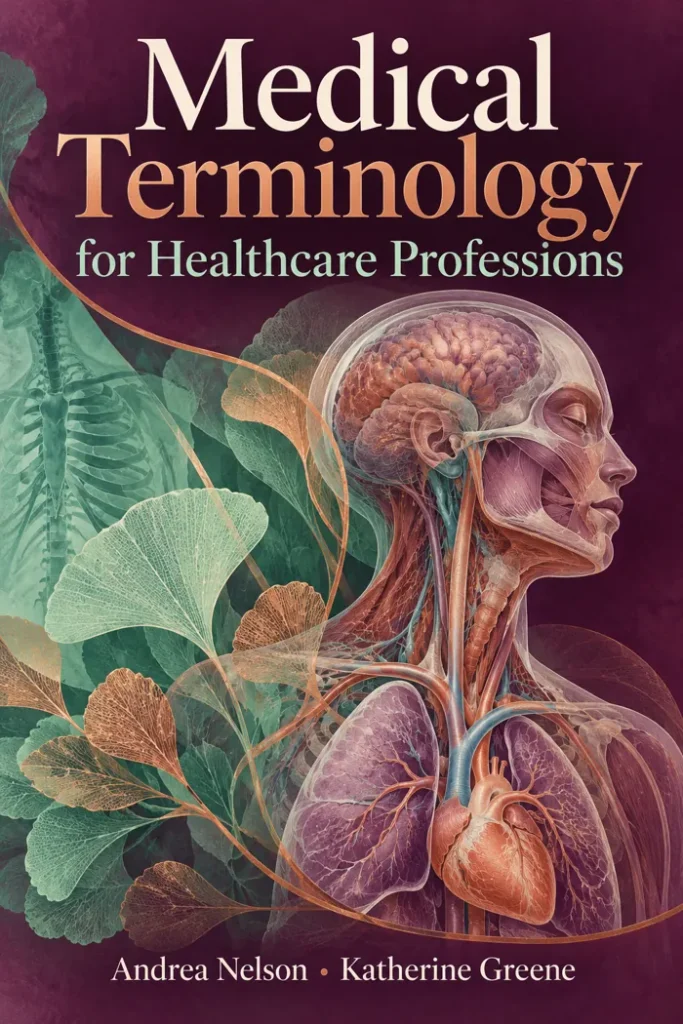
Medical Terminology for Healthcare Professions
Not rated yetRate this bookMedical Terminology for Healthcare Professions introduces the language used in healthcare settings. Andrea Nelson and Katherine Greene connect word parts and formation rules with anatomical context, then organise terminology around the body’s systems.
 Free
About this book
The introduction identifies healthcare administration, health sciences and pre-professional students as its original audience. The resource adapts material from an earlier terminology text and OpenStax anatomy and physiology, with its own revisions to presentation and activities. Readers learn to identify components of terms while connecting vocabulary with the body structures and functions being described. Interactive exercises belong to the online version and are linked from the PDF. The text is a terminology learning resource; this page does not turn vocabulary examples into diagnostic or treatment guidance.
The attached edition contains 525 PDF pages, including front matter. Cover: source edition title page rendered from the PDF. The textbook and its original notices are retained; Academic Master’s study material is separate from the source text.
Book summary
Medical Terminology for Healthcare Professions introduces word construction and system-based vocabulary for learners entering healthcare fields. The linked 2020 publisher text contains eighteen chapters followed by a glossary. Terms are connected with anatomy, physiology, conditions, procedures, and professional communication. This guide supports vocabulary study; a word’s structure can suggest its meaning, but definitions and clinical context must still be checked rather than inferred mechanically.
Chapter-by-chapter summaries
Chapter 1: Word Parts and Rules
Roots, combining forms, prefixes, and suffixes provide a framework for interpreting medical terms. Learn how word parts combine and when a connecting vowel is used. Analyze a term into meaningful components, then confirm the complete definition. The final meaning is not always a literal sum of the parts, and spelling affects recognition.
Chapter 2: Prefixes and Suffixes
Prefixes and suffixes modify location, quantity, condition, procedure, or other features. Compare easily confused forms using complete terms rather than memorize fragments without context. A suffix can change the grammatical and conceptual role of a root. Reconstruct the meaning in plain language before trying to recall a technical definition verbatim.
Chapter 3: Body Terminology
Anatomical position, directional terms, regions, cavities, and planes establish a shared spatial vocabulary. These descriptions depend on the defined reference position rather than the observer’s viewpoint. Use a diagram to locate paired terms and explain their relationships. Precision here prevents later confusion when a structure is described by its relation to another structure.
Chapter 4: Sensory Systems
The sensory chapter connects vocabulary with structures involved in receiving and processing sensory information. Keep the anatomical term, the function, and any condition or procedure distinct in notes. Compare terms that refer to a structure with those that describe a symptom. A vocabulary exercise should clarify what the word identifies without turning a familiar-sounding symptom into a diagnosis.
Chapter 5: Integumentary System
Skin and associated structures provide a setting for studying descriptive, pathological, and procedural language. Surface appearance and underlying meaning are not interchangeable, so learn the defined terms carefully. Connect each root with the structure it names and distinguish a general change from a specifically named condition. Practice translating a technical description into an accurate everyday explanation.
Chapter 6: Skeletal System
The skeletal chapter organizes terminology around bones, joints, and their supporting relationships. Location and movement vocabulary help distinguish structures and explain how terms are used. Build a labeled map before studying conditions and procedures so a name has a physical referent. Compare similar spellings and pronunciations, and check whether a term names anatomy, an injury, or an intervention.
Chapter 7: Muscular System
Muscle terminology connects tissue, movement, location, and function. A term describing weakness or pain differs from the name of a particular disorder. Use the word-building framework while retaining complete definitions. Relate vocabulary to a movement or diagram to support recall, and distinguish the roles of muscles from the bones and joints with which they interact.
Chapter 8: Nervous System
The nervous system introduces specialized language for structures, signaling, sensation, movement, and related conditions. Organize the vocabulary by anatomical division and function before adding procedural terms. Terms with similar roots may refer to different levels of the system. Practice explaining a pathway in plain language, then use technical terms to make the explanation more precise rather than more obscure.
Chapter 9: Cardiovascular System
Cardiovascular vocabulary connects the heart’s anatomy with circulation and functional descriptions. Distinguish a structure, a rhythm or functional observation, a condition, and a procedure. Trace a simple circulation diagram while saying the terms aloud. The chapter’s vocabulary supports reading and communication, but recognizing a term does not establish that a condition applies to a particular person.
Chapter 10: Blood Vessels and Blood
This chapter broadens circulation terminology to vessels, blood components, and related processes. Separate the name of a cell or substance from a measurement or abnormality involving it. Prefixes and suffixes can help distinguish increased, decreased, or altered states. Use comparison tables to prevent similar-looking terms from becoming interchangeable, and retain units and context when a word appears beside a numerical result.
Chapter 11: Lymphatic and Immune Systems
Terms concerning lymph, immune structures, and defense processes connect anatomy with functional responses. Distinguish an organ or tissue from the activity occurring within it. Organize vocabulary into a concept map showing relationships without assuming every immune term refers to the same mechanism. Compare everyday and technical uses of words whose apparent familiarity can conceal a more specific professional meaning.
Chapter 12: Respiratory System
Respiratory terminology follows the structures and processes involved in breathing and gas exchange. Location and function help organize roots and complete terms. Distinguish a symptom description from an anatomical name, a measurement, or a procedure. Work through a short passage by identifying what each term contributes, then rewrite it accurately for a reader unfamiliar with the technical language.
Chapter 13: Digestive System
The digestive chapter connects the path of food with organs, accessory structures, and processes. A systematic anatomical sequence can make a large vocabulary easier to organize. Compare terms for different regions and distinguish the suffix indicating a procedure from one indicating a condition. Check complete definitions rather than assume that every word built from the same root names the same kind of event.
Chapter 14: Endocrine System
Endocrine vocabulary relates glands, hormones, regulation, and conditions involving those relationships. A gland’s name and the substances it produces are different categories. Build a table that keeps structure, product, and role separate, then add the chapter’s associated terminology. Be cautious about inferring a person’s hormonal state from a word or an isolated symptom mentioned in an exercise.
Chapter 15: Urinary System
Urinary terminology connects organs and passages with filtration, storage, elimination, and related conditions or procedures. Direction and anatomical location are important for distinguishing similar terms. Trace a diagram and explain each component’s place in the sequence. Word analysis should support the complete definition, especially where a term’s everyday interpretation would be broader or different.
Chapter 16: Male Reproductive System
This chapter develops anatomical and procedural vocabulary associated with the male reproductive system. Organize structures by their relationships and distinguish reproductive functions from urinary structures that may be discussed nearby. Use complete, neutral definitions when translating into plain language. The study objective is accurate terminology rather than assumptions about an individual’s health, identity, or experience.
Chapter 17: Female Reproductive System
The female reproductive chapter provides vocabulary for anatomy, functions, conditions, and procedures. Connect terms with labeled structures and distinguish an organ’s name from a process involving it. Comparing related word forms helps reveal how the suffix changes the meaning. Maintain precise and respectful language in practice descriptions, and do not replace a defined anatomical term with a vague everyday expression when precision matters.
Chapter 18: Obstetrics
Obstetric terminology concerns pregnancy, birth, and related stages and processes. Time reference and the distinction among the pregnant person, fetus, and newborn can be essential to meaning. Learn terms in a sequence while recognizing that vocabulary describes possibilities rather than a universal course of experience. Use the glossary and chapter definitions to check exact meaning before applying a term in a written scenario.
Study instructions
- Create cards containing a complete term, its component parts, a checked definition, pronunciation, and a plain-language explanation.
- Draw one labeled system map per chapter and connect vocabulary with anatomy before studying related conditions.
- Practice both directions: interpret a technical term and choose the term fitting a clear definition.
- Keep similar spellings and suffixes in contrast pairs with examples of their different meanings.
- Read short passages for context rather than use word parts as an independent diagnostic method.
- Use the glossary to verify definitions after an independent attempt and revisit errors in later mixed review.
Questions for reflection
- When does a literal word-part translation fail to capture the complete definition?
- Does a term describe anatomy, a symptom, a condition, a measurement, or a procedure?
- How can a plain-language explanation remain precise and respectful?
Sources and coverage
This original study guide follows the complete linked source edition and all of its substantive chapters or named teaching sections. It condenses their main ideas and relationships; the study tasks are guidance for reading alongside the complete resource. It does not reproduce the source exercises or answer key. Book source; Complete source PDF.
About access & copyright
Check this edition’s source and licence before reusing its files or content. A library listing does not grant additional rights.
Read our Library Access & Copyright policyWord structure
Identify the components used to construct terms.
Contextual vocabulary
Relate terminology to anatomy and physiology.
Rules and exceptions
Recognise conventions without assuming every term is regular.
Format differences
Locate interactive practice in the online edition.
Reader ratings & reviews
Share your thoughts
Your review helps other students choose the right resources.
KEEP LEARNING
Your next great read
bioinformatics Behavioral sciences
Understanding Statistics and Experimental Design
View Understanding Statistics and Experimental Design — book Medicine
Veterinary Epidemiology: Principles and Methods
View Veterinary Epidemiology: Principles and Methods — book Medicine
Public Health Ethics: Cases Spanning the Globe
View Public Health Ethics: Cases Spanning the Globe — book Medicine
Cell Biology, Genetics, and Biochemistry for Pre-Clinical Students
View Cell Biology, Genetics, and Biochemistry for Pre-Clinical Students — book Medicine
Applying the International Classification of Functioning, Disability & Health: A Team-Based/Project Based Course for Undergraduate Students
View Applying the International Classification of Functioning, Disability & Health: A Team-Based/Project Based Course for Undergraduate Students — book Medicine
Urinalysis Atlas: A Pictorial Guide to Formed Elements in Urine (Doty and Taylor)
View Urinalysis Atlas: A Pictorial Guide to Formed Elements in Urine (Doty and Taylor) — book Medicine
Drug Use and Misuse: A Community Health Perspective
View Drug Use and Misuse: A Community Health Perspective — book Medicine
Neuroscience for Pre-Clinical Students
View Neuroscience for Pre-Clinical Students — book Medicine



