
Electromagnetics I
PhysicsTextbook
Mechanics and Relativity
Not rated yetRate this bookTimon Idema’s Mechanics and Relativity develops a continuous path from Newtonian motion to special relativity. Force, energy, momentum, rotation, oscillations, and waves establish the classical framework; six further chapters rebuild measurements and conservation laws for observers moving at relativistic speeds. This guide follows the publisher’s PDF dated September 17, 2019, first published in October 2018. Calculus, vectors, and elementary differential equations are useful prerequisites. Worked examples connect the mathematics with falling bodies, rockets, orbits, rotating objects, and particle interactions.
Free reading is available at the official source. Opens in a new tab.
 Free
About this book
Timon Idema’s Mechanics and Relativity develops a continuous path from Newtonian motion to special relativity. Force, energy, momentum, rotation, oscillations, and waves establish the classical framework; six further chapters rebuild measurements and conservation laws for observers moving at relativistic speeds. This guide follows the publisher’s PDF dated September 17, 2019, first published in October 2018. Calculus, vectors, and elementary differential equations are useful prerequisites. Worked examples connect the mathematics with falling bodies, rockets, orbits, rotating objects, and particle interactions.
Book summary
Timon Idema’s Mechanics and Relativity develops a continuous path from Newtonian motion to special relativity. Force, energy, momentum, rotation, oscillations, and waves establish the classical framework; six further chapters rebuild measurements and conservation laws for observers moving at relativistic speeds. This guide follows the publisher’s PDF dated September 17, 2019, first published in October 2018. Calculus, vectors, and elementary differential equations are useful prerequisites. Worked examples connect the mathematics with falling bodies, rockets, orbits, rotating objects, and particle interactions.
Chapter-by-chapter summaries
Chapter 1: Introduction to classical mechanics
Dimensions identify the physical kind of a quantity; units specify the scale used to express it. Idema introduces dimensional analysis as a way to constrain relationships before solving equations. The harmonic-oscillator example shows how mass and spring stiffness determine a characteristic time scale, while also illustrating that dimensions alone cannot usually supply a dimensionless numerical coefficient. A proposed expression must have matching dimensions on both sides, but that consistency does not prove it describes the correct physics. Keep angle conventions, unit conversions, and physical dimensions distinct. As a study exercise, predict how an oscillation period changes when the mass or stiffness changes, then compare the prediction with the full solution in later chapters.
Chapter 2: Forces
Newton’s laws become useful only after the system, interactions, and coordinates are specified. The chapter contrasts spring, gravitational, electrostatic, frictional, and drag forces, then turns the net force into an equation of motion. The falling-stone example makes velocity-dependent resistance concrete: acceleration changes as drag grows, so constant-acceleration equations cannot simply be reused. Multiple-force problems and the suspended-sign example require separate components and consistent signs. The optional section distinguishes forces depending on time, position, or velocity because each suggests a different integration method. Draw the body and its external forces before writing equations; a negative component indicates direction relative to the chosen axis, rather than automatically indicating a failed solution.
Chapter 3: Energy
Work measures the effect of a force along a displacement, and the work–kinetic-energy relationship gives a second route to many motion problems. Conservative interactions allow potential energy to replace repeated force calculations. Gravitational and spring examples lead into energy landscapes, where turning points and equilibrium positions can be identified geometrically. The Lennard-Jones example connects the shape of a potential to attraction, repulsion, and stable separation. A minimum is stable against sufficiently small displacements, whereas a maximum is unstable. Mechanical energy remains constant only under the appropriate conditions; friction or external work changes the bookkeeping. Practice distinguishing the value of potential energy, which depends on a reference choice, from its derivative, which determines the force.
Chapter 4: Momentum
The center of mass condenses part of a many-particle problem into the motion of one representative point. Momentum conservation follows when the system’s net external impulse vanishes, while internal interactions redistribute momentum among its parts. Reference frames and Galilean transformations clarify why kinetic energy can change between observers even when the same collision is being described. The optional rocket discussion treats momentum carried away by expelled material, so the changing mass must be included consistently. Elastic collisions conserve kinetic energy as well as momentum; totally inelastic collisions do not conserve the system’s kinetic energy. Work a collision in the laboratory and center-of-mass frames, then explain why their energy totals differ without implying contradictory physical outcomes.
Chapter 5: Rotational motion, torque and angular momentum
Angular velocity and acceleration describe rotation, while torque and angular momentum explain changes in rotational motion. The moment of inertia depends on the rotation axis and the distribution of mass, so it cannot be treated as an intrinsic scalar independent of geometry. Rotational kinetic energy links these ideas with the preceding energy chapter. Rolling adds a constraint between translation and rotation when contact occurs without slipping; the cylinder-on-a-slope example shows why acceleration depends on mass distribution. Precession and nutation introduce motion whose vector directions are as important as their magnitudes. Compare two objects with equal mass and radius but different moments of inertia, and identify which assumptions are required before predicting their descent down an incline.
Chapter 6: General planar motion
Cartesian projectile motion is contrasted with polar coordinates, where the coordinate directions themselves change during motion. Radial acceleration therefore includes a centripetal contribution, and the transverse component couples angular and radial motion. Under a central force, torque about the force center vanishes and angular momentum is conserved. This reduces the orbital problem and leads to Kepler’s laws for the inverse-square gravitational interaction. The equal-area law reflects angular-momentum conservation; the particular shape of a gravitational orbit requires additional information about the force and energy. Sketch the coordinate vectors at two points on a trajectory and explain why differentiating their directions is essential. A curved path alone does not establish that the governing force is inverse square.
Chapter 7: General rotational motion — optional advanced chapter
Rotation about an arbitrary axis requires more information than one fixed-axis moment of inertia. Idema develops rotating reference frames, the inertia tensor, and Euler’s equations to describe rigid-body behavior more generally. Angular velocity and angular momentum need not point in the same direction. Apparent forces in rotating coordinates arise from the frame’s motion and must be distinguished from interactions between bodies. The treatment explains why objects can rotate steadily about some axes yet behave unexpectedly about others, as in the familiar spinning-racket phenomenon. Read this chapter after gaining confidence with torque and vector products. State whether components are measured along laboratory axes or axes attached to the rotating body before interpreting a derivative or a conservation claim.
Chapter 8: Oscillations
A restoring response near a stable equilibrium often produces approximately harmonic motion. Springs, torsion, pendulums, and the local curvature of an energy landscape provide related examples. Damping introduces energy loss and separates qualitatively different responses; an external periodic drive introduces a frequency that need not match the system’s natural frequency. Resonance depends on that relationship and on damping, rather than meaning that every periodic force produces unlimited motion. Coupled oscillators are most clearly understood through normal modes, whose combinations can create more complicated observed behavior. Compare free, damped, driven, and coupled systems by listing the physical source of each term in their equations. Check the small-angle or small-displacement approximation before extending a harmonic result to large motion.
Chapter 9: Waves
The chapter turns local oscillation into propagation by developing sinusoidal waves and the one-dimensional wave equation. Frequency describes change in time, wavelength describes repetition in space, and phase connects both descriptions. Superposition explains interference and amplitude modulation without requiring either component wave to change its frequency. Sound provides a physical application, and the Doppler effect relates observed frequency to relative source and observer motion. The propagation of a pattern should not be confused with permanent bulk transport of the medium. Sketch both a spatial snapshot and a time trace at one location, marking what their axes measure. Then distinguish phase velocity from the motion of an envelope when combining waves of different frequencies.
Chapter 10: Einstein’s postulates
Special relativity begins by retaining the equivalence of inertial frames while requiring the same vacuum light speed for their observers. These principles undermine a single universal assignment of time and simultaneity. Light-clock reasoning motivates time dilation, while length contraction requires simultaneous endpoint measurements in the frame that reports the length. Proper time belongs to events occurring at one location in the relevant clock’s rest frame; proper length belongs to an object’s rest frame. Neither can be selected merely because one observer is described as stationary in ordinary language. Before substituting numbers, identify the actual events and measurement procedures. This prevents the common mistake of treating time dilation as a vague visual illusion or as a rule that can be applied indiscriminately to every interval.
Chapter 11: Lorentz transformations
The Lorentz transformation relates space and time coordinates of the same events in different inertial frames. Its mixing of position and time produces relativity of simultaneity, time dilation, contraction, and the relativistic velocity-addition law within one consistent framework. The headlight-effect example applies the transformation to directions of motion. Optional rapidity provides a particularly convenient parameter for repeated boosts along one direction. Establish the relative-motion sign convention and the origins of both coordinate systems first. Adding two speeds by the classical rule becomes inappropriate when the relativistic correction matters, even though that rule is recovered at low speeds. Verify a calculation by transforming an event forward and back and by checking that a light signal still has speed c.
Chapter 12: Spacetime diagrams
Events become points and trajectories become worldlines in a diagram with space horizontally and ct vertically. Light rays supply a geometric reference, while tilted axes show why observers disagree about simultaneity. The invariant interval classifies separations as timelike, lightlike, or spacelike and constrains possible causal connections. Observers can disagree about the order of spacelike-separated events without reversing a physically possible cause and effect. Proper time follows a worldline and is not simply the vertical coordinate distance on an arbitrary diagram. Draw each event independently before connecting it to a worldline; an intersection must represent a shared physical event. Use the diagram to predict which quantities can change under a boost, then verify the prediction algebraically.
Chapter 13: Position, energy and momentum in special relativity
Four-vectors combine time with space and energy with momentum so that their transformation properties remain explicit. The spacetime inner product has a different sign structure from an ordinary Euclidean dot product, allowing an invariant interval despite changing coordinates. Four-velocity and four-momentum lead to relativistic energy, rest energy, and the energy–momentum relation. Energy and momentum components depend on the frame, whereas invariant mass does not. The optional matrix and metric treatment formalizes the same relationships. Keep total energy separate from kinetic energy, and recover the classical kinetic-energy expression only as a low-speed approximation. A useful consistency check is to calculate the invariant mass from energy and momentum in two frames and confirm agreement.
Chapter 14: Relativistic collisions
Four-momentum conservation unifies photon interactions, inelastic collisions, decay, and Compton scattering. Photons carry momentum despite having zero invariant mass. When particles combine, the invariant mass of the final system can include energy that was initially kinetic, so adding isolated rest masses is generally insufficient. The threshold-energy example requires conserving momentum as well as providing enough energy for the products; the incoming energy need not equal a simple difference of rest energies. The center-of-momentum frame often simplifies the bookkeeping before results are translated to the laboratory frame. List every incoming and outgoing contribution, and use the invariant energy–momentum relationship to test whether a proposed final state is physically possible.
Chapter 15: Relativistic forces and waves
The final chapter extends the four-vector framework to force, acceleration, and wave quantities. Ordinary three-force and the force four-vector are related but distinct, because differentiation with respect to coordinate time differs from differentiation with respect to proper time. Relativistic waves combine frequency and wavevector in a transformation framework that connects with the Doppler effect. This makes the earlier chapters on classical waves relevant again, now with the observer dependence handled explicitly. Avoid constructing a hybrid calculation by inserting a Lorentz factor into one classical equation while leaving incompatible assumptions elsewhere. Track the frame and differentiation variable for every quantity, and test whether the result reduces to the corresponding classical expression when relative speeds are small.
Appendices A–D: Mathematics, reference data, credits, and closing material
Appendix A reviews vectors, polar coordinates, and several methods for differential equations; Appendix B collects constants, moments of inertia, solar-system data, and useful equations. Consult these for a particular gap, then return to the derivation that gives the formula its meaning and conditions. Appendix C records image, data, and problem credits, while Appendix D contains the closing summary and author biography. These reference and attribution sections are distinct from the fifteen teaching chapters. Build a personal reference sheet that records not just an equation but its assumptions, symbols, units, and frame convention. Such a sheet is more useful than a list of expressions detached from the physical models that justify them.
Study instructions
- Begin with Chapters 1–4 and review vector calculus or differential equations through Appendix A as needed. The author marks additional material with stars; use it for extension after the core argument is secure.
- For a mechanics problem, define the system, sketch interactions, choose coordinates, and decide whether force, energy, or momentum gives the most direct route. Explain why each conservation law applies.
- Keep derivations symbolic until the final numerical step. Check dimensions, signs, zero-force behavior, and other limiting cases before comparing an answer with a solution.
- For relativity, create an event table containing both frames and identify proper intervals. Pair a spacetime sketch with the Lorentz transformation rather than relying on an informal moving-observer story.
- After each chapter, solve an unfamiliar exercise without consulting a worked example. Record separately whether a mistake came from the physical model, coordinate/frame choice, or algebra.
- Finish by solving one collision classically and relativistically and describing the regime in which the predictions agree.
Questions for reflection
- Why can momentum be conserved while kinetic energy changes in a collision?
- What physical measurement defines the interval or length in a relativity problem?
- How does an energy landscape reveal stability without solving the full trajectory?
- Which classical limit should a relativistic result reproduce?
Sources and coverage
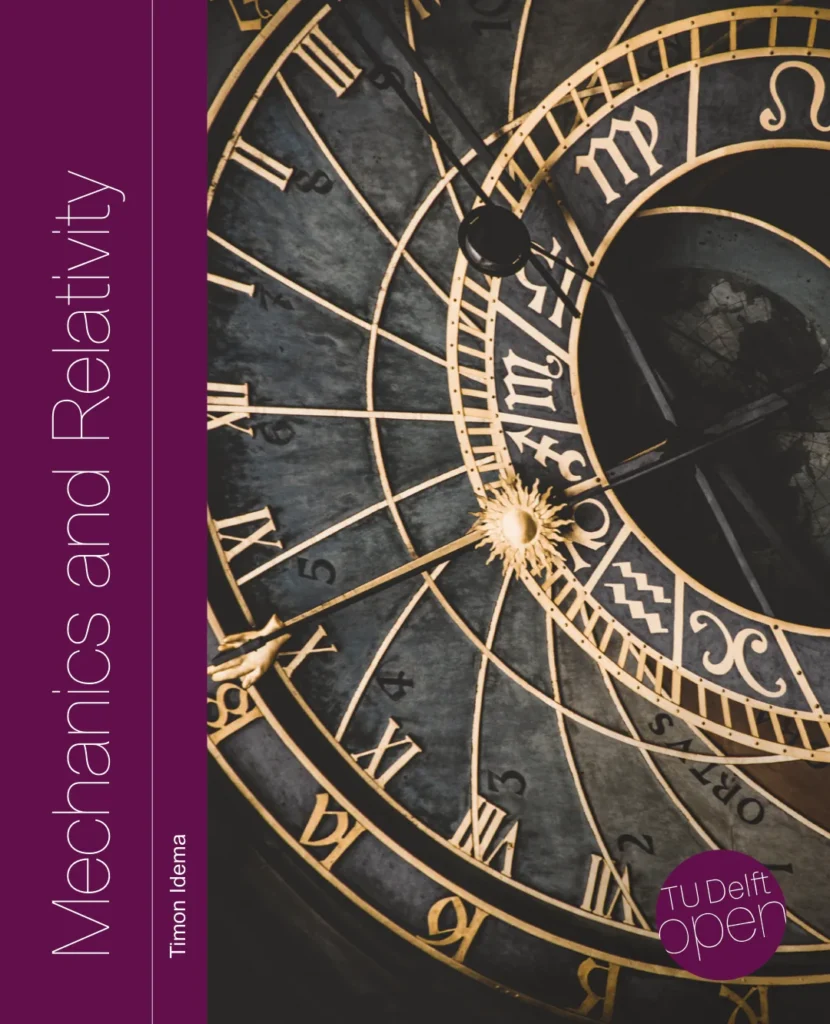
This original reading guide follows the linked source edition’s chapter, module, unit, or lesson structure. Consult the source for full arguments, cases, worked examples, exercises, illustrations, and references. Coverage follows all fifteen chapters, the starred advanced material, and Appendices A–D in the September 17, 2019 PDF. First publication was October 2018; the cover is the original TU Delft edition cover. Read the source edition.
About access & copyright
This page provides book information and study material. Full-text access is provided by the original publisher or authorised source; a listing does not grant permission to republish the book.
Read our Library Access & Copyright policyExplore the contents
Check the chapters covered in this edition.
Visit the official source
See reading, preview or purchase options.
Save for later
Keep this textbook in your saved collection.
Reader ratings & reviews
Share your thoughts
Your review helps other students choose the right resources.



