
COMS 246: Interpersonal Communication
PsychologyTextbook
Introduction to Psychology (First Canadian Edition)
Not rated yetRate this bookIntroduction to Psychology, first Canadian edition, by Charles Stangor and Jennifer Walinga surveys the scientific study of behaviour and mental processes across sixteen chapters. Biological, cognitive, developmental, social, and clinical perspectives offer different levels of explanation. Read by asking what evidence supports a claim, how it was obtained, and which alternative explanation remains possible. The guide connects concepts with examples and study tasks. Clinical terminology and research examples reflect the source edition; contemporary professional applications require current standards and evidence beyond this introductory text.
Read on the publisher’s website. Opens in a new tab.
 Free
About this book
Introduction to Psychology, first Canadian edition, by Charles Stangor and Jennifer Walinga surveys the scientific study of behaviour and mental processes across sixteen chapters. Biological, cognitive, developmental, social, and clinical perspectives offer different levels of explanation. Read by asking what evidence supports a claim, how it was obtained, and which alternative explanation remains possible. The guide connects concepts with examples and study tasks. Clinical terminology and research examples reflect the source edition; contemporary professional applications require current standards and evidence beyond this introductory text.
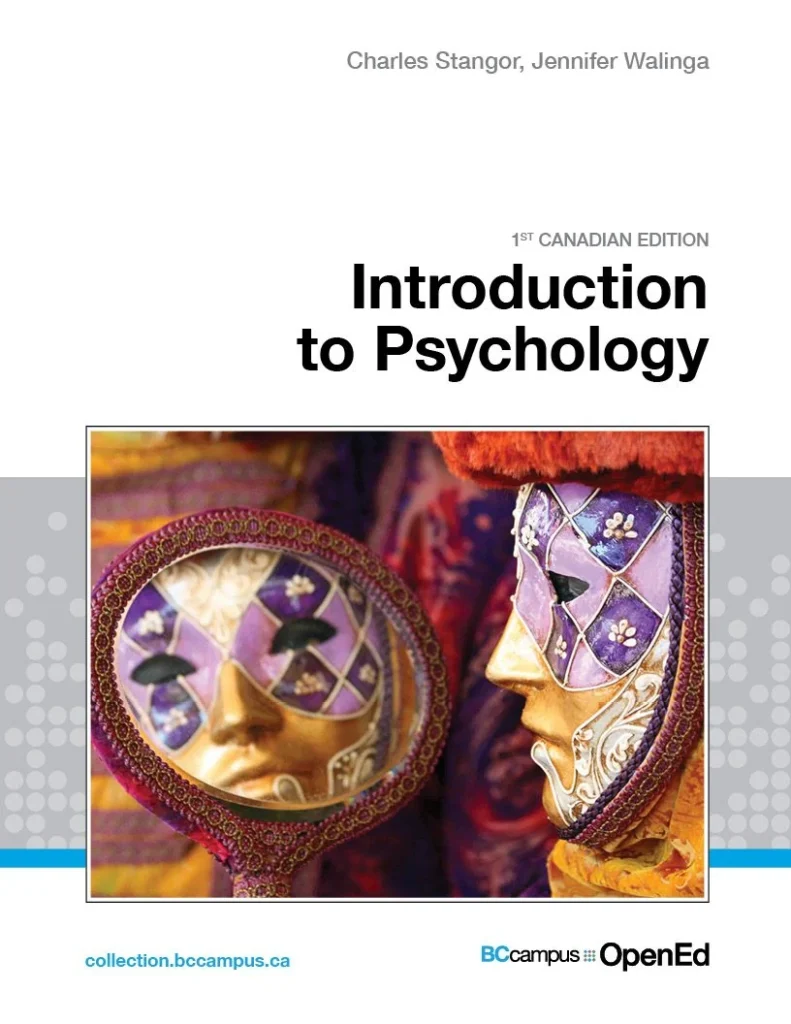
Cover: source-edition cover, displayed to identify the linked book. Publisher and third-party rights remain with their respective holders.
Book summary
Introduction to Psychology, first Canadian edition, by Charles Stangor and Jennifer Walinga surveys the scientific study of behaviour and mental processes across sixteen chapters. Biological, cognitive, developmental, social, and clinical perspectives offer different levels of explanation. Read by asking what evidence supports a claim, how it was obtained, and which alternative explanation remains possible. The guide connects concepts with examples and study tasks. Clinical terminology and research examples reflect the source edition; contemporary professional applications require current standards and evidence beyond this introductory text.
Chapter-by-chapter summaries
1. Introducing psychology
Psychology turns questions about behaviour and experience into systematically investigated problems. Its history helps explain the coexistence of different perspectives and research practices. Distinguish a scientific claim from an anecdote by identifying observations that could challenge it. Rewrite an everyday claim as a testable question, specifying an outcome and a comparison. Familiar wording does not automatically provide a precise measure. The chapter also introduces the diversity of work undertaken by psychologists.
2. Major perspectives
Biological, cognitive, behavioural, developmental, and social perspectives emphasize different mechanisms and contexts. A memory difficulty may involve neural processes, attention, learning strategies, and situational demands. Compare perspectives on one example and state the evidence each would seek. Not every difference requires one explanation to replace all the others. Avoid a label that restates behaviour without explaining it. A productive perspective generates questions and predictions rather than merely renaming the phenomenon.
3. Psychological science
Experiments, correlations, and descriptive studies support different conclusions. Operational definitions connect constructs with procedures; reliability and validity assess different features of measurement. Random assignment differs from random sampling, and association does not automatically establish causation. Identify sample, variables, comparison, and potential confounds in a reported finding. Ethics shapes both what can be studied and how participants are treated. Evaluate a conclusion against the actual design rather than the confidence of its presentation.
4. Brains, bodies, and behaviour
Neurons, communication, brain systems, and bodily regulation provide biological foundations. Research methods reveal different kinds of structural and functional information. A region’s involvement in a task does not place the entire experience in that region alone. Trace sensory information toward a response while identifying interacting systems. A physiological account can complement explanations involving goals, history, and social context. Keep the level of evidence clear when moving from a neural observation to a claim about behaviour.
5. Sensing and perceiving
Sensation concerns receiving physical stimulation, while perception organizes information into meaningful experience. Thresholds, adaptation, attention, and interpretation make processing selective and constructive. Illusions reveal regularities rather than proving the senses useless. Compare stimulus and judgment in an example, then identify contextual cues and how their effects could be measured. This distinction helps explain why confidence is not a guarantee of perceptual accuracy and why everyday experience may conceal the processing that produces it.
6. States of consciousness
Waking attention, sleep, dreaming, and altered states connect subjective experience with physiological organization. Rhythms and sleep processes affect everyday functioning, while substances and other influences can change awareness. Separate reports of experience from the methods used to investigate them. For a sleep claim, identify the measured outcome and comparison. The material is an introduction to concepts and evidence, not a diagnostic instrument or a basis for recommending substance use.
7. Growing and developing
Biological, cognitive, emotional, and social changes interact across life. Stage theories organize patterns but must accommodate variation across individuals and populations. Age-group differences can reflect cohort experiences as well as developmental processes. Compare longitudinal and cross-sectional approaches to one question. Describe mechanisms and contexts rather than treating an average timetable as a fixed standard. The chapter encourages explanations of how change occurs, not merely lists of abilities associated with successive ages.
8. Learning
Classical conditioning, operant conditioning, and observation describe different routes from experience to changed behaviour. Reinforcement is defined by an increase in the relevant behaviour, not by whether a consequence seems pleasant. Negative reinforcement differs from punishment. Identify stimuli, responses, consequences, and change across repeated occasions in a concrete example. Then test whether learning transfers to another setting. The relationships among events explain learning more precisely than the fact that two events occurred close together.
9. Remembering and judging
Encoding, storage, and retrieval are influenced by attention and interpretation. Reconstructive memory can be vivid without being accurate. Judgment shortcuts simplify decisions but sometimes produce systematic errors. Distinguish recognition from recall and immediate fluency from durable retention. Use retrieval practice to assess study instead of relying on familiarity during rereading. For a bias, state the judgment and the information a better alternative requires; simply naming a bias does not show that it explains a particular decision.
10. Intelligence and language
Intelligence research concerns abilities, measurement, prediction, and the interpretation of differences. Reliable scores do not settle every question about meaning or fairness. Language research examines structure, acquisition, and relations with thought. Compare a construct with the task measuring it and consider both environmental and biological contributions. Claims about groups require attention to sampling and context. Distinguish prediction from explanation: a score can forecast an outcome without identifying the complete process responsible for it.
11. Emotions and motivations
Emotion involves physiology, interpretation, expression, and action tendencies, while motivation directs and sustains activity. Theories assign different roles to arousal and appraisal. Analyze an episode by separating trigger, bodily response, meaning, and action. Consider how an alternative appraisal could alter the response. Needs and goals operate in social conditions, so a single instinct label rarely supplies a complete explanation. Look for interactions among components and specify the evidence for their proposed ordering.
12. Personality
Relatively enduring patterns can be described through traits or explained through motives, learning, processes, and personal meanings. A descriptive trait may predict behaviour without explaining its origin. Compare self-report, observation, and other assessment approaches for the same characteristic. Situations affect expression, so consistency does not require identical behaviour everywhere. Evaluate a personality account through evidence and measurement rather than its apparent personal resonance. Familiar descriptions can feel accurate even when they are too broad to distinguish people usefully.
13. Defining psychological disorders
Classification organizes patterns of distress and impairment, but judgment also involves context and individual circumstances. A diagnostic label is not a complete causal explanation. Compare the practical benefits of classification with risks of stigma and oversimplification. Keep a category distinct from the evidence required to apply it. Source-era terms may require historical reading. This chapter supports educational understanding and should not be used as a checklist for self-diagnosis or as a substitute for a qualified assessment.
14. Treating psychological disorders
Psychological and biomedical treatments differ in mechanisms and procedures, and effectiveness requires suitable outcome and comparison evidence. Improvement over time does not alone establish that a particular technique caused it. Compare assumptions, intended mechanisms, follow-up, and fit with the problem. Identify what a fair evaluation would measure. The chapter introduces treatment concepts; individual decisions require professional assessment and current evidence, especially where source-era recommendations or categories have since changed.
15. Psychology in social life
Attitudes, conformity, relationships, prejudice, and group processes show the influence of other people and expectations. Situational effects do not erase individual differences. Analyze demonstrations through manipulation, response, and competing explanations. Do not convert one laboratory finding into an unrestricted claim about all cultures or periods. Apply a concept to a group decision and identify evidence that its mechanism operated. Social explanations become stronger when the observed context is specified rather than assumed.
16. Stress, health, and coping
Demands, appraisal, physiology, resources, and coping interact. Consequences vary with duration, controllability, support, and meaning. A strategy’s usefulness depends on the problem and time horizon rather than a universal good-or-bad classification. Map one episode from demand through appraisal to response and outcome. Distinguish association with health from proof of one causal pathway. Keep personal coping connected with wider conditions that create demands or constrain available resources.
Study instructions
- Create concept-example-evidence cards, including an alternative explanation for major claims.
- Use delayed retrieval practice and revisit errors rather than only rereading.
- For studies, record design, variables, sample, finding, and strongest justified conclusion.
- Integrate biological, cognitive, developmental, and social explanations in a final case analysis.
Questions for reflection
- Can a reliable measure still miss its intended construct?
- How does negative reinforcement differ from punishment?
- When does a label describe behaviour without explaining it?
Sources and coverage
This original reading guide covers the linked edition’s main chapters, or the principal sections of its two-chapter calculus text. Consult the source for full arguments, cases, worked examples, exercises, illustrations, and references. First Canadian edition by Charles Stangor and Jennifer Walinga. Clinical categories and examples reflect that edition; this is educational material, not individual assessment or treatment guidance. Read the source edition.
About access & copyright
This page provides book information and study material. Full-text access is provided by the original publisher or authorised source; a listing does not grant permission to republish the book.
Read our Library Access & Copyright policyExplore the contents
Check the chapters covered in this edition.
Visit the official source
See reading, preview or purchase options.
Save for later
Keep this textbook in your saved collection.
Reader ratings & reviews
Share your thoughts
Your review helps other students choose the right resources.



