
Principles of Political Economy
Political ScienceTextbook
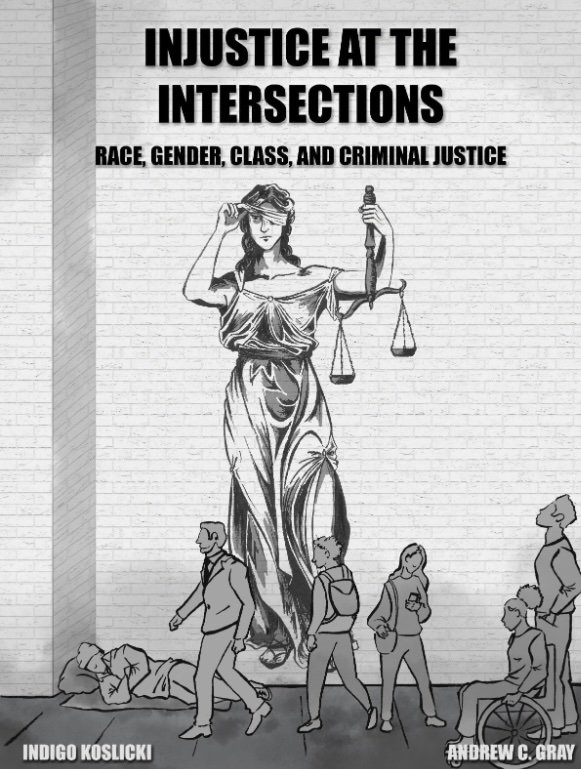
Injustice at the Intersections: Race, Gender, Class, and Criminal Justice
Not rated yetRate this bookA criminal justice textbook by Indigo Koslicki and Andrew C. Gray examining race, gender, class, and the relationships between social inequality and United States justice institutions.
Free reading is available at the official source. Opens in a new tab.
 Free
About this book
About this book
A criminal justice textbook by Indigo Koslicki and Andrew C. Gray examining race, gender, class, and the relationships between social inequality and United States justice institutions.
This page introduces the source edition and offers a focused reading route. Use the linked original resource for the complete text, references, activities, and the author’s full explanation. The overview below is limited to the sections identified in the coverage note.
Contents and further reading
Consult the official book or repository page for the resource’s contents and publication information. Open the source PDF to read the complete available edition.
Sources and coverage
This original overview is based on Chapter 1’s introduction (PDF sheet 7), with the 2026 title, copyright, contents, and official download checked. It is not a whole-book review. The verified source PDF contains 195 PDF sheets, including preliminary or repository pages; this may differ from its printed pagination. The source retains its own authorship, rights notices, and any separately credited third-party material.
Book summary
Study overview
The reviewed chapter opening establishes race, gender, and socioeconomic class as interconnected concepts rather than isolated topics. It explains why a working knowledge of these concepts matters when examining treatment within the criminal justice system and related social institutions. The authors encourage readers to examine inherited assumptions and compare them with historical and social-scientific evidence. They also distinguish evaluating policies and their outcomes from attacking an individual’s character. The opening acknowledges that the subject necessarily involves political questions, while explaining that the book does not advocate a political party. This overview describes that stated approach; it does not independently validate every later policy claim. The linked source is the verified 2026 edition of this title, not the authors’ separate introductory criminal justice book.
How to study this book
Define the terms used in an assigned passage before evaluating its argument. Identify the policy, institution, population, and outcome being discussed. Keep a note of whether a claim rests on a historical document, a quantitative study, or an interpretation. Ask how more than one social category may shape the situation without assuming the same experience for every person in a group. In discussion, address the quality of the evidence and the reasoning connecting it to a conclusion. Record an alternative explanation and the further information that would help distinguish between interpretations.
These study suggestions and the questions below are independent Academic Master editorial guidance.
Questions for reflection
- How do the concepts interact in the example you are studying?
- Which evidence supports the claimed policy outcome?
- What would make an alternative interpretation more or less persuasive?
About access & copyright
This page provides book information and study material. Full-text access is provided by the original publisher or authorised source; a listing does not grant permission to republish the book.
Read our Library Access & Copyright policyIntersections
Examine relationships between social categories.
Evidence
Distinguish assumptions from supported explanations.
Policy analysis
Evaluate outcomes and reasoning with identifiable sources.
Edition identity
This page links the correct 2026 book.
Reader ratings & reviews
Share your thoughts
Your review helps other students choose the right resources.
KEEP LEARNING
Your next great read
Economics
Trauma-Informed School Practices: Building Expertise To Transform Schools
Trauma-Informed School Practices: Building Expertise To Transform Schools
View Trauma-Informed School Practices: Building Expertise To Transform Schools — bookA Quick Guide to Quantitative Research in the Social Sciences
A Quick Guide to Quantitative Research in the Social Sciences
View A Quick Guide to Quantitative Research in the Social Sciences — bookExplorations: An Open Invitation To Biological Anthropology
Explorations: An Open Invitation To Biological Anthropology
View Explorations: An Open Invitation To Biological Anthropology — bookDigging into Archaeology: A Brief OER Introduction to Archaeology with Activities
Digging into Archaeology: A Brief OER Introduction to Archaeology with Activities
View Digging into Archaeology: A Brief OER Introduction to Archaeology with Activities — bookPrinciples of Social Psychology
Principles of Social Psychology
View Principles of Social Psychology — bookClimate Lessons: Environmental, Social, Local
Climate Lessons: Environmental, Social, Local
View Climate Lessons: Environmental, Social, Local — bookKnowing Home: Braiding Indigenous Science with Western Science
Knowing Home: Braiding Indigenous Science with Western Science
View Knowing Home: Braiding Indigenous Science with Western Science — bookIntroduction to Sustainability
Introduction to Sustainability
View Introduction to Sustainability — book Humanities



