
 Medicine
Textbook
Health Case Studies
Toward Closing the Healthcare Communication Gap
Not rated yetRate this bookHealth Case Studies by Glynda Rees, Rob Kruger, and Janet Morrison uses eight patient narratives to examine clinical reasoning and interprofessional communication. The cases follow people through homes, emergency departments, wards, procedures, and transitions in care. Conditions matter, but the patients’ relationships, resources, and experiences are equally important to understanding events. This guide follows the attached edition, including its case-specific learning objectives and narrative endpoints. It is a discussion resource for analyzing the published scenarios, whose clinical actions reflect their publication context rather than a statement that every depicted practice should be repeated today.
 Free
About this book
Health Case Studies by Glynda Rees, Rob Kruger, and Janet Morrison uses eight patient narratives to examine clinical reasoning and interprofessional communication. The cases follow people through homes, emergency departments, wards, procedures, and transitions in care. Conditions matter, but the patients’ relationships, resources, and experiences are equally important to understanding events. This guide follows the attached edition, including its case-specific learning objectives and narrative endpoints. It is a discussion resource for analyzing the published scenarios, whose clinical actions reflect their publication context rather than a statement that every depicted practice should be repeated today.
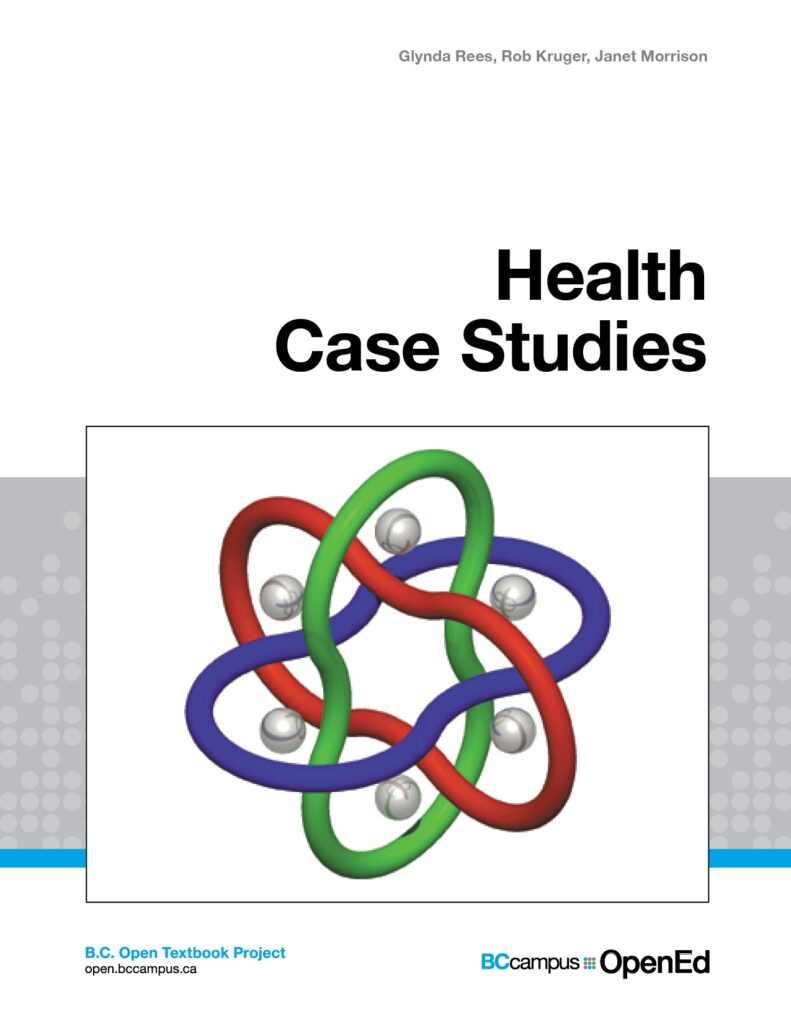
Health Case Studies — Glynda Rees, Rob Kruger, Janet Morrison. This book is released under a Creative Commons Attribution-ShareAlike 4.0 International (CC BY-SA 4.0) license. This means that you are free to copy, redistribute, and modify or adapt this book. Under this license, anyone who redistributes or modifies this resource, in whole or in part, can do so for free providing they properly attribute the book as follows:Health Case Studies by Glynda Rees, Rob Kruger, and Jane Morrison is used under a CC BY-SA 4.0 International License, except where otherwise noted.Additionally, if you redistribute this resource, in whole or in part, in either a print or digital format, then you must retain on every electronic page and at least one page at the front of a print copy the following attribution: Download this book for free at http://open.bccampus.caThis book can be referenced (APA) as follows:Rees, G., Kruger, R., Morrison, J. (2017). Health case studies. Victoria, BC: BCcampus.The image for the resource cover shows Molecular Borromean rings. This illustration was chosen to depict the interconnectedness of all members of the healthcare team, the patient, and the contexts surrounding the patient on their journey through the healthcare system.Cover image attribution: Schematic of a molecular Borromean ring was originally uploaded by 718 Bot at en.wikipedia, created by Armando-Martin, and used under a CC BY 2.5 license.For questions regarding this license or to learn more about BCcampus Open Education, please contact open@bccampus.ca.
Original publication · CC BY-SA 4.0
The following titles follow the attached PDF.
Book summary
Health Case Studies by Glynda Rees, Rob Kruger, and Janet Morrison uses eight patient narratives to examine clinical reasoning and interprofessional communication. The cases follow people through homes, emergency departments, wards, procedures, and transitions in care. Conditions matter, but the patients’ relationships, resources, and experiences are equally important to understanding events. This guide follows the attached edition, including its case-specific learning objectives and narrative endpoints. It is a discussion resource for analyzing the published scenarios, whose clinical actions reflect their publication context rather than a statement that every depicted practice should be repeated today.
Case-by-case summaries
1. Chronic Obstructive Pulmonary Disease: Erin Johns
Erin’s situation combines respiratory difficulty with ageing, family support, and challenges accessing primary care and medication. The case moves from home to emergency care, giving learners a chance to compare the patient’s experience with the information clinicians need. Her background prevents the respiratory problem from becoming a diagnosis detached from daily life. Build a timeline of changes, responses, and communicated information. Ask how transport, follow-up, and support affect the encounter. The analytical focus is recognizing meaningful cues and understanding how the team combines them, rather than diagnosing from a single symptom.
2. Pneumonia: Erin Johns
The longer second case revisits Erin and follows her from home through emergency assessment, several ward days, and discharge. Reassessment and continuity become more visible because the narrative extends across shifts and settings. Clinical improvement must be interpreted alongside the patient’s understanding of the plan and capacity to manage after leaving hospital. Compare the early concerns with the final discharge conversation, including the involvement of her son. Identify what information is repeated, updated, or at risk of being lost. The case shows how a successful transition requires coordinated explanation as well as changes in clinical findings.
3. Unstable Angina: Harj Singh
Harj’s chest-pain narrative places an acute cardiac concern within work stress, family relationships, smoking, and access to ongoing care. The emergency encounter involves medical, laboratory, and imaging contributions, illustrating how different professions develop a shared understanding. Distinguish risk factors from evidence about the immediate event; one does not automatically establish the other. Track the questions, observations, and tests presented in the case and explain how each changes the team’s reasoning. Discuss how the patient’s and partner’s perspectives can improve the assessment without allowing assumptions about lifestyle to replace careful evaluation.
4. Heart Failure: Meryl Smith
Meryl becomes unwell while shopping with her partner, Dorothy, and the narrative continues through emergency and ward care. A previous cardiac history and recent illness provide context, while later deterioration demonstrates the importance of reassessment during hospitalization. The family structure also invites reflection on inclusive communication and assumptions about who counts as family. Compare the observations at admission with the later night-time change and identify the information the team must reconcile. The case resists the idea that admission creates a stable problem: care requires continued attention to new findings and the patient’s experience.
5. Motor Vehicle Collision: Aaron Knoll
Aaron’s trauma case follows a collision through scene response, emergency care, surgery, recovery, and the ward. Multiple handovers make coordination, neurological observation, and family communication central. His girlfriend’s outcome is deliberately left unresolved, so readers should not invent a reassuring or tragic conclusion. The ward conversation shows how uncertainty remains meaningful even as physical care progresses. Map the professional roles and the information that must remain accurate across transitions. Then discuss how a clinician can acknowledge distress and uncertainty while continuing to explain the patient’s immediate care.
6. Sepsis: George Thomas
George becomes acutely unresponsive in his care facility and moves into hospital care. The scenario connects infection, comorbidity, recognition of change, and communication across institutions. Later discussion involves his family, social work, nursing, rehabilitation, and medical staff as they consider his progress and future care. Compare the urgent initial response with the subsequent family meeting: the questions and decisions are related but different. Evaluate whether George’s preferences are clearly represented and distinguish a discharge plan from assumptions about goals of care. The case provides material for examining both clinical coordination and shared decision-making.
7. Colon Cancer: Fred Johnson
Fred’s narrative begins with symptoms he has found difficult to disclose and follows the pathway toward surgical treatment and postoperative care. His relationship with Eric, family history, and upcoming wedding give the illness personal stakes that a procedure-focused account would miss. The case highlights collaboration among surgery, nursing, and social work while inviting attention to dignity and culturally responsive communication. Create two parallel timelines: clinical events and concerns important to Fred. Identify where a conversation could connect them. The published endpoint should be respected rather than extended into an invented long-term outcome.
8. Deep Vein Thrombosis: Jamie Douglas
Jamie develops leg symptoms after surgery for laryngeal cancer and communicates using a whiteboard. The narrative makes communication access a clinical issue: difficulty speaking does not mean an absence of information, preferences, or urgency. Nursing, diagnostic services, and medical staff contribute to the evolving assessment. Examine the case’s sequence critically, distinguishing what the text depicts from what current approved practice requires; do not turn a historical examination maneuver into a self-test. The final case reinforces the book’s larger theme that accurate information and coordinated professional roles are essential to understanding a patient’s changing situation.
Study instructions
- Read each case in stages and pause before the next setting or day. List the known facts, unanswered questions, and information you expect a handover to contain.
- Construct a patient timeline and a separate team-role map. At each transition, identify who has new information and who needs to receive it.
- Use the learning objectives to select an analysis question. Support your answer with specific events rather than general statements about a diagnosis.
- Compare the published clinical actions with current instructor-approved guidance during a facilitated discussion. Clearly label historical depiction and present teaching expectations.
- Debrief each case from the patient’s perspective: communication access, family inclusion, uncertainty, resources, and goals. Do not invent outcomes beyond the narrative.
Questions for reflection
- Where does a handover preserve understanding, and where could important context be lost?
- How do Erin’s everyday circumstances affect the meaning of discharge planning?
- What is the effect of leaving Aaron’s girlfriend’s outcome unresolved?
- How does Jamie’s whiteboard change what responsive communication requires from the team?
Sources and coverage
This original study guide follows all main chapters of the source edition linked below. Summaries explain the central concepts and their connections; practice tasks and reflection questions are editorial study aids. Consult the complete text for worked examples, figures, exercises, and references. The cases depict care in their publication context. Use current approved guidance to evaluate clinical actions; these summaries are not treatment protocols. Read the source edition.
About access & copyright
Check this edition’s source and licence before reusing its files or content. A library listing does not grant additional rights.
Read our Library Access & Copyright policyPatient narratives
Follow health events through a patient’s story.
Learning objectives
Connect each case with its educational goals.
Communication
Examine the information shared during care.
Case comparison
Compare eight distinct clinical learning scenarios.
Reader ratings & reviews
Share your thoughts
Your review helps other students choose the right resources.
KEEP LEARNING
Your next great read
Medicine Medicine
Public Health Ethics: Cases Spanning the Globe
View Public Health Ethics: Cases Spanning the Globe — book Medicine
Cell Biology, Genetics, and Biochemistry for Pre-Clinical Students
View Cell Biology, Genetics, and Biochemistry for Pre-Clinical Students — book Medicine
Applying the International Classification of Functioning, Disability & Health: A Team-Based/Project Based Course for Undergraduate Students
View Applying the International Classification of Functioning, Disability & Health: A Team-Based/Project Based Course for Undergraduate Students — book Medicine
Urinalysis Atlas: A Pictorial Guide to Formed Elements in Urine (Doty and Taylor)
View Urinalysis Atlas: A Pictorial Guide to Formed Elements in Urine (Doty and Taylor) — book Medicine
Drug Use and Misuse: A Community Health Perspective
View Drug Use and Misuse: A Community Health Perspective — book Medicine
Neuroscience for Pre-Clinical Students
View Neuroscience for Pre-Clinical Students — book Medicine
Cardiovascular Pathophysiology for Pre-Clinical Students
View Cardiovascular Pathophysiology for Pre-Clinical Students — book Medicine
Pulmonary Physiology for Pre-Clinical Students
View Pulmonary Physiology for Pre-Clinical Students — book Medicine



