
A Guide to Learning System Dynamics
ManagementTextbook
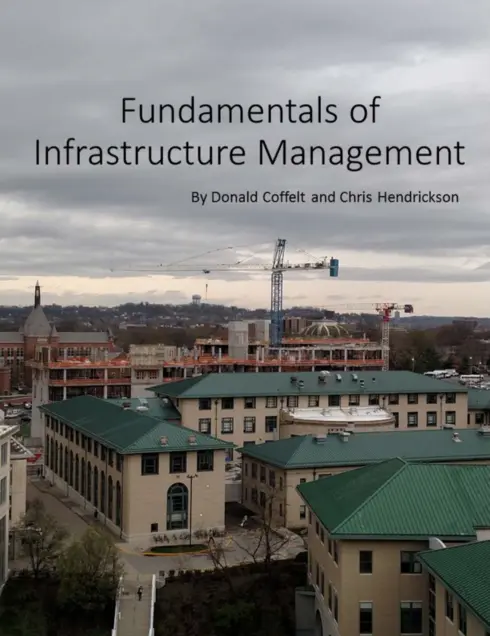
Fundamentals of Infrastructure Management
Not rated yetRate this bookFundamentals of Infrastructure Management by Donald Coffelt and Chris Hendrickson connects asset inventories and condition assessment with maintenance, investment, resilience, contracts, and sector-specific management. This guide follows the sixteen chapter entries in the LibreTexts export while flagging its empty benchmarking chapter.
Free reading is available at the official source. Opens in a new tab.
 Free
About this book
Fundamentals of Infrastructure Management by Donald Coffelt and Chris Hendrickson connects asset inventories and condition assessment with maintenance, investment, resilience, contracts, and sector-specific management. This guide follows the sixteen chapter entries in the LibreTexts export while flagging its empty benchmarking chapter.
How to study this book
Use a fictional asset portfolio and distinguish physical condition, service performance, risk, and cost. Record inspection dates, assumptions, uncertainty, and the planning horizon. Compare maintenance or investment options on a consistent basis and identify responsibilities as well as calculations. Treat historical sector descriptions as context rather than current inventory data.
Chapter-wise explanations and study tasks
Chapter 1 — Infrastructure
The opening defines the scope and importance of infrastructure management. Assets support services over time, so management decisions involve more than initial construction.
Study task: Define a small asset portfolio and identify the service outcomes it is meant to support.
Chapter 2 — Asset Management Process
Asset management connects information, objectives, planning, and action. A useful process makes decisions traceable to evidence rather than producing an inventory without a management purpose.
Study task: Draw a decision cycle from asset information to intervention and subsequent performance review.
Chapter 3 — Inventory, Inspection, and Condition
An inventory identifies what exists, while inspection and condition assessment describe observed state. Consistent definitions and repeatable methods matter when comparing assets or tracking deterioration.
Study task: Design a short inspection record and distinguish an observation from an inferred condition rating.
Chapter 4 — Deterioration Modeling
Forecasting methods include regression, Markov models, neural-network approaches, failure probabilities, and fault trees. Match the model to the available data and the management question rather than choosing complexity for its own sake.
Study task: Compare two deterioration models for a fictional asset and state the evidence needed to assess their predictions.
Chapter 5 — Optimization and Decisions
Linear, integer, nonlinear, and deterioration-linked optimization organize constrained choices. A mathematical optimum remains conditional on the objective, constraints, and model inputs.
Study task: Formulate a small maintenance-allocation problem and explain the consequence of changing its objective.
Chapter 6 — Performance, Usage, and Costs
Usage patterns, budgets, lifecycle costs, financing, and uncertainty shape intervention choices. Keep short-run operating decisions separate from long-run investment analysis.
Study task: Compare two lifecycle options using a common horizon and test one uncertain cost or demand assumption.
Chapter 7 — Interdependence and Resilience
Infrastructure systems depend on one another, and failures can propagate. Resilience, security, and emergency preparation require a system view rather than isolated asset condition alone.
Study task: Map a small dependency chain and identify an intervention that could reduce service disruption.
Chapter 8 — Contracts and Workflow
Contract management and workflow connect technical decisions with execution. Responsibilities, sequence, information, and completion checks affect whether an intervention achieves its purpose.
Study task: Create a maintenance-workflow diagram with ownership and an acceptance check at each critical handoff.
Chapter 9 — Commissioning
Testing, documentation, and integration connect a new facility with ongoing management. Completion of construction does not by itself establish readiness for reliable operation.
Study task: Prepare a commissioning checklist that includes testing evidence, records, and entry into the asset-management system.
Chapter 10 — Benchmarking: Empty Source Sections
The export lists Benchmarking and Best Practices but its Sections 10.1–10.6 contain headings and attribution rather than substantive instruction. This guide does not invent a source-based benchmarking method.
Study task: List the benchmarking questions your portfolio raises and document a supplementary source before developing the method.
Chapter 11 — Roadways
Roadway management combines physical extent, institutional arrangements, and sector-specific service issues. Roads may also provide access or space for other infrastructure, creating shared consequences.
Study task: Define a roadway intervention and identify affected services beyond the pavement itself.
Chapter 12 — Buildings
Building infrastructure involves long-lived physical systems, organizational responsibilities, and management issues across use and maintenance. Distinguish the building’s condition from the service experienced by occupants.
Study task: Compare a condition measure with a user-service measure and explain why they may point to different priorities.
Chapter 13 — Water
Water infrastructure requires attention to the network, institutions, and continuity of service. A local asset decision can affect a connected system rather than only the asset being repaired.
Study task: Map a fictional water-service asset and identify the upstream and downstream consequences of an outage.
Chapter 14 — Telecommunications
Telecommunications management combines network infrastructure with organizational and service requirements. Technology and network dependencies affect how physical assets are evaluated.
Study task: Create a service-dependency diagram and explain why an apparently minor component might be critical.
Chapter 15 — Electricity Infrastructure
Generation, transmission, and distribution form linked parts of electricity provision. Management priorities depend on system role and service consequences as well as physical condition.
Study task: Compare the management questions for one asset at each of the three system stages.
Chapter 16 — Bases, Campuses, Parks, and Ports
These portfolios combine multiple asset types and services within a shared organizational or geographic setting. Coordination and institutional arrangements become central to prioritization.
Study task: Develop a small campus or port asset map and identify a cross-system maintenance conflict.
Applied assignment
Create a fictional infrastructure-management plan with an inventory, inspection method, deterioration forecast, constrained intervention choice, lifecycle comparison, dependency map, and implementation workflow. Include a commissioning handover for one new asset. Mark the empty benchmarking chapter and any additional methods taken from separately identified sources.
Suggested reading plan
Read Chapters 1–3 to establish the information base, 4–6 for prediction and decisions, and 7–9 for system resilience and implementation. Treat Chapter 10 as a documented source gap, then compare the sector applications in Chapters 11–16 against the same portfolio framework.
Questions for reflection
- Does the proposed condition measure support the decision being made?
- Which dependency could change an apparently sensible asset priority?
- What information should be collected now to improve the next planning cycle?
Edition and source notes
The source identifies Coffelt and Hendrickson’s 2017 textbook and its DOI. The LibreTexts export has sixteen chapter entries, but Chapter 10 contains six empty template sections; stray template material also appears elsewhere. This guide covers developed material and identifies the main gap rather than presenting the export as uniformly complete.
About access & copyright
This page provides book information and study material. Full-text access is provided by the original publisher or authorised source; a listing does not grant permission to republish the book.
Read our Library Access & Copyright policyExplore the contents
Check the chapters covered in this edition.
Visit the official source
See reading, preview or purchase options.
Save for later
Keep this textbook in your saved collection.
Reader ratings & reviews
Share your thoughts
Your review helps other students choose the right resources.
KEEP LEARNING
Your next great read
Business
 Management
Organizational Behavior
View Organizational Behavior — book Management
Principles of Strategic Management
View Principles of Strategic Management — book Business
 Fundamentals for the Golf & Club Industry - Canadian Edition
View Business Fundamentals for the Golf & Club Industry - Canadian Edition — book Basic models of the enterprise
Management in a Dynamic Environment
View Management in a Dynamic Environment — book capsular
Principles of Hip Arthroscopy
View Principles of Hip Arthroscopy — book Business
Exploring Business
View Exploring Business — book Business
Project Management from Simple to Complex
View Project Management from Simple to Complex — book Business
Principles of Management
View Principles of Management — book Business



