
 Physics
Textbook
Foundations of Physics
Not rated yetRate this bookTerrance Berg’s Foundations of Physics develops quantitative problem solving through mechanics, waves, heat, gravitation, electrostatics, and circuits. This guide follows the 2023 BCcampus edition’s twenty-three topics and trigonometric appendix, emphasizing diagrams, assumptions, units, and independent checks.
Free reading is available at the official source. Opens in a new tab.
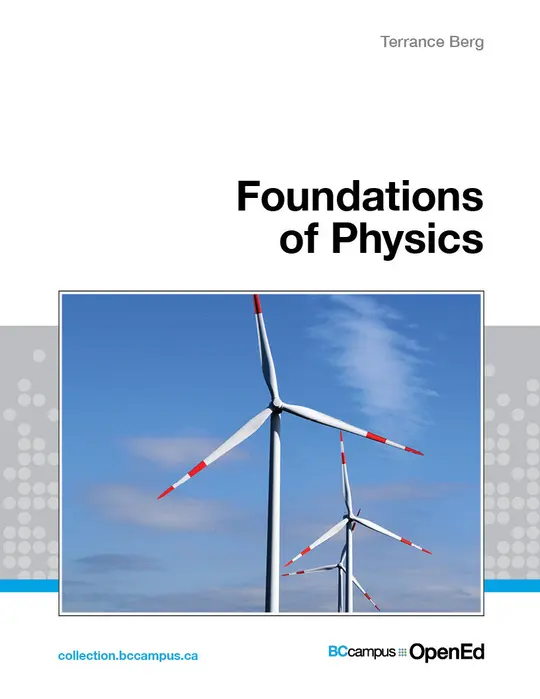 Free
About this book
Terrance Berg’s Foundations of Physics develops quantitative problem solving through mechanics, waves, heat, gravitation, electrostatics, and circuits. This guide follows the 2023 BCcampus edition’s twenty-three topics and trigonometric appendix, emphasizing diagrams, assumptions, units, and independent checks.
How to study this book
Before calculating, sketch the system, choose axes, identify known and unknown quantities, and state the model assumptions. Predict the sign or approximate size of an answer, then carry units through each step. Attempt worked examples and exercises independently before checking solutions, and explain why a relationship applies rather than selecting it only because its symbols match the data.
Chapter-wise explanations and study tasks
1. Measurement and Solutions
Units, conversions, measured quantities, and organized solution methods establish reliable quantitative reasoning. Conversion factors preserve a quantity while changing its numerical expression, and area or volume conversions need powers of the length factor.
Study task: Complete a multistep unit conversion and a dimensional check, explaining how the units verify the setup before arithmetic.
2. Average Speed and Velocity
Distance and displacement lead to different averages because one records path length and the other net change in position. Direction and the time interval are part of a velocity statement.
Study task: Analyse a fictional out-and-back journey, calculating average speed and average velocity and explaining why they differ.
3. Constant Acceleration and Accelerated Motion
Motion relationships connect position, velocity, acceleration, and elapsed time under a constant-acceleration assumption. Graphs help distinguish an instantaneous value from a change over an interval.
Study task: Solve one hypothetical motion problem and check it with a velocity–time graph, identifying the area and slope interpretations.
4. Vertical Motion
Vertical motion applies signed kinematics with gravitational acceleration under the stated idealization. An object can have zero instantaneous velocity while retaining nonzero acceleration.
Study task: Analyse a thrown object’s ascent and descent using a consistent axis, explaining the signs at launch, peak, and return.
5. Projectile Motion
Horizontal and vertical components share the same time while following different equations in an ideal projectile model. Separating components avoids treating a curved path as constant acceleration along one fixed direction.
Study task: Solve a hypothetical launch problem by components and explain the assumptions about air resistance, height, and acceleration.
6. Mass, Weight and Newton’s Second Law
Mass and gravitational force are distinct quantities, while net force governs acceleration. A free-body diagram identifies forces on one chosen object and prevents unrelated forces from being added together.
Study task: Draw a free-body diagram for a fictional accelerating load and distinguish its mass, weight, applied force, and net force.
7. Equilibrium and Newton’s First Law
Equilibrium connects balanced influences with a state that does not accelerate. Use the source’s force and balance methods with a clearly defined system, and distinguish no acceleration from no motion.
Study task: Resolve forces in a hypothetical supported system, check component balance, and explain how the same balance can coexist with constant velocity.
8. Momentum, Change in Momentum and Impulse
Momentum and impulse connect a force acting over time with a change in motion. Direction and system choice matter, while a force–time graph distinguishes peak force from total impulse.
Study task: Compare two hypothetical force pulses with the same impulse but different peak values and explain the resulting momentum change.
9. Conservation of Momentum
Momentum conservation depends on the external impulse relevant to the selected system. Collisions may conserve momentum without conserving kinetic energy, so the two checks should be kept separate.
Study task: Analyse a one-dimensional fictional collision and compare total momentum and kinetic energy before and after it.
10. Work and Mechanical Energy
Work relates force and displacement, while kinetic and potential energy describe useful contributions to an energy account. A force can act without doing work along a particular displacement.
Study task: Calculate work for a hypothetical motion with several forces and explain which contributions change the object’s kinetic energy.
11. Conservation of Mechanical Energy
Mechanical-energy conservation applies under specified conditions and with an explicit system boundary. Energy transferred by nonconservative interactions requires an expanded account rather than being ignored.
Study task: Solve a fictional height-and-speed problem first without losses, then show how including a stated energy transfer changes the result.
12. Power, Work and Energy
Power describes the rate of energy transfer, not the amount transferred alone. Compare average and instantaneous descriptions where appropriate and distinguish input, useful output, and losses.
Study task: Compare two hypothetical machines doing the same work in different times and construct a labelled energy-and-power account.
13. Friction and Accelerated Motion
Friction models connect contact conditions with force balance and motion. Static friction responds within a limit, while sliding friction uses a different idealization; assuming a limiting value before checking the situation can produce an incorrect equation.
Study task: Analyse a hypothetical block problem by first testing the possible static state, then constructing an accelerating model if that state is not supported.
14. Mechanical Waves
Wave speed, frequency, wavelength, reflection, refraction, sound, and Doppler-related questions connect disturbance propagation with a medium. Motion of the disturbance is different from net transport of the medium’s particles.
Study task: Compare two wave situations, calculate a wavelength or speed, and explain which quantities change or remain connected when the medium or observer changes.
15. Energy and Heat
Thermal questions connect temperature, heat transfer, material properties, and phase changes. Temperature is not the total energy of an object, and a phase transition can involve transfer without a temperature change.
Study task: Construct a hypothetical heating account with a temperature-change stage and a phase-change stage, identifying the different quantities needed.
16. Conservation of Heat Energy
Thermal energy balance applies conservation reasoning to interacting bodies under stated assumptions. A result depends on whether heat exchange with surroundings and energy used in phase change are included.
Study task: Solve a fictional calorimetry problem and check that the proposed equilibrium state is consistent with both the energy balance and the phase assumptions.
17. Gravitational Forces and Fields
Gravitational force depends on source properties and separation, while a field describes force per unit test mass. The near-surface constant-acceleration model is a useful approximation rather than a universal value at every distance.
Study task: Compare force and field strength at two hypothetical separations and explain how each responds to changing the test mass.
18. Centripetal Forces
Centripetal describes the required inward net force for curved motion, not an extra force to add to every diagram. Existing interactions must supply the radial requirement.
Study task: Draw a free-body diagram for a hypothetical circular-motion example and identify which actual force components provide the inward net force.
19. Selected Topics in Astrophysics
Orbital motion, escape-related quantities, gravitational potential, and selected compact-object topics extend mechanics to astronomical scales. State the idealizations and the physical quantity calculated rather than treating similar-looking formulas as interchangeable.
Study task: Compare a hypothetical circular-orbit calculation with an escape-speed calculation and explain why they answer different questions.
20. Electrostatic Fields and Forces
Charge interactions and superposition connect source charges with forces and fields. Field direction is defined through a positive test charge, while the force on a negative charge points oppositely.
Study task: Sketch and calculate the net field at a point for a small hypothetical charge arrangement, then determine how the test charge affects force but not the source field.
21. Uniform Electric Fields
Uniform-field models connect electric force, motion, potential-related quantities, and energy changes under stated conditions. A chosen sign convention must remain consistent across force and energy reasoning.
Study task: Analyse a hypothetical charged particle in a uniform field and compare a force-based prediction with an energy-based check.
22. Current, Ohm’s Law and Power
Current, potential difference, resistance, and power describe different aspects of electrical behaviour. Ohm’s law is a relationship for an appropriate model, not an identity that makes every component’s resistance constant.
Study task: Compare two fictional resistive components, calculate current and power, and check that units and energy-transfer interpretations agree.
23. Electric Circuits
Circuit topology determines shared currents and potential differences in series and parallel arrangements. Draw the actual connections before simplifying, then check consistency at branches and around loops.
Study task: Solve a hypothetical resistor network and verify the result with current balance and a power or energy-transfer check.
Appendix A. Trigonometric Tables
The table supports angle and ratio calculations used across mechanics and waves. A lookup value must match the angle convention and function, while rounded entries limit numerical precision.
Study task: Solve a right-triangle component problem with the table and a calculator, explaining any difference due to rounding.
Applied assignment
Create a physics problem-solving portfolio with one kinematics problem, a force diagram, a momentum comparison, an energy account, a thermal balance, and a circuit analysis. State assumptions, show units, and include an independent graphical, limiting-case, or conservation check for every result.
Suggested reading plan
Use seven blocks: topics 1–5 for measurement and motion; 6–9 for forces and momentum; 10–13 for energy, power, and friction; 14 for waves; 15–16 for heat; 17–19 for gravitation and astrophysics; and 20–23 for electricity. Work mixed exercises after each block and revisit the appendix when resolving components.
Questions for reflection
- Which system and assumptions make the equation applicable?
- Can the sign and scale be predicted before calculating?
- Which independent check would reveal a wrong setup?
Edition and source notes
Based on Terrance Berg’s 2023 BCcampus Foundations of Physics, with twenty-three numbered topics and Appendix A. The guide supplies original explanations and written study activities. Source videos, worked examples, exercise solutions, and diagrams remain in the complete textbook; real electrical or mechanical work requires appropriate instruction and facilities.
About access & copyright
This page provides book information and study material. Full-text access is provided by the original publisher or authorised source; a listing does not grant permission to republish the book.
Read our Library Access & Copyright policyExplore the contents
Check the chapters covered in this edition.
Visit the official source
See reading, preview or purchase options.
Save for later
Keep this textbook in your saved collection.
Reader ratings & reviews
Share your thoughts
Your review helps other students choose the right resources.
KEEP LEARNING
Your next great read
Physics Physics
 9A Lab
View Physics 9A Lab — book Physics
 7C General Physics
View Physics 7C General Physics — book Physics
 7A General Physics
View Physics 7A General Physics — book Physics
Sound - An Interactive eBook
View Sound - An Interactive eBook — bookUCD: Physics 9B Lab
UCD: Physics 9B Lab
View UCD: Physics 9B Lab — bookPhysics 7B General Physics
Physics 7B General Physics
View Physics 7B General Physics — bookUCD: Physics 9C – Electricity and Magnetism
UCD: Physics 9C - Electricity and Magnetism
View UCD: Physics 9C - Electricity and Magnetism — bookBiophysics 241: Membrane Biology
Biophysics 241: Membrane Biology
View Biophysics 241: Membrane Biology — bookDouglas College Physics 1108 Custom Textbook Winter 2021 current



