
Electromagnetics I
PhysicsTextbook
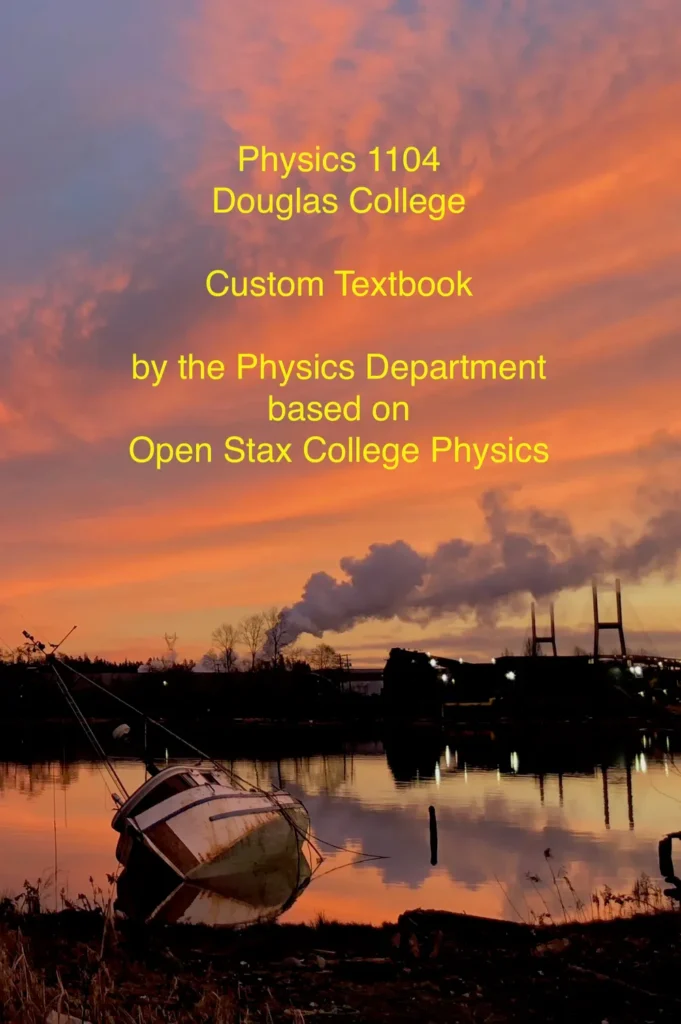
Douglas College Physics 1104 Custom Textbook - Winter and Summer 2020
Not rated yetRate this bookDouglas College Physics 1104 develops practical physical reasoning through fifteen custom chapters, linking mechanics with fluid statics, temperature, heat transfer, and introductory electricity. The source combines OpenStax material with additional measurement, graphing, and mathematical support. This guide follows the linked chapter selection. The catalogue calls the text Winter and Summer 2020, while the downloadable PDF title says Fall 2019 and Winter 2020; those labels differ, but the actual included material determines the coverage below.
Free reading is available at the official source. Opens in a new tab.
 Free
About this book
Douglas College Physics 1104 develops practical physical reasoning through fifteen custom chapters, linking mechanics with fluid statics, temperature, heat transfer, and introductory electricity. The source combines OpenStax material with additional measurement, graphing, and mathematical support. This guide follows the linked chapter selection. The catalogue calls the text Winter and Summer 2020, while the downloadable PDF title says Fall 2019 and Winter 2020; those labels differ, but the actual included material determines the coverage below.
Chapter-wise summaries and study tasks
Chapter 1 The Nature of Science and Physics
The introduction presents physics as a way to build and test quantitative explanations. Measurements need units, uncertainty, and a suitable number of reported digits. Metric prefixes, scientific notation, and conversions allow quantities from different sources to be combined meaningfully. The course adds graphing material to support visual interpretation as well as numerical work.
A graph must identify variables, units, scale, and the relationship being investigated. An apparent straight line can conceal a poor choice of representation or an unjustified extrapolation. Begin a problem by estimating scale and clarifying what is known; then use calculation and graphing as complementary checks. Good numerical formatting cannot rescue a model whose assumptions do not fit the situation.
Study task. Organize fictional measurements in a labeled graph, calculate a slope with units, and explain its physical meaning. Convert one input quantity and check that the interpretation remains unchanged when its numerical representation changes.
Chapter 2 One-Dimensional Kinematics
One-dimensional kinematics describes where an object is and how its motion changes without yet explaining the forces involved. Position, displacement, distance, velocity, speed, and acceleration answer different questions. Coordinate choice fixes signs, while graphs show rates and accumulated changes. Constant-acceleration equations provide useful relationships for the intervals in which that assumption is justified, including idealized free fall.
Returning to a starting point does not make the traveled distance zero, and passing through zero velocity does not establish zero acceleration. Check a calculation against the graph and the story. This keeps the physical motion visible rather than reducing a problem to matching listed numbers with a familiar formula.
Study task. Represent an out-and-back motion with position and velocity graphs. Compare average speed with average velocity, then solve a constant-acceleration interval and explain why the equation should not automatically be extended over the whole trip.
Chapter 3 Two-Dimensional Kinematics
Two-dimensional kinematics uses vectors to describe simultaneous motion along perpendicular axes. Graphical addition emphasizes geometry, while components allow algebraic calculation. Projectile motion combines a horizontal model with a vertical acceleration model through a shared elapsed time. The ideal treatment assumes conditions such as negligible air resistance and an appropriate gravitational field model.
A direction angle must be interpreted relative to the chosen axes and correct quadrant. The magnitude of a vector sum is not generally the sum of its magnitudes. Use a sketch to predict the answer’s direction before calculation and a reconstruction from components afterward. The retained chapter focuses on vector and projectile topics rather than every section of the larger source chapter.
Study task. Add two nonparallel displacement vectors by components and check the result geometrically. Solve a projectile example with a stated launch and landing height, keeping one time variable for both components.
Chapter 4 Dynamics: Force and Newton's Laws of Motion
Dynamics explains acceleration through the net external force on a defined system. The chapter combines Newton’s laws with elastic behavior, normal forces, tension, and practical problem-solving methods. Third-law pairs act on different objects, while a free-body diagram records forces acting on the object being analyzed. Hooke’s law models an elastic restoring interaction within its usable range. The introduction to fundamental forces provides a wider context for everyday interactions.
A force does not have to point along the motion, and motion does not require an unbalanced force to continue at constant velocity. State the system and reference frame before applying a net-force equation. These decisions determine which interactions belong in the analysis.
Study task. Draw separate diagrams for a load and its support, identifying third-law partners across them. Solve a spring or tension problem and explain the conditions under which the assumed force model remains valid.
Chapter 5 Uniform Circular Motion and Gravitation
Circular motion connects an angular description with changing velocity direction and inward acceleration. The required centripetal resultant is supplied by actual forces such as gravity, tension, or contact, so it should not be added as a separate interaction. Rotating observers can use apparent-force descriptions, but those must not be mixed indiscriminately with an inertial-frame diagram. Universal gravitation explains interactions across terrestrial and astronomical settings.
An object can move with constant speed while its velocity changes continuously. Orbital motion is an example of acceleration under gravity, not escape from gravitational influence. Identify whether the path is assumed circular before using relationships that require a fixed radius.
Study task. Analyze a circular path with all real forces labeled and calculate the required inward acceleration. Compare an inertial description with the perspective of a rotating observer, stating where an apparent-force term enters.
Chapter 6 Work, Energy, and Energy Resources
Work and energy describe the consequences of forces through transfers and changes in physical state. Work uses the component of force along displacement, while kinetic energy accounts for motion and potential energy represents suitable conservative interactions. Nonconservative forces can change mechanical energy while total energy remains conserved when other forms are included. Power measures how quickly transfer or work occurs. Human and energy-resource examples distinguish useful mechanical output from broader input.
Choose a system boundary and account for every transfer once. A body can experience a force without that force doing work along its displacement, and an energy calculation can be useful even when the detailed path or timing is not known.
Study task. Build an energy balance for a raised and then released object with a specified dissipative loss. Compare two delivery times for the same work and explain what changes in power without changing the total work.
Chapter 7 Linear Momentum and Collisions
Momentum is a vector quantity whose change is related to impulse. In collisions, the selected system’s total momentum is conserved when external impulse is negligible over the event. Elastic and inelastic collisions differ in whether kinetic energy is conserved under the model. Objects remaining together after an interaction provide a particular inelastic case, not the definition of every inelastic event.
Internal forces can be large while canceling in the total system account. The same event can therefore involve changing momentum for each object and conserved momentum for their combined system. Analyze energy separately instead of inferring it from the success of a momentum equation.
Study task. Solve two one-dimensional collisions with the same initial momentum but different interaction assumptions. Check final momentum and kinetic energy, then explain how a longer stopping interval changes average force for the same impulse.
Chapter 8 Statics and Torque
Equilibrium requires both translational and rotational conditions. Net force determines the motion of the center of mass, while net torque about a suitable point determines rotational change in the rigid-body model. Lever arms depend on perpendicular distance to a force’s line of action, not simply the full length of a component. Stability adds the effect of a small disturbance. Simple machines and muscle–joint applications make these relationships concrete.
A convenient pivot can simplify torque equations while leaving an unknown force necessary in the separate force balance. Static does not mean internally unstressed. State geometry, support assumptions, and the limits of a simplified body model when interpreting a result.
Study task. Analyze a supported beam or simplified limb using both equilibrium conditions. Change the load position and predict the effect before recalculating, explaining why internal support or muscle forces may exceed the applied load.
Chapter 9 Rotational Motion and Angular Momentum
The retained rotational chapter develops angular acceleration, rotational kinematics, torque with rotational inertia, and rotational work and energy. Mass distribution about the chosen axis determines rotational inertia, so equal masses need not respond alike to a torque. Linear and angular descriptions connect through distance from the axis, while a rigid-body assumption coordinates the motion of different points.
The inherited title mentions angular momentum, but the listed selection ends with rotational kinetic energy. Review the actual sections rather than assuming a complete angular-momentum unit is included. Constant-angular-acceleration equations also need their stated condition; they are not universal descriptions of every rotating machine or wheel.
Study task. Compare two rotating objects with equal mass but different distributions about an axis. Calculate a torque-driven acceleration and a change in rotational energy, identifying where constant acceleration or a fixed axis is assumed.
Chapter 10 Fluid Statics - Floating and Sinking
Fluid statics explains density, pressure, depth dependence, pressure transmission, and buoyancy in stationary fluids. Pressure is force per area and acts locally, while the net force on an immersed body follows from pressure differences over its surface. Pascal’s principle supports hydraulic reasoning under appropriate conditions. Archimedes’ principle relates buoyancy to displaced fluid rather than directly to the object’s own weight. Body-pressure examples connect the physics with biological settings.
Floating equilibrium is not the same as absence of gravity or pressure. Compare the object’s total weight with the buoyant effect and distinguish a fully immersed object from one whose displaced volume adjusts as it floats. Gauge and absolute pressure also answer different questions.
Study task. Calculate the displaced-fluid volume required for a floating object of given mass. Compare it with the fully submerged case, then explain how a hydraulic device trades force and displacement while respecting energy accounting.
Chapter 11 Temperature, Kinetic Theory, and the Gas Laws
Temperature, thermal expansion, ideal-gas behavior, and phase changes connect macroscopic observations with material models. Temperature scales require attention to offsets, while gas-law calculations use absolute temperature. Expansion coefficients apply to specified materials and ranges, and the ideal-gas model assumes behavior that can become less suitable near condensation or at conditions where interactions matter strongly.
Heating can change volume, pressure, phase, or temperature depending on constraints and the material. Identify which variables are controlled before selecting a relationship. The chapter provides selected topics rather than every kinetic-theory section from a complete general-physics text, so its practical scope is defined by the retained contents.
Study task. Compare heating a gas at fixed volume with heating it at fixed pressure under an ideal model. Include a thermal-expansion example and explain why a phase change may require a different energy description from a temperature increase.
Chapter 12 Heat and Heat Transfer Methods
Heat transfer concerns energy moving because of thermal conditions rather than a material substance stored as heat. Heat capacity describes temperature change within a phase, while latent heat accounts for phase change under the model. Conduction, convection, and radiation have distinct mechanisms and can act together. The source also places a general definition-of-fluids section within this part, reinforcing distinctions among solids, liquids, and gases.
A material that feels colder need not have a lower temperature; the rate of transfer affects the sensation. Analyze an actual thermal situation by identifying mechanisms and boundary conditions rather than applying one heat formula to every stage. A multistage process may require separate terms that are then combined consistently.
Study task. Plan an energy calculation for warming, melting, and further warming a fictional sample. Separate the stages and identify transfer mechanisms that could affect the rate without changing the required ideal energy total.
Chapter 13 Electric Charge and Electric Field
Electric charge and field introduce an interaction that can attract or repel depending on sign. Charge is conserved, while conductors and insulators differ in how charge can redistribute. Coulomb’s law describes point-charge interactions under appropriate assumptions, and field superposition combines the vector contributions of several sources. Field lines communicate a pattern but do not form literal tracks along which every charge must move. Conductor equilibrium and biological examples connect the ideas with material behavior.
A field exists as a property of the source arrangement whether or not a test charge is present in the idealized description. The force on a chosen charge additionally depends on that charge’s value and sign. Keep these questions separate.
Study task. Draw and calculate the field from two charges at a chosen point. Predict the force on positive and negative test charges there, and explain how a conductor can redistribute charge while preserving total charge.
Chapter 14 Electric Potential and Electric Field
Electric potential gives an energy-per-charge account that complements electric-field vectors. Potential differences connect with work and changes in electric potential energy. Point-charge potentials combine as scalars, whereas fields require vector addition. Equipotential lines or surfaces help describe the geometry and are perpendicular to field direction in the usual electrostatic setting. A uniform-field model provides a useful special relationship between distance and potential difference.
The zero of potential is a reference choice rather than a physical statement that no electrical influence exists. Equal potentials at two points do not establish a zero field everywhere between them. This retained chapter covers the introductory potential sections and does not include the capacitor unit found in some related adaptations.
Study task. Compare potential and field at a symmetric point between charges. Use an equipotential diagram to reason about work, then state the assumptions behind a calculation using a uniform field and a separation distance.
Chapter 15 Electric Current, Resistance, and Ohm's Law
Current measures charge flow, while resistance and resistivity connect an electrical response with a component’s geometry and material. Ohm’s law is a model for appropriate behavior rather than a law requiring every device to have a fixed resistance. Electrical power and energy account for useful output and heating. The chapter contrasts alternating and direct current, discusses hazards and biological measurements, and ends with series and parallel resistor arrangements.
Identify shared current or voltage from the circuit topology before combining resistances. A source’s voltage is not used up as a substance, and current does not normally disappear after passing through the first resistor. Educational circuit calculations should remain separate from unsupervised work on hazardous electrical systems.
Study task. Analyze a paper circuit with series and parallel resistors, verifying total current and power. Explain how meter placement would differ for voltage and current measurements, and identify an assumption of the ideal-component model.
How to study this book
- Begin each exercise with a diagram, a system definition, and a statement of the unknown quantity.
- Use units, direction, and an estimated scale as checks before reporting a numerical answer.
- Compare force-based and energy-based explanations where both apply; distinguish momentum conservation from kinetic-energy conservation.
- Keep the course’s retained section list beside a study plan so broad chapter headings do not imply absent topics.
- Use the mathematical and reference appendices when needed and follow instructor-approved arrangements for laboratory activities.
Questions for reflection
- Which physical principle determines the answer before any numbers are substituted?
- Where does a model rely on an idealization such as negligible resistance or a uniform field?
- How can a diagram or limiting case expose a result that is algebraically neat but physically wrong?
Source edition and coverage
This guide covers all fifteen numbered chapters in the linked Physics 1104 custom text. Its PDF title reads Fall 2019 and Winter 2020, while the library catalogue uses Winter and Summer 2020. Chapter 9 and chapter 14 are treated according to their retained sections rather than their broader inherited titles; reference and mathematics appendices remain in the complete source. These are original study explanations and learning tasks. Read the complete book at the official source.
About access & copyright
This page provides book information and study material. Full-text access is provided by the original publisher or authorised source; a listing does not grant permission to republish the book.
Read our Library Access & Copyright policyExplore the contents
Check the chapters covered in this edition.
Visit the official source
See reading, preview or purchase options.
Save for later
Keep this textbook in your saved collection.
Reader ratings & reviews
Share your thoughts
Your review helps other students choose the right resources.



