
 Computer Science
Textbook
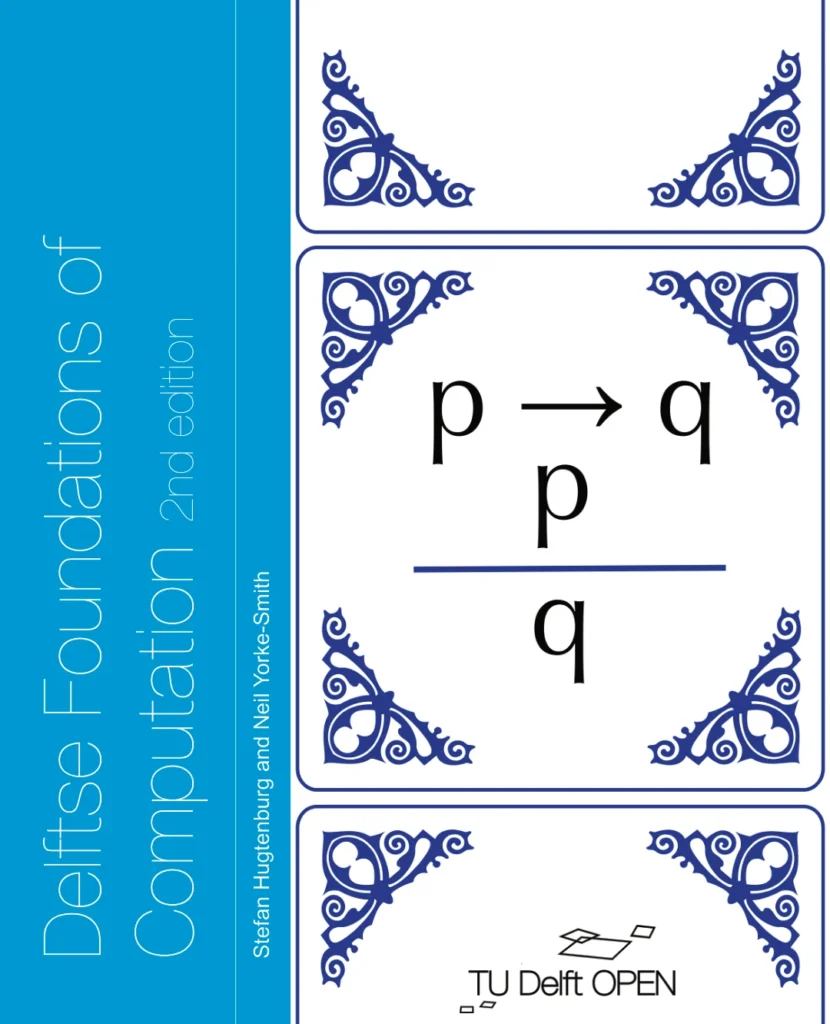
Delftse Foundations of Computation
Not rated yetRate this bookDelftse Foundations of Computation by Stefan Hugtenburg and Neil Yorke-Smith explains the mathematical reasoning behind precise claims about software and computation. This guide follows the second TU Delft edition, version TUD-2.0.1, August 2022. Its five chapters develop logic, proof, sets, functions, relations, and the limits of formal computation, with applications to circuits, trees, programs, and databases. Basic familiarity with programming is the main prerequisite. The text adapts material from Carol Critchlow and David Eck’s Foundations of Computation while presenting a distinct TU Delft course.
Free reading is available at the official source. Opens in a new tab.
 Free
About this book
Delftse Foundations of Computation by Stefan Hugtenburg and Neil Yorke-Smith explains the mathematical reasoning behind precise claims about software and computation. This guide follows the second TU Delft edition, version TUD-2.0.1, August 2022. Its five chapters develop logic, proof, sets, functions, relations, and the limits of formal computation, with applications to circuits, trees, programs, and databases. Basic familiarity with programming is the main prerequisite. The text adapts material from Carol Critchlow and David Eck’s Foundations of Computation while presenting a distinct TU Delft course.
Book summary
Delftse Foundations of Computation by Stefan Hugtenburg and Neil Yorke-Smith explains the mathematical reasoning behind precise claims about software and computation. This guide follows the second TU Delft edition, version TUD-2.0.1, August 2022. Its five chapters develop logic, proof, sets, functions, relations, and the limits of formal computation, with applications to circuits, trees, programs, and databases. Basic familiarity with programming is the main prerequisite. The text adapts material from Carol Critchlow and David Eck’s Foundations of Computation while presenting a distinct TU Delft course.
Chapter-by-chapter summaries
Chapter 1: Introduction and Learning Objectives
The opening chapter explains why precision matters even when software handles uncertain data or approximate results: the algorithm, specification, and assessment criteria still need a clear meaning. Learning objectives connect translation between language and symbols with proof, recursive structures, set and graph operations, and reasoning about verification tools. These skills recur throughout computer science rather than belonging to an isolated mathematics course. The course also distinguishes topics developed fully from optional applications or extensions. Use the objectives as observable tasks: being able to recognize a valid proof on the page is weaker than constructing a proof or producing a counterexample independently. A useful starting exercise is to rewrite a vague software requirement as a claim with an explicit input domain and measurable condition.
Chapter 2: Logic — propositions and Boolean algebra
Propositional logic studies statements with truth values and the operators that combine them. Truth tables make equivalence, contradiction, tautology, and satisfiability precise. Implication requires particular attention because its formal truth conditions do not imply a causal connection, and its converse need not be equivalent to the original statement. Boolean algebra then supplies substitution and simplification rules for manipulating formulas without enumerating every row of a table. De Morgan’s laws connect negation with conjunction and disjunction, while exclusive-or introduces a different combination rule. Translate everyday uses of if, only if, and unless carefully rather than matching isolated words to symbols. Check an algebraic simplification with a small truth table and explain which substitution law authorizes each transformation.
Chapter 2 application: Logic circuits and normal forms — Section 2.3
Logic gates give propositional formulas a computational interpretation. Combining gates implements more complicated expressions; conversely, a circuit can be represented symbolically and analyzed using the same equivalence rules. Disjunctive normal form expresses a truth function through alternatives corresponding to satisfying assignments. Binary addition illustrates how elementary logical operations support arithmetic computation. A formula’s logical equivalence does not mean its implementations have identical gate counts, delays, or physical characteristics; those are further engineering questions. Draw a truth table, construct a corresponding formula, and then trace a gate representation on several inputs. This three-way translation tests meaning more effectively than reproducing a diagram while leaving its input-output behavior unexplained.
Chapter 2: Predicate logic and deduction — Sections 2.4–2.5
Predicates extend logic to statements about objects, and quantifiers specify whether a claim concerns every object or at least one. A domain and the interpretation of each predicate are essential: the same symbolic expression can have different truth values in different structures. Quantifier order changes meaning, and negating a quantified claim switches universal and existential quantifiers while negating the relevant condition. Deduction examines whether a conclusion follows from premises. Validity concerns that relationship, not whether the premises happen to be true in a particular application. Practice translating a nested quantifier claim into ordinary language, drawing a small countermodel when it is false, and separating an argument’s premises from the conclusion it is meant to establish.
Chapter 3: Proof — direct reasoning and contradiction
Proof organizes a sequence of justified steps from assumptions and established results to a stated conclusion. The historical discussion helps distinguish mathematical proof within a formal framework from persuasive evidence about the physical world. Direct arguments, cases, and contradiction serve different forms of claim. To prove an implication by contradiction, assume its hypothesis and the negation of its conclusion, then derive an impossibility; assuming the conclusion itself would reverse the task. Examples clarify the difference between proving a universal statement and checking many instances. Write a proof so that another reader can identify the domain, assumptions, and reason for every major inference. A counterexample can disprove a universal claim, but one confirming example cannot establish it.
Chapter 3: Induction, strong induction, and recursion — Sections 3.4–3.7
Induction proves a family of claims by establishing a base case and a step that carries truth forward. The induction hypothesis is a temporary assumption inside that step, not permission to assume the theorem for every value. Strong induction allows reliance on all earlier cases and is especially natural when a construction depends on several smaller components. Recursive definitions specify initial objects and rules for building new ones; recursive programs similarly reduce a task to smaller tasks. Factorials and the Towers of Hanoi connect the mathematical method with concrete computation. State the measure that gets smaller in a recursive call, ensure all required base cases are covered, and distinguish the correctness of a returned result from the separate question of whether execution terminates.
Chapter 3: Trees and invariants — Sections 3.8–3.9
Trees make recursive structure visible through roots, branches, subtrees, and leaves. Binary-tree examples connect definitions with Java representations and traversal procedures. Reasoning about an entire tree often works by proving a property for its immediate subtrees and then showing that their combination preserves the property. Loop invariants provide a related method for iterative programs: identify a condition that holds before execution and after each complete iteration. Initialization, maintenance, termination, and the implication of the desired postcondition must all be addressed. An invariant can support partial correctness without proving termination on its own. Trace a small loop or tree algorithm, state its invariant in words, and then test whether that claim is strong enough to explain the final output rather than merely remain true.
Chapter 4: Sets and structural induction — Sections 4.1–4.2
Sets collect distinct elements without treating ordering or repetition as part of membership. Set-builder notation, subsets, power sets, tuples, and Cartesian products provide different ways to describe data and its organization. The distinction between an element and a subset becomes crucial when a set contains other sets. Boolean operations on sets mirror propositional operations through membership conditions, providing a systematic way to prove identities. Structural induction extends induction beyond integers to objects generated by recursive rules, including trees. Identify the base constructors and show that every permitted construction preserves the desired property. Translate a proposed set identity into a statement about an arbitrary element; this often reveals the appropriate logical equivalence and prevents an attractive Venn diagram from substituting for a complete argument.
Chapter 4 applications: Graphs and programming with sets — Sections 4.3–4.4
Graphs represent relationships between vertices through edges, and their properties depend on whether direction and other structural conventions are included. The task-ordering application connects mathematical structure with dependencies in a practical problem. Representing sets in a program introduces implementation choices that are separate from the abstract definition; an array-like representation, for example, may require explicit handling of membership and duplicates. Work through a small dependency graph and explain which edges encode prerequisites rather than mere association. Then compare the mathematical set operation with the procedure used to implement it. The representation should preserve the intended meaning even when the stored order or internal arrangement changes.
Chapter 4: Functions and their programming applications — Sections 4.5–4.6
A function assigns exactly one output in its codomain to each input in its domain. That definition makes the domain, codomain, and actual image different objects, even when informal notation obscures the distinction. Composition, injectivity, surjectivity, and invertibility describe different properties and should be checked against the specified sets. Functions on trees and graphs extend the framework to structured data. Treating functions as first-class objects then connects the mathematical idea with programs that pass, return, or store functions. For each example, explicitly write the input and output sets before deciding whether an inverse exists. A change in codomain can change surjectivity without changing the formula used to compute outputs, illustrating why the formula alone does not fully define the mathematical function.
Chapter 4: Counting Past Infinity — Section 4.7
Cardinality compares sizes of sets through one-to-one correspondences rather than relying only on finite counting. An infinite set can correspond bijectively to one of its proper subsets, so intuitions based on finite collections need revision. Countability concerns whether elements can be arranged in a sequence indexed by the natural numbers, not whether an individual can finish listing them. The optional uncountability discussion and related foundational questions show that there are different infinite cardinalities. To test an enumeration, explain why every intended object eventually appears and how duplication is handled. A diagonal argument works by constructing an object missing from any proposed complete list; merely saying that a collection seems too large is not a proof of uncountability.
Chapter 4: Relations and relational databases — Sections 4.8–4.9
A binary relation is a set of ordered pairs, allowing mathematical descriptions of connections that need not be functions. Reflexivity, symmetry, antisymmetry, and transitivity are independent properties, each tested against its own definition. Equivalence relations organize a set into equivalence classes, connecting pairwise relationships with partitions. The database application uses relations to organize records and illustrates queries and modifications with SQL. A database table’s practical conventions are additional to the abstract set-of-tuples model, so examples should be interpreted within the text’s assumptions. Construct a small relation and verify each property pair by pair, then describe the same information as a table. When reading a query, explain which records satisfy its condition and which attributes are returned.
Chapter 5: Looking Beyond — optional closing chapter
The closing chapter introduces foundational limits associated with Gödel and Turing after the book has developed formal reasoning and discrete structures. Incompleteness concerns sufficiently expressive, effectively axiomatized formal systems under the relevant consistency assumptions; it does not say that every everyday question is unanswerable or that all logical systems fail in the same way. Computability asks whether an algorithm can solve a specified problem at all, a different issue from whether an existing algorithm is efficient on practical hardware. These ideas put the preceding methods into perspective without making them useless. Explain the difference between an unproved claim, an undecidable problem under stated assumptions, and a program that merely takes too long. The chapter is an introduction to deeper theory rather than a complete treatment.
Selected Solutions and Further Reading
Selected solutions provide feedback on the reasoning process, while further reading points beyond this introductory course. Attempt an exercise first, preserve the attempt, and only then compare the structure of the argument with the supplied solution. A different valid proof is not automatically inferior, but every assumption and inference still needs justification. When the answer exposes a mistake, identify the earliest unjustified step rather than copying the entire replacement argument. Use the index to revisit prerequisite definitions when a later proof becomes unclear. These back sections support the five chapters and their optional applications; they are not additional chapters in the book’s table of contents.
Study instructions
- Read Chapter 1 as a skills checklist. After each study session, demonstrate one objective through a new translation, construction, proof, or counterexample.
- For Chapter 2, move between natural language, symbolic formulas, and truth tables. With quantifiers, write the domain and test the effect of reversing their order.
- Maintain a proof notebook with the claim, assumptions, selected method, and each justified step. For induction, label base cases and the induction hypothesis explicitly.
- Draw small sets, relations, trees, and graphs before generalizing. Use examples to discover a pattern, then supply a proof or a counterexample rather than relying on the drawings alone.
- Trace a recursive program and a loop on paper. Identify a decreasing measure for termination and a separate property for correctness.
- Use selected solutions only after a complete attempt. Rewrite the corrected argument later without looking at the answer, and explain the mistake in one sentence.
Questions for reflection
- How can an argument be valid even when a premise is false?
- What changes when two nested quantifiers exchange order?
- Why does an invariant alone not necessarily prove termination?
- How does changing a function’s codomain affect its properties?
- What distinguishes a very slow algorithm from an undecidable problem?
Sources and coverage
This original reading guide follows the linked source edition’s chapter, module, unit, or lesson structure. Consult the source for full arguments, cases, worked examples, exercises, illustrations, and references. The guide follows all five chapters of TUD-2.0.1 (August 2022), with separately labelled section summaries for the substantial logic, proof, and discrete-structure topics. Optional starred applications and selected solutions are identified as such. The cover is the original second-edition cover. Read the source edition.
About access & copyright
This page provides book information and study material. Full-text access is provided by the original publisher or authorised source; a listing does not grant permission to republish the book.
Read our Library Access & Copyright policyExplore the contents
Check the chapters covered in this edition.
Visit the official source
See reading, preview or purchase options.
Save for later
Keep this textbook in your saved collection.
Reader ratings & reviews
Share your thoughts
Your review helps other students choose the right resources.
KEEP LEARNING
Your next great read
Computer Science Computer Science
Relational Databases and Microsoft Access
View Relational Databases and Microsoft Access — book Computer Science
A Guide to MATLAB
View A Guide to MATLAB — book Computer Science
Introduction To MIPS Assembly Language Programming
View Introduction To MIPS Assembly Language Programming — book Computer Science
Java, Java, Java - Object-Oriented Programming
View Java, Java, Java - Object-Oriented Programming — book Computer Science
Think Java - How to Think Like a Computer Scientist
View Think Java - How to Think Like a Computer Scientist — book Computer Science
Think Python - How to Think Like a Computer Scientist (Downey)
View Think Python - How to Think Like a Computer Scientist (Downey) — book Computer Science
High Performance Computing
View High Performance Computing — book Computer Science
Foundations of Computation
View Foundations of Computation — book Algorithms and Data Structures



