
Making Games with Python & Pygame
Computer ScienceTextbook
Deep into Pharo
Not rated yetRate this bookDeep into Pharo extends introductory Smalltalk study into libraries, source management, frameworks, language mechanisms and development tools. Alexandre Bergel, Damien Cassou, Stéphane Ducasse and Jannik Laval present Pharo as both a language and a live programming environment.
 Free
About this book
Published as a companion volume to Pharo by Example, this textbook moves beyond basic syntax into the wider system available to a Pharo programmer. Its preface describes five parts: libraries, source management, frameworks, language topics and tools. File handling, networking, visualisation, package management, exceptions and blocks appear in the verified contents. The text reflects the Pharo environment of its 2013 edition, so it is valuable to record that context when using code examples. The guide on this page reviews the preface and structure rather than claiming to cover every library or API in detail.
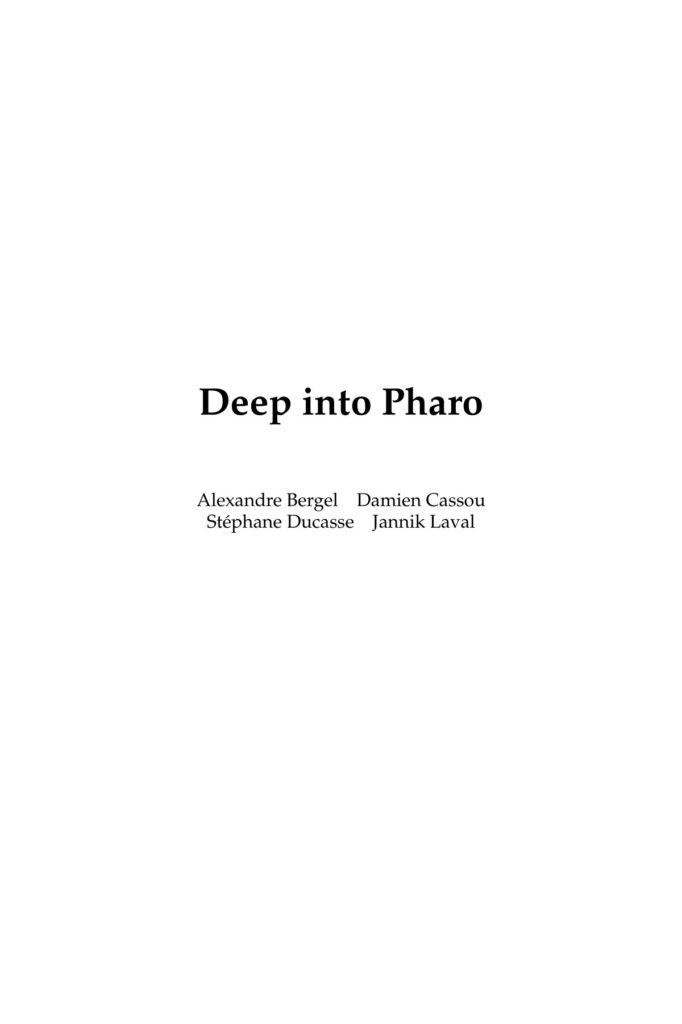
The attached edition contains 420 PDF pages, including front matter. Cover: source edition title page rendered from the PDF. The textbook and its original notices are retained; Academic Master’s study material is separate from the source text.
Book summary
Study overview of the reviewed opening
The preface emphasises that Pharo is more than the syntax of a programming language. It includes an extensible environment together with libraries and frameworks for activities such as modelling, networking, scripting and visualisation. The authors connect its object-oriented model with exploratory work in a live system.
As a second volume, the book assumes a reading path that extends beyond the introduction provided by Pharo by Example. Its first part concerns libraries; the next concerns source code and package management. Framework chapters then introduce tools for building interfaces and visualisations. A language-focused part examines mechanisms such as exceptions, blocks and numbers, while the final part turns to development tooling.
This structure matters because effective work in the environment draws on several kinds of knowledge at once. A programmer may need the language model, an available library, a package-management tool and a way to inspect or profile the result. The preface also documents a collaborative community of contributors. The page’s overview does not test the examples against current releases or assign complete coverage to later chapters. Readers should use the hosted edition’s own references and verify the software version when working through its technical material.
Book contents
- Zero Configuration Scripts and Command-Line Handlers
- Files with FileSystem
- Sockets
- The Settings Framework
- Regular Expressions in Pharo
- Versioning Your Code with Monticello
- Gofer: Scripting Package Loading
- Managing Projects with Metacello
- Glamour
- Agile Visualization with Roassal
- Scripting Visualizations with Mondrian
- Handling Exceptions
- Blocks: a Detailed Analysis
- Exploring Little Numbers
- Fun with Floats
- Profiling Applications
- PetitParser: Building Modular Parsers
- Biographies
Questions for study
The following prompts are Academic Master’s editorial material.
- Why describe Pharo as an environment as well as a language?
- How do libraries, frameworks and development tools differ in the book’s structure?
- What version information would you record before reproducing an example?
Sources and coverage
Preface read in full (PDF pages 9–11); first-edition title, copyright and contents checked.
About access & copyright
Check this edition’s source and licence before reusing its files or content. A library listing does not grant additional rights.
Read our Library Access & Copyright policyLive environment
Understand the preface’s view of Pharo.
Beyond syntax
Recognise the book’s progression into system facilities.
Reading structure
Distinguish the five verified parts.
Version awareness
Interpret technical material within its edition.
Reader ratings & reviews
Share your thoughts
Your review helps other students choose the right resources.
KEEP LEARNING
Your next great read
Computer Science
Think Raku: How to Think Like a Computer Scientist
Think Raku: How to Think Like a Computer Scientist
View Think Raku: How to Think Like a Computer Scientist — bookIntroduction to Drafting and AutoCAD 2D
Introduction to Drafting and AutoCAD 2D
View Introduction to Drafting and AutoCAD 2D — bookIntroduction to Drafting and AutoCAD 3D
Introduction to Drafting and AutoCAD 3D
View Introduction to Drafting and AutoCAD 3D — bookProgramming for Computations – Python: A Gentle Introduction to Numerical Simulations with Python 3.6
Programming for Computations - Python: A Gentle Introduction to Numerical Simulations with Python 3.6
View Programming for Computations - Python: A Gentle Introduction to Numerical Simulations with Python 3.6 — bookCISC 187: Data Structures in C++
CISC 187: Data Structures in C++
View CISC 187: Data Structures in C++ — bookAccounting Analytics: An Integrated Approach
Accounting Analytics: An Integrated Approach
View Accounting Analytics: An Integrated Approach — bookGame Based and Adaptive Learning Strategies
Game Based and Adaptive Learning Strategies
View Game Based and Adaptive Learning Strategies — book Computer Science
The Shallow and the Deep: A biased introduction to neural networks and old school machine learning
View The Shallow and the Deep: A biased introduction to neural networks and old school machine learning — bookComputer Systems Security: Planning for Success



