
 Computer Science
Textbook
Combinatorics
Not rated yetRate this bookJoy Morris’s Combinatorics is an upper-level introduction to enumeration, graph theory, and design theory. This guide follows Version 2.1.1, March 2023, through all nineteen chapters. Counting, construction, existence, and structural analysis share one discipline: specify the objects, constraints, and conventions determining when objects are distinct. Work through proofs as well as formulas. Small cases can reveal mistakes or suggest conjectures, but general arguments must explain why every permitted case is covered without omissions or duplicate counting.
Free reading is available at the official source. Opens in a new tab.
 Free
About this book
Joy Morris’s Combinatorics is an upper-level introduction to enumeration, graph theory, and design theory. This guide follows Version 2.1.1, March 2023, through all nineteen chapters. Counting, construction, existence, and structural analysis share one discipline: specify the objects, constraints, and conventions determining when objects are distinct. Work through proofs as well as formulas. Small cases can reveal mistakes or suggest conjectures, but general arguments must explain why every permitted case is covered without omissions or duplicate counting.
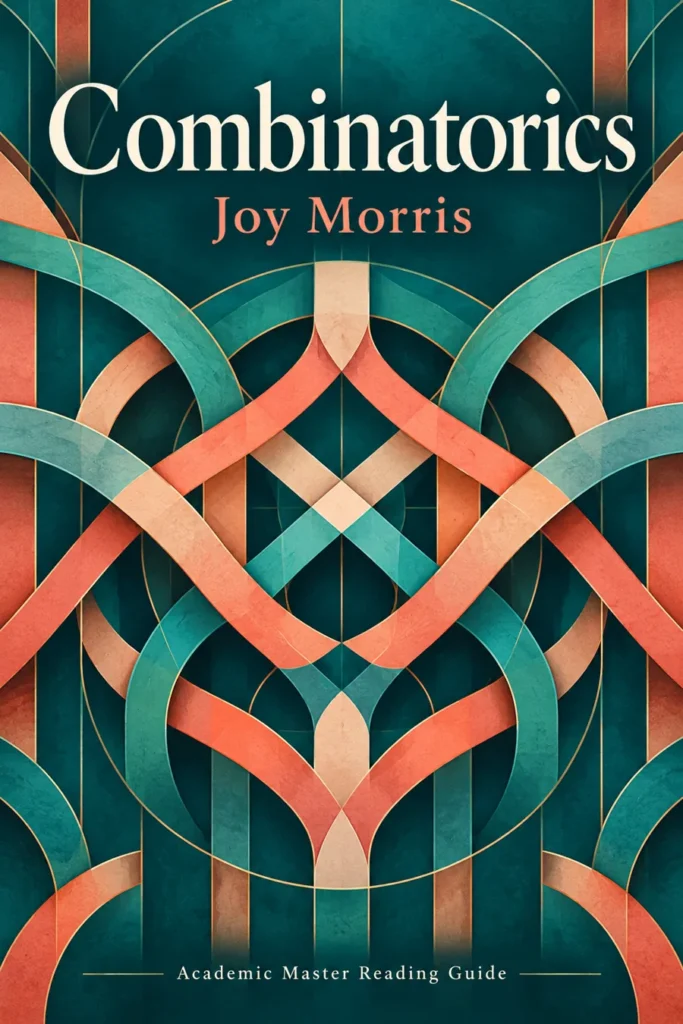
Cover: original Academic Master reading-guide design. The linked source remains the edition described above.
Book summary
Joy Morris’s Combinatorics is an upper-level introduction to enumeration, graph theory, and design theory. This guide follows Version 2.1.1, March 2023, through all nineteen chapters. Counting, construction, existence, and structural analysis share one discipline: specify the objects, constraints, and conventions determining when objects are distinct. Work through proofs as well as formulas. Small cases can reveal mistakes or suggest conjectures, but general arguments must explain why every permitted case is covered without omissions or duplicate counting.
Chapter-by-chapter summaries
1. What is combinatorics?
Counting, existence, construction, and structure ask different questions about discrete objects. Specify objects and constraints before seeking a formula. A question about how many arrangements exist differs from asking whether any arrangement is possible. Small examples expose ambiguities about order, repetition, and equivalence. Resolve these conventions before generalizing, since a formula answers a precisely modeled question rather than every everyday interpretation of its wording.
2. Basic counting techniques
Addition counts disjoint alternatives and multiplication counts successive choices. Complements help when the full and excluded collections are clearly defined. Describe a construction procedure and check that each valid object appears exactly once. An overlapping case split requires correction. Explain every factor and summand. This reasoning distinguishes a legitimate count from arithmetic that happens to match a small example without explaining why it should generalize.
3. Permutations, combinations, and binomial theorem
Permutations preserve order; combinations select subsets without order. Compare choosing a committee with assigning distinct offices. Binomial coefficients also count choices contributing to polynomial expansion. For an identity, specify one collection counted in two ways. Check boundary cases such as selecting none or all. Algebra becomes more informative when the expressions’ combinatorial meaning explains the relationship rather than merely verifies it through manipulation.
4. Bijections and combinatorial proofs
A bijection translates objects without omission or duplication. Define a map, prove its outputs valid, and construct the inverse. Similar-looking correspondences can fail by assigning several inputs to one output. Double counting provides another route by decomposing one collection differently. These methods reveal why sizes agree. An inverse is especially useful because it establishes recoverability instead of leaving the claim that the correspondence is one-to-one at an intuitive level.
5. Counting with repetitions
Repeated selections change assumptions behind familiar formulas. Distinguish items and containers, then specify order, empty positions, upper bounds, and repeated symbols. Translate to a representation such as occupancy counts. Compare two problems differing in only one convention to see why their counts change. The chapter discourages keyword matching: the correct method depends on the structure of an outcome, not the presence of words such as choose or arrange.
6. Induction and recursion
Recursive construction reduces objects to smaller cases; induction proves claims across the corresponding range. Initial conditions are part of the definition. Explain why recursive cases cover everything without overlap before writing the recurrence. Verify small values directly. In a proof, state the induction hypothesis and its use in the next case. A repeating numerical pattern is evidence for a conjecture, while the logical dependency supplies the justification.
7. Generating functions
Formal power series encode sequences through coefficients. Sums and products represent specified alternatives and combinations when the encoding is consistent. Explain exponent and coefficient meanings before algebra. Build a function from allowed choices and expand early terms as a check. The method manipulates a sequence collectively, but coefficient extraction only answers the original question when the encoding faithfully represents its objects and restrictions.
8. Generating functions and recursion
Translate recurrences into equations, retaining initial terms and handling index shifts carefully. Solving can provide coefficients or closed forms. Verify the first values and connect the result with the original recursive decomposition. Missing a starting term can invalidate an otherwise elegant derivation. Compare computational convenience with explanatory value: the algebra solves the relation, while the construction explains why that relation counts the intended objects.
9. Important recursive sequences
Derangements, Catalan numbers, and Bell numbers illustrate distinctive structures rather than arbitrary lists. Exponential generating functions become relevant when labels affect combination rules. Derive early values directly and recursively, then compare an appropriate generating-function interpretation. Matching early terms does not prove two definitions equivalent. Identify the decomposition behind each recurrence and the role of labels, order, and admissibility in determining its form.
10. Other counting methods
The pigeonhole principle establishes unavoidable repetition when too many objects occupy too few categories. Inclusion-exclusion corrects overlapping sets through alternating intersections. Define boxes or excluded events before applying either tool. Work a three-set example completely and track how often each type of object is counted. This explains the signs and conditions instead of turning inclusion-exclusion into an unexplained alternating expression.
11. Basics of graph theory
Vertices, edges, adjacency, degrees, and substructures describe a graph independently of its drawing. Degree counting constrains possible structures. Test a proposed degree pattern and construct an example where feasible. An isomorphism must preserve adjacency, not visual resemblance. State whether loops, direction, or repeated edges belong to the model. These foundations support later traversal, colouring, and planar questions while preventing the picture from silently supplying false assumptions.
12. Moving through graphs
Walks, trails, paths, and connectedness impose different restrictions on movement. Repeated vertices and repeated edges are not interchangeable conditions. List a route as a sequence and check the exact definition. Explore components and removal of vertices or edges. Model the application’s direction and repetition requirements explicitly. A visually plausible route is valid only if every consecutive pair respects the actual adjacency and all required restrictions are satisfied.
13. Euler and Hamilton
Eulerian questions concern edges; Hamiltonian questions concern vertices. This changes criteria and difficulty. Apply degree and connectedness tests where they are appropriate without transferring them to a different problem. Construct examples separating the properties. A claimed route needs a full check, while impossibility needs an obstruction rather than unsuccessful searching. Distinguish producing one solution from counting all solutions or proving that a method will find one whenever it exists.
14. Graph colouring
Labels are assigned under conflict constraints, with vertex and edge versions distinct. A construction establishes an upper bound; an obstruction can establish a lower bound. Both are necessary for an exact optimum. In scheduling, define vertices, edges, and the interpretation of colours. Verify the model before optimizing it. A clever colouring of the wrong graph may violate the original constraints even when every graph-theoretic step is correct.
15. Planar graphs
Planarity asks for some crossing-free drawing, not whether the displayed drawing has crossings. Faces, Euler-type relations, and structural restrictions support analysis. Redraw examples to distinguish accidental from unavoidable crossings. Check assumptions of counting inequalities and distinguish necessary from sufficient conditions. An inequality’s failure may prove nonplanarity, while satisfying it does not automatically construct an embedding. This chapter develops structural reasoning beyond inspecting a single picture.
16. Latin squares
Each symbol appears once in every row and column, producing a balanced arrangement. Verify small examples by rows and columns independently. Relabeling or permuting rows can preserve the relevant property without being the same operation as adding a new constraint. Examine how extra requirements affect existence. The chapter introduces design thinking through local balance conditions whose simultaneous satisfaction imposes strong global structure.
17. Designs
Points and blocks satisfy controlled incidence conditions summarized by parameters. Double counting produces necessary relationships. Explain what each parameter counts before using the equations. Arithmetic consistency is not an existence proof. Verify a small construction directly and distinguish feasibility from realization. The connection with enumeration shows that counting can constrain structure even when the objective is to produce an arrangement rather than calculate its total number.
18. More designs
Further constructions build or transform balanced structures, addressing existence beyond necessary arithmetic conditions. Trace the origin of every point and block and verify the defining properties. Identify changed and preserved parameters. Compare construction with nonexistence arguments. The chapter reinforces that combinatorics includes creating and understanding objects, not merely assigning formulas to hypothetical families. A construction is complete when its claimed conditions have been checked generally.
19. Designs and codes
Codewords and distance connect combinatorial organization with detecting and correcting errors. Explain why minimum distance constrains protection and compare redundancy with message capacity. Balanced structures can help organize coding systems, linking design theory with communication. Distinguish detection from correction and verify a small example through actual distances. The final chapter combines representation, counting, and structure while retaining the need to state precisely which errors a guarantee covers.
Study instructions
- State order, repetition, distinguishability, and equivalence before counting.
- Check small cases, then prove coverage and uniqueness generally.
- Support graph optima with a construction and a matching lower bound where possible.
- Verify design equations by counting and check a construction separately.
Questions for reflection
- What makes a correspondence genuinely bijective?
- Why do Eulerian criteria not solve every Hamiltonian question?
- How can feasible parameters leave existence unsettled?
Sources and coverage
This original reading guide covers the linked edition’s main chapters, or the principal sections of its two-chapter calculus text. Consult the source for full arguments, cases, worked examples, exercises, illustrations, and references. Version 2.1.1, March 2023, as identified in the linked source. Read the source edition.
About access & copyright
This page provides book information and study material. Full-text access is provided by the original publisher or authorised source; a listing does not grant permission to republish the book.
Read our Library Access & Copyright policyExplore the contents
Check the chapters covered in this edition.
Visit the official source
See reading, preview or purchase options.
Save for later
Keep this textbook in your saved collection.
Reader ratings & reviews
Share your thoughts
Your review helps other students choose the right resources.
KEEP LEARNING
Your next great read
Computer Science Computer Science
Relational Databases and Microsoft Access
View Relational Databases and Microsoft Access — book Computer Science
A Guide to MATLAB
View A Guide to MATLAB — book Computer Science
Introduction To MIPS Assembly Language Programming
View Introduction To MIPS Assembly Language Programming — book Computer Science
Java, Java, Java - Object-Oriented Programming
View Java, Java, Java - Object-Oriented Programming — book Computer Science
Think Java - How to Think Like a Computer Scientist
View Think Java - How to Think Like a Computer Scientist — book Computer Science
Think Python - How to Think Like a Computer Scientist (Downey)
View Think Python - How to Think Like a Computer Scientist (Downey) — book Computer Science
High Performance Computing
View High Performance Computing — book Computer Science
Foundations of Computation
View Foundations of Computation — book Algorithms and Data Structures



