
 Algebra
Textbook
College Algebra & Trigonometry
Not rated yetRate this bookCollege Algebra & Trigonometry by Richard W. Beveridge combines algebraic methods, analytic geometry, sequences, counting, and trigonometry across eleven chapters. This guide follows the complete Clatsop Community College PDF dated October 2019, replacing an imported export that contained only a few introductory pages. Its sequence places exponents and logarithms before the fuller discussion of functions. Follow that organization while connecting equations, graphs, domains, and interpretations. A procedure is useful when you can explain what it preserves and how to check its result in the original problem.
Free reading is available at the official source. Opens in a new tab.
 Free
About this book
College Algebra & Trigonometry by Richard W. Beveridge combines algebraic methods, analytic geometry, sequences, counting, and trigonometry across eleven chapters. This guide follows the complete Clatsop Community College PDF dated October 2019, replacing an imported export that contained only a few introductory pages. Its sequence places exponents and logarithms before the fuller discussion of functions. Follow that organization while connecting equations, graphs, domains, and interpretations. A procedure is useful when you can explain what it preserves and how to check its result in the original problem.
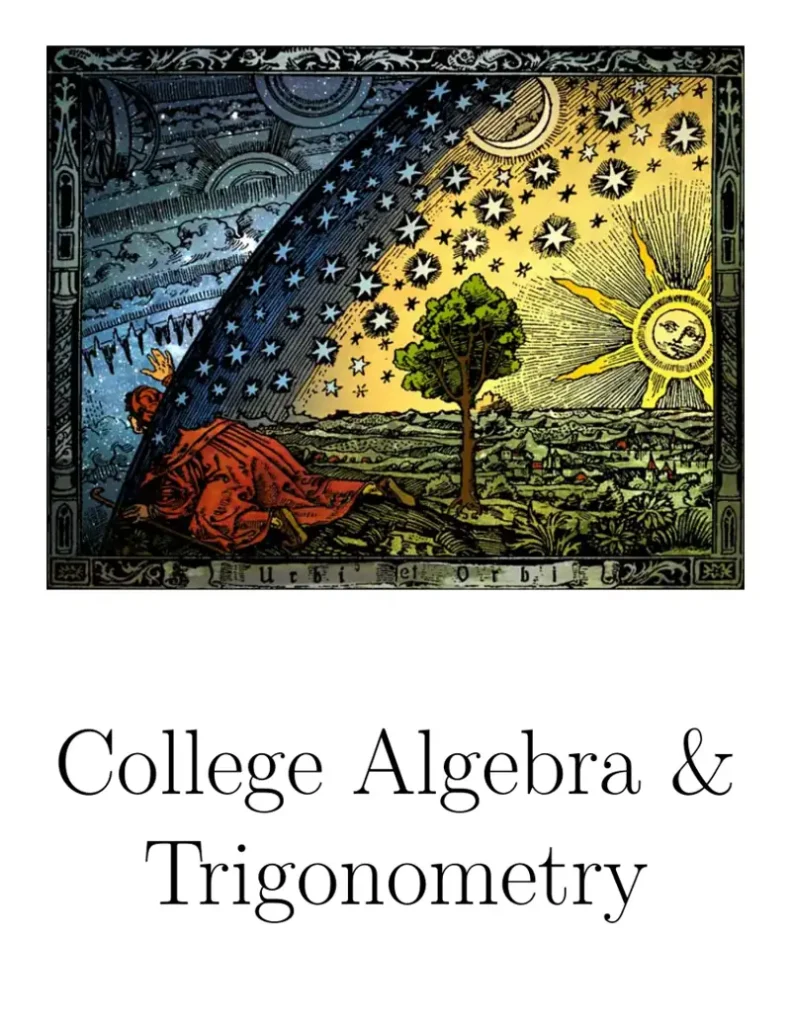
Cover: source-edition cover, displayed to identify the linked book. Publisher and third-party rights remain with their respective holders.
Book summary
College Algebra & Trigonometry by Richard W. Beveridge combines algebraic methods, analytic geometry, sequences, counting, and trigonometry across eleven chapters. This guide follows the complete Clatsop Community College PDF dated October 2019, replacing an imported export that contained only a few introductory pages. Its sequence places exponents and logarithms before the fuller discussion of functions. Follow that organization while connecting equations, graphs, domains, and interpretations. A procedure is useful when you can explain what it preserves and how to check its result in the original problem.
Chapter-by-chapter summaries
1. Algebra review
Expressions, operations, equations, and inequalities establish the foundation for later work. Equivalent transformations preserve a solution set only under the conditions governing the operation. Dividing by an expression requires attention to whether it can be zero, while squaring can introduce extraneous candidates. Keep restrictions visible throughout a calculation. Check answers in the original statement rather than only the simplified one. The chapter’s review is most productive when errors are traced to a specific rule or assumption instead of treated as general weakness at algebra.
2. Polynomial and rational functions
Factoring, zeros, graphs, and algebraic structure connect equations with behaviour. A factor can reveal an intercept, while a denominator identifies restrictions that may remain after cancellation. Compare a removable discontinuity with an asymptote and explain the underlying distinction. Graphs should be checked through domain, intercepts, sign, and end behaviour rather than drawn from a few arbitrary points. An algebraically similar expression may represent a different function at excluded inputs, making the original definition essential to interpretation.
3. Exponents and logarithms
Exponential and logarithmic forms express inverse relationships and support equations and models. Logarithm rules have domain conditions and do not permit distributing a logarithm over every operation. Distinguish a multiplication property from a false addition rule. Compare exact symbolic solutions with approximations and check admissible inputs. In an application, identify what the growth or decay assumption says and which data determine constants. A fitted expression does not justify extrapolation beyond the conditions under which its model is meaningful.
4. Functions
Function notation organizes input-output relationships, domains, ranges, composition, inverse relationships, and graph interpretation. A formula alone does not fully specify every relevant restriction. Distinguish an inverse function from a reciprocal and verify composition in the appropriate domain. Compare transformations by their effect on inputs and outputs. The chapter gives a unifying language for earlier algebra while making graphical and symbolic information complement each other. State what one plotted point means in context rather than regarding a graph as decoration after calculation.
5. Conic sections: circles and parabolas
Equations and geometric definitions connect circles and parabolas with locations, distances, and coordinate choices. Completing the square can reveal a circle’s centre and radius or a parabola’s structure. Check whether parameters permit the claimed real geometric object. A translated equation changes position without necessarily changing shape. For an application, connect the model’s quantities with the geometry before substituting values. This chapter focuses on the two conics named in the source rather than implying a full survey of every conic section.
6. Sequences and series
Ordered terms, recursive patterns, and sums express discrete change. Arithmetic and geometric structures require different relationships. Identify whether a question asks for one term, a partial sum, or another property. A finite pattern suggests a rule without determining it uniquely. Check initial indices and conditions before using a formula. Compare a recursively defined process with an explicit expression and explain why both represent the same sequence. Units and context can expose a formula applied to the wrong quantity.
7. Combinatorics
Counting requires precise objects and conventions about order, repetition, and distinguishability. Addition and multiplication apply to different structures, while permutations and combinations answer different questions. Define one outcome before calculating and explain why the method counts every valid object once. A familiar formula can be wrong when a condition changes. Compare direct counting with a complementary approach for a small example. The chapter develops reasoning useful beyond arithmetic because correct enumeration depends on a justified representation of the problem.
8. Right-triangle trigonometry
Angle measurement and trigonometric ratios connect geometry with numerical relationships. Identify opposite and adjacent sides relative to the selected angle, not by a fixed position on the page. Compare degrees and radians carefully and keep calculator settings consistent. In an application, draw the actual geometric relationship before choosing a ratio. A computed angle or length must satisfy the triangle’s constraints. The chapter develops a foundation for extending trigonometric reasoning beyond a single diagram.
9. Graphing trigonometric functions
Period, amplitude where applicable, shifts, zeros, and asymptotic behaviour connect formulas with repeating patterns. Different trigonometric functions have different domains and ranges; not all share a sine wave’s shape. Identify transformations through the input and output structure, keeping phase units consistent. Compare a graph over one period with the full periodic function. A model should specify what one cycle represents and how its parameters connect with the observed quantity rather than fitting a curve by appearance alone.
10. Identities and equations
An identity holds throughout its common domain, while an equation may hold only at selected inputs. Transformations used in proofs and solution methods therefore require different care. Work from established relationships and preserve domain restrictions. When solving, account for periodic families and then apply any specified interval. Check candidates in the original equation, especially after operations introducing possible extraneous values. A numerical graph can help locate solutions without replacing the algebraic reasoning establishing completeness.
11. Laws of sines and cosines
Non-right triangles require relationships beyond basic right-triangle ratios. Choose a law from the known sides and angles, then examine whether the data determine no triangle, one triangle, or multiple triangles. The ambiguous sine-law case requires explicit consideration rather than accepting the first inverse-trigonometric output. Check side-angle consistency and the angle sum. Applications become manageable when the geometry is modeled accurately before calculation. Explain why every admissible configuration has been considered when claiming a unique answer.
Study instructions
- For each problem, record the domain, model, method, transformations, and an independent check.
- Connect every symbolic result with a graph, geometric interpretation, or meaningful application where appropriate.
- Keep an error log distinguishing algebraic rules, domain mistakes, angle units, and modeling assumptions.
- Use mixed practice requiring method selection rather than only repeated exercises of one announced type.
Questions for reflection
- Which algebraic operations can introduce or remove candidates?
- How does an identity differ from an equation to solve?
- Why can sine-law data allow more than one triangle?
Sources and coverage
This original reading guide follows the linked source edition’s chapter, module, unit, or lesson structure. Consult the source for full arguments, cases, worked examples, exercises, illustrations, and references. The complete Clatsop Community College PDF, October 2019, replaces a short incomplete imported export. The guide follows its eleven main chapters. Read the source edition.
About access & copyright
This page provides book information and study material. Full-text access is provided by the original publisher or authorised source; a listing does not grant permission to republish the book.
Read our Library Access & Copyright policyExplore the contents
Check the chapters covered in this edition.
Visit the official source
See reading, preview or purchase options.
Save for later
Keep this textbook in your saved collection.
Reader ratings & reviews
Share your thoughts
Your review helps other students choose the right resources.
KEEP LEARNING
Your next great read
AlgebraIntermediate Algebra
Intermediate Algebra
View Intermediate Algebra — bookIntermediate Algebra
Intermediate Algebra
View Intermediate Algebra — book Mathematics
Book of Proof
View Book of Proof — book Algebra
College Algebra
View College Algebra — book Calculus
Precalculus (Version 3, Corrected 2013 Edition)
View Precalculus (Version 3, Corrected 2013 Edition) — book Geometry and Trigonometry
College Trigonometry
View College Trigonometry — book Calculus
Whitman Calculus
View Whitman Calculus — book Calculus
Vector Calculus
View Vector Calculus — book Calculus



