
 Diseases and disorders
MedicineTextbook
Clinical Procedures for Safer Patient Care
Not rated yetRate this bookGlynda Rees Doyle and Jodie Anita McCutcheon’s Clinical Procedures for Safer Patient Care organizes nursing skills around assessment, procedural reasoning, patient communication, and evaluation. Ten chapters progress from infection control and basic assessment to handling, wound care, oxygen, medication routes, intravenous therapy, glucose monitoring, and tubes. Its checklists pair actions with rationales, encouraging learners to understand why a step matters. This guide follows the attached textbook and explains its educational structure. Because the source was first published in 2015, clinical performance should be checked against current institutional policy and supervised competency requirements rather than inferred from these summaries.
 Free
About this book
Glynda Rees Doyle and Jodie Anita McCutcheon’s Clinical Procedures for Safer Patient Care organizes nursing skills around assessment, procedural reasoning, patient communication, and evaluation. Ten chapters progress from infection control and basic assessment to handling, wound care, oxygen, medication routes, intravenous therapy, glucose monitoring, and tubes. Its checklists pair actions with rationales, encouraging learners to understand why a step matters. This guide follows the attached textbook and explains its educational structure. Because the source was first published in 2015, clinical performance should be checked against current institutional policy and supervised competency requirements rather than inferred from these summaries.
The ten main chapters range from infection control and assessment to patient movement, wound care, medication administration, intravenous therapy, monitoring and care involving tubes. The textbook supports classroom, laboratory and supervised clinical learning and assumes knowledge of medical terminology, anatomy, physiology and pathophysiology. The 2015 edition contains 792 PDF pages, including front matter. Its clinical recommendations have not been reviewed here against current standards.
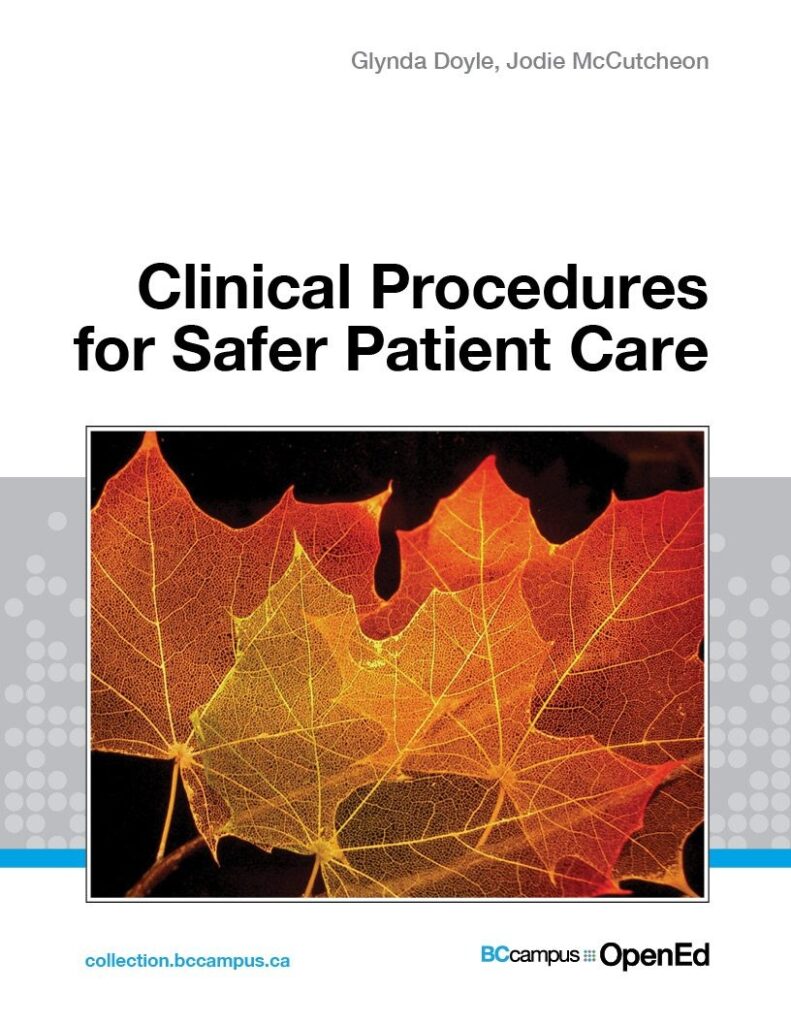
Clinical Procedures for Safer Patient Care by Glynda Rees Doyle and Jodie Anita McCutcheon is used under a CC BY 4.0 Licence, except where otherwise noted. © 2015 British Columbia Institute of Technology. Download for free from the B.C. Open Collection. Cover photograph: Maple Leaf Structure by Steve Jurvetson, CC BY 4.0. Full original notices remain in the PDF.
Book summary
Glynda Rees Doyle and Jodie Anita McCutcheon’s Clinical Procedures for Safer Patient Care organizes nursing skills around assessment, procedural reasoning, patient communication, and evaluation. Ten chapters progress from infection control and basic assessment to handling, wound care, oxygen, medication routes, intravenous therapy, glucose monitoring, and tubes. Its checklists pair actions with rationales, encouraging learners to understand why a step matters. This guide follows the attached textbook and explains its educational structure. Because the source was first published in 2015, clinical performance should be checked against current institutional policy and supervised competency requirements rather than inferred from these summaries.
Chapter-by-chapter summaries
1. Infection Control
The opening chapter links routine practices, point-of-care risk assessment, hand hygiene, personal protective equipment, and additional precautions. It distinguishes ordinary clean practice from surgical asepsis and connects sterile fields and attire with invasive procedures. The central reasoning task is identifying how contamination could travel between the patient, worker, equipment, and environment. Draw that chain for a simulated encounter, then explain which measures address each link. Memorizing equipment names is insufficient if the learner cannot explain when the precautions apply or recognize that the circumstances have changed.
2. Patient Assessment
Health history, pain assessment, vital signs, head-to-toe assessment, emergency assessment, and focused assessment serve different but related purposes. Assessment is not a one-time inventory: findings must be interpreted, compared with baseline, documented, and communicated. The chapter’s progression helps students distinguish a broad survey from a targeted response to a particular concern. In a written scenario, separate subjective reports, objective observations, and your interpretation. Identify the information still missing. This structure supports clearer reasoning and handover without treating a single measurement as a complete account of the patient’s condition.
3. Safe Patient Handling, Positioning, and Transfers
Mobility and handling tasks can expose both patients and staff to injury. The chapter combines body mechanics with risk assessment, positioning, assistive devices, ambulation, transfers, and fall prevention. A patient’s abilities may change between encounters, making an earlier successful transfer an inadequate basis for the next decision. Use a classroom scenario to list the relevant patient, environmental, staffing, and equipment factors before selecting a simulated approach. The important concept is matching assistance to assessed need, rather than assuming that technique alone makes every manual task appropriate.
4. Wound Care
Wound assessment and the process of healing guide the chapter’s discussion of dressings, irrigation, packing, removal of sutures or staples, and drains. Local wound characteristics interact with wider factors such as nutrition and health status. The rationale for an intervention therefore cannot be separated from the type and condition of the wound. Compare assessment findings over time and explain what would count as improvement, an unresolved problem, or a need for further review. Learn the procedural steps from the complete source and approved teaching materials, preserving the assessment and evaluation that surround them.
5. Oxygen Therapy
Ventilation, perfusion, and transport explain why oxygenation problems require interpretation rather than a response to one number alone. The chapter discusses pulse oximetry, manifestations of hypoxia, delivery systems, hazards, and oral suctioning. Oxygen is presented as a clinical intervention whose use and evaluation depend on the patient’s circumstances and local protocols. For study, compare a monitoring device’s reading with the broader clinical picture in a provided case. Explain what the device can indicate and what it cannot establish by itself; consult current approved guidance for actual targets and delivery decisions.
6. Non-Parenteral Medication Administration
The chapter covers safety principles and routes including oral, gastric tube, rectal, vaginal, eye, ear, nose, inhaled, and topical administration. Route and formulation influence how a medicine is delivered and absorbed, so products are not interchangeable merely because their names appear similar. Build a route-comparison table focused on required assessment, preparation, patient education, and evaluation. In a simulation, identify discrepancies that must be resolved before administration. The educational point is to integrate medication checks with the person’s condition and ability to receive the prescribed form, rather than reduce safe practice to a memorized list.
7. Parenteral Medication Administration
Ampules, vials, injections, direct intravenous medication, and intermittent or continuous infusions introduce additional preparation and delivery considerations. The chapter links route-specific technique with assessment, calculation, and recognition of complications. Organize a study sheet around what must be verified, what might go wrong, and how the result is evaluated under the applicable protocol. Distinguish a medicine’s amount, concentration, volume, and delivery rate in practice problems. Practical administration requires authorized, supervised competence; the summary explains the learning relationships without supplying a substitute injection or infusion procedure.
8. Intravenous Therapy
Fluid therapy, equipment, tubing, saline locks, peripheral access, blood products, and parenteral nutrition are considered as parts of an ongoing system. Assessment includes both the access site and the patient’s wider response. The chapter connects setup and maintenance with complications and documentation, making continuity important across changes of staff or equipment. In a diagram, trace the system from its ordered fluid or product to the patient, marking the information that requires verification. Use current teaching protocols when practising the full procedure, including its monitoring and escalation requirements.
9. Blood Glucose Monitoring
Glucose testing is presented as a clinical skill embedded in assessment and interpretation. Reliable results depend on correct patient identification, equipment use, sample collection, and documentation, not simply reading a displayed value. The result must be understood in the context of symptoms, timing, treatment, and the relevant care plan. For study, map the sequence from reason for testing to the communication of a result. Distinguish a possible measurement problem from a genuine change in condition, and identify which decisions belong to the supervising clinician or approved protocol.
10. Tubes and Attachments
The final chapter brings together care involving urinary and gastrointestinal devices and related attachments. Their purpose, placement-related considerations, maintenance, drainage or feeding functions, infection risks, and patient experience must be understood together. A tube is not only an isolated technical object; it affects mobility, comfort, observation, and handover. Create a device profile describing its purpose, what is monitored, and the questions that require clarification in a case. The conclusion returns to the book’s central pattern: assess first, understand the rationale, perform only within competence, evaluate, and communicate.
Study instructions
- Read each chapter’s theory before its checklists. In your notes, pair each procedural stage with its rationale, assessment requirement, and expected evaluation.
- Use a case-study worksheet with baseline findings, new findings, interpretation, missing information, and the communication required. Keep observation separate from inference.
- Practise clinical calculations and route comparisons using instructor-approved exercises. Record units explicitly and resolve conflicting information rather than guessing.
- Rehearse skills only in the authorized learning setting with approved equipment, current local procedures, and supervision. Ask an instructor to evaluate reasoning as well as hand movements.
- Use the glossary and checklist index to revisit weak areas. Before practical assessment, compare the source edition with current institutional teaching requirements.
Questions for reflection
- How does a change from baseline alter the meaning of an otherwise familiar assessment finding?
- Why is knowing the rationale important when a checklist cannot be followed exactly as expected?
- Which information must travel with the patient when a device or therapy continues across a handover?
- How would you distinguish textbook study, simulation competence, and authorization to perform a clinical procedure?
Sources and coverage
This original study guide follows all main chapters of the source edition linked below. Summaries explain the central concepts and their connections; practice tasks and reflection questions are editorial study aids. Consult the complete text for worked examples, figures, exercises, and references. These are educational summaries of the source edition, not current bedside protocols or individualized treatment instructions. Read the source edition.
About access & copyright
Check this edition’s source and licence before reusing its files or content. A library listing does not grant additional rights.
Read our Library Access & Copyright policyClinical foundations
Connect procedure checklists with the knowledge needed to use them.
Structured practice
Follow learning objectives and rationales alongside skills instruction.
Patient safety
Consider assessment and infection control across procedures.
Reference tools
Locate the glossary, checklists, and supporting videos.
Reader ratings & reviews
Share your thoughts
Your review helps other students choose the right resources.
KEEP LEARNING
Your next great read
Diseases and disorders Medicine
Veterinary Epidemiology: Principles and Methods
View Veterinary Epidemiology: Principles and Methods — book Medicine
Public Health Ethics: Cases Spanning the Globe
View Public Health Ethics: Cases Spanning the Globe — book Medicine
Cell Biology, Genetics, and Biochemistry for Pre-Clinical Students
View Cell Biology, Genetics, and Biochemistry for Pre-Clinical Students — book Medicine
Applying the International Classification of Functioning, Disability & Health: A Team-Based/Project Based Course for Undergraduate Students
View Applying the International Classification of Functioning, Disability & Health: A Team-Based/Project Based Course for Undergraduate Students — book Medicine
Urinalysis Atlas: A Pictorial Guide to Formed Elements in Urine (Doty and Taylor)
View Urinalysis Atlas: A Pictorial Guide to Formed Elements in Urine (Doty and Taylor) — book Medicine
Drug Use and Misuse: A Community Health Perspective
View Drug Use and Misuse: A Community Health Perspective — book Medicine
Neuroscience for Pre-Clinical Students
View Neuroscience for Pre-Clinical Students — book Medicine
Cardiovascular Pathophysiology for Pre-Clinical Students
View Cardiovascular Pathophysiology for Pre-Clinical Students — book Medicine



