
 Humanities
Textbook
BC Reads: Adult Literacy Fundamental English – Course Pack 5
Not rated yetRate this bookBC Reads: Adult Literacy Fundamental English – Course Pack 5 by Shantel Ivits develops reading and writing through nine units about the brain, learning, memory, personality, and well-being. Each unit uses a reading in the companion Reader 5 as a starting point for vocabulary, comprehension, spelling, grammar, and paragraph development. The book’s purpose is adult literacy instruction, and its brain-themed readings should not be treated as individualized psychological assessment or a current neuroscience review. This guide explains both the topic sequence and the language skills learners practise throughout the course pack.
 Free
About this book
BC Reads: Adult Literacy Fundamental English – Course Pack 5 by Shantel Ivits develops reading and writing through nine units about the brain, learning, memory, personality, and well-being. Each unit uses a reading in the companion Reader 5 as a starting point for vocabulary, comprehension, spelling, grammar, and paragraph development. The book’s purpose is adult literacy instruction, and its brain-themed readings should not be treated as individualized psychological assessment or a current neuroscience review. This guide explains both the topic sequence and the language skills learners practise throughout the course pack.
The first unit introduces prediction, visualization, vocabulary, main ideas, sequence, punctuation, sentence subjects, and paragraph organization. The contents show nine thematic units followed by supporting organizers, assessment checklists, and a scope and sequence. The reading guide below covers all nine units and connects their topics with the course pack’s reading, grammar, punctuation, and writing practice. Scientific and psychological statements in the source belong to its publication context and have not been independently checked here as current research claims.
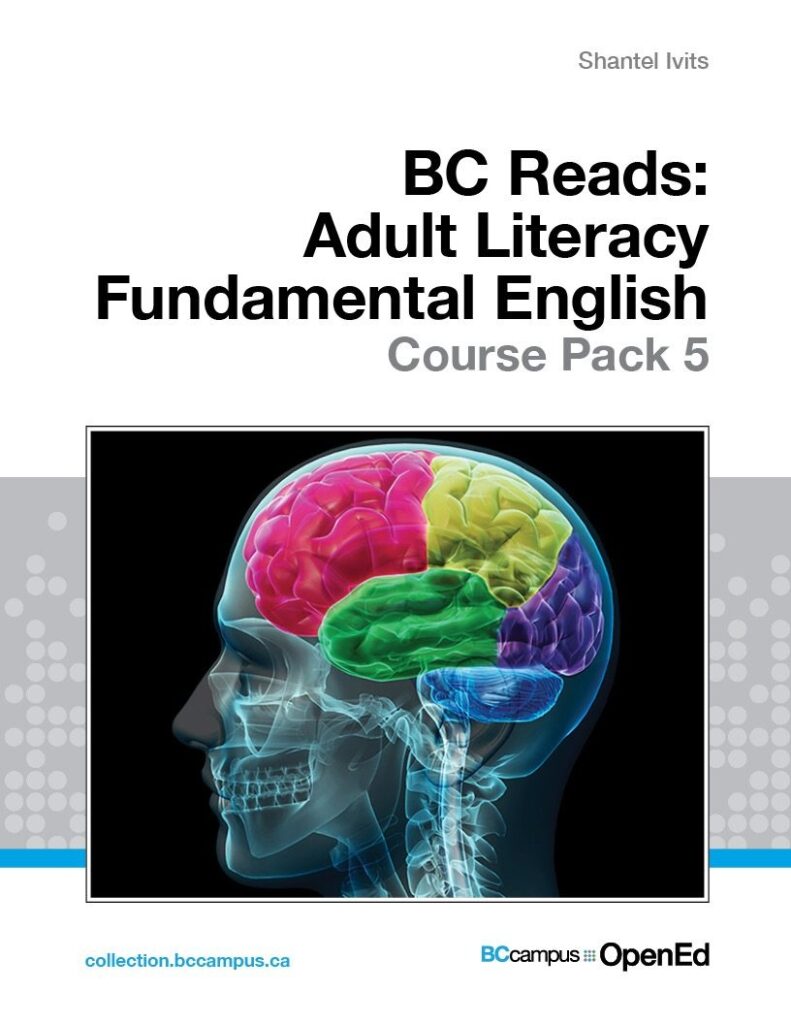
BC Reads: Adult Literacy Fundamental English — Shantel Ivits. © 2015 Shantel IvitsThe CC licence permits you to retain, reuse, copy, redistribute, and revise this book—in whole or in part—for free providing the author is attributed as follows:BC Reads: Adult Literacy Fundamental English – Course Pack 5 by Shantel Ivits is used under a CC BY 4.0 licence.If you redistribute all or part of this book, you must include the following on the copyright page:Download for free from the B.C. Open Collection.This textbook can be referenced. In APA citation style, it should appear as follows:Ivits, S. (2015). BC Reads: Adult Literacy Fundamental English – Course Pack 5. Victoria, B.C.: BCampus. Retrieved from https://opentextbc.ca/abealf5/.Cover image attribution:Brain lobes by Allan Ajifo is used under a CC BY 2.0 licence.Visit BCcampus Open Education to learn about open education in British Columbia.
Original publication · CC BY 4.0
The following titles follow the attached PDF.
Book summary
BC Reads: Adult Literacy Fundamental English – Course Pack 5 by Shantel Ivits develops reading and writing through nine units about the brain, learning, memory, personality, and well-being. Each unit uses a reading in the companion Reader 5 as a starting point for vocabulary, comprehension, spelling, grammar, and paragraph development. The book’s purpose is adult literacy instruction, and its brain-themed readings should not be treated as individualized psychological assessment or a current neuroscience review. This guide explains both the topic sequence and the language skills learners practise throughout the course pack.
Unit-by-unit summaries
1. The Most Amazing Structure on Earth
The opening unit uses the brain as an engaging topic for reading closely and identifying central ideas. Vocabulary, end punctuation, sentence subjects, and paragraph writing establish a repeatable learning routine. Separate a reading’s main point from the facts or examples used to support it. Then write a short paragraph with an identifiable topic and connected details. The important achievement is being able to explain the text in your own words and organize a response, rather than simply recalling striking comparisons or numbers from the reading.
2. The Many Faces of Genius
This unit broadens the conversation about ability and the different forms achievement can take. Its literacy activities ask learners to understand examples, build vocabulary, and develop clearer sentences and paragraphs. Compare the people or abilities discussed without assuming that a label such as genius measures every aspect of a person. Choose a main idea and explain how the examples support it. Relate the reading to a strength you have developed, using a specific event rather than a general statement about being good or bad at learning. The unit also practises colons and identifying a sentence’s verb; connect each grammar choice with the meaning it helps express.
3. The Many Pathways to Knowledge
Ways of learning become the context for comprehension and writing practice. The unit encourages reflection on experience while continuing the course pack’s systematic language work. Distinguish a preference for an activity from a claim that it is the only way you can learn. Identify what the reading says, what your experience suggests, and what would require further evidence. For a writing task, organize several approaches under a clear main point and use examples that help a reader understand the connection among them. Its grammar work addresses contractions and sentence fragments, helping learners distinguish abbreviated forms from incomplete thoughts.
4. Boost Your Brainpower
The fourth unit links the theme of learning and everyday habits with practice in extracting useful information from a text. Learners continue to work on vocabulary, sentence accuracy, and supported writing. Turn the reading into a short list of claims, then identify the reasons or illustrations attached to each. When writing a response, distinguish the source’s recommendation from your own experience. A useful literacy goal is explaining an idea accurately with appropriate qualification, rather than promising that one habit will produce the same result for everyone. Commas in a series and compound sentences support the organization of related ideas in the unit’s written work.
5. Memory Magic
Memory provides a concrete topic for exploring strategies and organizing information. The unit asks learners to engage with a reading, practise language forms, and produce a structured response. Try a classroom memory exercise and record what you actually did, what you recalled, and what remained difficult. Compare that account with the reading without turning a small personal result into proof of a universal claim. In writing, make the sequence clear enough that another learner can understand the method and the limits of the observation. Transition words and run-on sentences supply an editing focus: clarify connections without joining independent thoughts incorrectly.
6. Put to the Test
Testing raises questions about preparation, performance, and how learning is assessed. The course-pack activities use those questions to develop comprehension and written explanation. Distinguish what a particular test asks you to do from a broad judgment about your ability. Use the reading and a specific learning experience to discuss preparation or difficulty. A practical writing exercise is to explain a plan in a clear sequence, then check whether each sentence contributes a distinct step. The unit supports reflection that leads to manageable learning actions. Direct quotations and complex sentences help learners integrate another voice and express relationships between ideas.
7. The Sixth Sense: Intuition
The intuition theme invites learners to examine how a text explains an experience that may feel immediate or hard to describe. Comprehension involves distinguishing the author’s explanation from examples, impressions, and personal beliefs. Summarize a claim with enough context to avoid exaggerating it. For a response paragraph, use a concrete situation and explain why it is relevant, while acknowledging what the example cannot establish. The language goal is a clear relationship between statement and support, especially when the subject encourages strong personal reactions. Commas with place names and dates and subject-verb agreement provide the unit’s explicit language practice.
8. The Big Five: Personality
Personality becomes the topic for reading categories and discussing variation. Learners should distinguish a broad descriptive framework from a complete account of an individual. The course pack uses the theme to practise comprehension, vocabulary, and writing, not to diagnose or fix someone’s identity. Compare descriptions carefully and avoid treating a category as destiny. In a paragraph, develop one focused point with examples and qualifications. This allows a reader to follow an observation without being asked to accept an oversimplified judgment about a person. Appositives and shifting verb tense add an editing focus on explanatory detail and consistent time reference.
9. Secrets of a Happy Brain
The final unit uses well-being as a context for integrating the reading and writing skills developed across the course. Learners identify key ideas, examine support, and formulate a response that connects ideas coherently. Separate what the text proposes from what you can responsibly conclude about your own life. Review an early paragraph beside a final paragraph and identify improvements in focus, support, sentence clarity, and editing. The course ends with evidence of growing literacy and reflective skill rather than a promise of a single formula for happiness. Possessive apostrophes provide the closing unit’s punctuation focus and another opportunity to distinguish meaning from surface form.
Study instructions
- Follow each unit’s routine: preview the topic, read the companion Reader 5 selection, record unfamiliar vocabulary, answer comprehension questions, and draft the writing task.
- Use the answer keys after an independent attempt. For each error, explain the rule or reading evidence that changes your answer.
- Build a paragraph portfolio with an initial draft, feedback, a revision, and one sentence explaining what improved.
- Use the graphic organizers and writing-assessment checklists to plan and review a main idea, supporting details, order, and sentence accuracy.
- Keep source claims, personal examples, and wider scientific questions separate. Use the brain theme to practise careful reading rather than self-diagnosis.
Questions for reflection
- How do you identify a paragraph’s main idea when several facts seem interesting?
- What makes a personal example useful support, and what can it not prove?
- How can a writing checklist make revision more manageable?
- Which skill shows the clearest improvement between your first and last writing samples?
Sources and coverage
This original study guide follows all main chapters of the source edition linked below. Summaries explain the central concepts and their connections; practice tasks and reflection questions are editorial study aids. Consult the complete text for worked examples, figures, exercises, and references. Read the source edition.
About access & copyright
Check this edition’s source and licence before reusing its files or content. A library listing does not grant additional rights.
Read our Library Access & Copyright policyReading practice
Work with accessible readings about the human brain.
Language skills
Connect vocabulary, spelling, grammar, and writing.
Comprehension
Explore learning, memory, intuition, and personality.
Course sequence
Use the course pack alongside its companion reader.
Reader ratings & reviews
Share your thoughts
Your review helps other students choose the right resources.
KEEP LEARNING
Your next great read
Humanities Humanities
Stand up, Speak out - The Practice and Ethics of Public Speaking
View Stand up, Speak out - The Practice and Ethics of Public Speaking — book Humanities
Yorùbá Yé Mi
View Yorùbá Yé Mi — book Humanities
The Process of Research Writing
View The Process of Research Writing — book Humanities
Modern Philosophy
View Modern Philosophy — book Humanities
A Foundation Course in Reading German
View A Foundation Course in Reading German — book Humanities
Intermediate Biblical Greek Reader: Galatians and Related Texts
View Intermediate Biblical Greek Reader: Galatians and Related Texts — book Arts
Vocal Techniques for the Instrumentalist
View Vocal Techniques for the Instrumentalist — book Arts
Music on the Move
View Music on the Move — book Humanities



