
 Medicine
Textbook
Athletic Therapy Skills: Support Techniques
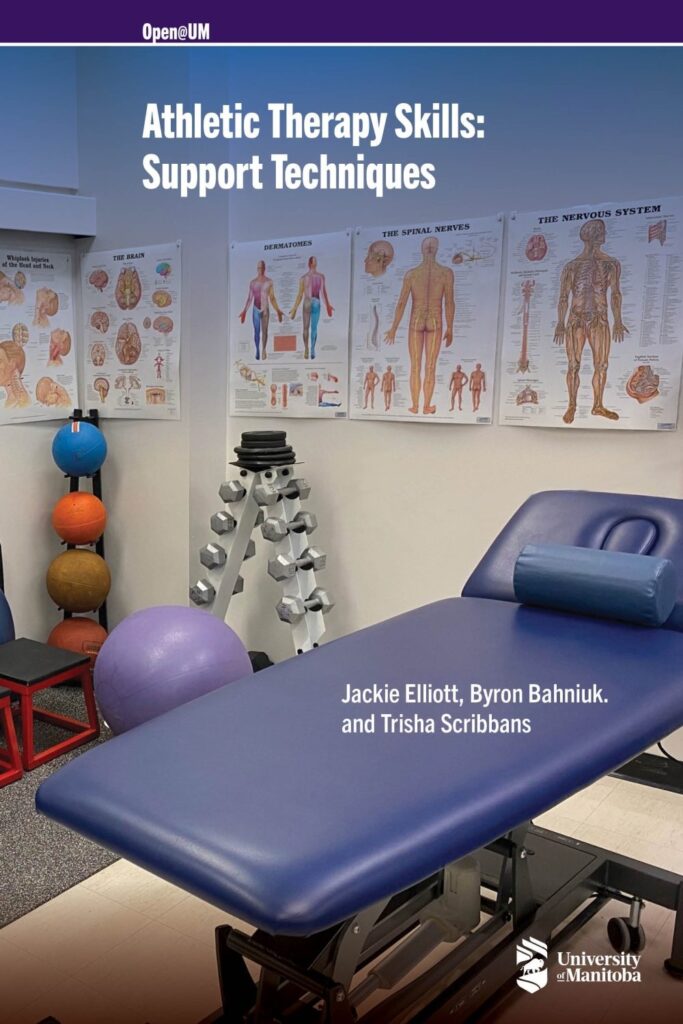
Not rated yetRate this bookAthletic Therapy Skills: Support Techniques by Jackie Elliott, Byron Bahniuk, and Trisha Scribbans links taping and wrapping with anatomical reasoning and assessment. Seven introductory chapters establish principles, material selection, removal, and pre- and post-application evaluation. Seventeen technique chapters then address specific regions from the ankle to the hand. Their recurring structure connects purpose, materials, screening, application, and functional testing. This guide explains those relationships for learners; it does not replace injury assessment, supervised practical instruction, or a clinician’s decision about suitability and return to activity.
 Free
About this book
Athletic Therapy Skills: Support Techniques by Jackie Elliott, Byron Bahniuk, and Trisha Scribbans links taping and wrapping with anatomical reasoning and assessment. Seven introductory chapters establish principles, material selection, removal, and pre- and post-application evaluation. Seventeen technique chapters then address specific regions from the ankle to the hand. Their recurring structure connects purpose, materials, screening, application, and functional testing. This guide explains those relationships for learners; it does not replace injury assessment, supervised practical instruction, or a clinician’s decision about suitability and return to activity.
Athletic Therapy Skills: Support Techniques — Jackie Elliott, Byron Bahniuk, Trisha Scribbans. Text © 2025 Jackie Elliott, Byron Bahniuk, and Trisha Scribbans Images and video © 2025 University of Manitoba Athletic Therapy Program The publication, including all text and video elements, is licensed under Creative Commons Attribution 4.0 International License ( CC-BY ). Attribution footer added by Academic Master; textbook content retained.
Original publication · CC BY 4.0
The following titles follow the attached PDF.
Book summary
About this book
Athletic Therapy Skills: Support Techniques by Jackie Elliott, Byron Bahniuk, and Trisha Scribbans links taping and wrapping with anatomical reasoning and assessment. Seven introductory chapters establish principles, material selection, removal, and pre- and post-application evaluation. Seventeen technique chapters then address specific regions from the ankle to the hand. Their recurring structure connects purpose, materials, screening, application, and functional testing. This guide explains those relationships for learners; it does not replace injury assessment, supervised practical instruction, or a clinician’s decision about suitability and return to activity.
Chapter-by-chapter summaries
1. Support Technique Application Principles
External support aims to protect injured structures while preserving appropriate function. The chapter connects limiting harmful movement with controlling swelling and avoiding secondary problems. These are purposes to evaluate, not guaranteed outcomes from putting tape on a body part. Distinguish a support’s intended mechanical role from the underlying injury and recovery process. A useful study question is what movement the technique is meant to limit and what useful movement should remain possible after it is applied.
2. Factors to Consider Before Application
History, mechanism, injured structure, severity, stage of recovery, previous assessment, and the activity’s demands inform suitability. The chapter makes assessment a prerequisite rather than an optional addition to a familiar technique. Write a case-based list of information still needed before a decision could be made. An anatomical label alone does not establish that two people need the same support, because the injury and functional context may differ substantially.
3. Factors Affecting Effectiveness
Positioning, adherence, material behavior, fit, and tension influence the result. Support that is too loose may not serve its purpose, while excessive restriction can create new problems. The chapter explains why application quality depends on more than reproducing a visible pattern. Compare the intended alignment and movement with the observed result in a supervised simulation. Evaluate effectiveness through the individual’s response and the required function rather than the appearance of the finished tape alone.
4. Types and Quality of Taping Material
Elastic and rigid products provide different combinations of conformity, movement, and mechanical restraint. Selection also involves adhesive properties, availability, and the intended application. Make a comparison table that links each material property to a purpose. The point is not that one product is universally superior, but that a support needs material behavior consistent with its design. Check the source’s materials list and any allergy or skin considerations before supervised practice.
5. Tape Grades
Weave density, tensile strength, adhesive quality, and material composition influence performance. A product’s color or familiar name does not by itself establish those characteristics. Compare how two hypothetical tapes could differ in durability and adherence despite having similar dimensions. This chapter provides a basis for explaining material choice rather than judging quality solely by cost. Performance should be considered under the demands and conditions of the particular activity.
6. Tape Removal
Removal is part of the complete support process because skin and underlying tissues still require protection. The chapter introduces removal tools and the need for controlled handling rather than hurried cutting or pulling. Study the illustrated method with an instructor and identify how the tool’s path is kept appropriate. Afterwards, assessment of the skin and the person’s response completes the process; successful application does not excuse careless removal.
7. Standard Pre- and Post-Taping Protocol
The common protocol connects mechanism and history with allergy screening, skin inspection, and baseline motor, sensory, and circulatory findings. Reassessment and activity-related testing then evaluate the result. Compare findings before and after a simulated application, keeping a record of any change. This chapter supplies the framework repeated throughout the regional techniques. A visually tidy support is not an adequate endpoint if its effect on comfort, circulation, sensation, or function has not been evaluated.
8. Ankle Taping
The ankle chapter addresses limiting excessive inversion or eversion while supporting function. Its components are understood in relation to the position and movements of the ankle and subtalar region. Draw the movements before studying the tape pattern, then explain which parts of the design address them. The pre- and post-taping checks remain essential; completing the pattern does not establish that an injured athlete is ready to resume participation.
9. Turf Toe Support
The focus shifts to excessive movement at the first metatarsophalangeal joint, especially hyperextension during push-off. The chapter’s materials and alternatives serve a different target from a general ankle support. Compare the two joints and their activity demands before comparing techniques. In a supervised demonstration, explain how the intended restriction relates to the described mechanism. Avoid assuming that pain around the big toe has a single cause or automatically indicates the same application.
10. Arch Support
This technique aims to support the foot’s arches, particularly the medial longitudinal arch, and reduce strain on related structures. The chapter connects the presenting problem with possible injury, repetitive loading, alignment, and footwear factors. Draw the arch and describe the intended support direction. Then identify which wider contributing factors tape alone cannot resolve. This makes the technique part of an assessment-based plan rather than an explanation that attributes every foot symptom to a low arch.
11. Heel Cup Support
The heel-cup chapter focuses on support and compression of the calcaneal fat pad. Its target differs from the longitudinal arch even though both techniques involve the foot. Compare the anatomical location, intended effect, and functional evaluation of the two applications. The distinction helps learners avoid treating regional proximity as evidence that techniques are interchangeable. The original demonstration and supervised assessment are needed to judge the actual application and its effect.
12. Achilles Tendon Support
The source describes a support intended to limit excessive dorsiflexion and reduce demand on the Achilles region. The mechanical goal must be understood alongside the nature and stage of the assessed problem. Trace the relationship among calf, tendon, heel, and ankle movement before reading the application. Explain what motion is being moderated and how useful activity is evaluated afterward. Do not equate external restriction with repair of the tendon or clearance for sport.
13. Patellar Tendon Support: Cho-Pat
This chapter addresses loading around the patellar tendon with a support intended to alter local demand during activity. It differs from a ligament-stability application at the same knee. Identify the tendon’s anatomical relationship to the patella and tibial attachment, then compare the purpose with the next chapter. The book’s discussion supplies a rationale for study; the presence of anterior knee pain alone does not establish the diagnosis or suitability of a particular support.
14. MCL/LCL Support
The fan technique is associated with limiting excessive valgus or varus loading after assessed collateral-ligament injury. Direction matters because medial and lateral structures respond differently to the movement being restrained. Sketch both movements and label the relevant side before studying the pattern. Compare stability goals with the patellar-tendon chapter’s loading goal. A support’s intended function is specific, and the common assessment and post-application checks remain necessary regardless of the region.
15. Hip and Hip-Flexor Spica
The hip-flexor chapter uses wrapping to support the region and moderate excessive extension. It connects the application with the muscular structures being protected and with compression. Use an anatomical sketch to explain why extension can challenge the target tissues. Consider how a wrap crossing the hip must permit appropriate activity while serving its intended purpose. The technique is best learned through the complete demonstration and instructor feedback rather than by copying the visible crossing pattern alone.
16. Groin and Adductor Wrap
The adductor-focused wrap addresses a different set of structures and movement demands, particularly excessive abduction and external rotation in the source’s description. Contrast it with the hip-flexor spica using the same limb diagram. Identify the intended restriction before discussing materials or appearance. This comparison helps learners explain why two wraps around a similar region have different rationales. Screening, individual anatomy, comfort, and the activity-specific reassessment must guide the supervised exercise.
17. Herringbone Support for Quadriceps
The herringbone pattern provides support and compression for muscular strain, with the source noting related applications to other muscle groups. The chapter encourages understanding the relationship between the pattern and the tissue rather than treating it as a named decoration. Map the injured region in a case and state the intended effect. Any extension to another muscle requires its own assessment and teaching context; a shared pattern does not establish that all strains should be handled identically.
18. Shoulder Spica
The shoulder wrap addresses support around the glenohumeral region and can also secure protective material. Its described movement restrictions differ from those at the hip despite sharing the spica name. Identify the joint involved, the movement intended to be moderated, and the practical demands of the person’s activity. Compare the support goal with the next chapter’s more localized AC-joint focus. The distinction helps keep anatomical reasoning ahead of memorizing a wrapping sequence.
19. Acromioclavicular Joint Support
This chapter targets the relationship between the clavicle and acromion in an assessed AC-joint injury. Its local support goal is distinct from stabilizing the entire shoulder complex. Draw the two structures and locate the support’s intended action before studying the demonstration. Discuss what assessment must establish before applying it and what function must be evaluated afterward. The technique should not be interpreted as a way for an unassessed shoulder injury to bypass professional evaluation.
20. Elbow Hyperextension Fan
The elbow fan is designed to limit excessive or painful extension while supporting appropriate movement. Learners should distinguish the intended end-range restriction from completely immobilizing the joint. Sketch the movement and identify the structures considered in the source’s rationale. During supervised practice, relate the chosen position and pattern to that purpose. The post-application evaluation asks whether the person can perform the permitted task appropriately, rather than whether the tape simply feels firm.
21. Wrist Bar Block
The bar-block method addresses excessive wrist extension or flexion after the relevant assessment. The direction of protection and the individual’s required hand use determine the application’s goal. Compare a flexion-limiting plan with an extension-limiting plan before studying placement. This clarifies that a wrist support is not a generic tight band. Material choices and optional padding belong to a complete technique whose effectiveness and distal function require evaluation.
22. Wrist Fan
The fan provides an alternative wrist-support arrangement for the movement restrictions discussed in the previous chapter. Compare the two methods by intended effect, construction, and functional demands rather than declaring one universally better. Explain which similarities come from their shared anatomical target and which differences arise from the support design. The common history, skin, allergy, and motor-sensory-circulatory checks apply to both. A familiar region never removes the need to reassess the person and the result.
23. Thumb Hyperextension and Abduction Support
The thumb chapter focuses on limiting excessive extension and abduction in relation to assessed ligament injury. Its functional demands differ from those of the wrist because grasp and hand use depend on thumb motion. Sketch the target movements and compare them with the wrist techniques. The educational challenge is balancing the intended protection with appropriate function. Technique completion should therefore be followed by the prescribed assessment and activity-specific evaluation in the supervised learning context.
24. Thumb Checkrein and Buddy-Finger Techniques
The final chapter adds checkrein and buddy-finger support concepts, extending the learner’s comparison of small-joint protection and retained function. Padding, alignment, and the relationship between adjacent digits become important topics for the practical demonstration. Compare the intended purpose with the preceding thumb technique and identify which anatomical and activity factors must be considered before selection. The book closes by applying the same principles introduced at the beginning: assess suitability, understand the target movement, choose appropriate materials, and evaluate the actual response.
Study instructions
- Learn the first seven chapters before the regional techniques. Make a standard worksheet for history, purpose, screening, baseline findings, and post-application evaluation.
- For each technique, draw the anatomy and target movement before watching the demonstration. Explain what should be limited and what function should remain.
- Create comparison pairs: arch versus heel cup, patellar tendon versus collateral ligament, shoulder spica versus AC support, and wrist bar block versus fan.
- Practise only within instructor-approved training and supervision. Use the original materials lists, demonstrations, and assessment requirements rather than a summary as an application protocol.
- After a supervised exercise, document the result, feedback, and changes needed. Treat taping skill and return-to-activity clearance as separate judgments.
Questions for reflection
- Why can a support’s neat appearance tell you little about its suitability?
- How do elastic and rigid materials change the intended behavior of a technique?
- Which regional techniques have similar appearances but different anatomical purposes?
- Why must motor, sensory, circulatory, skin, and functional findings be considered before and after application?
Sources and coverage
This original study guide follows all main chapters of the source edition linked below. Summaries explain the central concepts and their connections; practice tasks and reflection questions are editorial study aids. Consult the complete text for worked examples, figures, exercises, and references. Technique descriptions explain the textbook for supervised education; they are not self-treatment instructions or return-to-sport clearance. Read the source edition.
About access & copyright
Check this edition’s source and licence before reusing its files or content. A library listing does not grant additional rights.
Read our Library Access & Copyright policyPreparation
Consider purpose, materials, and pre-application assessment.
Technique principles
Relate support methods to their intended function.
Effectiveness
Recognize factors affecting the usefulness of support.
Evaluation
Connect application with the book’s post-technique assessment protocols.
Reader ratings & reviews
Share your thoughts
Your review helps other students choose the right resources.
KEEP LEARNING
Your next great read
Medicine Medicine
Public Health Ethics: Cases Spanning the Globe
View Public Health Ethics: Cases Spanning the Globe — book Medicine
Cell Biology, Genetics, and Biochemistry for Pre-Clinical Students
View Cell Biology, Genetics, and Biochemistry for Pre-Clinical Students — book Medicine
Applying the International Classification of Functioning, Disability & Health: A Team-Based/Project Based Course for Undergraduate Students
View Applying the International Classification of Functioning, Disability & Health: A Team-Based/Project Based Course for Undergraduate Students — book Medicine
Urinalysis Atlas: A Pictorial Guide to Formed Elements in Urine (Doty and Taylor)
View Urinalysis Atlas: A Pictorial Guide to Formed Elements in Urine (Doty and Taylor) — book Medicine
Drug Use and Misuse: A Community Health Perspective
View Drug Use and Misuse: A Community Health Perspective — book Medicine
Neuroscience for Pre-Clinical Students
View Neuroscience for Pre-Clinical Students — book Medicine
Cardiovascular Pathophysiology for Pre-Clinical Students
View Cardiovascular Pathophysiology for Pre-Clinical Students — book Medicine
Pulmonary Physiology for Pre-Clinical Students
View Pulmonary Physiology for Pre-Clinical Students — book Medicine



