
Open Data Structures: An Introduction
Computer ScienceTextbook
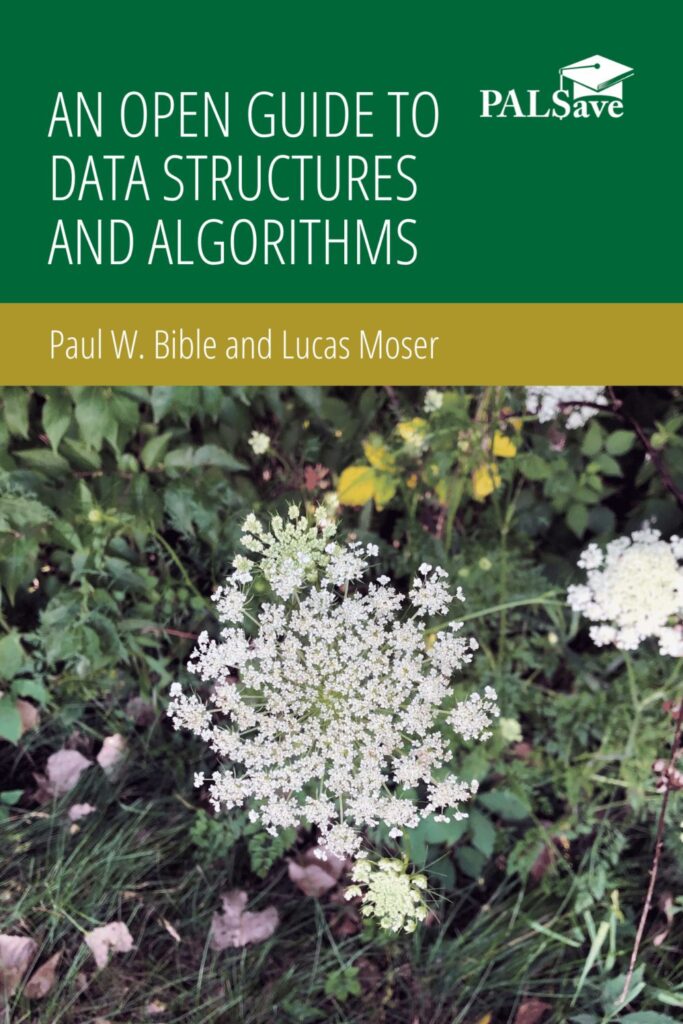
An Open Guide to Data Structures and Algorithms
Not rated yetRate this bookAn Open Guide to Data Structures and Algorithms by Paul W. Bible and Lucas Moser asks learners to connect programming knowledge with the design and analysis of solutions. Twelve chapters move from complexity and recursion to sorting, searching, linked structures, hashing, trees, heaps, dynamic programming, graphs, and computational difficulty. The recurring question is not merely whether an implementation works on one input, but what properties it preserves, what resources it uses, and why it suits a task. This guide follows the source’s full chapter sequence and links theoretical reasoning with concrete tracing and implementation exercises.
 Free
About this book
An Open Guide to Data Structures and Algorithms by Paul W. Bible and Lucas Moser asks learners to connect programming knowledge with the design and analysis of solutions. Twelve chapters move from complexity and recursion to sorting, searching, linked structures, hashing, trees, heaps, dynamic programming, graphs, and computational difficulty. The recurring question is not merely whether an implementation works on one input, but what properties it preserves, what resources it uses, and why it suits a task. This guide follows the source’s full chapter sequence and links theoretical reasoning with concrete tracing and implementation exercises.
An Open Guide to Data Structures and Algorithms — Paul W. Bible, Lucas Moser. Original publisher copyright and third-party credits remain in the unmodified book.
Original publication · CC BY 4.0
The following titles follow the attached PDF.
Book summary
About this book
An Open Guide to Data Structures and Algorithms by Paul W. Bible and Lucas Moser asks learners to connect programming knowledge with the design and analysis of solutions. Twelve chapters move from complexity and recursion to sorting, searching, linked structures, hashing, trees, heaps, dynamic programming, graphs, and computational difficulty. The recurring question is not merely whether an implementation works on one input, but what properties it preserves, what resources it uses, and why it suits a task. This guide follows the source’s full chapter sequence and links theoretical reasoning with concrete tracing and implementation exercises.
Chapter-by-chapter summaries
1. Algorithms, Big-O, and Complexity
Algorithms organize computational work into explicit steps, and complexity describes how resource needs grow with input size. Big-O abstracts from particular hardware, but the abstraction must be applied to a defined input and operation. Distinguish an asymptotic growth claim from a measurement of elapsed time. Count operations in a small loop, explain the dominant term, and compare the prediction with several input sizes. The chapter’s larger purpose is to make problem-solving choices explainable instead of relying on the appearance of code or a single fast run.
2. Recursion
Recursive solutions reduce a problem to smaller instances and rely on base cases to stop. The call structure, returned values, and stack use matter as much as the compactness of the source code. Trace both the descent into smaller problems and the return of partial answers. State a measure that decreases toward the base case and identify what happens on the smallest permitted input. Compare repeated subproblems with genuinely independent work; that distinction becomes important when the book later introduces dynamic programming.
3. Sorting
Sorting provides a family of algorithms for comparing design approaches and complexity. Simple methods make repeated comparisons and movements visible, while more advanced approaches organize work to improve growth behavior under their assumptions. Trace a small input through each method studied in the chapter, counting the kind of operation being compared consistently. Include ordered, reverse-ordered, and duplicate-rich data. A meaningful comparison considers behavior across inputs and properties such as auxiliary storage and preservation of equal-item order, rather than assuming one named sort is best in every context.
4. Search
Linear search checks candidates directly, while binary search repeatedly narrows an ordered search region. The latter’s speed depends on the required ordering and access assumptions. Maintain an explicit interval invariant while tracing a successful and unsuccessful search. Then compare total work for a workload with many queries: preparing sorted data may be worthwhile in one setting and unnecessary in another. The chapter’s exercises encourage including preprocessing cost, illustrating why evaluating a single search operation in isolation can misrepresent the practical decision.
5. Linked Lists
Nodes and references provide a representation whose operations differ from those of an array. Traversal, insertion, removal, singly and doubly linked forms, and optional tail or length fields expose the importance of invariants. Draw every changed reference when editing a list, including empty, first-node, and last-node cases. Explain which extra fields make a particular operation faster and which fields must then be maintained. The abstract list behavior can remain the same while its representation changes, but runtime and error risks depend on the implementation.
6. Stacks and Queues
Last-in-first-out and first-in-first-out behavior define different abstract data types. Linked and array-based representations can implement them, with allocation and operation costs influencing the choice. An array queue’s wraparound organization shows why physical index order need not match logical order. Trace operations on a small bounded representation and label front, back, and occupancy separately. When using a language’s built-in container, investigate the operations actually invoked; choosing a familiar method name does not establish that it has the required complexity.
7. Hashing and Hash Tables
Hash functions map keys toward storage locations, while collisions require strategies such as probing or chaining. Load and clustering affect performance, so the expectation of rapid access depends on more than the existence of a hash function. Insert a deliberately colliding set of keys by several methods and trace successful and unsuccessful lookups. Compare how the representation indicates an available location or a missing key. The chapter encourages evaluating space, collision behavior, and workload rather than treating expected constant-time access as an unconditional guarantee.
8. Search Trees
Binary search trees organize keys through an ordering invariant. Search, insertion, and deletion must preserve that invariant, particularly when removing a node with two children. Height controls performance, and an unbalanced tree can lose the efficiency suggested by its branching shape. Draw trees produced by different insertion orders and compare path lengths. Study self-balancing approaches, including the chapter’s AVL discussion, as ways of maintaining useful structural properties. The lesson is that a data structure’s name does not by itself guarantee the shape on which a complexity claim depends.
9. Priority Queues
A priority queue selects by priority rather than arrival order. Binary heaps support this through a structural arrangement and heap-order property, while binomial heaps illustrate different costs for operations such as merging. Distinguish the abstract selection behavior from the chosen representation. Trace insertion and extraction, checking both the ordering property and the representation’s shape. Compare workloads with frequent merging against workloads dominated by ordinary access. The chapter’s implementation comparisons also invite reflection on locality and practical performance alongside the asymptotic operation table.
10. Dynamic Programming
Overlapping subproblems and reusable optimal results motivate storing work rather than repeating it. Matrix-chain multiplication and longest common subsequence demonstrate how states, recurrences, base cases, and reconstruction fit together. Define the meaning of one table entry before filling the table. Then explain why the computation order makes its dependencies available. Compare a final numerical optimum with recovering the choices that produce it. Dynamic programming is not merely replacing recursion with a table; the essential reasoning lies in the state definition and the recurrence’s correctness.
11. Graphs
Vertices and edges represent relationships that simpler sequential structures cannot express directly. Adjacency matrices and lists trade space and access behavior, while traversal algorithms use systematic rules to explore connections. State whether a graph is directed, weighted, or otherwise constrained before selecting an algorithm. Trace the visited set and frontier on a small example containing a cycle and a disconnected component. Explain how representation affects the work performed. A correct traversal depends on both the algorithm’s rules and a model that accurately reflects the problem’s relationships.
12. Hard Problems
The final chapter distinguishes algorithmic difficulty from ordinary implementation inconvenience. P, NP, reductions, NP-hardness, and NP-completeness organize questions about efficient solution and verification, while the halting problem introduces a different limit: undecidability. Approximation and heuristics provide practical responses when exact computation is unsuitable. Explain a reduction’s direction carefully and avoid treating NP as a synonym for proven exponential time. The conclusion asks learners to recognize when improving code is insufficient and the problem’s mathematical structure must inform expectations and solution strategy.
Study instructions
- For every algorithm, write the input assumptions, output requirement, invariant, termination argument, and time and space costs before implementation.
- Use small hand-traced cases that expose boundaries: empty input, one item, duplicates, missing keys, collisions, skewed trees, and graph cycles.
- Compare representations using one workload with stated operation frequencies. Include preparation and maintenance costs in the comparison.
- Implement selected exercises, verify correctness separately from timing, then measure several input sizes and explain differences from asymptotic predictions.
- For dynamic programming, define each state in words and reconstruct one solution. For complexity classes, practise precise definitions and reduction directions.
Questions for reflection
- When can a faster individual query produce a slower total workload?
- Which invariant is easiest to break when deleting a linked-list or tree node?
- Why is a dynamic-programming table meaningless without a precise state definition?
- How do NP-completeness and undecidability describe different kinds of limitation?
Sources and coverage
This original study guide follows all main chapters of the source edition linked below. Summaries explain the central concepts and their connections; practice tasks and reflection questions are editorial study aids. Consult the complete text for worked examples, figures, exercises, and references. Read the source edition.
About access & copyright
Check this edition’s source and licence before reusing its files or content. A library listing does not grant additional rights.
Read our Library Access & Copyright policyComplexity
Compare algorithms through their growth and resource needs.
Data structures
Connect organization of data with supported operations.
Problem solving
Explore recursion, dynamic programming, and graph methods.
Limits
Recognize that some computational problems are difficult to solve efficiently.
Reader ratings & reviews
Share your thoughts
Your review helps other students choose the right resources.
KEEP LEARNING
Your next great read
Computer Science
Foundations of Computation
Foundations of Computation
View Foundations of Computation — bookThink Bayes: Bayesian Statistics Made Simple
Think Bayes: Bayesian Statistics Made Simple
View Think Bayes: Bayesian Statistics Made Simple — book Computer Science
Python for Everybody: Exploring Data Using Python 3
View Python for Everybody: Exploring Data Using Python 3 — book Computer Science
An Introduction to Computer Networks
View An Introduction to Computer Networks — book Computer Science
Introduction to Computer Graphics
View Introduction to Computer Graphics — book Computer Science
Introduction to Programming Using Java
View Introduction to Programming Using Java — book Computer Science
Nature of Geographic Information
View Nature of Geographic Information — book Computer Science
Java with BlueJ Part 2
View Java with BlueJ Part 2 — book Computer Science



