
Introduction
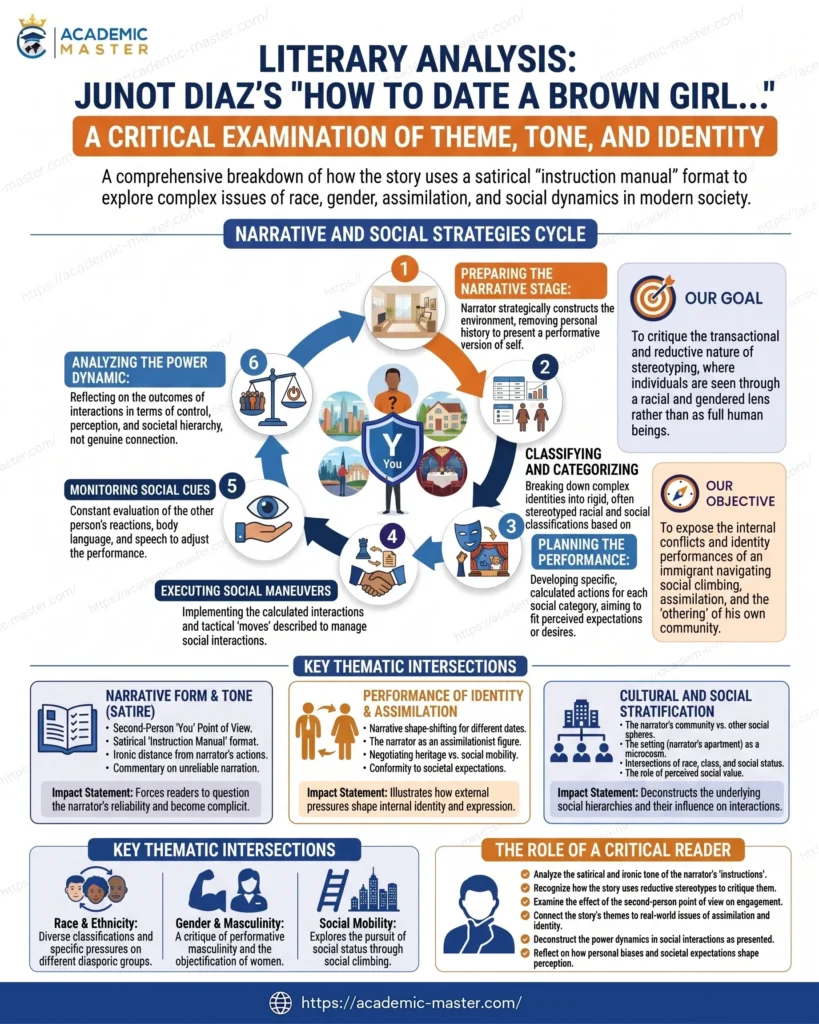
Junot Díaz’s short story “How to Date a Browngirl, Blackgirl, Whitegirl, or Halfie,” first published in The New Yorker and later collected in Drown, uses the form of a dating manual to expose the pressures shaping Yunior, a Dominican American teenager in New Jersey. The story is narrated in the second person, so Yunior’s private anxieties are converted into commands about how “you” should prepare an apartment, speak, eat, touch, and behave depending on the race and class of the expected date. That confident instructional voice is deliberately unstable. Yunior appears to possess a system for controlling social encounters, yet the details reveal embarrassment about poverty, fear of rejection, and a masculinity built on prediction rather than genuine intimacy (Díaz, 1996). Race, class, migration, language, and gender therefore operate together rather than as separate themes. The story’s stereotypes should not be treated as Díaz’s instructions to readers; they reveal the social scripts Yunior has absorbed and the emotional costs of relying on them.
Second-Person Narration and Yunior’s Unreliable Authority
The second-person point of view is central because it turns insecurity into procedure. Instead of confessing that he is ashamed of government cheese or worried that a visitor will judge his neighborhood, Yunior directs an imagined listener to hide evidence, arrange the apartment, and adjust behavior before the girl arrives. Grammar becomes a defense mechanism: the command form allows him to sound experienced while avoiding the first-person vulnerability that would accompany “I am embarrassed” or “I am afraid she will reject me.” The same device implicates readers by temporarily placing them inside his racial and gender calculations. They must hear instructions that classify women before meeting them and decide whether to comply, resist, or recognize their absurdity. Because Yunior is both narrator and character, his claims cannot be accepted as reliable social truths. Díaz uses exaggeration and contradiction to expose how little Yunior actually knows about the individual girls he reduces to categories, making narrative form part of the story’s critique (Díaz, 1996).
Race, Class, and the Performance of Respectability
Race and class become most visible through Yunior’s preparation of the apartment. He anticipates that a white or middle-class girl may interpret the family’s food, housing, and neighborhood as signs of poverty or immigrant difference, so he curates the domestic space before the date. Hiding government-issued food is not merely ordinary teenage tidying; it shows his awareness that economic hardship may be read through racial stereotypes about Dominican families. The apartment therefore becomes a stage on which he attempts to perform respectability. The title’s categories—“browngirl, blackgirl, whitegirl, or halfie”—extend that performance because Yunior predicts behavior, parental rules, sexuality, and class expectations from racial identity before the encounter begins. Machado Sáez (2011) argues that Caribbean diasporic fiction often confronts market expectations for easily consumable ethnic identity. Díaz’s story resists such simplicity by showing how categories can organize perception while failing to capture individual people. Yunior’s system promises certainty, but its very rigidity reveals insecurity.
Code-Switching, Language, and Cultural Multiplicity
Language provides another form of social positioning. Díaz mixes English with Spanish, Dominican references, slang, and neighborhood speech without consistently translating or explaining them for an English-dominant audience. The effect is not decorative ethnicity but a representation of multilingual experience in which speakers move among linguistic and cultural settings without treating one language as the unquestioned norm. Ch’ien (2005) describes the capacity of multilingual writers to reshape literary English rather than assimilate completely to standardized expectations, and Díaz’s prose demonstrates that principle. Readers who do not know every Spanish expression may have to infer meaning from context, briefly experiencing the uncertainty routinely imposed on multilingual speakers. Yunior’s code-switching also complicates the idea of a single authentic self. His language changes with audience and situation, just as his dating persona, family identity, and neighborhood identity overlap without becoming identical. The story therefore distinguishes flexible cultural multiplicity from the more damaging self-editing driven by shame, stereotype, or fear of judgment.
Masculinity, Stereotypes, and Consent
The dating manual is also a study of masculinity. Yunior assumes that a successful boy should appear sexually experienced, emotionally controlled, and capable of moving a date through predictable stages. He treats the girl’s reactions as variables to manage and suggests that racial categories can forecast how intimate the encounter will become. That logic reduces women to types and replaces communication with strategy. Read from a contemporary ethical perspective, the story demonstrates why consent cannot be inferred from race, class, prior behavior, or a supposedly correct sequence of moves. Consent requires continuing willingness and the freedom to pause or change direction, conditions that Yunior’s formula cannot guarantee. His bravado therefore functions less as evidence of mastery than as protection against embarrassment. The more he insists that he knows what will happen, the more the reader can see that rejection remains possible and that he cannot control another person. Díaz’s irony exposes the fragility beneath a masculinity built on certainty (Díaz, 1996).
Setting, Food, and Satirical Tone
Setting, food, and humor deepen the same critique. Yunior’s New Jersey neighborhood is not a neutral backdrop; he expects an outsider to read streets, buildings, family possessions, and food as information about race and class. A date therefore becomes a tour through a social geography that Yunior tries to manage before anyone arrives. Food carries similar meanings. What remains visible in the kitchen can signify poverty, ethnicity, or belonging depending on the observer, so Yunior attempts to control those interpretations. Díaz presents these anxieties through a comic, blunt, intimate tone in which abrupt commands and exaggerated confidence make the narrator entertaining even when his assumptions are prejudiced or manipulative. The humor does not neutralize those problems. Instead, satire allows readers to recognize the gap between Yunior’s claimed expertise and his actual vulnerability. Machado Sáez (2011) helps explain why this discomfort matters: the story denies readers a flattering, simplified version of Dominican American identity and instead presents contradiction, insecurity, and social performance.
Conclusion
“How to Date a Browngirl, Blackgirl, Whitegirl, or Halfie” remains powerful because its apparently simple dating instructions reveal a complex struggle over identity, belonging, masculinity, race, class, and language. The second-person narration converts Yunior’s shame into commands while implicating readers in the stereotypes he repeats. His apartment preparation shows how poverty and immigrant identity can become objects of social surveillance, and his racial categories demonstrate how stereotypes offer an illusion of control at the cost of recognizing individual people. Díaz’s multilingual prose, by contrast, presents cultural multiplicity as a literary resource rather than a deficiency requiring correction (Ch’ien, 2005). The story’s treatment of gender further undermines Yunior’s confidence because intimacy cannot be ethically or accurately predicted through a racialized formula. Humor and satire keep the narration energetic while exposing the limits of its assumptions. Rather than functioning as an actual guide to dating, the story is best read as a self-revealing portrait of an adolescent trying to manage vulnerability through scripts that repeatedly prove inadequate (Díaz, 1996; Machado Sáez, 2011).
Works Cited
Ch’ien, Evelyn Nien-Ming. Weird English. Harvard University Press, 2005.
Díaz, Junot. Drown. Riverhead Books, 1996.
Machado Sáez, Elena. Market Aesthetics: The Purchase of the Past in Caribbean Diasporic Fiction. University of Virginia Press, 2011.
Cite This Work
To export a reference to this article please select a referencing stye below:

Academic Master Education Team is a group of academic editors and subject specialists responsible for producing structured, research-backed essays across multiple disciplines. Each article is developed following Academic Master’s Editorial Policy and supported by credible academic references. The team ensures clarity, citation accuracy, and adherence to ethical academic writing standards
Content reviewed under Academic Master Editorial Policy.





