
1.1 Introduction of Solar PV Systems
The popularity of renewable energy sources (RES) in electricity generation is diminishing due to the reducing global demand for electricity. RES facilitates the mitigation of global warming and the transition of the conventional electricity grid from a centralized generation system to a decentralized distributed electricity system, incorporating distributed energy resources [1]. The goal of this system is to allow consumers to actively engage in the economy through both energy usage and production. Solar photovoltaic (SPV) technology is an insignificant contributor to the generation of renewable power, delivering electricity at no charge and fostering environmental sustainability [2]. SPV systems have emerged as an undeniable response to addressing the increasing global demand for sustainable and renewable energy sources. By harnessing the copious and environmentally friendly energy emitted by the sun, SPV systems convert sunlight directly into electricity, offering a promising alternative to conventional power generation reliant on fossil fuels. The transition of solar energy into electrical power is accomplished by means of photovoltaic cells, which capture photons emitted by sunlight and generate a flow of electrons, thereby producing a direct current (DC) electrical output [3]. The increasing concern surrounding climate change and the imperative to reduce greenhouse gas emissions have intensified the focus on renewable energy technologies, specifically SPV energy [4]. Solar power presents a convincing resolution to the predicaments of ecological sustainability, energy stability, and worldwide access to electricity. Its decentralized and modular characteristics render it suitable for a vast array of environments, ranging from urban rooftops to isolated rural regions, thereby facilitating the democratization of energy production [5] [6].
1.2 Photovoltaic (PV) Cells
The photovoltaic (PV) cell is a technology utilized for energy harvesting. This technology converts solar energy into electricity that is valuable by means of the photovoltaic effect. There exist various types of PV cells, all of which employ semiconductors to interact with photons coming from the Sun [7]. This interaction is done in order to produce an electric current. A PV cell is built with multiple layers of materials, each fulfilling a specific function [8]. The paramount layer of a photovoltaic cell is the meticulously treated semiconductor layer. It consists of two distinct layers: p-type and n-type. It is responsible for the conversion of the Sun’s energy into usable electricity through a process known as the photovoltaic effect (refer to the explanation below). Adjacent to the semiconductor layer, a conductive material exists that “gathers” the generated electricity [9].
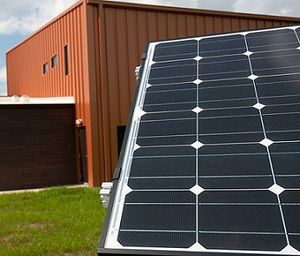
Figure 1.1: A solar panel consisting of many photovoltaic cells
1.2.1 Photovoltaic Effect
When a photovoltaic cell is exposed to sunlight, a process known as the photovoltaic effect causes it to produce voltage or electric current. These solar cells are made of a p-n junction, which is formed by joining two different types of semiconductors—an n-type and a p-type—together. When these two varieties of semiconductors are combined, an electric field is created in the junction area as electrons and holes migrate from the negative n-side to the positive p-side. Positively charged particles flow in the opposite direction from negatively charged particles as a result of this field. Photons, which are just tiny bundles of electromagnetic radiation or energy, are the building blocks of light [10]. A photon’s energy is transferred to a semiconducting material’s electron when the light of the right wavelength strikes these cells, forcing the electron to move to the conduction band, a higher energy state. These electrons are free to flow through the material while they are in their excited condition in the conduction band, and it is this movement of the electron that generates an electric current in the cell [11].
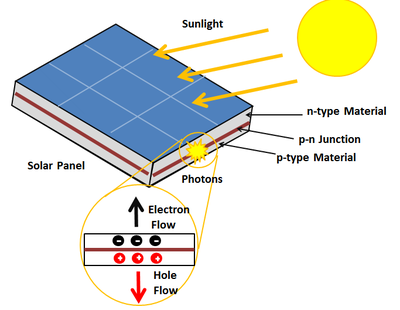
Figure 1.2: photovoltaic effect
1.3 Grid connected Solar PV systems
Grid-connected energy systems or grid-connected PV systems are systems that are connected to the utility grid. The system may collect solar energy through this grid-tied link, convert it to electrical power, and then provide it to the residences where it can be used by various electronic devices [12]. All of the electrical ports and plugs are supplied with solar power when the grid-connected PV system is put on a building’s rooftop, whether it be residential or commercial. The grid-tied PV system’s bidirectional meter exports extra units of electricity to the grid when excess power is generated. Those exported units are imported to maintain the power supply later (at night). Additionally, the grid-connected PV system gives customers the freedom to use grid electricity when there is no sunlight. This PV system is more affordable than other PV types because of its straightforward design and low maintenance needs. Solar panels quickly transform the sunlight’s absorbed energy into a DC supply. A solar inverter receives that DC power. An integral part of any grid-connected PV system is the inverter. It does this by converting the DC electricity from the panels it receives into AC power. The AC supply is then delivered to the house by the inverter, allowing all of the connected equipment to run on solar power. The exported units are pulled (imported) from the grid by the net meter at night. It continues to operate all the appliances. The term “net metering” refers to this power exchange. A grid-connected PV system must have a grid as its foundation. Since surplus electricity is supplied there and then retrieved when needed, it functions more like a battery. Consequently, it serves as a form of power backup [13].
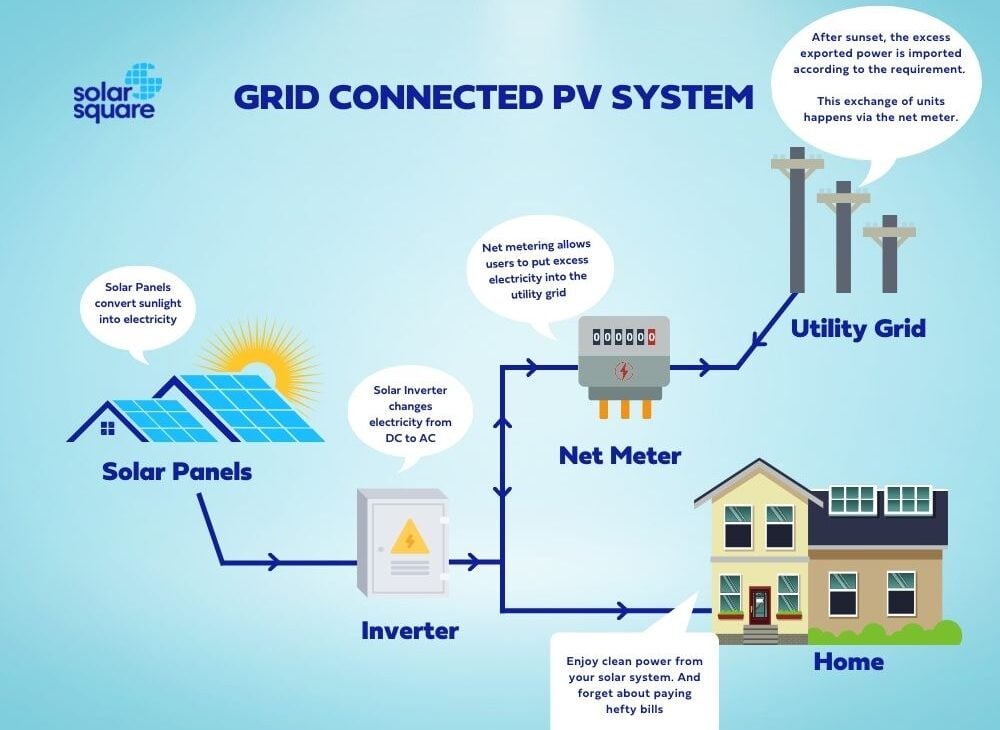
Figure 1.3: Grid connected Solar PV systems
1.3.1 Advantages
It does not have expensive upkeep costs.
Solar energy reduces electricity usage by harnessing sunlight, making installation easy.
The grid-connected PV system has a short development time.
It operates without emitting carbon dioxide.
Most grid-connected PV systems do not need extra batteries, making them more cost-effective.
A grid-connected PV solar system can be installed in available roof space without the need for extra land. Its reliability is high.
Consumers have the alternative to make use of this system in diverse settings such as homes, commercial establishments, industrial units, and educational institutions.
1.3.2 Disadvantages
The system relies on a grid for its operation. If the grid malfunctions, the system will cease functioning.
The cost of installing initially is expensive.
Models without battery backup cannot supply electricity when there is a power outage [14].
1.4 Grid integration of SPV systems
Solar system integration pertains to the advancement of techniques and instruments that facilitate the incorporation of solar energy into the electrical power network, all the while ensuring the steadfastness, safeguarding, and effectiveness of the said network. Harmonizing intermittent solar energy production with grid demand requires advanced inverters and power electronics. These technologies manage fluctuations and synchronize solar PV systems with the grid. Sophisticated monitoring and control systems allow real-time assessment of system performance and grid conditions [15].
1.4.1 Overview of Grid integration of SPV systems
Due to the rising demand for renewable energy sources to replace fossil fuels, the integration of solar electricity into the electrical grid has become a common practice in many nations throughout the world. By the end of 2016, the capacity of solar-generated electricity had increased significantly and quickly, reaching about 290 gigawatts (GW) [16]. China presently ranks as the top producer of solar energy, followed by Japan, Germany, and the United States, according to the Renewable Energy Capacity Statistics of the International Renewable Energy Agency (IRENA) for 2017. Additionally, the installed solar capacity by region reveals that Asia comes in second with 92.3 GW, closely following Europe in first place with almost 98.8 GW. Africa, on the other hand, is far behind with only 1.92 GW of solar capacity. This is a pitiful 1.16% of the 290 GW global solar capacity. In South Africa, most of the country’s landmass enjoys more than 2500 hours of sunshine annually, with daily solar radiation levels typically ranging from 4.5 to 6.5 kilowatt-hours per square meter (kWh/m2/day). According to estimates, South Africa receives about 220 watts per square meter (W/m2) of yearly average worldwide solar radiation. Egypt is situated in a region with abundant solar energy. The country has a high solar radiation level, ranging from 1950 to 2600 kWh/m2/yr. The majority of Egypt’s land has a global radiation level above 2200 kWh/m2/yr. Egypt’s first CSP plant project at Koraymat includes gas turbines and a steam turbine, with an estimated total capacity of 140 MW. Advanced inverters, anti-islanding, grid-plant protection, solar-grid forecasting, and smart grids are all components of solar-grid integration technology. A smart grid technology is made to have a large number of photovoltaic systems in homes and businesses. It is an intelligent system that can sense overloads and redirect power to avoid power outages. When upgrades are needed, it is more cost-effective to use smart grid technology than conventional technology [17].
1.4.2 Challenges of Grid integration of SPV systems
The variable nature of solar energy poses a challenge to the incorporation of solar PV systems into the power grid. This necessitates the implementation of energy storage solutions and grid upgrades to ensure a consistent and reliable power supply. The management of voltage fluctuations and the maintenance of grid stability in the face of varying solar output are of utmost importance [18]. To facilitate smooth integration and equitable compensation, regulatory frameworks and market incentives must undergo further development. The reduction of carbon emissions, attainment of energy autonomy, and promotion of economic growth through clean energy technologies provide noteworthy prospects. The advancement of grid management and storage technologies holds great promise in fostering a resilient and sustainable energy future [19] [20].
Safety
Recently, industrial clients have concentrated on integrating PV generation systems so they may run concurrently with the grid. For the security of big generation facilities, significant safety equipment and routine inspections by utility staff or professional engineers may be necessary and cheap, but these demands are impractical for tiny PV installations. Some utility-connected PV systems operate at DC voltages above 300 volts depending on the system architecture before being inverted to common alternating current. Because a DC arc is harder to put out than an AC arc at the same voltage, the potential fire hazard of DC at these voltages is greater than that of conventional AC. However, with the right wiring, any risks associated with DC power are considerably diminished.
Islanding
Islanding is one of the most significant safety concerns for small customer-sited PV systems. When a section of the utility system that has both loads and a generation source is cut off from the rest of the system while still being powered, it is said to be “islanding.” PV-supported islanding is the term used when a PV system is in place. A utility can manage whether its generation sources are turned off or separated from the region that needs repair, but it has no control over an island generated by a PV system. This raises safety concerns. A utility line worker may come into contact with a line that is unexpectedly electrified, which is a potentially dangerous outcome of islanding. Thus, there is a need for inverters with integrated anti-islanding safety features. Grid-tied inverters keep an eye on the utility line and can swiftly (in 2 seconds or less) cut themselves off if irregularities arise on the utility system.
1.4.2.3 Power Quality
Devices and appliances are made to accept power at or near specific voltage and frequency parameters, and variations may result in appliance damage or malfunction. As a result, power should always be supplied at a standard voltage and frequency. When using a microwave or hand mixer, you could notice lines on the TV screen or static sounds on the radio, which are both signs of poor power quality. Unwanted noise can be injected by a PV inverter. Power quality standards also cover harmonics, power factor, DC injection, and voltage flicker, in addition to straightforward voltage and frequency ranges.
1.4.2.4 Codes and Standards
National codes and safety groups have established the standards for equipment manufacture, operation, and installation in order to address protection, safety, and power quality issues. The International Electro-Technical Commission (IEC), the Institution of Electrical and Electronics Engineers (IEEE), the Bureau of Indian Standards (BIS), Underwriters Laboratories (UL), Deutsches Institute fuer Normung, a German Institute for Standardization (DIN), and the National Fire Protection Association (NFPA) are the major code and safety organizations that deal with photovoltaic systems. Due to their complex and modular design, IEC protocols are utilized all over the world and serve as the foundation for building national protocols in other nations. Developers and producers, nevertheless, adopt the most exquisite DIN procedures. BIS protocols, which are based on IEC and IEEE standards, make up the Indian standards. These guidelines are still being developed.
1.4.2.5 Metering issues
Net metering enables the flow of electricity to and from customers who own their own electricity-generating equipment through a single, bidirectional meter. In the new availability-based tariff schemes, this arrangement is preferable to two-meter arrangements for the consumer. Any electricity generated by a consumer that is not immediately consumed by the customer flows to the utility through the second meter under the most typical two-meter arrangement, known as net purchase and sale. While the customer pays the retail rate for any electricity purchased off the grid, the utility purchases the excess generation flowing via the second meter at the avoided cost of the utility [21].
1.5 Grid Codes and Regulations for Solar PV Integration
Grid codes and regulations related to the incorporation of solar photovoltaic (PV) systems encompass a compilation of guidelines established by governing bodies to guarantee the secure, efficient, and reliable integration of these systems into the electrical grid [22]. These guidelines delineate the technical specifications, interconnection standards, and compliance prerequisites for inverters, voltage levels, frequency tolerance, and protection mechanisms [23].
1.5.1 Overview of relevant grid codes and standards
The term “grid-connected photovoltaic (PV) system” (GCPS) is commonly used to describe solar power facilities that are connected to the utility grid.1 Modern power systems are increasingly relying on GCPS to generate electricity, and the effects this has on power infrastructure are becoming more pronounced. It is crucial to examine how PV power plants (PVPPs) affect the utility grid’s operation, stability, and power quality and how the utility grid affects PV system generators [24]. The operation of renewable energy sources, particularly the PV system, has been subject to a number of new standards and laws issued by various nations for this reason. These are referred to as the new grid code (GC) specifications. These GCs were initially created to control how conventional power stations were connected to the network. Based on the features of the national grid, GC technical specifications differ from one country to the next. In comparison to typical energy plants, the number of renewable energy power plants connected to the grid in recent years was initially quite low. However, in the most recent years, this satiation has undergone significant alteration. In order to prevent any issues with network operations, it has become crucial to strengthen the GCs with regard to the connection of renewable energy power plants as one of the primary sources of generation. Certain nations throughout the world have implemented strict technical standards for the connection of wind power plants (WPPs) as a part of modern GCs. The evaluation of the new GC regulations governing the integration of WPP was the subject of several research in the literature. Numerous reviews have contrasted and analyzed in recent years [25].
1.5.2 Compliance requirements for solar PV integration
These GCs are used globally. The manufacturing and installation of photovoltaic power plants (PVPPs) have significantly increased globally in recent years. With more than 100 GW of generated electricity added merely in the past year, photovoltaic (PV) systems now account for nearly 55% of the world’s newly installed renewable energy capacity. The penetration level is still increasing. Grid-connected PV systems (GCPS) will face additional difficulties as a result of the PVPPs’ rapid expansion in both generation and integration in the future. PVPPs differ from traditional power plants in a number of ways. Furthermore, the stability, security, dependability, and quality of the power system start to be impacted by the large penetration of this renewable energy source [26]. The power network may be negatively impacted by voltage fluctuation, voltage sag, harmonics, voltage flicker, power factor, and voltage unbalance at the point of common coupling (PCC). Hence, these issues need to be handled. For this reason, new and demanding technical specifications regarding the integration of PVPPs into the utility grid are being imposed by the grid codes of several nations and other international standards. These technological conditions must be met in order to prevent the grid from receiving any power of subpar quality. PVPPs must also operate similarly to conventional power plants and support the grid during disruptions [27].
Solar, wind, and other renewable energy sources will be used in an increasing variety of applications as governments aggressively promote them and premium feed-in tariffs are established globally. One of the sources of renewable energy that are being incorporated into distribution systems the fastest is solar photovoltaic systems. Certain technological concerns of integrating renewable energy must be taken into account as distributed generation resources become more integrated into the grid. Due to their erratic nature, renewable energy sources’ extensive integration with power grids could have a significant impact on how well the distribution network functions. To ensure the security and dependability of the power supply, it is necessary to create the necessary precautions and protective gear [28]. The operating safety, warning signals, access restrictions, insulation, protection against islanding, grounding, and other factors should all be included in standards and recommendations for PV integration. To guarantee system dependability and safety, numerous worldwide organizations and nations have created distinct standards or norms. While some regulations exclusively address the integration of PV sources, others address the integration of all distributed generators, including PV sources. This study investigates several standards and guidelines related to the interconnection of PV systems, as well as the impact of high PV penetration on system performance. It includes fundamental ideas, specifications for power quality, general technical needs, power control, voltage regulation, a system’s reactions to abnormal situations, safety, and protection. In order to provide a reference for creating domestic rules for PV integration, this inquiry also examines the specifications of PV inverters. The growth of distributed power generation may be impacted by several standards or rules that control how dispersed generators are connected to power systems [29].
1.6 Power Quality Issues in Grid-Connected Solar PV Systems
Voltage swings, harmonics, and transients are power quality problems in solar PV systems that may affect the power grid’s reliability and effectiveness. Voltage changes brought on by solar intermittency have an effect on delicate equipment and cause flashing. Due to their non-linear design, solar inverters run the risk of interfering with other grid-connected equipment by introducing harmonics. Transients are brought on by abrupt variations in solar output and undermine the overall stability of the grid. To reduce these power quality issues and guarantee a regular and dependable power supply from solar PV systems, efficient power conditioning and grid management solutions are crucial [30].
1.6.1 Voltage fluctuations and harmonics
Generation of distribution in terms of Solar PV installations can prevent load shedding by reducing distribution system overload. However, incorrect planning, installation, and placement could affect the efficiency of power systems. The inverter’s functioning, which is thought to be the biggest source of harmonics, is the main cause of power quality problems in the distribution grid.
Voltage fluctuations: One of the causes of voltage fluctuations in grid-connected PV systems is the intermittent nature of solar PV. Voltage fluctuations are mostly caused by irregular solar irradiance brought on by passing clouds, the location of the PV installation, and the chosen angle of incidences/reflections. In the distribution network, these erratic oscillations generate voltage flicker and flicker noise, overloading issues, line losses, and network losses [31].
Harmonics: One of the key effects that must be taken into account while operating grid-connected PV systems is harmonic distortion. When used to convert DC current to AC current, inverters introduce voltage and current harmonics into the system, which leads to power harmonics. Due to the overheating of transformers and capacitor banks, the system becomes more unstable and unreliable as the number of inverters rises [32].
Voltage imbalances and flicker
Voltage imbalances: PV (photovoltaic) systems experience power imbalances when the solar electricity generated either exceeds or falls short of demand or grid needs. This imbalance can result in problems like excessive power output, which could be too much for the local grid’s capacity or demand, or insufficient generation, which would call for backup sources. Furthermore, the unforeseen imbalances caused by solar power’s intrinsic fluctuation and intermittency, which are impacted by weather, have an effect on the stability of the grid. A comprehensive strategy including good system design, the integration of energy storage like batteries, and smart grid techniques is essential to reducing these imbalances. To provide a steady and consistent energy supply, it is essential to strike a balance between solar energy generation and consumption [33].
Flicker: Fast and obvious changes in the power supply called flickers are primarily caused by nonlinear loads in the electrical system. The power waveform’s smoothness is interfered with by nonlinear loads, which are frequently connected to electronics and other nonlinear loads. These fast power shifts can impair the functionality of delicate electronic gadgets and cause noticeable changes in lighting. In order to provide a constant and steady power supply, flicker reduction entails regulating nonlinear loads and utilizing power conditioning devices [34].
Intermittency and variability of solar power generation
Solar power generation in PV (photovoltaic) systems is hampered by intermittency and fluctuation. Due to varying weather, cloud cover, and day-night cycles, solar energy generation is irregular and unexpected, which is referred to as intermittent. Variability includes the daytime variations in solar power output caused by shifting clouds and other environmental conditions. To maintain a steady and consistent power supply from solar PV systems, especially when demand and grid requirements are constant, both intermittency and variability call for appropriate energy storage technologies and grid integration strategies. For effective use and integration into the larger energy environment, solar power’s intermittent and fluctuating characteristics must be balanced [35].
1.7 Advanced Technologies for Power Quality Improvement
Customers are accountable for the quality of the electric current they receive from the utility, and the power distribution supplier is responsible for the voltage quality. Transients, short-duration variations, long-duration variations, and waveform distortions are the four categories used to classify electromagnetic phenomena that have an impact on the power quality of power systems. [38].
1.7.1 MPPT Techniques
The maximum power point tracking (MPPT) method is employed to maximize the power from solar PV cells. Researchers have proposed a number of different MPPT scheme types, including open circuit, short circuit, perturb and observe (P&O)/hill climbing, incremental conductance, and others [39]. While the P&O and incremental conductance approaches iteratively perturb the operating point to track the MPP, the open circuit and short circuit methods identify the MPP by studying the extremes of the I-V curve. These MPPT methods are essential for increasing the effectiveness and energy output of solar PV systems and promoting the wider use of renewable energy sources. To further enhance the efficiency and cost-effectiveness of solar power generation, researchers are constantly modifying and innovating MPPT systems [40].
1.7.2 Grid synchronization methods
According to control research, the most important characteristics that must be measured and managed for grid-tied applications are voltage’s frequency, phase, and amplitude [41]. Synchronization is a major issue in the operation of grid-tied inverters. Both open-loop and closed-loop approaches are used. Input signal characteristics can be immediately detected using open-loop approaches, whereas phase errors are said to be reduced using closed-loop techniques. A feedback loop mechanism in a closed loop system updates the estimated value of the phase as needed. This loop fixes the signal’s estimated value to its real value. Compared to open-loop methods, closed-loop techniques are preferable. The phase-locked loop (PLL) technique is a well-liked method for producing reference currents in closed-loop systems. A PLL is a device that produces output signals whose phases are related to their input signals. In noisy communications channels, it is frequently used to modulate, demodulate, filter, or recover a signal. A PLL is a non-linear feedback control system that maintains a constant minimum phase error(s) while freezing its output signal to the input signal. Phase-detector (PD), loop-filter (LF), and voltage-controlled oscillator (VCO) make up the PLL block diagram. Despite the fact that certain new approaches have been studied in the literature and proven to perform better than traditional PLL, PLL is still well-liked for its dependability and simplicity [42].
1.7.3 Selective harmonic elimination (SHE)
The output voltage from two or more inverters is successfully blended utilizing transformer connections in the selective harmonic reduction approach. When these inverters’ switching patterns and phases are precisely coordinated, the total output shows a markedly lower harmonic content than the voltages from the separate inverters. Each inverter’s harmonics have a tendency to cancel one another out or add together in a way that dramatically reduces the undesired harmonics, producing a cleaner and smoother output waveform. This method helps to improve power quality by ensuring that the total output voltage is more sinusoidal and in compliance with grid specifications, hence reducing the possibility of system interruptions or interference [43].
1.7.4 FACTS (Flexible AC Transmission Systems)
The term “Flexible AC Transmission Systems” refers to a collection of tools used to get around some restrictions on the capacity of electrical networks for static and dynamic transmission. According to the IEEE, FACTS are alternating current transmission systems that incorporate static controllers based on power electronics and other technologies to improve control and power transfer capabilities. These systems’ major objective is to provide the network with inductive or capacitive reactive power that is tailored to its specific needs as rapidly as possible while also enhancing transmission quality and the effectiveness of the power transmission system. Power companies will be able to more effectively utilize their current transmission networks thanks to Flexible AC Transmission Systems (FACTS), which will also significantly increase the availability and reliability of their line networks and enhance both dynamic and transient network stability while ensuring a higher standard of supply [44]. The common features of FACT are as follows,
Fast voltage regulation,
Increased power transfer over long AC lines,
Damping of active power oscillations, and
Load flow control in meshed systems,
1.7.5 SVC (Static Var Compensators)
A static VAR compensator is a parallel assembly of the fixed shunt capacitor and controlled reactor depicted in the image below. The reactor is managed by the thyristor switch assembly in the SVC. The voltage across the inductor, and consequently the current flowing through the inductor, are controlled by the thyristor’s firing angle. The inductor’s reactive power draw can be managed in this way. The SVC may steplessly adjust reactive power over an infinite range without experiencing any delay. It raises the system’s power factor and stability. The following SVC schemes are the most popular ones. TCR: Thyristor-controlled reactor Capacitor with a thyristor switch (TSC) SR: Self Reactor, Fixed capacitor thyristor-controlled reactor (TCR-FC), TSC-TCR stands for thyristor-switched capacitor – thyristor controlled reactor. The advantages of SVS are,
It improved the transmission lines’ ability to transmit power.
It increased the system’s transient stability.
Both the steady state and transient overvoltage were within its control.
As a result, line losses decreased, and system capability increased. It also enhanced the load power factor.
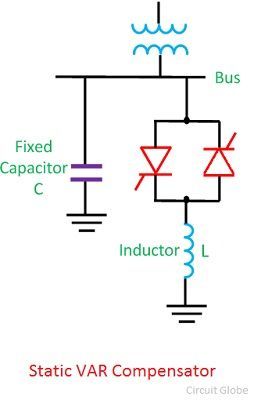
Figure 1.5: SVC
1.7.6 Static Synchronous Series Compensator (SSSC)
A voltage source converter is used in the Static Synchronous Series Compensator (SSSC), a contemporary power quality FACTS device, which is coupled in series to a transmission line via a transformer. The SSSC functions as a series capacitor and inductor with variable capacitance. The main distinction is that its injected voltage can be controlled independently and is not reliant on the line intensity. This characteristic enables the SSSC to function successfully under both heavy and light loads. Three fundamental parts make up the Static Synchronous Series Compensator: The primary component is the voltage source converter (VSC). The transformer, which connects the SSSC to the transmission line. The energy source supplies voltage across the DC capacitor and makes up for device losses.
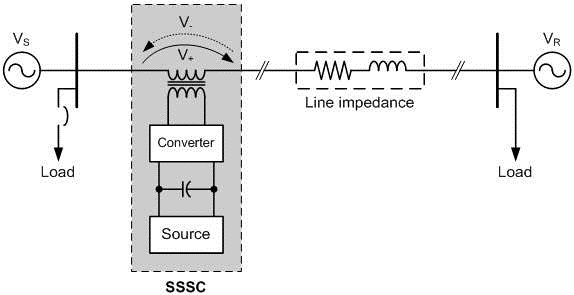
Figure 1.6: SSSC
Typically, the SSSC is used to restore voltage when there is a power system fault. However, it also offers a number of benefits in typical circumstances:
Power factor adjustment using a correctly designed controller in conjunction with continuous voltage injection.
Distribution networks with connections that balance load.
Use active filtering to reduce harmonic distortion.
Power flow management.
1.8 Problem Statement
[32] covers the integration of renewable energy sources into the grid, power quality difficulties connected to these issues, the role of power electronic devices, and flexible AC transmission systems. Due to its high production and installation costs, PV technology confronts difficulties that prevent its mainstream adoption. Additionally, despite progress, PV system efficiency is still insufficient to fully convert solar energy. For solar energy solutions to become more sustainable and affordable, these obstacles must be removed. [43] The unexpected and variable nature of renewable energy sources makes it difficult to maintain power quality and stability when they are integrated into the utility grid. The type of control algorithms utilized affects how well distributed flexible AC transmission system (DFACTS) devices work, including distributed static compensator (DSTATCOM) and dynamic voltage restorer (DVR), which are used to reduce power quality issues. [44] The proposed research project has been simulated in MATLAB and modelled and managed using ANFIS intelligence. Voltage fluctuations and protection issues may result from the distributed AC power grid’s integration of renewable energy sources, which may provide difficulties for the utility grid’s dependability and power quality.
1.9 Motivation of the study
The modelling and simulation of closed control loops based on three-phase grid-connected systems are the main topics of discussion. The goal is to compare the performance of PI and FOPID controllers in terms of how well they respond to harmonic reduction in grid-connected systems. The necessity for better efficiency in PV-integrated distribution grids and the rising demand for photovoltaic (PV) systems globally served as the driving forces behind the study. To stabilize photovoltaic (PV) system integration into the power grid in order to take advantage of its inexpensive and clean energy source.
1.10 Objectives
To employ a FOPID controller to enhance the dynamic response of grid-connected solar systems that are voltage- and current-harmonically regulated. Further, the issue of harmonics in power systems brought on by nonlinear loads was discussed, and active filters were suggested to reduce current and voltage harmonics. To suggest the Recurrent Neural Network (RNN) as a control technique for the PV integrated distribution grid. The study’s main goals were to minimize Total Harmonic Distortion (THD) and provide the most power possible to the grid-side Voltage Source Converter (VSC). to create a composite controller capable of synchronizing photovoltaic (PV) systems with the grid while allowing for bidirectional power flow, and to test the effectiveness of this controller using a MATLAB Simulink model. Additionally, evaluate how well RL and LCL filters perform in reducing power quality problems in grid-connected PV systems.
1.11 Contribution of this study
Active filters are tools designed to address the harmonic issue in power systems brought on by the nonlinear load. FOPID controller generates and controls inverter switching pulses using a voltage source. Harmonics in current and voltage are reduced using active filters. Simulation results are presented to determine the effects of active filters utilizing PI and FOPID. This research suggests an algorithm called Recurrent Neural Network (RNN) for the control of the PV-integrated distribution grid system in order to increase the efficiency of the PV integrated distribution grid. This algorithm controls the voltage source converter (VSC), which aims to solve power quality issues like load balancing and harmonic abatement. This method aims to provide the grid-side VSC with the most power possible. It is necessary to stabilize the PV system integration with the electrical grid. In order to solve this problem, this study introduces a composite controller that can synchronize photovoltaic (PV) systems with the grid and allow for bidirectional power flow in the grid. Both RL and LCL filters are used to investigate the suggested method. A control loop for power quality disturbance reduction is modelled with grid synchronization of PV power generation. On the grid-connected converter, Power Quality disruptions are reduced using the multicarrier SVPWM with DQ controller. The PV Grid configuration is modelled using MATLAB Simulink, and the reliability of the composite controller is assessed. The PI controllers are used in the grid-integrated, DQ-controlled PV. Criteria for power quality: Both RL and LCL filters have intact THD.
1.12 Thesis Organization
Chapter 1 of this thesis is about the introduction of solar PV systems, PV cells and photovoltaic effects, grid-connected Solar PV systems and their advantages and disadvantages. Outlines the Grid integration of SPV systems and its challenges, Codes and Regulations, and Compliance requirements. Also explains the Power Quality Issues in Grid-Connected Solar PV Systems and its advanced technologies to overcome the issues of power quality improvement. And its compresence with the problem statement of the existing works. Also, it discusses the motivation of the study, objectives and contribution of the study. Chapter 2 discusses the literature review of existing works and its advantages and disadvantages. Chapters 3, 4, and 5 explain the proposed methodology and results of each paper. Finally, the thesis is concluded, and the future scope is explained in Chapter 6.
1.13 Summary
The usage of grid-connected PV systems in a variety of situations, including residences, businesses, factories, and educational institutions, is covered in this article. Along with a review of the literature, the report also covered the study’s inspiration, goals, and contributions. It explained the details of the results and suggested techniques for each chapter of the study. Future horizons are discussed as the thesis comes to a close. The report cited a number of further studies that shed light on photovoltaic solar cells, solar PV cell materials and technologies, and how grid-connected solar and wind power systems complement one another. The report also cited works that cover the integration specifications in contemporary grid codes for grid-connected photovoltaic power plants, suggested simulation models, and an evaluation of grid code specifications from the viewpoint of PV power plants.
Reference
Boopathi, R. and Indragandhi, V., 2023. Comparative analysis of control techniques using a PV-based SAPF integrated grid system to enhance power quality. E-Prime-Advances in Electrical Engineering, Electronics and Energy, 5, p.100222.
Abdulai, D., Gyamfi, S., Diawuo, F.A. and Acheampong, P., 2023. Data analytics for prediction of solar PV power generation and system performance: A real case of Bui Solar Generating Station, Ghana. Scientific African, p.e01894.
Abo-Khalil, A.G., Sayed, K., Radwan, A. and El-Sharkawy, I.A., 2023. Analysis of the PV system sizing and economic feasibility study in a grid-connected PV system. Case Studies in Thermal Engineering, 45, p.102903.
Bonilla, O. and Le, H.T., 2023. Multi-functional energy storage system for supporting solar PV plants and host power distribution system. Journal of Energy Storage, 73, p.108933.
Meriläinen, A., Montonen, J.H., Kosonen, A., Lindh, T. and Ahola, J., 2023. Cost-optimal dimensioning and operation of a solar PV–BESS–heat pump-based on-grid energy system for a Nordic climate townhouse. Energy and Buildings, 295, p.113328.
Rashwan, A., Mikhaylov, A., Hemeida, M., Pinter, G. and Osheba, D.S., 2023. Two-stage grid-connected inverter topology with high-frequency link transformer for solar PV systems. Energy Reports, 10, pp.1864-1874.
Jordehi, A.R., 2016. Parameter estimation of solar photovoltaic (PV) cells: A review. Renewable and Sustainable Energy Reviews, 61, pp.354-371.
Xiao, W., Dunford, W.G. and Capel, A., 2004, June. A novel modeling method for photovoltaic cells. In 2004 IEEE 35th Annual Power Electronics Specialists Conference (IEEE Cat. No. 04CH37551) (Vol. 3, pp. 1950-1956). IEEE.
Chenni, R., Makhlouf, M., Kerbache, T. and Bouzid, A., 2007. A detailed modeling method for photovoltaic cells. Energy, 32(9), pp.1724-1730.
Al-Ezzi, A.S. and Ansari, M.N.M., 2022. Photovoltaic solar cells: a review. Applied System Innovation, 5(4), p.67.
Singh, B.P., Goyal, S.K. and Kumar, P., 2021. Solar PV cell materials and technologies: Analyzing the recent developments. Materials Today: Proceedings, 43, pp.2843-2849.
Weschenfelder, F., Leite, G.D.N.P., da Costa, A.C.A., de Castro Vilela, O., Ribeiro, C.M., Ochoa, A.A.V. and Araújo, A.M., 2020. A review on the complementarity between grid-connected solar and wind power systems. Journal of Cleaner Production, 257, p.120617.
Khezri, R., Mahmoudi, A. and Aki, H., 2022. Optimal planning of solar photovoltaic and battery storage systems for grid-connected residential sector: Review, challenges and new perspectives. Renewable and Sustainable Energy Reviews, 153, p.111763.
Basit, M.A., Dilshad, S., Badar, R. and Sami ur Rehman, S.M., 2020. Limitations, challenges, and solution approaches in grid‐connected renewable energy systems. International Journal of Energy Research, 44(6), pp.4132-4162.
Thotakura, S., Kondamudi, S.C., Xavier, J.F., Quanjin, M., Reddy, G.R., Gangwar, P. and Davuluri, S.L., 2020. Operational performance of megawatt-scale grid integrated rooftop solar PV system in tropical wet and dry climates of India. Case Studies in Thermal Engineering, 18, p.100602.
Panigrahi, R., Mishra, S.K., Srivastava, S.C., Srivastava, A.K. and Schulz, N.N., 2020. Grid integration of small-scale photovoltaic systems in secondary distribution network—A review. IEEE Transactions on Industry Applications, 56(3), pp.3178-3195.
Nwaigwe, K.N., Mutabilwa, P. and Dintwa, E., 2019. An overview of solar power (PV systems) integration into electricity grids. Materials Science for Energy Technologies, 2(3), pp.629-633.
Alqahtani, B.J., Holt, K.M., Patiño-Echeverri, D. and Pratson, L., 2016. Residential solar PV systems in the Carolinas: opportunities and outcomes. Environmental science & technology, 50(4), pp.2082-2091.
Ostfeld, A.E. and Arias, A.C., 2017. Flexible photovoltaic power systems: integration opportunities, challenges and advances. Flexible and Printed Electronics, 2(1), p.013001.
Ghosh, S. and Rahman, S., 2016, October. Global deployment of solar photovoltaics: Its opportunities and challenges. In 2016 IEEE PES Innovative Smart Grid Technologies Conference Europe (ISGT-Europe) (pp. 1-6). IEEE.
Shafiullah, M., Ahmed, S.D. and Al-Sulaiman, F.A., 2022. Grid integration challenges and solution strategies for solar PV systems: A review. IEEE Access, 10, pp.52233-52257.
Marinopoulos, A., Papandrea, F., Reza, M., Norrga, S., Spertino, F. and Napoli, R., 2011, June. Grid integration aspects of large solar PV installations: LVRT capability and reactive power/voltage support requirements. In 2011 IEEE Trondheim PowerTech (pp. 1-8). IEEE.
Crăciun, B.I., Kerekes, T., Séra, D. and Teodorescu, R., 2012, May. Overview of recent grid codes for PV power integration. In 2012 13th International Conference on Optimization of Electrical and Electronic Equipment (OPTIM) (pp. 959-965). IEEE.
Al‐Shetwi, A.Q. and Sujod, M.Z., 2018. Grid‐connected photovoltaic power plants: A review of the recent integration requirements in modern grid codes. International Journal of Energy Research, 42(5), pp.1849-1865.
Martínez-Lavín, M., Villena-Ruiz, R., Honrubia-Escribano, A., Hernández, J.C. and Gómez-Lázaro, E., 2022. Proposal for an aggregated solar PV power plant simulation model for grid code compliance. Electric Power Systems Research, 213, p.108676.
Martinez-Lavin, M., Villena-Ruiz, R., Honrubia-Escribano, A., Hernández, J.C. and Gomez-Lazaro, E., 2022. Evaluation of the latest Spanish grid code requirements from a PV power plant perspective. Energy Reports, 8, pp.8589-8604.
Buraimoh, E. and Davidson, I.E., 2020, September. Overview of fault ride-through requirements for photovoltaic grid integration, design and grid code compliance. In 2020 9th International Conference on Renewable Energy Research and Application (ICRERA) (pp. 332-336). IEEE.
MacDowell, J., Wang, Y., Quint, R., Chi, Y., Ernst, B., Saylors, S., Jacobson, D., Andresen, B., Sorensen, P.E., Portales, R. and Brake, D., 2019. A journey through energy systems integration: Trending grid codes, standards, and IEC collaboration. IEEE Power and Energy Magazine, 17(6), pp.79-88.
Wu, Y.K., Lin, J.H. and Lin, H.J., 2017. Standards and guidelines for grid-connected photovoltaic generation systems: A review and comparison. IEEE Transactions on Industry Applications, 53(4), pp.3205-3216.
Al-Shetwi, A.Q., Hannan, M.A., Jern, K.P., Alkahtani, A.A. and PG Abas, A.E., 2020. Power quality assessment of grid-connected PV system in compliance with the recent integration requirements. Electronics, 9(2), p.366.
Deshmukh, A.N. and Chandrakar, V.K., 2021, January. Power quality issues and their mitigation techniques in grid tied Solar Photovoltaic Systems-A review. In 2021 International Conference on Computer Communication and Informatics (ICCCI) (pp. 1-6). IEEE.
Kumar, V., Pandey, A.S. and Sinha, S.K., 2016, March. Grid integration and power quality issues of wind and solar energy system: A review. In 2016 International Conference on Emerging Trends in Electrical Electronics & Sustainable Energy Systems (ICETEESES) (pp. 71-80). IEEE.
Kumary, S.S., Oo, V.A.A.M.T., Shafiullah, G.M. and Stojcevski, A., 2014, September. Modelling and power quality analysis of a grid-connected solar PV system. In 2014 Australasian Universities Power Engineering Conference (AUPEC) (pp. 1-6). IEEE.
Srungarakavi Venkata, S.K., Oo, V.A.A.M.T., Shafiullah, G.M. and Stojcevski, A., 2014. Modelling and power quality analysis of a grid-connected solar PV system.
Salem, W.A.A., Gabr Ibrahim, W., Abdelsadek, A.M. and Nafeh, A.A., 2022. Grid connected photovoltaic system impression on power quality of low voltage distribution system. Cogent Engineering, 9(1), p.2044576.
Rao, S.N.V.B., Kumar, Y.V.P., Pradeep, D.J., Reddy, C.P., Flah, A., Kraiem, H. and Al-Asad, J.F., 2022. Power quality improvement in renewable-energy-based microgrid clusters using fuzzy space vector PWM controlled inverter. Sustainability, 14(8), p.4663.
Haque, A., 2014. Maximum power point tracking (MPPT) scheme for solar photovoltaic system. Energy Technology & Policy, 1(1), pp.115-122.
Ahmed, J. and Salam, Z., 2015. An improved perturb and observe (P&O) maximum power point tracking (MPPT) algorithm for higher efficiency. Applied Energy, 150, pp.97-108.
Gawhade, P. and Ojha, A., 2021. Recent advances in synchronization techniques for grid-tied PV system: A review. Energy Reports, 7, pp.6581-6599.
Yang, Y. and Blaabjerg, F., 2012, June. Synchronization in single-phase grid-connected photovoltaic systems under grid faults. In 2012, the 3rd IEEE International Symposium on Power Electronics for Distributed Generation Systems (PEDG) (pp. 476-482) was held. IEEE.
Pranahita, B.S., Babu, A.P., Aditya, D.V.S. and Kumar, A.S., 2015. Selective harmonic elimination technique using transformer connection for PV fed inverters. International Journal of Engineering Research & Technology (IJERT), 4(04), pp.2278-0181.
Gomis-Bellmunt, O., Sau-Bassols, J., Prieto-Araujo, E. and Cheah-Mane, M., 2019. Flexible converters for meshed HVDC grids: From flexible AC transmission systems (FACTS) to flexible DC grids. IEEE Transactions on Power Delivery, 35(1), pp.2-15.
Chawda, G.S., Shaik, A.G., Mahela, O.P., Padmanaban, S. and Holm-Nielsen, J.B., 2020. Comprehensive review of distributed FACTS control algorithms for power quality enhancement in utility grid with renewable energy penetration. IEEE Access, 8, pp.107614-107634.
Jayaraju, G. and Rao, G.S., 2019. Intelligent controller based power quality improvement of microgrid integration of photovoltaic power system using new cascade multilevel inverter. International Journal of Electrical and Computer Engineering (IJECE), 9(3), pp.1514-1523.
Cite This Work
To export a reference to this article please select a referencing stye below:

Academic Master Education Team is a group of academic editors and subject specialists responsible for producing structured, research-backed essays across multiple disciplines. Each article is developed following Academic Master’s Editorial Policy and supported by credible academic references. The team ensures clarity, citation accuracy, and adherence to ethical academic writing standards
Content reviewed under Academic Master Editorial Policy.




