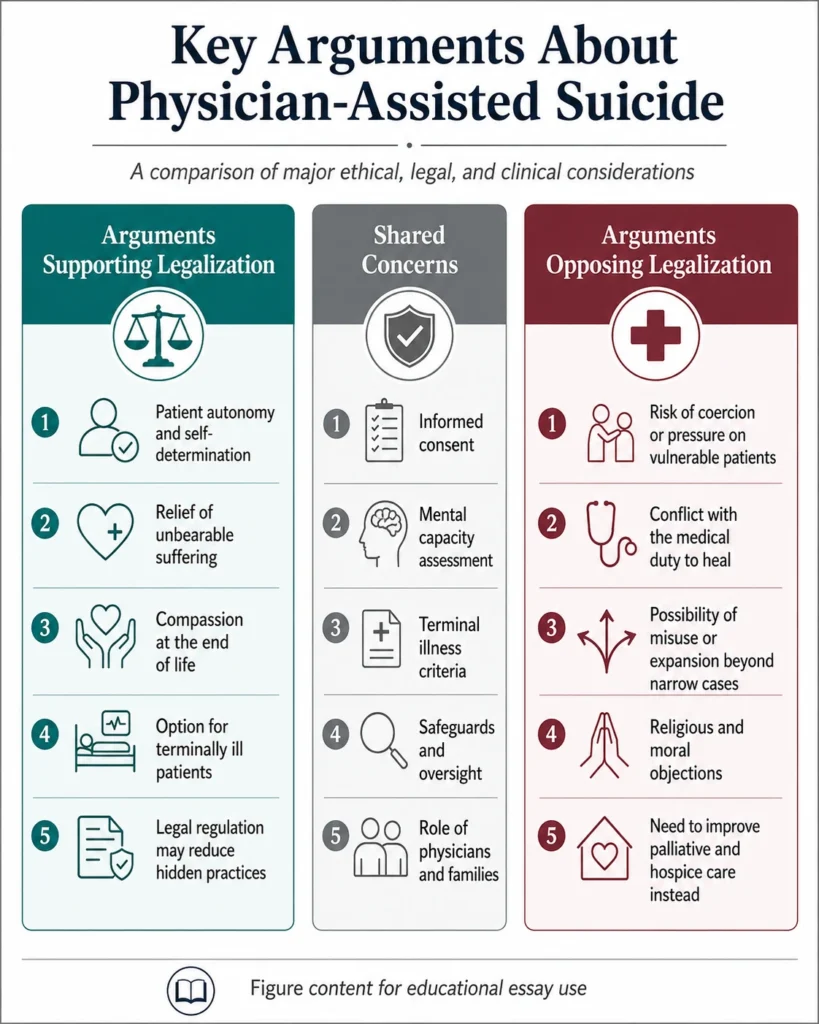
Physician-assisted suicide is one of the most complex ethical and legal issues in modern medicine. It raises difficult questions about personal autonomy, unbearable suffering, medical responsibility, human dignity, and the protection of vulnerable patients. Supporters believe that mentally capable adults with terminal illnesses should be allowed to decide when prolonged suffering has made life intolerable. Opponents argue that helping a patient die conflicts with the physician’s role as a healer and may expose vulnerable people to pressure, discrimination, or inadequate care. Both sides generally agree that people approaching the end of life deserve compassion, honest communication, effective pain control, and respect for their dignity. Their disagreement concerns whether these values justify giving a physician a legally regulated role in helping a patient end life. Physician-assisted suicide should be legal for carefully selected terminally ill adults, but only when strict safeguards, informed consent, independent medical review, and access to palliative care are guaranteed.
What Is Physician-Assisted Suicide?
Physician-assisted suicide occurs when a physician provides a capable patient with the medication or information needed to end the patient’s own life. The patient, rather than the physician, performs the final act by voluntarily taking the prescribed medication. This distinction separates physician-assisted suicide from euthanasia, in which a clinician directly administers the substance that causes death. Supporters often use the terms “medical aid in dying” or “physician-assisted dying” because existing laws normally restrict the practice to adults who have a terminal medical condition. The American Medical Association defines physician-assisted suicide as a situation in which a physician facilitates death by providing the necessary means or information while knowing how the patient intends to use it (American Medical Association, n.d.). It is also different from refusing life-sustaining treatment because a patient who refuses treatment dies from the underlying disease rather than from a newly prescribed life-ending medication. Accurate terminology is essential because these practices involve different intentions, procedures, responsibilities, and legal standards.
Laws authorizing medical aid in dying usually do not permit any person who is distressed, disabled, elderly, or chronically ill to request life-ending medication automatically. Oregon’s model, for example, requires the patient to be an adult who can make and communicate healthcare decisions and who has a terminal illness expected to cause death within six months. The attending physician and a consulting physician must confirm the diagnosis, prognosis, and decision-making capacity. A psychological or psychiatric assessment is required when either physician believes that a disorder may be impairing the patient’s judgment. The physician must also discuss feasible alternatives, including hospice services, comfort care, and pain management. The patient must remain able to make the decision voluntarily and must personally administer the medication. These restrictions show that legalization, as commonly proposed in the United States, concerns a narrow end-of-life option rather than unrestricted assistance with suicide.
Correcting the Evidence in the Original Argument
The article originally selected to support the statement that “physician-assisted suicide should be legal” was titled “Ethics and the Legalization of Physician-Assisted Suicide: An American College of Physicians Position Paper.” However, the paper does not favor the voluntary termination of life through a lethal substance, as the original discussion claimed. Snyder Sulmasy and Mueller (2017) instead reaffirm the American College of Physicians’ opposition to legalization. They argue that physicians have a professional responsibility to care for dying patients, relieve suffering, improve communication, and increase access to hospice and palliative care. The authors also maintain that legalizing physician-assisted suicide could alter the physician’s role as a healer and affect trust within the patient-physician relationship. Their paper recognizes that individual cases can be medically and ethically difficult, but it concludes that the arguments against legalization are more convincing. The source should therefore be used as evidence for the opposing position rather than as support for legalization.
The original essay also discusses “An Alternative to Physician-Assisted Suicide: A Conceptual and Moral Analysis” by Gert, Culver, and Clouser. This work was first published in 1998, although later editions of the book may display a more recent electronic publication date. The authors distinguish physician-assisted suicide from euthanasia, refusing treatment, and allowing a patient to die from an underlying illness. They argue that conceptual clarity is necessary before society can decide whether physicians should participate in life-ending practices. Their analysis also considers alternatives through which physicians can relieve suffering without directly helping a patient cause death. These alternatives include pain management, psychological support, the withdrawal of unwanted treatment, and appropriate end-of-life care. This source strengthens the opposing argument by showing that respect for a patient’s wishes does not always require a physician to provide life-ending medication. However, the availability of alternatives does not prove that every patient’s suffering can be relieved completely.
Arguments Supporting Legalization
The strongest argument supporting legalization is respect for patient autonomy. Competent adults are generally permitted to make important decisions about medical treatment, even when those decisions may shorten their lives. A patient can refuse surgery, chemotherapy, artificial nutrition, ventilation, dialysis, or other life-sustaining interventions. Supporters question why a capable terminally ill person may legally refuse treatment and experience a prolonged death but may be denied a more controlled end-of-life option. They argue that personal autonomy should include the authority to decide how much physical decline, dependence, or loss of function an individual is willing to endure. The decision should not be made casually or in response to temporary distress, but neither should the government impose one understanding of a dignified death on every person. Legalization can therefore be viewed as an extension of the independence already recognized in other areas of medical decision-making.
Autonomy does not mean that every patient request must be accepted without evaluation. A legally valid decision must be informed, voluntary, consistent, and made by a person who understands the diagnosis, prognosis, alternatives, and probable consequences. Physicians should investigate whether untreated depression, misinformation, family conflict, financial pressure, or inadequate symptom control is influencing the request. They should also give the patient repeated opportunities to reconsider the decision. A patient may request the medication but later decide never to obtain or use it. Oregon’s reporting shows that some people receive prescriptions but die from their illness without taking them, suggesting that having the option itself may provide a sense of control. Respecting autonomy therefore includes protecting the patient from pressure as well as respecting a carefully considered choice. Properly designed safeguards can support autonomy rather than treating it as an unrestricted personal preference.

Relief of Unbearable Suffering
Another argument for legalization is the moral duty to relieve suffering when a terminal illness has made the patient’s remaining life intolerable. Modern medicine can control many forms of pain, but suffering is not limited to physical discomfort. Patients may experience breathlessness, nausea, weakness, loss of mobility, dependence on others, inability to communicate, or the loss of activities that gave life meaning. Some symptoms respond poorly to treatment, while medications that provide relief may also cause sedation, confusion, or other burdensome effects. Supporters argue that compassion requires physicians to consider the patient’s complete experience rather than focusing only on whether pain medication is technically available. When a capable patient is approaching death and concludes that continued decline has become unbearable, forcing that person to endure it may appear cruel rather than protective. Physician-assisted suicide may therefore be considered a final option when acceptable treatment cannot restore a level of life the patient regards as tolerable.
Evidence from Oregon shows that requests are often connected with autonomy and quality of life rather than pain alone. In the state’s 2025 report, the most frequently recorded concerns were loss of autonomy, decreasing ability to participate in enjoyable activities, and loss of dignity (Oregon Health Authority, 2026). This pattern does not mean that these concerns automatically justify assisted death. It does, however, show why the debate cannot be reduced to whether conventional pain medication is effective. A person may be physically comfortable but deeply distressed by the complete loss of independence or bodily control. Supporters maintain that patients themselves are best placed to determine how these losses affect the meaning and acceptability of their remaining lives. Opponents respond that healthcare professionals should help patients adapt to these changes rather than present death as a solution. The disagreement reflects different understandings of dignity, dependence, compassion, and the goals of medicine.
Legal Regulation and Safeguards
Legalization may make the practice more transparent and accountable than leaving desperate patients and families to act without medical oversight. A regulated system can establish eligibility standards, documentation requirements, waiting periods, consulting-physician reviews, reporting obligations, and penalties for coercion or falsification. Physicians can be required to explain hospice care, pain management, psychological support, and the patient’s right to withdraw the request at any stage. Requests should be made by the patient rather than by relatives, insurers, institutions, or legal representatives. Witnesses can confirm that the written request was made voluntarily, while medical professionals can assess diagnosis and capacity independently. Cases can then be reported to a health authority for review and public analysis. Supporters argue that legal regulation does not remove every risk, but it creates safeguards that cannot exist when the practice remains hidden.
A responsible law should also protect physicians and healthcare institutions that object to participating. A patient’s legal option should not require every physician to write a prescription that conflicts with personal conscience or professional judgment. At the same time, conscientious objection should not be used to abandon a dying patient or prevent access to information about lawful care. Policies should explain whether an objecting physician must transfer records, provide a referral, or direct the patient to an independent information service. No physician should receive a financial reward for recommending assisted death, and insurers should not pressure patients toward the less expensive option. Governments should collect detailed data about eligibility decisions, medication use, complications, psychiatric referrals, and demographic patterns. Independent review is necessary to determine whether safeguards are functioning as intended. Legalization can only be ethically defended when regulation protects both patient choice and professional integrity.
Arguments Opposing Legalization
The central argument against legalization is that physician-assisted suicide conflicts with the traditional duty of medicine to heal, comfort, and avoid harm. The American College of Physicians and the American Medical Association both maintain formal positions opposing the practice. The AMA states that physician-assisted suicide is incompatible with the physician’s role as healer and could create serious risks for society (American Medical Association, n.d.). Critics fear that patients may begin to wonder whether recommendations are based entirely on their welfare or partly on the cost and difficulty of continued care. The trust required in medicine may be weakened when the same professional responsible for preserving life is also authorized to provide the means of ending it. Opponents therefore believe that physicians should respond to requests for death by addressing pain, fear, loneliness, depression, family concerns, and spiritual distress. From this perspective, compassion requires continued care rather than participation in a patient’s death.
However, the physician’s role has never been limited to curing disease or extending biological life for as long as possible. Physicians also respect treatment refusals, withdraw interventions that patients regard as burdensome, provide strong symptom-relieving medication, and sometimes use palliative sedation when suffering cannot otherwise be controlled. These accepted practices may foreseeably shorten life, although their primary intention is to relieve symptoms rather than cause death. Supporters argue that the role of a healer should include helping patients avoid a prolonged and unwanted dying process. Opponents maintain that intention remains morally important and that directly facilitating death crosses a boundary that symptom relief does not. This distinction is one of the most difficult parts of the debate because both positions appeal to compassion and professional responsibility. The real question is not whether physicians should care for dying patients but whether providing life-ending medication can ever be consistent with responsible care. Reasonable people can accept the same ethical values while reaching different conclusions about this boundary.
Coercion and Vulnerable Patients
The risk of coercion is another serious objection to legalization. A terminally ill patient may feel like a burden because of medical expenses, dependence on relatives, disability, or the emotional strain experienced by caregivers. Even when no family member openly applies pressure, a patient may believe that choosing death is the responsible way to protect others. Economic inequality increases this concern because access to high-quality treatment, home assistance, hospice care, disability support, and mental healthcare is not equally distributed. A choice between prolonged suffering and assisted death cannot be considered fully free when suitable care is unavailable or unaffordable. Disability-rights advocates also warn that social prejudice may lead people to underestimate the quality and value of life with severe physical limitations. Legalization must therefore be evaluated not only as an individual liberty but also within a society where some lives receive less support than others.
The original article states that physician-assisted suicide may benefit insurers or families seeking to avoid the high cost of life-extending treatment. This possibility should be described as an ethical concern rather than presented as the established motive of families or insurers in individual cases. Many relatives provide demanding and compassionate care without wanting the patient’s life to end prematurely. Similarly, a patient may request medical aid in dying while receiving insurance, family support, and hospice services. Oregon’s 2025 data reported that most patients who died under the law were enrolled in hospice, indicating that medical aid in dying and palliative care are not always treated as alternatives. Nevertheless, financial incentives and caregiver burden can affect healthcare decisions and must be taken seriously. Strong laws should prohibit anyone from altering insurance benefits, inheritance arrangements, or care eligibility to influence the decision. Independent assessment, confidential patient interviews, and access to social support are necessary to reduce these risks.
Palliative and Hospice Care
Opponents correctly emphasize that palliative and hospice care should be available before physician-assisted suicide is considered. Palliative care focuses on relieving symptoms, supporting families, discussing treatment goals, and improving quality of life during serious illness. Hospice care provides specialized end-of-life support when cure is no longer the primary goal. These services can reduce pain, anxiety, breathlessness, isolation, and confusion while helping patients remain at home when possible. Gert et al. (1998) argue that physicians should consider alternatives that relieve suffering without requiring direct participation in death. The American College of Physicians similarly calls for improved access to hospice, palliative care, advance planning, and compassionate communication. A patient should never request death simply because effective comfort care was unavailable or poorly explained. Expanding these services is therefore necessary whether physician-assisted suicide remains prohibited or becomes legal.
Palliative care does not eliminate every ethical argument supporting legalization. Some patients continue to experience intolerable symptoms despite appropriate treatment, while others find the anticipated loss of autonomy or function unacceptable even when physical pain is controlled. Requiring patients to accept a particular level of sedation, dependency, or cognitive impairment may conflict with their own values. Furthermore, enrollment in hospice does not necessarily mean that all suffering has been removed. Oregon reported that 92 percent of patients who died after taking medication under its law in 2025 were enrolled in hospice care (Oregon Health Authority, 2026). This evidence suggests that some patients view medical aid in dying as an additional end-of-life option rather than a replacement for hospice. The strongest policy would therefore improve palliative care while recognizing that a small number of capable terminally ill adults may still make a persistent request. Legalization and palliative care should not be framed as mutually exclusive choices.
What the Oregon Evidence Shows
Oregon provides the longest-running regulated example in the United States, although its experience cannot answer every moral question. During 2025, 637 people were reported to have received prescriptions under the Oregon Death with Dignity Act. As of January 23, 2026, the state had received reports of 400 people who died during 2025 after ingesting prescribed medication, including some who had received prescriptions in earlier years. Most were aged 65 or older, and cancer was the most common underlying diagnosis. Most died at home and were enrolled in hospice care. The report also showed that some patients received prescriptions but did not take the medication before dying from other causes. These findings demonstrate that access to medication does not necessarily result in its use. For some patients, the ability to control the timing of death may matter even when they ultimately allow the illness to follow its natural course.
The Oregon evidence must also be interpreted cautiously. State reporting depends heavily on information submitted by participating healthcare professionals and may not capture every private conversation, family influence, symptom, or complication. Small numbers of psychiatric referrals have raised questions about whether mental-health evaluations are requested often enough, although the law only requires them when impaired judgment is suspected. Prognosis is also uncertain because physicians cannot determine the exact time of death with complete accuracy. In 2025, some patients lived longer than six months after receiving a prescription despite having qualified under the required prognosis. These limitations do not prove that the law is unsafe, but they show why continuous monitoring and independent research are necessary. Policymakers should not treat the absence of reported violations as proof that no ethical problems exist. Evidence from regulated systems should guide improvement without being used to dismiss legitimate concerns from either side.
My Position on Legalization
I support the patient’s right to autonomy and independence because a capable individual should have meaningful control over major decisions affecting the end of life. Medicine is a profession of healing, but healing does not always mean curing disease or extending life regardless of suffering. For a person with a terminal condition, compassionate care may involve helping the patient live comfortably, refuse unwanted treatment, prepare family members, and make informed decisions about the final stage of life. When suffering remains intolerable and the patient repeatedly requests assistance without coercion, a narrowly regulated option may respect dignity more effectively than an absolute prohibition. This right should not extend automatically to people who are merely elderly, disabled, depressed, socially isolated, or unable to make an informed decision. It should apply only after qualified professionals confirm terminal illness, decision-making capacity, voluntariness, and awareness of alternatives. Legalization should therefore be understood as a carefully controlled exception within end-of-life care rather than a routine medical treatment.
Physicians must continue to elevate human dignity and recognize the self-worth of every patient, including those who are nearing death. They should never suggest assisted death because a patient requires expensive treatment, depends on caregivers, or lives with a disability. Every request should begin a detailed conversation about the patient’s symptoms, fears, goals, family situation, spiritual concerns, and available support. The patient should receive effective palliative care and sufficient time to reconsider the decision. At least two independent clinicians should confirm eligibility, and a mental-health professional should assess any concern about depression or impaired judgment. The patient must be free to withdraw the request at any moment without losing access to medical or hospice care. These protections cannot remove every moral concern, but they can reduce avoidable harm while respecting a limited form of personal choice. A humane law must defend both the right to choose and the right to receive continued care.
Conclusion
Physician-assisted suicide should be legal for mentally capable adults with terminal illnesses when strict safeguards and high-quality end-of-life care are available. The practice raises legitimate concerns about coercion, medical ethics, discrimination, prognosis, economic pressure, and the role of physicians. These objections should shape the law rather than being ignored by supporters of legalization. At the same time, an absolute prohibition may force some patients to experience a dying process they consider unbearable, even after receiving appropriate treatment and support. Respect for autonomy does not require physicians to approve every request, but it does require serious consideration of a competent patient’s values and suffering. Legalization should include independent medical confirmation, capacity assessment, voluntary and repeated requests, transparent reporting, protection for conscientious objectors, and unrestricted access to hospice and palliative care. Under these narrow conditions, physician-assisted suicide can be treated as a last-resort end-of-life option that seeks to balance compassion, dignity, patient choice, and public protection.
References
American Medical Association. (n.d.). Physician-assisted suicide. Code of Medical Ethics Opinion 5.7.
Gert, B., Culver, C. M., & Clouser, K. D. (1998). An alternative to physician-assisted suicide: A conceptual and moral analysis. In M. P. Battin, R. Rhodes, and A. Silvers (Eds.), Physician assisted suicide: Expanding the debate (pp. 182–202). Routledge.
Oregon Health Authority. (2026). Oregon Death with Dignity Act 2025 data summary. Public Health Division.
Snyder Sulmasy, L., & Mueller, P. S. (2017). Ethics and the legalization of physician-assisted suicide: An American College of Physicians position paper. Annals of Internal Medicine, 167(8), 576–578. doi:10.7326/M17-0938
Cite This Work
To export a reference to this article please select a referencing stye below:

Academic Master Education Team is a group of academic editors and subject specialists responsible for producing structured, research-backed essays across multiple disciplines. Each article is developed following Academic Master’s Editorial Policy and supported by credible academic references. The team ensures clarity, citation accuracy, and adherence to ethical academic writing standards
Content reviewed under Academic Master Editorial Policy.

- Editorial Staff