
The Scholarship of Writing in Nursing Education
NursingTextbook
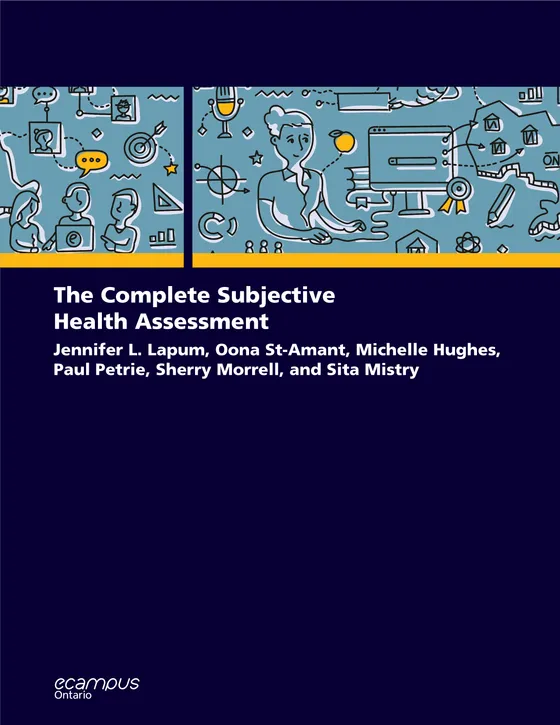
The Complete Subjective Health Assessment
Not rated yetRate this bookOrganize subjective health-assessment learning around interviewing, health-history domains, cultural safety and summaries. Original communication tasks clarify the source’s repeated summary section and supporting appendices.
Read on the publisher’s website. Opens in a new tab.
 Free
About this book
The Complete Subjective Health Assessment by Jennifer Lapum and collaborators introduces health-history interviewing as a way to understand a person’s current and past health. The source moves from purpose and influencing factors to introductory information, reasons for seeking care, symptom-related inquiry and broader domains of health and daily life. It then develops cultural safety, care partners and concluding the interview.
The downloaded collection contains both “Summary” and “Summary and Appendices,” each numbered 4 and repeating some material. This guide preserves that visible source structure while explaining that the second entry also includes supporting appendices. Original study tasks emphasize listening, question design, respectful language and summaries based on what a fictional client actually says. They are communication exercises rather than diagnostic checklists. The source’s interview guide can support teaching, while links to screening recommendations require a separate current check. Short overviews here are based on selected openings and the verified contents rather than every prompt or multimedia demonstration.
AI-assisted book summary
Reading guide
Begin with the purpose of a subjective assessment before its domains. Practice open questions and listening, then consider cultural safety and care partners. Distinguish the repeated summary entries from the additional appendices.
Part-by-part guide
1: Introduction to the Complete Subjective Health Assessment
The introduction defines subjective assessment as a health history obtained through communication and listening. Reports may come from the client or another identified source when needed. Distinguish a person’s account from the professional’s interpretation.
Study task: Label the sources of information in a fictional history and separate reports from inferences.
2: The Complete Subjective Health Assessment
The main assessment part organizes introductory information, health needs and wider health-history domains. Brief demographic details should support respectful care rather than reduce someone to a label. Domain prompts need room for the person’s narrative.
Study task: Rewrite three fictional closed or assumption-based prompts as clear open questions.
3: Cultural Safety and Care Partners
Cultural safety considers exclusion, judgment and the conditions of the interaction, alongside the role of care partners. It requires attention to systems and relationships rather than a checklist of cultural traits.
Study task: Examine a fictional interview for barriers to communication and propose respectful questions about preferences.
4: Summary
The first summary part describes concluding the history through a concise account and an invitation to add information. Summarizing is also a chance to identify omissions. Preserve the person’s concerns and strengths rather than substituting an unsupported conclusion.
Study task: Write a short summary of a fictional narrative and a question inviting correction or additions.
4: Summary and Appendices
The second part numbered 4 repeats summary material and adds appendices with screening-resource links and an interview guide. It is not a separate new clinical sequence. Resource links need currency checks before practical use.
Study task: Identify repeated material and choose an interview-guide domain for a fictional communication exercise.
How to study this book
Use fictional accounts, record the speaker’s meaning accurately and distinguish their report from an inference. Revise leading questions into open prompts. Check a summary with the speaker before treating it as a complete account.
Reflection questions
- Whose account is being recorded?
- Does a question invite a narrative or assume an answer?
- What has the summary omitted or interpreted?
Sources and coverage
Source: The Complete Subjective Health Assessment — LibreTexts.
Original reader guide based on the verified contents and selected substantive chapter or section openings, introductions and learning objectives in the linked source PDF. It is not a full review of every subsection, exercise, illustration, research study or procedure. Study tasks are original additions, not exercises attributed to the source.
The source lists both “4: Summary” and “4: Summary and Appendices.” They are retained as separate source entries with their overlap explained. Screening-resource links were not validated as current recommendations.
About access & copyright
This page provides book information and study material. Full-text access is provided by the original publisher or authorised source; a listing does not grant permission to republish the book.
Read our Library Access & Copyright policyNarrative
Subjective assessment centers on the person’s account.
Safety
Respectful inquiry requires attention to context and power.
Summary
A concise account should preserve meaning and invite correction.
Reader ratings & reviews
Share your thoughts
Your review helps other students choose the right resources.
KEEP LEARNING
Your next great read
Nursing
 Nursing
Medical-Surgical Nursing
View Medical-Surgical Nursing — book Nursing
Community and Public Health Nursing: A Call to Action
View Community and Public Health Nursing: A Call to Action — book Nursing
Strategies for Success in Nursing School From Start to Finish
View Strategies for Success in Nursing School From Start to Finish — book Nursing
 Advanced Skills
View Nursing Advanced Skills — book Nursing
Interpreting Canada's 2019 Food Guide and Food Labelling for Health Professionals
View Interpreting Canada's 2019 Food Guide and Food Labelling for Health Professionals — book Nursing
Vaccine Practice for Health Professionals
View Vaccine Practice for Health Professionals — book Nursing
Leadership and Influencing Change in Nursing
View Leadership and Influencing Change in Nursing — book Nursing
View Nursing — book Nursing



