
The Scholarship of Writing in Nursing Education
NursingTextbook
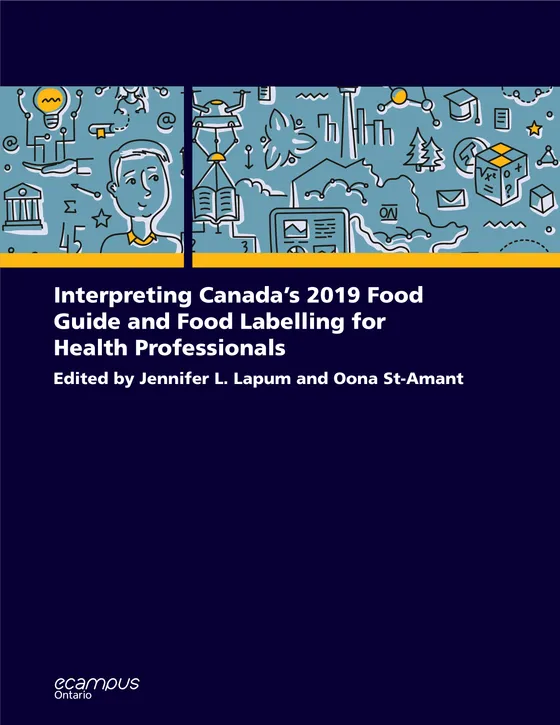
Interpreting Canada's 2019 Food Guide and Food Labelling for Health Professionals
Not rated yetRate this bookExplore Canada’s 2019 Food Guide through three parts on guide principles, nutrition labels and nursing conversations. Original tasks connect information with access, culture and individual circumstances.
Read on the publisher’s website. Opens in a new tab.
 Free
About this book
Interpreting Canada’s 2019 Food Guide and Food Labelling for Health Professionals by Jennifer Lapum and collaborators connects food-guide learning with nutrition labels and person-centered nursing discussions. Three main parts introduce the 2019 guide and its context, examine labelling, and consider how food-related conversations can be integrated with the nursing process. Social determinants, accessibility, culture, time and food skills are part of that discussion.
The title’s year is important: the book interprets a named guide and a particular policy context. This page does not assert that every labelling requirement or policy description remains current. Original tasks support comparing information types, identifying questions and understanding a fictional client’s circumstances without setting an individual diet. Some self-assessments and learning checks are excluded from the PDF as interactive media; the tasks added here are independent learning activities rather than substitutes attributed to the authors. Readers should consult the full source for its examples and a current official source separately when a legal or professional decision depends on the latest requirements.
AI-assisted book summary
Reading guide
Read the 2019 guide in its stated context before comparing labels and ingredient information. Then examine how the nursing process can support conversations that account for resources, culture and preferences.
Part-by-part guide
1: An Introduction to Canada’s Food Guide
The first part introduces the 2019 guide, its emergence, recommendations and critiques. Understanding the document’s purpose and audience comes before applying an example. Treat its date as part of the account rather than assuming all policy context remains unchanged.
Study task: Compare a guide principle with a question about how it is communicated to different audiences.
2: Nutrition Labelling
Nutrition labelling covers nutrient information, ingredient lists and related label topics. Different label elements answer different questions. Legal descriptions belong to the source period and require a separate current check before compliance decisions.
Study task: Compare the information a fictional nutrition table and ingredient list provide without legal conclusions.
3: Integrating the Food Guide into the Nursing Process
The nursing-process part connects assessment and discussion with a person’s life circumstances. Access, cultural relevance, resources and preferences shape the questions to ask. A general guide is not a substitute for understanding a particular person’s situation.
Study task: Draft respectful questions about access and food preferences for a fictional nutrition conversation.
How to study this book
Separate source-period guidance, label information and a person’s circumstances. Use fictional examples to identify questions rather than prescribe a diet. Verify current legal requirements separately when needed for practical work.
Reflection questions
- Which part of a claim concerns the 2019 guide?
- What can a label establish about a food?
- How do access and personal circumstances affect a discussion?
Sources and coverage
Source: Interpreting Canada's 2019 Food Guide and Food Labelling for Health Professionals — LibreTexts.
Original reader guide based on the verified contents and selected substantive chapter or section openings, introductions and learning objectives in the linked source PDF. It is not a full review of every subsection, exercise, illustration, research study or procedure. Study tasks are original additions, not exercises attributed to the source.
This guide interprets the source’s 2019 Food Guide context and does not verify present-day labelling law. Interactive self-assessments excluded from the PDF were not reviewed; the study tasks here are original additions.
About access & copyright
This page provides book information and study material. Full-text access is provided by the original publisher or authorised source; a listing does not grant permission to republish the book.
Read our Library Access & Copyright policyContext
The book interprets a specific 2019 guide.
Information
Nutrition tables and ingredient lists serve different purposes.
Conversation
Resources, culture and preferences matter to understanding.
Reader ratings & reviews
Share your thoughts
Your review helps other students choose the right resources.
KEEP LEARNING
Your next great read
Nursing
 Nursing
Medical-Surgical Nursing
View Medical-Surgical Nursing — book Nursing
Community and Public Health Nursing: A Call to Action
View Community and Public Health Nursing: A Call to Action — book Nursing
Strategies for Success in Nursing School From Start to Finish
View Strategies for Success in Nursing School From Start to Finish — book Nursing
 Advanced Skills
View Nursing Advanced Skills — book Nursing
The Complete Subjective Health Assessment
View The Complete Subjective Health Assessment — book Nursing
Vaccine Practice for Health Professionals
View Vaccine Practice for Health Professionals — book Nursing
Leadership and Influencing Change in Nursing
View Leadership and Influencing Change in Nursing — book Nursing
View Nursing — book Nursing



