
 differential equations
Textbook
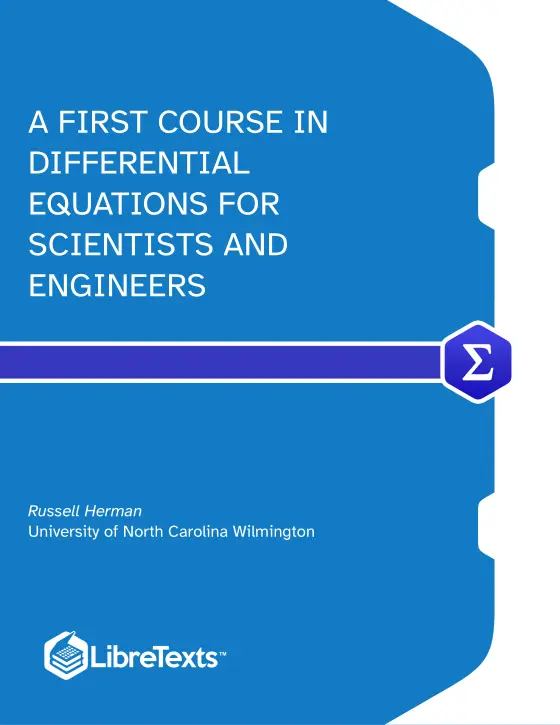
A First Course in Differential Equations for Scientists and Engineers
Not rated yetRate this bookConnect physical models with analytical, numerical and qualitative methods for differential equations. Herman’s course starts with free fall and first-order equations, then develops second-order problems, transforms, coupled systems and nonlinear behavior.
Read on the publisher’s website. Opens in a new tab.
 Free
About this book
Russell Herman’s A First Course in Differential Equations for Scientists and Engineers introduces differential equations through physical modeling and then develops analytical, numerical and qualitative methods. The opening free-fall example connects rates of change with familiar mechanics, giving a concrete reason for studying equations involving derivatives. First-order methods lead into second-order linear equations and oscillatory systems.
The course then broadens through numerical approximation, power-series solutions and Laplace transforms. Linear systems bring coupled models and matrix ideas into the discussion, while nonlinear systems introduce behavior that cannot generally be understood by finding a single closed-form expression. An appendix reviews calculus needed for the main chapters. The text suits learners with a calculus background who want to connect mathematical methods with scientific interpretation. Working through it requires both computation and explanation: a solution should be checked against the equation, its initial conditions and the assumptions of the model.
AI-assisted book summary
Reading guide
Follow first- and second-order equations before choosing among numerical, series and transform methods. Study linear systems before nonlinear systems. Return to the calculus appendix whenever differentiation, integration or power-series manipulation interrupts the main argument.
Chapter-by-chapter study guide
1: First Order ODEs
The chapter opens with free fall, relating acceleration to position and velocity through derivatives. This familiar setting motivates differential equations as descriptions of change. The verified contents proceed to first-order methods, applications and problems.
Study task: State a free-fall model’s assumptions and explain how an initial velocity affects its solution.
2: Second Order ODEs
The opening introduces more general second-order linear equations after earlier oscillation examples. It uses differential-operator language and linearity to organize their solutions. The contents include constant-coefficient equations, harmonic motion, forcing and Cauchy–Euler equations.
Study task: Classify a second-order equation and identify whether its forcing term is zero.
3: Numerical Solutions
Euler’s method opens the numerical chapter as a simple way to approximate an initial-value problem at successive points. Its slope-based construction provides a starting picture for improved techniques. Later contents include Taylor and Runge–Kutta methods and applications.
Study task: Approximate a simple initial-value problem using two step sizes and compare the results.
4: Series Solutions
The introduction motivates power series when exact solutions are unavailable or local descriptions are useful. It reviews Taylor and Maclaurin expansions before the chapter’s solution methods. The wider contents include singular points, Frobenius methods and named special functions.
Study task: Write a trial power series and explain how matching coefficients can determine unknown terms.
5: Laplace Transforms
The opening places the Laplace transform within the broader family of integral transforms and highlights initial-value problems on a semi-infinite domain. The verified sequence includes transform properties, step and impulse functions, convolution and systems.
Study task: Explain how transforming an initial-value problem changes the kind of equation to be solved.
6: Linear Systems
Coupled oscillators introduce systems in which one unknown depends on another. The opening connects this coupling with familiar spring–mass modeling. Matrix methods and eigenvalue ideas in the contents provide a way to organize and solve linear systems.
Study task: Draw a two-component model and identify which terms couple its equations.
7: Nonlinear Systems
The introduction surveys nonlinear models and explains how sensitivity to initial conditions can complicate their behavior. It motivates numerical and local linear approaches when direct integration is difficult. The contents include autonomous systems, bifurcation, stability, populations and limit cycles.
Study task: Compare two nearby initial conditions in a simple nonlinear model and describe what should be monitored.
8: Appendix Calculus Review
The calculus review revisits derivatives as rates and integrals as accumulated quantities. Motion graphs illustrate connections among position, velocity, acceleration and displacement. This appendix supplies prerequisite support for understanding the main course rather than a separate differential-equation method.
Study task: Use a velocity graph to distinguish its slope from the area beneath it.
How to study this book
Begin a problem by naming the dependent variable, independent variable and initial data. After solving, substitute the result back into the equation. For numerical work, compare step sizes and interpret the approximation in the context of the model.
Reflection questions
- What does an initial condition add to a differential equation?
- Why might a numerical method be useful even when an exact solution exists?
- What information can a phase portrait provide without a closed-form solution?
Sources and coverage
Original book and chapter navigation on LibreTexts
This original guide is based on the verified table of contents and selected opening text from the main chapters, not a complete reading of every chapter, proof, example or exercise. Appendix entries describe available reference resources; they do not claim full appendix review. Mathematical expressions and figures should be checked in the original, since PDF text extraction does not preserve every symbol or diagram.
About access & copyright
This page provides book information and study material. Full-text access is provided by the original publisher or authorised source; a listing does not grant permission to republish the book.
Read our Library Access & Copyright policyModeling
Physical assumptions determine the differential equation.
Method choice
Analytical, numerical and series methods have different uses.
Systems
Coupling and nonlinearity require attention to qualitative behavior.
Reader ratings & reviews
Share your thoughts
Your review helps other students choose the right resources.
KEEP LEARNING
Your next great read
differential equations differential equations
ES.1803 Topic Notes, Spring 2024
View ES.1803 Topic Notes, Spring 2024 — book differential equations
Numerical Methods for Ordinary Differential Equations
View Numerical Methods for Ordinary Differential Equations — bookIntroduction to Human Geography: A Disciplinary Approach
Introduction to Human Geography: A Disciplinary Approach
View Introduction to Human Geography: A Disciplinary Approach — bookPublic Speaking
Public Speaking
View Public Speaking — bookThe Whole Child: Development in the Early Years (Budzyna and Buckley)
The Whole Child: Development in the Early Years (Budzyna and Buckley)
View The Whole Child: Development in the Early Years (Budzyna and Buckley) — bookIntroduction to Global Studies
Introduction to Global Studies
View Introduction to Global Studies — bookPrinciples of Social Psychology 1e International Edition
Principles of Social Psychology 1e International Edition
View Principles of Social Psychology 1e International Edition — bookIt’s About Them – Public Speaking in the 21st Century
It’s About Them - Public Speaking in the 21st Century
View It’s About Them - Public Speaking in the 21st Century — bookThe Psychology of Exceptional Children



