
Environmental Analysis (NWTC)
Industrial and Systems EngineeringTextbook
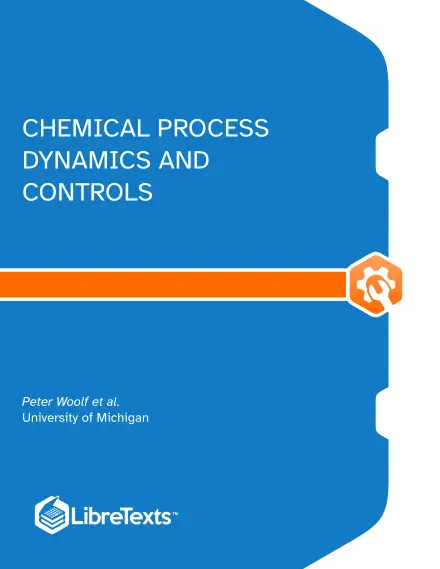
Chemical Process Dynamics and Controls
Not rated yetRate this bookChemical Process Dynamics and Controls, attributed to Peter Woolf and collaborators, connects process models with measurement, feedback, optimization, and statistical analysis. This guide follows the fourteen chapters of the LibreTexts compilation and emphasizes the assumptions connecting a physical process with a control calculation.
Free reading is available at the official source. Opens in a new tab.
 Free
About this book
Chemical Process Dynamics and Controls, attributed to Peter Woolf and collaborators, connects process models with measurement, feedback, optimization, and statistical analysis. This guide follows the fourteen chapters of the LibreTexts compilation and emphasizes the assumptions connecting a physical process with a control calculation.
How to study this book
Define the process boundary, state variables, inputs, outputs, and units before solving equations. Separate physical balances, empirical relationships, sensor behavior, and control logic. Use fictional numerical models for practice, checking open-loop behavior before closing a feedback loop. The tasks are academic modeling exercises rather than operating procedures.
Chapter-wise explanations and study tasks
Chapter 1 — Overview
The overview introduces the purpose and setting of process dynamics and control. Identify the quantity to regulate, the disturbances, and the available actions before choosing a controller.
Study task: Draw a simple controlled-process diagram with a setpoint, measured output, disturbance, and manipulated input.
Chapter 2 — Modeling Basics
Modeling translates physical or observed behavior into equations with stated assumptions. A useful model has a defined purpose and need not represent every feature of the real process.
Study task: Develop a small balance-based model and identify an approximation that limits where it applies.
Chapter 3 — Sensors and Actuators
Measurements and actions pass through devices with their own characteristics. A controller’s mathematical output is not automatically the physical input delivered to the process.
Study task: Add a simple measurement lag or actuator limit to a model and explain its effect on the loop.
Chapter 4 — Piping and Instrumentation Diagrams
P&IDs communicate equipment, measurement, and control relationships. They should be read as organized technical representations, not as substitutes for a complete dynamic model.
Study task: Interpret a fictional diagram and trace one measurement-to-actuation path.
Chapter 5 — Logical Modeling
Truth tables, state-transition diagrams, and conditional control programs represent discrete decisions. The allowed states and transitions must be explicit before code is written.
Study task: Create a small state diagram and test what happens when two input conditions change together.
Chapter 6 — Modeling Cases
Tank, thermal, reactor, and other examples illustrate how balances and assumptions produce different dynamic models. Compare their construction rather than copying parameters from one application into another.
Study task: Choose a simple tank example and derive its accumulation equation before comparing it with a supplied case.
Chapter 7 — Mathematics for Control
Impulse functions, differential equations, Taylor expansions, and Laplace transforms support dynamic analysis. Match each tool to the model’s conditions and initial information.
Study task: Solve a simple first-order response by two methods and verify the initial and final behavior.
Chapter 8 — Optimization
Linear and nonlinear optimization organize choices through objectives and constraints. A numerical optimum remains conditional on model accuracy and the feasible region.
Study task: Formulate a small constrained tuning or operating-point problem and explain one active constraint.
Chapter 9 — PID Control
Block diagrams, proportional, integral, and derivative actions, tuning methods, and practical downsides connect controller parameters with response. Test behavior rather than assuming a tuning rule is universally suitable.
Study task: Compare two simulated PID settings using a stated tracking criterion and actuator-demand measure.
Chapter 10 — Dynamical Systems
Equilibria, linearization, eigenvalues, phase planes, root locus, and Routh reasoning describe stability and response. Separate local conclusions from claims about all possible states.
Study task: Find an equilibrium, linearize a toy model, and state the scope of the resulting stability conclusion.
Chapter 11 — Control Architectures
Feedback, feedforward, cascade, and ratio arrangements use different information and signal paths. Select an architecture by the disturbance and measurement problem it addresses.
Study task: Compare feedback and feedforward for a hypothetical disturbance, identifying the extra model information feedforward needs.
Chapter 12 — MIMO Control
Interactions among inputs and outputs complicate independent loop design. Decoupling, relative-gain reasoning, predictive control, and model construction require explicit treatment of coupling.
Study task: Analyze a small two-input model and explain why pairing each input with the nearest output may be misleading.
Chapter 13 — Statistics and Probability
The background chapter connects descriptive statistics, control charts, probability models, tests, Bayesian ideas, and dependence measures. Distinguish random variability from a specific causal explanation.
Study task: Design a small analysis that separates estimation of variation from a test for a process change.
Chapter 14 — Experimental Design
Orthogonal arrays, factorial designs, and randomized designs structure learning from experiments. A design determines which effects can be separated and what remains confounded.
Study task: Plan a fictional two-factor experiment with replication and explain how randomization supports interpretation.
Applied assignment
Prepare a simulated process-control study with a balance model, open-loop check, sensor or actuator model, feedback design, and a disturbance experiment. Compare two controller choices using explicit criteria. Add a small experiment-design plan and separate conclusions supported by simulation from claims requiring real measurements.
Suggested reading plan
Read Chapters 1–4 for process and measurement context, 5–7 for representations and mathematical tools, 8–12 for design and analysis, and 13–14 for evidence and experiments. Reuse one simple model throughout and document every changed assumption.
Questions for reflection
- Does the model distinguish the process from the sensor and actuator?
- Which behavior is local to the selected operating point?
- What evidence would show that an apparent improvement is repeatable?
Edition and source notes
This guide follows the fourteen-chapter LibreTexts compilation attributed to Woolf and collaborators. The source combines methods and application cases from several domains; the exercises here use fictional educational models and do not treat application examples as validated industrial or clinical control instructions.
About access & copyright
This page provides book information and study material. Full-text access is provided by the original publisher or authorised source; a listing does not grant permission to republish the book.
Read our Library Access & Copyright policyExplore the contents
Check the chapters covered in this edition.
Visit the official source
See reading, preview or purchase options.
Save for later
Keep this textbook in your saved collection.
Reader ratings & reviews
Share your thoughts
Your review helps other students choose the right resources.



