
BUS 310: Business Communications
BusinessTextbook
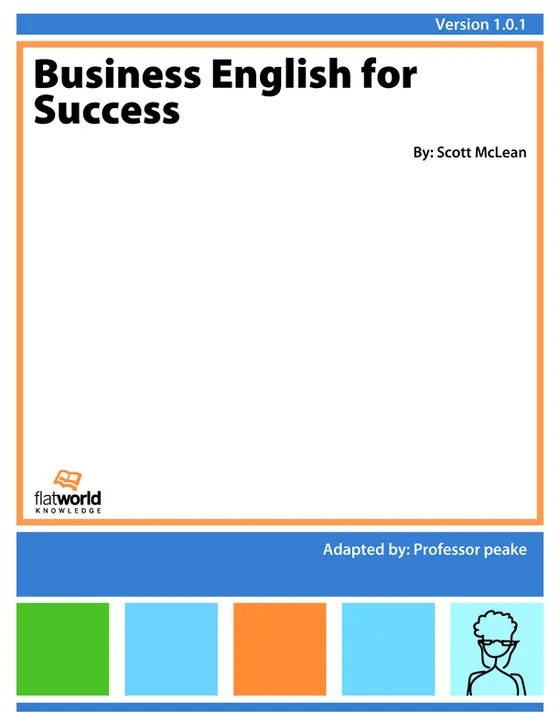
Business English for Success
Not rated yetRate this bookBusiness English for Success develops writing from sentence accuracy and vocabulary through planning, organization, research, revision, and workplace documents. This guide follows the fourteen chapters of the LibreTexts version 1.0 text and uses a portfolio approach to connect language practice with purposeful business communication.
Free reading is available at the official source. Opens in a new tab.
 Free
About this book
Business English for Success develops writing from sentence accuracy and vocabulary through planning, organization, research, revision, and workplace documents. This guide follows the fourteen chapters of the LibreTexts version 1.0 text and uses a portfolio approach to connect language practice with purposeful business communication.
How to study this book
Begin with a short writing sample and retain successive drafts. Work on meaning and organization before sentence-level polishing, then use a personal error log for recurring grammar and punctuation problems. For every document, identify the reader, purpose, requested action, evidence, tone, and format.
Chapter-wise explanations and study tasks
Chapter 1 — Sentence Basics
Sentence structure, agreement, tense, capitalization, modifiers, and related grammar affect clarity. Diagnose why a sentence is unclear before making isolated word changes.
Study task: Edit a short paragraph and explain three corrections in terms of structure or meaning.
Chapter 2 — Punctuation
Punctuation shows relationships among ideas and helps readers interpret sentence boundaries. Choose marks for their function rather than adding them only where you would pause while speaking.
Study task: Revise a paragraph using commas, semicolons, and other marks, explaining how each clarifies a relationship.
Chapter 3 — Choosing Words
Confused words, spelling, vocabulary, word parts, synonyms, and context clues support precise expression. A more elaborate word is not necessarily a more accurate one.
Study task: Replace vague or misused words in a fictional business message and justify the changes for its audience.
Chapter 4 — English-Learner Support
Word order, negatives, nouns, articles, pronouns, tense, modals, prepositions, and idioms receive focused practice. Use the chapter to investigate recurring patterns rather than memorizing disconnected corrections.
Study task: Choose one recurring language difficulty and create original examples that contrast correct and misleading forms.
Chapter 5 — Paragraphs
Purpose, audience, tone, and content shape a paragraph’s controlling idea and support. A paragraph should develop a meaningful unit of thought rather than meet an arbitrary sentence count.
Study task: Write a focused paragraph for a workplace reader and identify the role of each supporting sentence.
Chapter 6 — Refining Technique
Refinement improves the way ideas are expressed and connected. Revisit sentence choices and clarity after ensuring that the message contains the necessary information.
Study task: Revise an overlong passage for clarity while preserving its evidence and intended meaning.
Chapter 7 — Beginning the Writing Process
The writing process turns an initial task into a manageable sequence of idea generation and development. Early planning should help the writer explore the problem rather than lock in an unsupported answer.
Study task: Generate and organize ideas for a short business-related writing task before drafting.
Chapter 8 — Essays from Start to Finish
Extended writing requires a coherent central claim, organization, development, and revision. Practice connecting individual paragraphs with the purpose of the complete piece.
Study task: Prepare an outline and draft a short argument whose paragraphs each advance the central claim.
Chapter 9 — Effective Business Writing
Written communication differs from speech in its planning, persistence, and reader expectations. Style and communication principles help writers anticipate barriers and reduce misunderstanding.
Study task: Rewrite a spoken-style request as a clear business message with an explicit purpose and next action.
Chapter 10 — Preparation and Research
Planning, investigation, source reliability, ethics, and analysis precede drafting. Gather information to answer the actual communication problem and keep source notes traceable.
Study task: Create a research plan and source log for a fictional business recommendation.
Chapter 11 — Writing
Organization, style, argument, paraphrase, and summary turn research into a message. Clearly distinguish your reasoning from the material obtained from sources.
Study task: Draft a recommendation using a sourced summary and an original argument, marking the boundary between them.
Chapter 12 — Revision and Presentation
Revision addresses content, structure, style, and design, while proofreading checks remaining errors. Peer evaluation is most useful when linked to the document’s purpose and reader.
Study task: Review a draft in separate content, organization, and proofreading passes and record a meaningful change from each.
Chapter 13 — Workplace Documents
Messages, memoranda, letters, proposals, reports, résumés, and sales writing serve different purposes. Format should support the task rather than substitute for relevant content.
Study task: Present the same fictional information as a memo and a short report, explaining the different organizational choices.
Chapter 14 — Documentation and Formatting
APA and MLA examples illustrate the relationship between in-text attribution, references, and document format. Citation accuracy requires matching the actual source and the required style edition.
Study task: Audit a small set of citations for source correspondence and check formatting against the style edition required by your course.
Applied assignment
Create a business-writing portfolio with a request email, a memo, a short evidence-based recommendation, and a résumé section or proposal excerpt. Include an audience analysis, source log, first draft, peer-feedback notes, and revised version. Explain three revisions that improved the reader’s ability to act.
Suggested reading plan
Use Chapters 1–4 to diagnose language needs, 5–8 to build extended writing, 9–11 to plan and draft business messages, and 12–14 to revise, format, and document. Return to grammar topics selectively as patterns emerge in your own drafts.
Questions for reflection
- What must the reader understand or do after reading?
- Does the document’s structure make that action easy?
- Which revision improves meaning rather than merely changing wording?
Edition and source notes
The PDF identifies Business English for Success version 1.0 and includes an About the Author page describing Scott McLean. Its fourteen chapters include historical APA and MLA examples; use them for principles of attribution and verify the edition-specific rules required for current work. The guide’s tasks are additional practice, not answer keys.
About access & copyright
This page provides book information and study material. Full-text access is provided by the original publisher or authorised source; a listing does not grant permission to republish the book.
Read our Library Access & Copyright policyExplore the contents
Check the chapters covered in this edition.
Visit the official source
See reading, preview or purchase options.
Save for later
Keep this textbook in your saved collection.
Reader ratings & reviews
Share your thoughts
Your review helps other students choose the right resources.
KEEP LEARNING
Your next great read
Business
INT 2080: Database Design (Watt and Eng)
INT 2080: Database Design (Watt and Eng)
View INT 2080: Database Design (Watt and Eng) — bookBusiness Law I Essentials
Business Law I Essentials
View Business Law I Essentials — bookACCT 311: Managerial Accounting
ACCT 311: Managerial Accounting
View ACCT 311: Managerial Accounting — bookBUS 215: Introduction to Business
BUS 215: Introduction to Business
View BUS 215: Introduction to Business — book Business
BMT 1600: Principles of Management
View BMT 1600: Principles of Management — book Business
BMT 2580: Compensation and Benefits Management
View BMT 2580: Compensation and Benefits Management — book Business
SMALL BUSINESS MANAGEMENT IN THE 21ST CENTURY
View SMALL BUSINESS MANAGEMENT IN THE 21ST CENTURY — bookBUS 340: Business Law
BUS 340: Business Law
View BUS 340: Business Law — bookBMT 2720: Managing Workplace Diversity



