
 General and Comparative Literary Studies and Linguistics
Art, Art TheoryTextbook
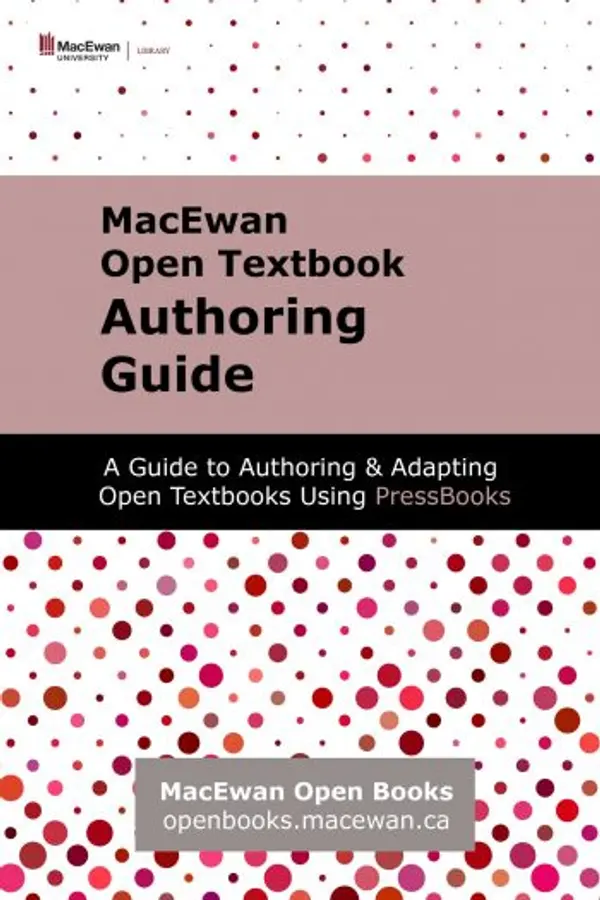
MacEwan Open Textbook Authoring Guide
Not rated yetRate this bookMacEwan Open Textbook Authoring Guide takes educators through planning, adapting, writing, and publishing an open textbook with Pressbooks. Its seven chapters combine platform workflows with instructional design, editorial consistency, copyright attribution, accessibility, and distribution.
Free reading is available at the official source. Opens in a new tab.
 Free
About this book
MacEwan Open Textbook Authoring Guide takes educators through planning, adapting, writing, and publishing an open textbook with Pressbooks. Its seven chapters combine platform workflows with instructional design, editorial consistency, copyright attribution, accessibility, and distribution.
How to study this book
Use one small sample textbook throughout the guide. Start with learning objectives and a chapter outline, then test each publishing technique on a draft. Maintain a style sheet, rights log, and accessibility checklist as you work.
Chapter-wise explanations and study tasks
Chapter 1 — Introduction
The guide explains what makes an open textbook reusable and adaptable, and introduces Pressbooks as a publishing environment. Free access and permission to modify a work are related but distinct questions. Identify the educational need your project serves and the permissions that make adaptation possible.
Study task: Compare one openly licensed textbook with a freely readable resource and record which reuse permissions each actually provides.
Chapter 2 — Getting Started with Pressbooks
Planning comes before production: decide whether to create or adapt, establish learning objectives, and choose a consistent instructional structure. The chapter also considers adaptation scale, recording changes, and expert review. A coherent plan helps prevent a collection of borrowed chapters from becoming an inconsistent learning experience.
Study task: Prepare a project brief with audience, measurable objectives, a chapter pattern, an adaptation log, and a review schedule.
Chapter 3 — Developing Content in Pressbooks
This chapter moves from account access and book organization into practical content development. Work with the relationship between book information, chapters, formatting, and media rather than focusing only on the text editor. Test how a change appears to readers and in exported formats before repeating it across the book.
Study task: Build a two-chapter sample with structured headings, one attributed image, and a table; inspect the web version and a sample export.
Chapter 4 — Writing and Editing
A style sheet gives contributors shared decisions about language, citations, formatting, and recurring features. Editing also involves coordinated review rather than relying on the original author's final reread. Separate revisions to meaning and teaching sequence from copy editing so unresolved content problems are addressed first.
Study task: Create a style sheet and revise a sample page for consistent terminology, heading hierarchy, citations, and learner-facing instructions.
Chapter 5 — Copyright Considerations
The copyright chapter connects source choice, licence conditions, permissions, and attribution. Track the rights attached to each item because an open textbook can contain material with different restrictions. Attribution and academic citation serve overlapping but different purposes, and neither automatically supplies permission to reuse an item.
Study task: Create a rights log for five proposed resources showing creator, source, licence, intended use, attribution, and unresolved permission questions.
Chapter 6 — Making Your Open Textbook Accessible
Accessibility is presented as part of content design, including organization, images, tables, links, multimedia, formulas, and colour contrast. Work through barriers that affect how learners navigate and understand information. Check both the presence of an alternative format and whether it communicates the same educational meaning.
Study task: Audit your sample chapter for heading order, meaningful links, alternative text, table structure, contrast, and media alternatives; record and fix each barrier.
Chapter 7 — Publishing and Distribution
The final chapter brings review, accessibility, rights, metadata, and export settings together before release. Multiple formats increase reader choice and editable files support future adaptation. Treat publication as a checked handoff that includes how corrections and later versions will be managed.
Study task: Produce a release checklist and test PDF, EPUB, and editable exports, noting differences that require correction before distribution.
Applied assignment
Create a pilot chapter and publication package containing objectives, a style sheet, attribution records, peer-review notes, accessibility findings, and tested exports.
Suggested reading plan
Complete Chapters 1–2 for planning, Chapter 3 while building the sample, Chapters 4–6 during review, and Chapter 7 when preparing the release.
Questions for reflection
- When is adaptation preferable to writing from scratch?
- Which decisions belong in a style sheet?
- How will readers report errors and identify the edition?
Edition and source notes
Based on the seven-chapter MacEwan University Library guide, an adaptation of earlier open-textbook authoring resources. Platform screens and institutional procedures reflect the source and may change; consult the live guide for current local arrangements. Embedded media may require the web edition.
About access & copyright
This page provides book information and study material. Full-text access is provided by the original publisher or authorised source; a listing does not grant permission to republish the book.
Read our Library Access & Copyright policyExplore the contents
Check the chapters covered in this edition.
Visit the official source
See reading, preview or purchase options.
Save for later
Keep this textbook in your saved collection.
Reader ratings & reviews
Share your thoughts
Your review helps other students choose the right resources.
KEEP LEARNING
Your next great read
General and Comparative Literary Studies and Linguistics General and Comparative Literary Studies and Linguistics
Beginning Japanese for Professionals, Book 1
View Beginning Japanese for Professionals, Book 1 — book Electrical Engineering
ICT - Energy - Concepts Towards Zero
View ICT - Energy - Concepts Towards Zero — book Applied probability
Probability in Electrical Engineering and Computer Science
View Probability in Electrical Engineering and Computer Science — book Atomic and molecular physics
Detectors in High-Energy Physics Experiments
View Detectors in High-Energy Physics Experiments — book Dead Zones
Marine Pollution – Monitoring, Management and Mitigation
View Marine Pollution – Monitoring, Management and Mitigation — book Air Pollution
Introduction to Environmental Economics and Policy in Japan
View Introduction to Environmental Economics and Policy in Japan — book Biomedical Research
Introduction to Epigenetics
View Introduction to Epigenetics — book awareness, access, aortoiliac occlusive disease, critical limb ischemia
Angiography and Endovascular Therapy for Peripheral Artery Disease
View Angiography and Endovascular Therapy for Peripheral Artery Disease — book Complaints; Family medicine; General practice; Symptoms; Primary care; Prognosis; Diseases; Practice



