
 Mathematics
Textbook
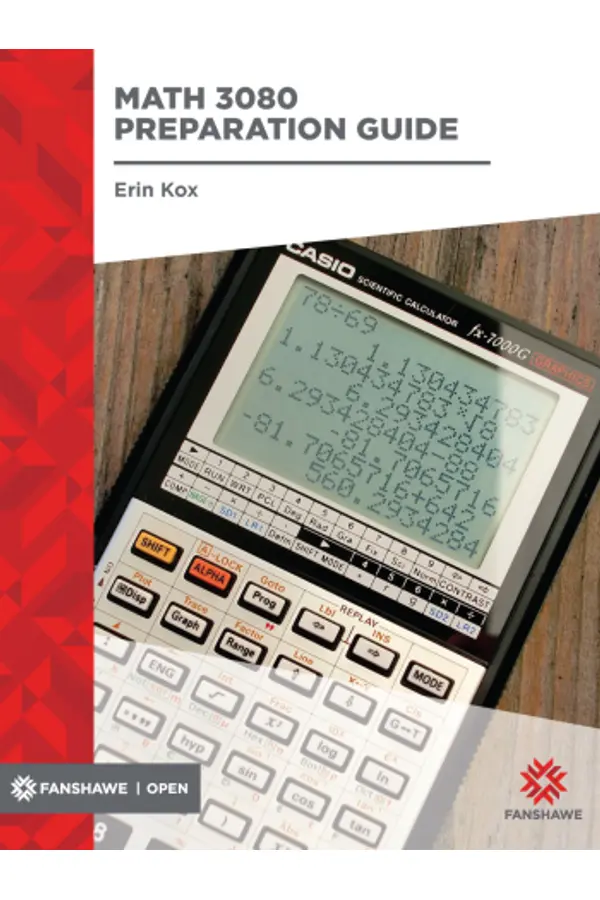
Math 3080 Preparation
Not rated yetRate this bookMath 3080 Preparation reviews prerequisite skills for learners moving from foundational mathematics into advanced functions. Erin Kox's four chapters cover function notation, domain and range, transformations, and polynomial factoring, followed by a Foundations of Mathematics review.
Free reading is available at the official source. Opens in a new tab.
 Free
About this book
Math 3080 Preparation reviews prerequisite skills for learners moving from foundational mathematics into advanced functions. Erin Kox's four chapters cover function notation, domain and range, transformations, and polynomial factoring, followed by a Foundations of Mathematics review.
How to study this book
Use the practice questions diagnostically: attempt a small set without the solutions, identify the skill behind each error, then revisit the corresponding worked examples. Keep graphical and algebraic representations side by side. Treat the package as preparation rather than a substitute for the complete advanced-functions course.
Chapter-wise explanations and study tasks
Chapter 1 — Functions and Function Notation
The chapter distinguishes functions from general relations and develops notation, input-output reasoning, tables, one-to-one relationships, and basic toolkit functions. An input may have only one output in a function, while one-to-one asks a further question about repeated outputs. Connect verbal, tabular, graphical, and symbolic representations before relying on a visual shortcut alone.
Study task: Represent one relation in four ways, test whether it is a function and one-to-one, and explain the difference between f(3) and solving f(x)=3.
Chapter 2 — Domain and Range
Domain and range describe allowable inputs and resulting outputs. The chapter examines restrictions from equations, interval and other notation, graphs, toolkit functions, and piecewise definitions. Separate restrictions imposed by a mathematical expression from those imposed by a real-world context. Endpoints and excluded values require careful representation.
Study task: Find domain and range for a rational expression, a radical expression, and a piecewise graph; justify every endpoint or excluded value.
Chapter 3 — Transformation of Functions
Shifts, reflections, stretches, compressions, and even or odd behaviour connect a parent function with related graphs. Horizontal changes require particular care because an operation inside the input affects the graph differently from an outside operation on the output. Track points through transformations and check your interpretation against an equation.
Study task: Start with a toolkit function, apply a shift, reflection, and scale change, then write the new equation and track three points to the transformed graph.
Chapter 4 — Factoring Polynomials
Factoring methods include common factors, trinomials, grouping, perfect squares, differences of squares, cubes, and expressions with fractional or negative exponents. Choose the method from the structure and look for a common factor first. Factored and expanded forms communicate different features, and multiplication provides an independent check on the result.
Study task: Build a six-expression mixed factoring set, explain the strategy for each, and verify by expansion; include one example that cannot be factored further over the chosen number system.
Math 3069 Review — Foundations of Mathematics Review
The closing review points back to prerequisite material that may need attention before advanced functions. Use it to diagnose foundations rather than assuming every difficulty belongs to the new topic. The package's course introduction lists broader advanced-function areas, but those are not additional completed chapters in this preparation text.
Study task: Create a readiness checklist from your practice results and schedule targeted review of three prerequisite weaknesses before attempting another mixed set.
Applied assignment
Assemble a readiness portfolio with a multiple-representation function problem, a domain-and-range analysis, a transformation diagram, and a mixed factoring set. Include corrected errors and a brief plan for maintaining fluency.
Suggested reading plan
Work through Chapter 1 before Chapters 2–3, then Chapter 4. Return to the Foundations review whenever prerequisite errors recur, and finish by repeating a mixed diagnostic without consulting solutions.
Questions for reflection
- How does a domain restriction change a graph?
- Why do input and output transformations behave differently?
- Which factoring check would expose a sign error?
Edition and source notes
Based on Erin Kox's Fanshawe College preparation package. Its four chapters and closing Foundations review are covered; the introduction's outline of the later MATH 3080 course is not treated as content supplied by this book. Course access and scheduling details in the source are institution-specific.
About access & copyright
This page provides book information and study material. Full-text access is provided by the original publisher or authorised source; a listing does not grant permission to republish the book.
Read our Library Access & Copyright policyExplore the contents
Check the chapters covered in this edition.
Visit the official source
See reading, preview or purchase options.
Save for later
Keep this textbook in your saved collection.
Reader ratings & reviews
Share your thoughts
Your review helps other students choose the right resources.
KEEP LEARNING
Your next great read
Mathematics Biology
Principles of Development - An inquisitive journey into embryology -
View Principles of Development - An inquisitive journey into embryology - — book Algebra
Fanshawe Pre-Health Sciences Mathematics 2
View Fanshawe Pre-Health Sciences Mathematics 2 — book Algebra
Fanshawe Pre-Health Sciences Mathematics 1
View Fanshawe Pre-Health Sciences Mathematics 1 — book Algebra
Linear Algebra with Applications
View Linear Algebra with Applications — book Atoms
Introductory Chemistry- 1st Canadian Edition
View Introductory Chemistry- 1st Canadian Edition — book Business and Economics
Mathematics of Finance
View Mathematics of Finance — book Biology
Environmental Science
View Environmental Science — book Business and Economics
Data Analytics and Decision Making
View Data Analytics and Decision Making — book Anatomy



