
Electromagnetics I
DynamicsTextbook
Introductory Dynamics: 2D Kinematics and Kinetics of Point Masses and Rigid Bodies, Edition 1.1
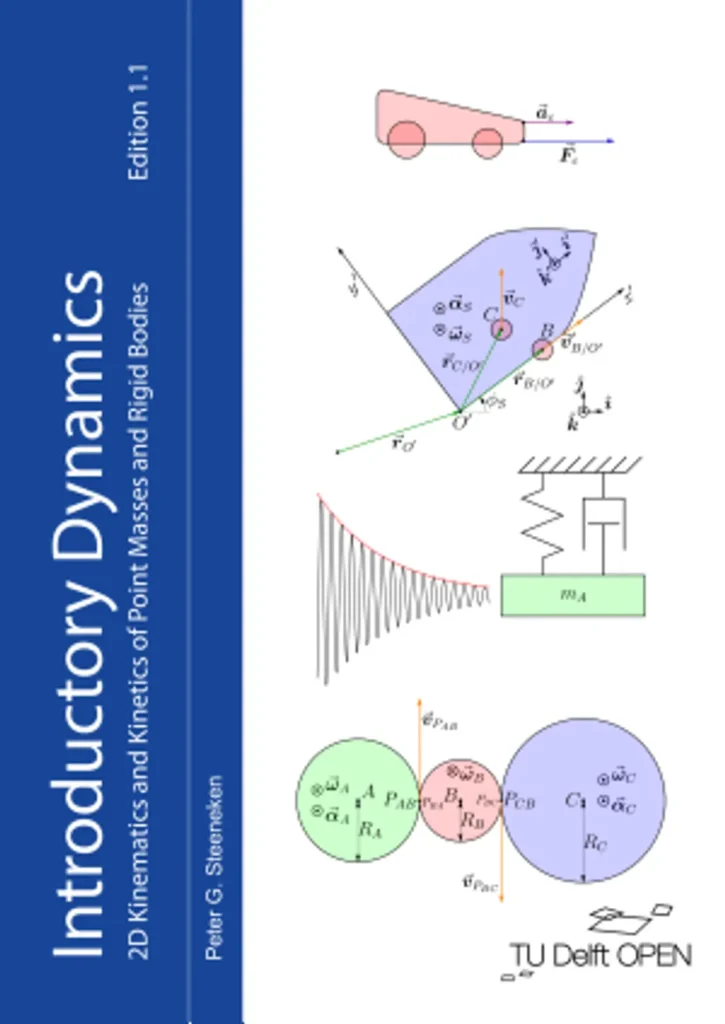
Not rated yetRate this bookPeter G. Steeneken’s Introductory Dynamics develops a systematic approach to two-dimensional motion of point masses and rigid bodies. Edition 1.1 organizes fourteen learning chapters across foundations, point-mass dynamics, rigid-body dynamics, vibrations, and solution strategy. This guide follows that sequence and emphasizes symbolic modeling, constraints, coordinate choices, free-body diagrams, and independent checks. The aim is to select and justify an approach, not merely identify a formula that contains the supplied numbers.
Free reading is available at the official source. Opens in a new tab.
 Free
About this book
Peter G. Steeneken’s Introductory Dynamics develops a systematic approach to two-dimensional motion of point masses and rigid bodies. Edition 1.1 organizes fourteen learning chapters across foundations, point-mass dynamics, rigid-body dynamics, vibrations, and solution strategy. This guide follows that sequence and emphasizes symbolic modeling, constraints, coordinate choices, free-body diagrams, and independent checks. The aim is to select and justify an approach, not merely identify a formula that contains the supplied numbers.
Chapter-wise summaries and study tasks
Chapter 1. Preface
The preface explains prerequisites and an approach to learning dynamics through active problem solving. Reading a worked solution can feel fluent without producing the ability to choose the method independently. The source encourages symbolic work before numerical substitution, consistent notation, and persistence when a problem exposes a gap in understanding. The edition notes also identify the scope and revisions of version 1.1.
Use a worked example as a comparison after an independent attempt, recording the first point where the reasoning became uncertain. This turns an error into a specific revision target rather than a general impression that the topic is difficult.
Study task. Attempt a short problem before reading its solution. Record your diagram, assumptions, symbolic equations, and first uncertainty, then explain the reasoning change needed to finish it independently.
Chapter 2. Notation, Math, and Engineering Basics
Notation, units, significant digits, calculus, and complex numbers provide tools for later mechanical analysis. Scalars, vectors, and matrices need distinct representations, while subscripts identify objects, points, directions, or reference frames. Units help test equations, and uncertainty limits the precision of a reported result. First-order differential equations connect rates with motion when constant-acceleration shortcuts do not apply.
The chapter’s problem-solving and plausibility checks establish a standard for the rest of the book. An equation should remain meaningful before values are inserted. Sign, scale, units, and limiting behavior can reveal errors that a calculator will reproduce without complaint.
Study task. Solve a simple rate equation symbolically with an initial condition. Check units and a limiting case, then substitute data with appropriate precision and distinguish a notation error from an arithmetic one.
Chapter 3. Vectors and Coordinates
Vectors describe position, relative location, and interactions, while coordinate systems supply a representation rather than alter the physical vector. The chapter develops drawing conventions, signed components, magnitude–angle forms, and distinctions among fixed, sliding, and free vectors. Cartesian and cylindrical descriptions suit different geometry. Dot and cross products support work and moment calculations, while fields and vector calculus prepare later force and motion analysis.
A component changes when axes change even though the underlying direction need not. In a rotating or curvilinear basis, derivatives must account for changing unit vectors. Consistent diagrams prevent a signed scalar magnitude from being confused with a vector or an unsigned distance.
Study task. Represent one vector in two coordinate systems and verify an invariant magnitude or product. Draw a force and its line of action, explaining which changes preserve its mechanical effect and which do not.
Chapter 4. Introduction to Dynamics
The introduction to dynamics separates kinematics, which describes motion, from kinetics, which relates it to interactions and inertia. Newton’s laws connect these descriptions within an appropriate reference frame. A model must identify objects, constraints, degrees of freedom, and forces before equations can predict motion.
A point-mass approximation neglects rotational extent for a purpose; a rigid-body approximation retains geometry while neglecting deformation. Neither is universally correct. The chapter supplies an organizing framework that allows later energy and momentum principles to be understood as related tools rather than unrelated recipes.
Study task. Choose a physical system and compare point-mass and rigid-body models. State the question each can answer, a neglected effect, and an observation that would show the simpler model is insufficient.
Chapter 5. Kinematics of Point Masses
Point-mass kinematics relates position, path, velocity, and acceleration under predetermined or constrained motion. Constraint equations link coordinates, including pulley arrangements and geometric paths. Time-based and path-coordinate methods offer different routes depending on the known relationships. Cartesian, cylindrical, circular, and natural-coordinate descriptions expose different components of acceleration. Segmented motion requires continuity and appropriate matching between intervals.
A path constraint does not necessarily prescribe the speed along it. Conversely, knowing a speed does not establish the direction of acceleration on a curved path. Choose coordinates that simplify the constraint and differentiate the complete relationship rather than only the most convenient term.
Study task. Analyze a constrained motion in two coordinate descriptions. Separate tangential and normal acceleration, then check a segment boundary for consistent position and velocity under the stated physical conditions.
Chapter 6. Kinetics of Point Masses
Point-mass kinetics turns a system sketch and constraints into equations of motion. The source gives a deliberate sequence: identify objects and coordinates, determine constraints, draw free-body diagrams, express and project forces, and solve the resulting equations. Gravity, normal contact, friction, springs, dampers, rods, ropes, and massless mechanisms require models consistent with the actual arrangement. Relative motion and inertial frames affect the equation form.
Do not add a force because its name is familiar or omit a constraint reaction because it is unknown. Equations can determine the forces required by a prescribed motion as well as predict motion from given interactions. Validate both the direction and admissibility of a computed contact or tension result.
Study task. Model a constrained mass with a spring, contact, or rope. Derive its equations before inserting values and check whether the resulting reaction satisfies the assumed contact or tension condition.
Chapter 7. Work and Energy
Work–energy reasoning integrates force effects along motion and can reduce a dynamics problem to initial and final conditions. Kinetic energy, conservative force fields, potential energy, power, and efficiency describe different parts of the account. For systems of masses, internal interactions and the chosen boundary determine how terms are represented. Center-of-mass ideas support gravitational-energy descriptions under appropriate conditions.
Conservation of mechanical energy requires the relevant conditions; total energy conservation does not mean every form remains mechanical. A force perpendicular to displacement may influence a path while doing no work in that description. Use energy when it answers the desired question efficiently, retaining constraints needed to connect coordinates.
Study task. Solve a constrained-motion endpoint problem by work and energy. Identify a force that does no work, account for a dissipative term if present, and explain why the method does not automatically provide the elapsed time.
Chapter 8. Impulse and Momentum
Impulse and momentum relate force history to changes in linear momentum. The system form distinguishes internal exchanges from external impulse, and conservation applies when the latter is negligible or appropriately accounted for. Collisions require geometry: the line of impact and contact plane organize components, while restitution describes a selected relative-velocity relationship under its model.
A coefficient of restitution is not a universal material constant independent of conditions, and momentum conservation does not establish kinetic-energy conservation. Separate the event interval from the slower motion before and after it. This clarifies why a force negligible during a brief collision can still matter over a longer trajectory.
Study task. Analyze a two-body impact by resolving normal and tangential components. Check system momentum and kinetic energy separately, and justify any neglected external impulse over the collision interval.
Chapter 9. Kinematics of Rigid Bodies
Rigid-body kinematics connects the motion of several points through fixed geometry and planar rotation. Translation, fixed-axis rotation, and general plane motion require different descriptions. Relative-velocity and acceleration relations link points on the same body; instantaneous-center reasoning can simplify velocity calculations when its conditions hold. Constraints such as rolling relate translation and rotation without necessarily eliminating every contact force.
An instantaneous center useful for velocity is not automatically a fixed pivot for all acceleration or kinetic equations. Draw the configuration at the instant of interest and distinguish body-fixed geometry from quantities that change with time. Check the normal and tangential acceleration contributions rather than carrying over a velocity construction unchanged.
Study task. Find velocities at two points on a moving rigid body using relative motion and an appropriate instantaneous-center check. Then compute acceleration separately and explain why the velocity shortcut cannot simply be reused.
Chapter 10. Kinetics of Rigid Bodies
Rigid-body kinetics combines translational motion of the center of mass with rotational response to moments. Mass moments of inertia depend on the axis, and the source develops force–moment systems, couples, angular momentum, and Euler relationships for planar analysis. Constraints connect accelerations and determine reactions. Choosing a moment point is a modeling decision whose conditions must be respected.
A rigid body can translate and rotate simultaneously, so one torque equation generally does not replace all force equations. A fixed-point simplification is useful only when the geometry and motion justify it. Keep the inertia definition and the reference used for each moment consistent to avoid mixing superficially similar formulas.
Study task. Derive planar equations for a body with both translation and rotation. Compare taking moments about the mass center and another justified reference, checking that both approaches give compatible motion and reactions.
Chapter 11. Work and Energy of Rigid Bodies
Work and energy for rigid bodies includes both translational and rotational kinetic energy, with a convenient center-of-mass decomposition for planar motion. Forces and couples contribute work differently, and a torsional spring provides a rotational potential-energy example. Conservative interactions can support a mechanical-energy balance while other transfers require explicit accounting.
Rolling constraints and contact conditions must be examined before deciding which forces do work. A friction force is not automatically dissipative in every idealized rolling description, just as a stationary contact point does not remove all force effects. The chapter extends earlier energy reasoning while retaining the body’s distribution and angular motion.
Study task. Use energy to analyze a rolling or spring-driven body and verify the kinematic constraint. Identify force and couple work, then compare the result with a force–moment analysis at one instant.
Chapter 12. Angular Impulse and Angular Momentum
Angular impulse connects an external moment integrated over time with angular-momentum change. Reference-point choice matters, particularly when the point moves or a fixed-point simplification is being considered. Conservation follows from the appropriate external-moment conditions, not from rotation alone. The source develops a procedure for choosing a useful reference and applying the principle to planar bodies and interactions.
A convenient point can eliminate an unknown moment contribution while other external effects remain. Linear momentum, angular momentum, and energy provide different statements; selecting one does not authorize assuming the others are conserved. Check the physical interval and all external interactions before simplifying.
Study task. Analyze a short interaction using angular impulse about a justified point. Explain which unknown contribution is eliminated, which conservation statement remains valid, and why an energy balance may still include losses.
Chapter 13. Vibrations
Vibrations combine an equilibrium configuration with a differential equation for motion about it. Free undamped systems connect inertia and restoring stiffness with frequency and phase. Damped cases distinguish oscillatory and nonoscillatory responses, while forcing introduces particular and homogeneous solutions, resonance, and initial-condition dependence. Rotating rigid bodies extend the same reasoning to angular coordinates.
Determine equilibrium before linearizing or interpreting displacement. Damping and driving affect transient and sustained responses differently, so a large forced response is not described completely by the free natural frequency alone. State the range in which the linearized model remains physically reasonable.
Study task. Derive a vibration equation about equilibrium and compare free, damped, and forced responses. Separate transient from sustained motion and identify a parameter change that alters the qualitative response.
Chapter 14. Solution Strategy Dynamics
The final learning chapter organizes preparation, kinematics, and kinetics through solution flowcharts. Its purpose is method selection: identify what is known, what is constrained, what is sought, and which principle relates them most directly. The strategy returns to symbolic equations, clear diagrams, and checks rather than presenting one universal formula sequence.
Use the flowcharts to diagnose an incomplete solution. A missing constraint, inconsistent coordinate, or unjustified conservation assumption requires a different repair from an arithmetic mistake. Comparing two methods can strengthen confidence and reveal which information each does or does not supply. The numbered bibliography that follows is a reference list rather than another mechanics topic.
Study task. Revisit an earlier difficult problem using the strategy flowchart. Mark each modeling decision, solve by a second method where possible, and classify any discrepancy by its first incorrect assumption or equation.
How to study this book
- Solve problems independently before consulting worked solutions; use errors to identify a specific conceptual gap.
- Keep quantities symbolic until the model and equations are complete, then check units and limiting behavior.
- Draw constraints, coordinates, and a free-body diagram separately so geometry and interactions remain distinguishable.
- Compare force–moment, energy, and impulse approaches using the quantity requested and the available information.
- State approximation limits, including point mass, rigidity, planar motion, linear elasticity, or small vibration where relevant.
Questions for reflection
- Which constraint reduces the independent motion, and which force enforces it?
- Why is a reference convenient for one principle but unsuitable for another?
- What information does the chosen method leave undetermined?
Source edition and coverage
This guide follows edition 1.1, dated 2025 on the linked PDF title page. It covers numbered learning chapters 1–14; the bibliography and index are reference material. Optional starred sections remain available in the full text. These are original study explanations and learning tasks. Read the complete book at the official source.
About access & copyright
This page provides book information and study material. Full-text access is provided by the original publisher or authorised source; a listing does not grant permission to republish the book.
Read our Library Access & Copyright policyExplore the contents
Check the chapters covered in this edition.
Visit the official source
See reading, preview or purchase options.
Save for later
Keep this textbook in your saved collection.
Reader ratings & reviews
Share your thoughts
Your review helps other students choose the right resources.



