
Introduction
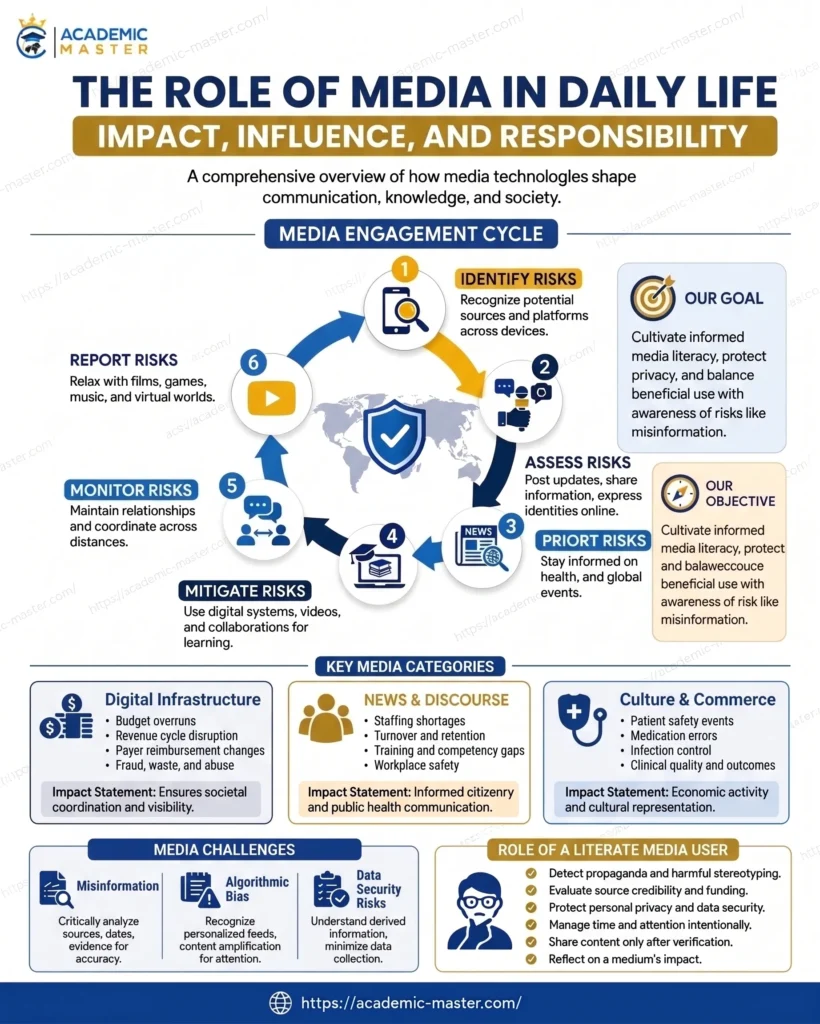
Media are the technologies, institutions, and forms through which people create, distribute, receive, and interpret messages. They include books, newspapers, television, radio, film, advertising, websites, messaging services, podcasts, games, social platforms, search engines, and public information systems. Media are deeply integrated into daily life because they support communication, work, education, entertainment, commerce, public health, and civic participation. Their effects cannot be reduced to whether individual users behave responsibly because ownership, algorithms, business models, laws, accessibility, social inequality, and platform design influence what information becomes visible and how people interact with it. Contemporary news habits show this integration clearly: Pew Research Center reported in 2025 that more than half of U.S. adults at least sometimes obtained news from social media, even as websites, apps, television, and other digital pathways remained important (Pew Research Center, 2025). Media therefore function as both content and infrastructure. They can expand access, connection, and creativity while also enabling misinformation, surveillance, attention capture, commercialization, and unequal participation.
Communication, Relationships, and Education
Digital media allow families, friends, students, and coworkers to communicate across distance through text, voice, images, and video. Group chats coordinate households and communities, while video calls support relationships that would otherwise depend on travel. The same connectivity can create pressure for immediate response through read receipts, activity indicators, and persistent notifications. Education similarly benefits from digital libraries, learning platforms, simulations, collaborative documents, recorded lectures, and accessible reference materials, but technology does not automatically improve learning. Distraction, inaccessible interfaces, unreliable sources, weak connectivity, and commercial data collection can undermine educational value. Families and schools therefore need intentional norms rather than one rule treating all screen use as equivalent. Shared viewing, creative production, interactive learning, reading, and passive autoplay differ substantially in purpose and effect. UNESCO’s media and information literacy framework emphasizes the ability to access, analyze, evaluate, create, and reflect on media rather than merely consume it (UNESCO, 2021). Everyday media use becomes more useful when people understand both the message and the systems through which it reaches them.
News, Algorithms, and Misinformation
News media help people understand government, science, economics, emergencies, conflict, and local affairs, but digital distribution has blurred boundaries among journalism, commentary, advertising, entertainment, and rumor. Social platforms add algorithmic gatekeeping because recommendation systems decide which items receive visibility based partly on predicted engagement, personalization, and platform rules. Personalization can improve relevance, yet it can also repeatedly expose users to sensational or emotionally charged material. Misinformation has many sources, including ordinary mistakes, misunderstood satire, financial scams, coordinated influence operations, and deliberate propaganda. Effective correction requires more than deletion. Timely evidence, trusted messengers, contextual explanation, and transparent corrections can reduce harm, while overly broad content suppression can also hide legitimate disagreement. Media literacy therefore involves checking source, date, authorship, evidence, funding, and whether an image or quotation has been altered. A social feed is not a neutral newspaper page; it is a ranked environment shaped by technical and commercial decisions. Users need to understand that the order of information is itself part of media influence.
Attention, Mental Health, and Platform Design
Many digital services compete for attention because advertising, subscriptions, and data-driven business models often benefit from sustained engagement. Infinite scroll, autoplay, streaks, notifications, and variable rewards reduce natural stopping points and can make it harder for users to regulate time. Individual boundaries remain useful: people can disable unnecessary notifications, protect sleep, schedule device-free periods, and separate work communication from personal time. Yet responsibility cannot rest entirely on users when design is intentionally optimized to prolong engagement. Mental-health effects are similarly complex. Media can provide social support, creative communities, health information, and connection for people who feel isolated, while also exposing users to harassment, idealized comparison, disturbing material, and sleep disruption. Research does not support a universal claim that social media either causes or cures mental illness. Outcomes vary according to age, prior vulnerability, type of use, social environment, and platform features. A healthier media ecosystem therefore requires both individual agency and institutional design that provides meaningful controls, transparent recommendation systems, age-appropriate protections, and proportionate limits on manipulative engagement features.
Culture, Identity, and Representation
Media influence how people understand gender, race, nationality, religion, disability, class, language, and sexuality by providing stories and symbols through which identity is represented. Inclusive representation can validate groups historically excluded from public culture, while stereotypes can normalize prejudice or make unequal treatment appear ordinary. Diversity therefore concerns more than placing varied faces on screen. It also involves who writes, owns, directs, receives credit, controls distribution, and decides which stories are considered commercially valuable. Global circulation allows music, film, fashion, language, and ideas to cross borders rapidly, producing hybrid forms as communities adapt outside influences to local contexts. This exchange is unequal because large firms and dominant languages possess greater distribution power. Cultural protection should therefore support creators, archives, minority languages, education, and community control rather than treating culture as authentic only when isolated from change. Couldry and Hepp (2017) emphasize that reality itself is increasingly mediated through communication systems. Media globalization is therefore best understood as an unequal but active exchange in which audiences interpret, remix, accept, and resist circulating forms.
Privacy, Commerce, and the Digital Divide
Everyday digital activity can reveal location, relationships, beliefs, health interests, shopping habits, work routines, and financial vulnerability. Platforms may infer information that users never explicitly disclosed, while advertisers and data brokers can use behavioral patterns to target messages or categorize audiences. Meaningful privacy therefore requires more than long consent notices. Data minimization, purpose limitation, security, retention limits, access rights, and restrictions on secondary use matter because users cannot realistically evaluate every future data flow. Commerce creates related risks through hidden sponsorship, counterfeit reviews, scams, discriminatory targeting, and impulse-oriented design. Security threats such as phishing, impersonation, and account takeover further show that media literacy includes practical digital protection. Participation also remains unequal. Income, geography, disability, age, language, infrastructure, and device quality influence access. Having a smartphone does not guarantee affordable data, private study space, accessible software, or a device suitable for work. Institutions that move essential services online should therefore preserve accessible alternatives and treat connectivity as a condition of participation rather than merely a consumer preference.
Conclusion
Media shape daily life because they are simultaneously tools, institutions, cultural systems, and infrastructures. They connect families, support learning, distribute news, enable creative expression, organize work, facilitate commerce, and help communities respond to emergencies. They can also spread falsehoods, reward sensationalism, collect personal data, reinforce stereotypes, fragment attention, and deepen inequality when access or design is poor. These outcomes cannot be explained solely through personal responsibility because users make choices inside environments structured by ownership, algorithms, interface design, regulation, commercial incentives, and unequal resources. The appropriate goal is therefore not a life without media but a media environment in which people can participate with informed agency. That requires critical literacy, privacy and security safeguards, accessible design, sustainable journalism, transparent advertising, meaningful user controls, and institutions willing to correct harmful incentives. The growing importance of social platforms as a route to news demonstrates why these questions are no longer peripheral. Media systems now help structure how everyday reality is encountered, interpreted, discussed, and shared.
References
Couldry, N., & Hepp, A. (2017). The mediated construction of reality. Polity.
Pew Research Center. (2025). Social media and news fact sheet.
UNESCO. (2021). Media and information literacy curriculum for educators and learners.
Cite This Work
To export a reference to this article please select a referencing stye below:

Academic Master Education Team is a group of academic editors and subject specialists responsible for producing structured, research-backed essays across multiple disciplines. Each article is developed following Academic Master’s Editorial Policy and supported by credible academic references. The team ensures clarity, citation accuracy, and adherence to ethical academic writing standards
Content reviewed under Academic Master Editorial Policy.





