
Martin Scorsese’s Raging Bull is often described as a boxing film, but the label does not fully explain what makes it so unsettling and memorable. Boxing provides the setting, yet the film is primarily a study of anger, jealousy, masculinity, loneliness, and self-destruction. Its central character, Jake LaMotta, knows how to absorb punishment in the ring, but he cannot manage the emotions that damage his marriage, his relationship with his brother, and eventually his entire life.
Released in 1980, the film was directed by Martin Scorsese from a screenplay by Paul Schrader and Mardik Martin. It was adapted from the autobiography of real-life middleweight boxer Jake LaMotta. Robert De Niro plays Jake, Joe Pesci portrays his brother Joey, and Cathy Moriarty appears as Jake’s second wife, Vickie. Michael Chapman served as cinematographer, while Thelma Schoonmaker edited the film (American Film Institute, n.d.).
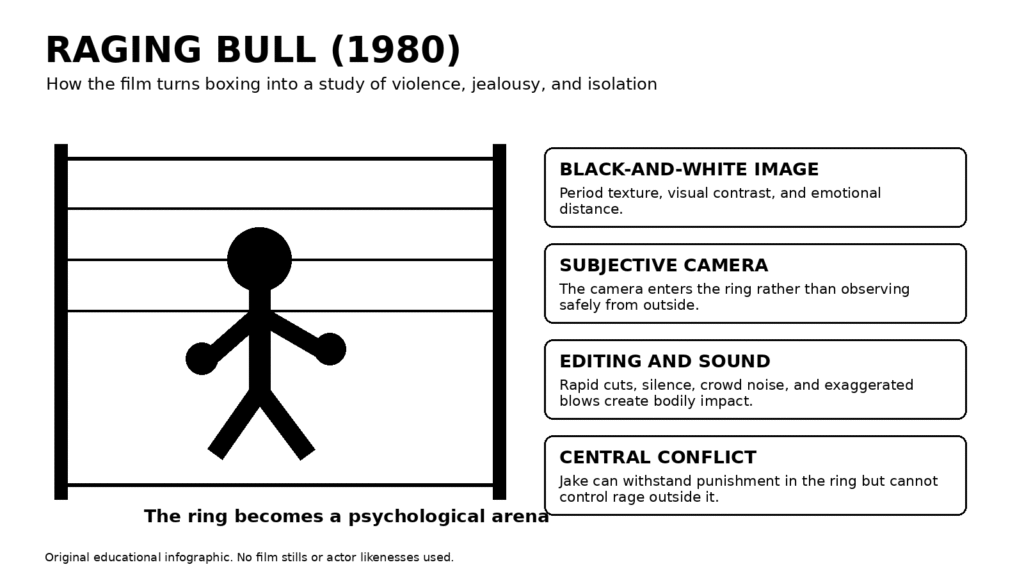
What makes Raging Bull extraordinary is the way its form reflects its subject. The black-and-white photography, shifting camera speeds, sudden silences, exaggerated sounds, tight interiors, and violent editing do not simply record Jake’s life. They draw the viewer into his unstable perception of the world. The film is visually beautiful, but its beauty never makes Jake’s behavior admirable. Instead, the elegance of the filmmaking makes his emotional and moral collapse even more disturbing.
Plot Overview
The film follows Jake LaMotta through several stages of his boxing career and personal life. It opens in 1964, when an older and heavier Jake prepares to perform a comedy routine in a small nightclub. The story then moves back to 1941, when he is a younger professional boxer struggling to advance toward a championship opportunity.
Jake is a powerful fighter with an exceptional ability to endure punishment. He wants recognition, but he is unwilling to cooperate with the criminal figures who influence professional boxing. His refusal is not presented as entirely honorable. Jake’s pride makes him resistant to anyone who might control him, whether that person is a boxing promoter, his brother, or his wife.
Joey acts as Jake’s manager and closest companion. He understands the boxing business more clearly than Jake and repeatedly tries to protect his brother from poor decisions. Their relationship is close but unstable because Jake’s suspicion gradually extends even to Joey.
Jake meets Vickie at a neighborhood swimming pool and becomes intensely attracted to her. Their relationship initially appears tender, but Jake’s insecurity soon becomes controlling jealousy. He constantly questions Vickie about other men and interprets ordinary conversations as evidence of betrayal.
His behavior becomes increasingly violent. He abuses Vickie and eventually attacks Joey after convincing himself that the two have had an affair. There is no reliable evidence supporting his suspicion. His jealousy grows from fear, insecurity, and his need to dominate the people closest to him.
Jake eventually wins the world middleweight championship, but success does not solve his emotional problems. His career declines, his marriage collapses, and he becomes estranged from Joey. In later life, he operates a nightclub, is imprisoned, and attempts to rebuild himself as a stage performer.
The film does not offer a conventional story of triumph followed by complete redemption. Jake survives and gains some awareness of what he has lost, but the ending leaves open the question of whether he genuinely understands the suffering he caused.
Jake LaMotta as an Antihero
Most sports films present a clear path toward victory. The athlete faces obstacles, works harder, develops discipline, and eventually earns success. Raging Bull rejects this familiar structure.
Jake has determination, courage, and physical strength, but these qualities do not make him a morally admirable hero. The characteristics that help him in the ring become destructive in his private life. His refusal to surrender can look courageous during a boxing match, but the same refusal prevents him from admitting mistakes or accepting help.
Jake’s identity depends on physical power. He understands conflict through domination and endurance. When he feels threatened, he attacks. When he feels ashamed, he redirects that shame toward someone else. He can tolerate punches more easily than emotional vulnerability.
This is what makes him such a difficult character to watch. The film does not excuse his violence, yet it refuses to reduce him to a simple villain. Viewers see his insecurity, humiliation, ambition, and loneliness without being asked to approve of his actions.
Jake wants to believe that he is in control, but much of his behavior reveals the opposite. His jealousy controls him. His pride controls him. His fear of humiliation controls him. Even his physical strength becomes another form of imprisonment because he has never learned a healthier way to express himself.
Robert De Niro’s performance captures these contradictions. His Jake can appear intimidating one moment and emotionally helpless the next. De Niro does not play him as a permanently explosive man. Much of the danger comes from pauses, suspicious glances, repeated questions, and the feeling that an ordinary conversation could suddenly become violent.
Violence Inside and Outside the Ring
The original article correctly recognized that the film connects physical violence with internal self-destruction. The crucial difference is that violence inside the ring follows rules, while Jake’s violence outside the ring destroys trust and intimacy.
In boxing, both participants agree to fight within a regulated space. There are rounds, referees, judges, gloves, and boundaries. Jake understands this world. He can focus his rage on an opponent, endure pain, and receive applause for his aggression.
Outside the ring, there is no such control. Jake carries the emotional logic of boxing into his home. He treats conversations like contests and imagines that respect can be maintained through fear. His wife and brother become opponents rather than people whose trust he should protect.
The contrast creates the film’s tragedy. Jake appears most controlled while participating in an openly violent sport. He becomes most dangerous in ordinary domestic situations that require patience, honesty, and emotional maturity.
Scorsese does not portray boxing as the sole cause of Jake’s behavior. The sport gives him a socially acceptable outlet, but his jealousy and insecurity exist beyond it. He does not become abusive simply because he is a boxer. Rather, boxing becomes the only language through which he knows how to understand himself.
The violence is therefore psychological as well as physical. Jake repeatedly interprets affection as betrayal and independence as disrespect. He damages relationships before anyone can abandon or humiliate him, creating the very isolation he fears.
Black-and-White Cinematography
One of the film’s most striking creative decisions is its black-and-white cinematography. Scorsese partly chose this approach because black and white reflected how boxing from the 1940s and 1950s appeared in news photography, television broadcasts, and older films. He was also concerned about the long-term fading of contemporary color film and wanted to distinguish Raging Bull from other boxing films being produced at the time (Lustgarten, 2022).
However, the effect is more than historical authenticity. Michael Chapman’s cinematography gives the film the appearance of memory rather than straightforward documentation. The strong contrast between light and shadow makes faces, bodies, smoke, sweat, and blood feel both realistic and strangely abstract.
The boxing ring often appears detached from the ordinary world. Smoke surrounds the ropes, flashbulbs explode in the darkness, and figures emerge from bright or shadowed spaces. The ring can resemble a stage, a prison, a church, or a private mental landscape.
Black and white also prevents the boxing sequences from resembling colorful sports entertainment. The absence of bright colors directs attention toward shape, texture, movement, and facial expression. Sweat and blood appear as substances rather than spectacle.
The limited color home-movie sequences create a deliberate contrast. These images show weddings, family gatherings, and apparently happy domestic moments. Their faded and imperfect appearance resembles private memory. Yet the viewer already knows that the relationships shown in these scenes are unstable. The home movies preserve the appearance of happiness without revealing what happens behind it.
Realism and Formalism
The original review described Raging Bull as belonging to the realist film genre. The film does contain realistic elements, but it cannot accurately be understood as purely realist.
Its locations, costumes, dialogue, performances, and period details create a believable social world. The conversations often sound natural, with interruptions, repetition, incomplete sentences, insults, and uncomfortable pauses. Characters do not always explain what they mean, and the film does not provide simple psychological answers for Jake’s behavior.
At the same time, the fight scenes are highly formalized. Scorsese changes camera speeds, alters the apparent size of the ring, uses smoke and unusual angles, and exaggerates the sounds of punches. The camera sometimes moves as though it shares Jake’s fear or aggression.
Each major fight has its own visual and emotional character. The viewer is not watching a neutral sporting record. The scenes communicate Jake’s mental condition. A ring may suddenly appear enormous, claustrophobic, chaotic, or dreamlike depending on what the moment means to him.
This combination of realism and formalism is one of the film’s greatest achievements. The everyday scenes create social credibility, while the stylized boxing scenes communicate an internal reality that ordinary observation could not capture.
The film is realistic about Jake’s world but expressionistic about how that world feels.
Camera Movement and the Boxing Sequences
Most traditional boxing coverage places the viewer outside the ring. The audience watches from a stable position and follows the contest as a sporting event. Raging Bull frequently places the camera within the ring, beside the fighters, or extremely close to their bodies.
This perspective makes the boxing sequences feel personal and uncomfortable. Punches do not simply land on Jake. They seem to move toward the camera and, by extension, the viewer.
The camera may circle, shake, rush forward, or move in slow motion. At other moments, it becomes strangely calm. These changes prevent the fights from settling into a predictable rhythm.
One of the film’s most celebrated movements follows Jake from his dressing room through the arena corridors and toward the ring. The shot temporarily creates the feeling of a public triumph. Crowds gather, noise increases, and Jake moves toward the space where he feels most powerful.
Yet the movement also leads him into an enclosed area. The ring is a stage for achievement, but its ropes resemble the boundaries of a cage. Jake’s greatest ability is inseparable from his confinement.
The final major fight against Sugar Ray Robinson is structured almost like a horror sequence. The violence becomes distorted through editing, sound, light, and camera position. Jake’s refusal to fall may look heroic, but it also expresses his destructive belief that suffering proves his worth.
Editing and the Experience of Impact
Thelma Schoonmaker’s editing is essential to the film’s force. She controls not only the speed of the boxing scenes but also the abrupt transitions between public success and private failure.
During the fights, rapid cuts break the body into fragments. Gloves, ropes, faces, feet, blood, and flashbulbs appear in quick succession. The viewer cannot always observe the entire movement of a punch. Instead, the impact is assembled through separate images.
At other moments, slow motion stretches a brief expression or movement. A glance from Vickie may last long enough to become suspicious in Jake’s mind. A fighter’s approach may become threatening before any punch is thrown.
This editing reflects Jake’s unstable attention. He notices what supports his fears and ignores what challenges them. The film does not confirm that Vickie is unfaithful, but its images show how Jake turns ordinary behavior into evidence.
Schoonmaker also gives the quieter scenes room to become uncomfortable. Conversations do not always move quickly. Silence remains long enough for tension to grow. The possibility of violence can be more disturbing than violence itself.
The Academy recognized Schoonmaker’s work with the Oscar for film editing. Robert De Niro also won best actor, while the film received six additional nominations, including best picture, directing, cinematography, sound, supporting actor, and supporting actress (Academy of Motion Picture Arts and Sciences, n.d.).
Sound Design and Silence
The sound of Raging Bull is as carefully constructed as its images. The boxing scenes include crowd noise, bells, breathing, camera flashes, animal-like sounds, and heavily layered impacts.
The punches do not sound like ordinary punches recorded during a sporting event. Sound editor Frank Warner combined multiple effects to give each blow a particular physical quality. Some impacts included sounds associated with breaking bones, water, meat, breath, and bodily movement (Lustgarten, 2022).
These exaggerated sounds make the fights feel subjective. The viewer hears violence as Jake experiences it rather than as a distant spectator would hear it.
Silence is equally important. Crowd noise may suddenly disappear or become muted. A moment that should feel loud can become strangely empty, isolating Jake from the people surrounding him.
The movement between noise and silence creates emotional instability. The audience cannot relax into a familiar sports-film rhythm. A cheering crowd can become threatening, while a quiet room can contain the possibility of an explosion.
Sound also separates the public and private versions of Jake. In the ring, noise confirms his importance. Outside it, silence exposes his inability to communicate.
Masculinity, Jealousy, and Control
Jake’s tragedy is closely connected to a destructive idea of masculinity. He believes a man must be physically dominant, sexually powerful, emotionally guarded, and respected by others.
Any suggestion of weakness becomes intolerable. He cannot openly admit fear, insecurity, or dependence. Instead, those emotions appear as suspicion and aggression.
His jealousy toward Vickie is not evidence of deep romantic love. It is an attempt to control how she looks, speaks, moves, and interacts with other people. He treats her independence as a threat to his identity.
The film does not romanticize this behavior. Vickie’s exhaustion and fear reveal the damage created by Jake’s obsession. She is not merely a symbol within his psychological struggle. She is a person forced to live under repeated accusation and abuse.
Jake also becomes suspicious of Joey, the person who has worked hardest to advance his career. When Jake attacks him, he destroys the relationship that provided both personal loyalty and professional stability.
His need for control ultimately produces complete loss of control. He loses Vickie, Joey, his career, and the public identity that once protected him from self-examination.
Robert De Niro’s Transformation
Robert De Niro’s physical transformation has become one of the most discussed aspects of the film. He trained extensively as a boxer and performed the fight scenes with unusual technical confidence. Production was paused so that he could gain substantial weight for the scenes showing Jake later in life (American Film Institute, n.d.).
The transformation is impressive, but its value is not limited to physical realism. De Niro creates two versions of Jake that remain psychologically connected.
The younger Jake is compact, watchful, and ready to attack. Even when seated, he seems physically prepared for conflict. The older Jake moves more slowly and hides behind jokes, performance routines, food, and alcohol.
Yet the same need for attention remains. In the ring, he performs toughness for an audience. In the nightclub, he performs comedy and dramatic speeches. Both settings provide a stage on which he can temporarily avoid private self-knowledge.
De Niro does not rely only on dramatic outbursts. Some of his strongest moments occur when Jake is thinking, listening, or trying to decide whether he has been insulted. The pauses show the machinery of suspicion beginning to work.
The Ending and the Question of Redemption
Near the end of the film, Jake rehearses a speech from On the Waterfront in front of a mirror. The borrowed speech concerns lost opportunity and blame. Its use is deeply ironic.
Jake has certainly been affected by corruption in boxing and by the limitations of his social environment. However, he cannot blame every failure on someone else. Many of his greatest losses result from his own choices.
The mirror suggests self-examination, but it does not confirm that Jake has achieved complete understanding. He looks at himself, performs the words of another damaged boxer, and prepares to walk onstage.
The scene can be interpreted as a small movement toward awareness. Jake is no longer physically attacking anyone, and he appears capable of recognizing failure. Yet performance may also be another way of avoiding a direct apology.
The film refuses to provide an easy moral conclusion. Jake is neither fully redeemed nor completely unchanged. He remains alive, separated from much of what he once valued, still trying to turn pain into entertainment.
This ambiguity gives the ending its power. Real people do not always transform according to the clean structure of a fictional redemption story.
Critical Evaluation
Raging Bull is difficult to enjoy in the conventional sense because its central character repeatedly harms those closest to him. The domestic violence and emotional cruelty are intentionally distressing, and some viewers may find the repetition exhausting.
That discomfort is part of the film’s purpose. Scorsese does not create suspense by asking whether Jake will become champion. The more disturbing question is whether success will change him. It does not.
The film’s strongest achievement is the unity between character and technique. Cinematography, sound, editing, performance, costume, and production design all reveal different parts of Jake’s inner world.
Its black-and-white images create period authenticity while also turning the ring into an expressionistic space. Its editing makes violence fragmented and immediate. Its sound design transforms every blow into an emotional event. Its quieter scenes reveal how jealousy grows through suggestion, silence, and repetition.
The film’s limitations are connected to its narrow perspective. The story remains closely attached to Jake, which means Vickie and Joey sometimes receive less independent development than they deserve. Viewers see the harm done to them, but much of their inner experience remains outside the film’s focus.
Even so, their performances prevent them from becoming flat supporting figures. Cathy Moriarty gives Vickie a mixture of confidence, frustration, fear, and emotional exhaustion. Joe Pesci makes Joey practical, loyal, impatient, and finally unwilling to accept further abuse.
The result is not a celebration of masculine rage. It is a portrait of what happens when a person builds an identity around domination and treats vulnerability as defeat.
Conclusion
Raging Bull is not an ordinary boxing drama about an underdog overcoming obstacles. It is a tragic character study of a man who wins professional recognition but destroys the relationships that might have given his success meaning.
Jake LaMotta’s greatest strength is his ability to endure punishment. His greatest weakness is his inability to understand why he needs punishment in the first place. He can survive blows from other fighters, yet he cannot tolerate uncertainty, jealousy, shame, or emotional dependence.
Martin Scorsese presents this conflict through a mixture of realism and formalism. The period setting, performances, costumes, and dialogue make Jake’s world believable. The stylized camera work, editing, sound, lighting, and slow motion reveal the psychological violence beneath that world.
The film’s physical force is inseparable from its emotional tragedy. Violence enters Jake’s relationships, shapes his identity, and eventually leaves him isolated. His fall is not caused by fate alone. It develops from repeated choices that he refuses to question until much of his life has already disappeared.
More than four decades after its release, Raging Bull remains one of the most important American films because it refuses to turn a destructive man into a simple hero or villain. It asks viewers to observe him closely, recognize the human fears beneath his behavior, and still hold him responsible for the harm he causes.
References
Academy of Motion Picture Arts and Sciences. (n.d.). The 53rd Academy Awards: 1981.
American Film Institute. (n.d.). Raging Bull (1980). AFI Catalog of Feature Films.
Bernard, J. (n.d.). Raging Bull. National Film Preservation Board, Library of Congress.
Ehrenstein, D. (1990, December 2). Raging Bull. The Criterion Collection.
Lustgarten, A. (2022, August 25). 10 things I learned: Raging Bull. The Criterion Collection.
Robertson, R. (2022, July 13). Raging Bull: American Minotaur. The Criterion Collection.
Scorsese, M. (Director). (1980). Raging Bull [Film]. Chartoff-Winkler Productions; United Artists.
:::
Cite This Work
To export a reference to this article please select a referencing stye below:

Academic Master Education Team is a group of academic editors and subject specialists responsible for producing structured, research-backed essays across multiple disciplines. Each article is developed following Academic Master’s Editorial Policy and supported by credible academic references. The team ensures clarity, citation accuracy, and adherence to ethical academic writing standards
Content reviewed under Academic Master Editorial Policy.




