
Introduction
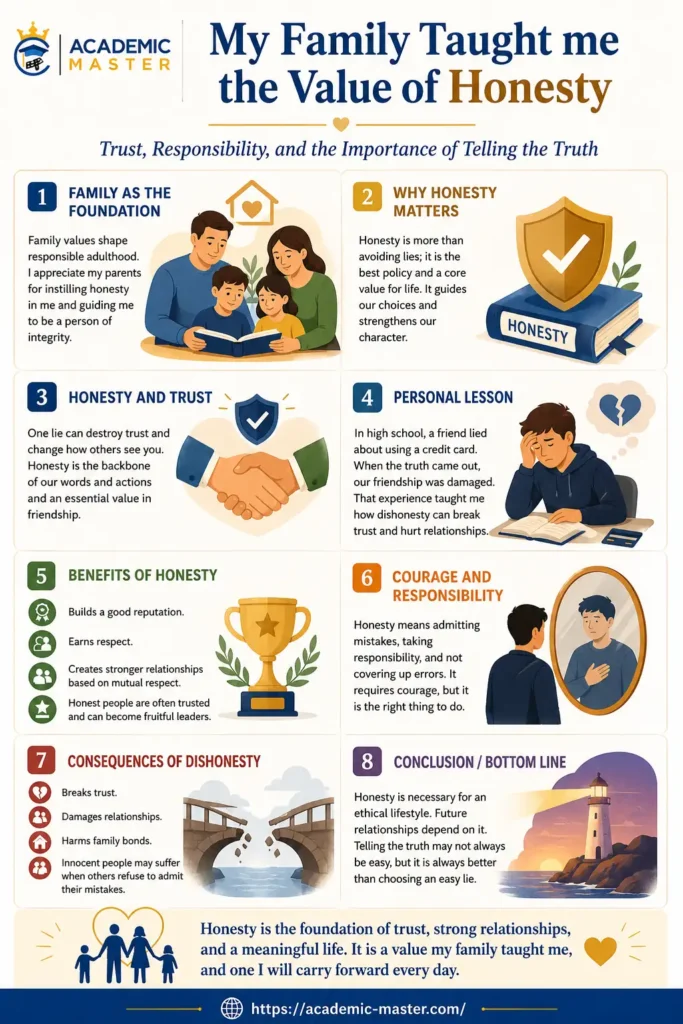
My family taught me that honesty is not limited to avoiding a direct lie. It means trying to make my words, actions, promises, and responsibilities consistent with one another. As a child, I understood honesty through simple rules: tell the truth, return what does not belong to you, admit when you have made a mistake, and do not hide wrongdoing by blaming someone else. As I became older, the lesson became more complicated because deception can also occur through silence, exaggeration, selective facts, false promises, and the creation of an image designed only to gain approval (Bok, 1999). My parents did not teach me that an honest person never fails. They taught me that mistakes should be acknowledged and repaired rather than protected through additional dishonesty. That distinction remains important because truthfulness is tested most clearly when admitting the truth carries a cost. Honesty becomes a form of responsibility when a person chooses accuracy even though deception might offer temporary protection from embarrassment, punishment, or disappointment.
Promises and Personal Responsibility
One of the strongest lessons I learned at home concerned the meaning of a promise. My father often emphasized that a person’s word should have weight because other people make decisions based on what they have been told. Agreeing to complete a task, repay money, meet someone, protect confidential information, or arrive by a certain time creates an expectation that affects another person’s plans. Honesty therefore requires humility about what I can realistically do. It is more truthful to say that I cannot meet a deadline than to agree immediately and repeatedly fail. The same principle applies to mistakes. If I damage something, forget an obligation, or give incorrect information, admitting the problem allows the other person to respond to reality. Hiding it transfers the cost of my decision to someone else. This connection between truth and responsibility changed my understanding of character. Honesty is not simply a reputation for being “good.” It is a habit of giving other people information they need in order to make fair and informed choices.
A Friendship That Changed My Understanding of Trust
A high-school experience with a friend made the consequences of dishonesty more concrete. She used my credit card without permission and denied doing so when I asked her about it. The financial loss could have been corrected, but the denial changed the nature of the problem because I could no longer separate the unauthorized use from the question of whether future explanations would be reliable. A truthful confession would not have erased the original action, yet it could have created a basis for apology, restitution, and gradual repair. Continued denial forced me to protect myself by limiting access and questioning later claims. The experience taught me that trust is cumulative but can be damaged very quickly when a person chooses deception after being given an opportunity to tell the truth. It also taught me not to turn one betrayal into permanent suspicion of everyone. Healthy boundaries are different from cynicism. An honest response to broken trust protects oneself while leaving room for other relationships to be judged by their own evidence rather than by one painful experience.
Truth, Kindness, and Privacy
Honesty does not require saying every thought that enters my mind or using “truth” as an excuse for cruelty. A person can be truthful while still choosing respectful language, appropriate timing, and a constructive purpose. If a friend asks for feedback on important work, an empty compliment may prevent improvement, but humiliation is not a more honest alternative. Useful honesty explains what works, identifies the problem clearly, and gives the other person room to respond. Privacy also matters. There are questions that another person has no right to ask, and refusing to answer is not automatically deceptive. I can say that information is private, decline to discuss it, or change the subject without inventing a false story. Difficult situations involving so-called white lies require similar judgment. Before misleading someone, I should ask who benefits, whether the person has a right to the information, whether the lie removes their ability to make an important decision, and whether a truthful but limited answer could avoid unnecessary harm (Bok, 1999).
Honesty in School, Work, and Digital Life
The same family lesson applies beyond personal relationships. In education, honesty means submitting original work, citing sources accurately, reporting data truthfully, and following the actual rules for collaboration. Cheating can produce a grade while weakening the skill that the grade is supposed to represent. In professional life, employees make claims about time, expenses, safety incidents, performance, deadlines, and customer expectations. Small distortions can influence decisions far beyond the person who created them, especially when records are used for financial, medical, or legal purposes. Digital life creates additional pressures because social platforms encourage selective presentation. No online profile represents a whole person, but deliberate fabrication is different from ordinary selection. Sharing information without checking its source can also spread falsehood even when the person did not invent the claim. Correcting an inaccurate post publicly may feel embarrassing, yet it demonstrates that truth matters more than protecting an image. Honesty becomes especially important in environments where false information can be copied quickly and reach people who cannot easily verify its origin.
Self-Honesty and Reputation
The hardest form of honesty may be recognizing my own motives. People can describe jealousy as concern, avoidance as patience, fear as principle, or selfishness as responsibility because those explanations protect self-image. Self-honesty requires curiosity rather than constant self-accusation. I can ask what outcome I am afraid of, what evidence I may be ignoring, and whether I would interpret the same behavior differently if another person did it. Trusted friends, reflection, counseling, journaling, or spiritual practice can help reveal patterns that are difficult to see alone. Reputation also has limits. A history of honest behavior can reduce the need for constant monitoring, but reputation should never make a person immune from reasonable questions. Institutions often fail when respected people are assumed incapable of deception. The goal should therefore be to deserve trust while accepting accountability. Honest people do not need every decision to be believed automatically; they should be willing to provide evidence when the situation reasonably requires it. Trust is strongest when character and verification support one another.
Conclusion
My family’s teaching about honesty began with simple childhood rules but gradually became a broader philosophy of responsible living. I learned that lies can transfer harm, damage future trust, and cause other people to make important decisions using false information. I also learned that truthfulness must be joined with kindness, privacy, humility, and realistic boundaries. An honest person can still make serious mistakes; the difference lies in whether those mistakes are admitted, corrected, and prevented from growing into a larger pattern of deception. The experience with my friend showed me that trust can be damaged quickly, while family lessons about promises taught me that truthful communication helps other people plan their lives fairly. In school, work, and digital spaces, the same principle applies because records and statements affect people who may never meet the person who created them. Honesty remains difficult precisely because it sometimes costs comfort, approval, or advantage. Its value comes from choosing truth even when temporary deception would be easier.
References
Cite This Work
To export a reference to this article please select a referencing stye below:

Academic Master Education Team is a group of academic editors and subject specialists responsible for producing structured, research-backed essays across multiple disciplines. Each article is developed following Academic Master’s Editorial Policy and supported by credible academic references. The team ensures clarity, citation accuracy, and adherence to ethical academic writing standards
Content reviewed under Academic Master Editorial Policy.





