
Introduction
Robert Browning and Elizabeth Barrett Browning were major Victorian poets whose marriage connected two remarkable literary careers without making those careers stylistically identical. Both wrote about moral responsibility, art, love, social power, religion, and the difficulty of interpreting human motives, yet they often approached those subjects through different poetic strategies. Robert became especially associated with the dramatic monologue, a form in which a speaker reveals character indirectly through self-justification, contradiction, tone, and the presence of a silent listener. Elizabeth used lyric, sonnet, ballad, dramatic voice, and verse narrative to address intimate experience alongside slavery, child labor, nationalism, gender, and artistic vocation. The most useful comparison therefore does not divide Robert into “objective” social poetry and Elizabeth into “subjective” personal poetry. Both poets move between private consciousness and public ethics. Their difference lies more often in rhetorical method: Robert frequently makes readers infer what a speaker cannot see about himself, whereas Elizabeth often uses lyric intensity and argument to make suffering or injustice difficult for readers to ignore.
Voice as the Central Point of Comparison
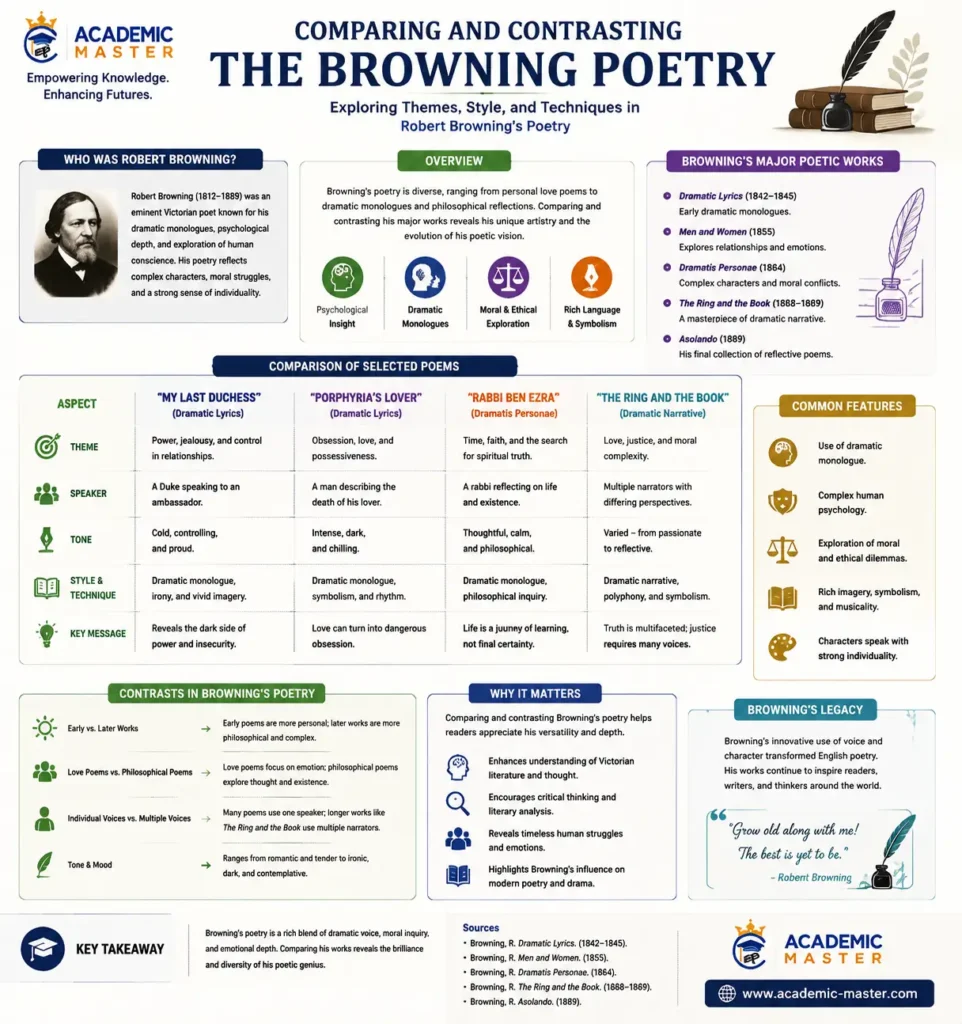
The most revealing way to compare the Brownings is through their management of voice. In Robert’s “My Last Duchess,” the Duke appears to control the conversation, but his polished explanation exposes jealousy, possessiveness, class arrogance, and the possibility of violence. The reader must reconstruct a moral reality that the speaker himself refuses to acknowledge. Similar dynamics shape “Fra Lippo Lippi” and “Andrea del Sarto,” where dramatic voices mix insight with evasion. Elizabeth also uses constructed speakers, but her political poems often direct voice toward witness rather than ironic exposure. “The Runaway Slave at Pilgrim’s Point,” for example, gives a first-person account designed to confront readers with racial violence and the contradiction between American liberty and slavery. Modern readers can question the ethics of a white British poet adopting the voice of an enslaved Black woman while still recognizing the poem’s antislavery purpose. In both poets, voice is never merely decoration; it determines how readers encounter evidence, sympathy, judgment, and responsibility.
Marriage, Love, and Unequal Power
Marriage becomes a productive contrast because Robert frequently dramatizes relationships in which possession or failed communication disfigures intimacy, while Elizabeth’s best-known love poems explore reciprocity and the difficulty of accepting love without surrendering selfhood. In “My Last Duchess,” the Duke turns his deceased wife into an artwork under his control, revealing a model of marriage structured by status and domination. “Andrea del Sarto” presents a different failure, in which artistic compromise, emotional dependency, and marital dissatisfaction become intertwined. Elizabeth’s Sonnets from the Portuguese moves through doubt, gratitude, mortality, and spiritual recognition, using the Petrarchan sonnet form to give shape to vulnerable private feeling. Yet her verse novel Aurora Leigh complicates any simple association between Elizabeth and domestic romance. Aurora insists that artistic vocation cannot be subordinated automatically to marriage. Across both careers, intimacy is therefore connected with authority. The poems ask whether love recognizes another person as an independent consciousness or attempts to absorb that person into an existing structure of expectation.
Public Ethics: Slavery, Labor, and Social Responsibility
Elizabeth Barrett Browning’s political poetry makes public injustice unusually explicit. “The Cry of the Children” responds to child labor by combining repetition, religious language, testimony, and emotional appeal, presenting industrial exploitation as both a social and moral failure. “The Runaway Slave at Pilgrim’s Point” condemns slavery, sexual violence, and racial hypocrisy, while Casa Guidi Windows and Poems Before Congress engage Italian nationalism and political change. Robert’s social criticism is usually less direct but no less concerned with structures of power. His historical speakers expose aristocratic entitlement, religious authority, artistic patronage, possessive marriage, and the capacity of educated people to rationalize harmful conduct. The distinction is therefore rhetorical rather than political versus nonpolitical poetry. Elizabeth often names the injustice and urges recognition, whereas Robert creates a speaker whose language becomes evidence against him. Both methods require readers to participate morally. One asks the audience to hear suffering that public life suppresses; the other asks the audience to identify corruption hidden inside cultivated or persuasive speech.
Art, Artists, and the Purpose of Poetry
Both Brownings repeatedly ask what art should do and what kind of life makes artistic achievement possible. Robert’s “Andrea del Sarto” presents a technically accomplished painter whose perfection is not matched by the imaginative or spiritual force he admires in other artists. “Fra Lippo Lippi” stages a debate over whether religious art should idealize the body or represent ordinary life vividly. These speakers make artistic theory inseparable from personality, patronage, appetite, and institutional pressure. Elizabeth develops a more programmatic theory of art in Aurora Leigh, where the woman poet argues that contemporary life deserves serious poetic treatment and that artists should engage the social realities of their own age. Her position links aesthetic form with women’s intellectual authority and the responsibility to represent poverty, work, love, and political change. Neither poet treats art as a detached ornament. Robert dramatizes artists arguing from within compromised situations, while Elizabeth more openly defends poetry as a vocation capable of reshaping perception and bringing private experience into public understanding.
Nature, History, and the Construction of Setting
Setting performs different functions across the two careers. Robert frequently turns to Renaissance Italy and other historical environments because distance allows him to examine authority, religion, violence, patronage, and marriage without writing simple topical commentary about Victorian Britain. The historical setting also constrains the speaker: a Duke, monk, or painter speaks from within social institutions that shape what he believes he may demand. Elizabeth uses history and politics directly, especially in poems concerning Italy, but she also draws on the use of nature as a symbol. In “The Cry of the Children,” the vitality normally associated with childhood and the natural world is contrasted with the confinement of industrial labor. In the sonnets, organic and spatial imagery helps express the growth, risk, and spiritual dimensions of love. Nature in her poetry is therefore not merely decorative escape. Like Robert’s historical settings, it becomes an interpretive structure through which human arrangements can be measured, challenged, or made newly visible.
Form, Syntax, and the Reader’s Work
The Brownings also differ in the kinds of labor they demand from readers. Robert’s syntax can be abrupt, compressed, parenthetical, and strongly conversational. Enjambment, interruption, and sudden shifts imitate thought occurring under pressure and make grammar part of characterization. The reader must listen for hesitation, manipulation, defensiveness, and the unspoken reaction of the silent listener. Elizabeth often uses more recognizable lyric or rhetorical patterns, but her formal control is equally deliberate. Refrain and repetition intensify the protest of “The Cry of the Children,” the sonnet sequence disciplines emotional development through inherited form, and Aurora Leigh expands poetic argument across the scale of a verse novel. Her accessibility should not be confused with simplicity. Both poets make interpretation active. Robert’s reader often acts like a cross-examiner reconstructing what a speaker conceals, while Elizabeth’s reader is frequently positioned as witness, listener, or participant in an ethical appeal. Form determines not only how a poem sounds but what kind of responsibility the reader assumes.
Two Kinds of Psychological and Moral Complexity
Robert Browning’s psychological reputation rests partly on his willingness to let morally compromised speakers speak at length without direct authorial correction. That distance produces uncertainty: readers may understand a character deeply without approving of the character’s actions. Elizabeth Barrett Browning more often permits emotional and ethical commitment to appear on the poem’s surface, yet her work also contains tension rather than simple moral certainty. Her religious language can express faith while condemning social institutions that claim Christian legitimacy, and her political poetry can support national liberation while remaining attentive to disappointment and betrayal. The comparison therefore should not oppose Robert’s complexity to Elizabeth’s conviction. They construct complexity differently. Robert often creates it through dramatic irony and the gap between what a speaker intends and what the reader perceives. Elizabeth often creates it by placing intense personal or religious commitments inside conflicts involving gender, labor, race, nation, and artistic independence. Both demonstrate that moral poetry becomes stronger when it preserves contradiction rather than reducing human experience to a slogan.
Conclusion
Robert Browning and Elizabeth Barrett Browning share a conviction that poetic form can investigate human responsibility, but their methods reveal the extraordinary range of Victorian poetry. Robert’s dramatic monologues use historical speakers, unstable self-knowledge, conversational syntax, and irony to make language expose the consciousness attempting to control it. Elizabeth’s sonnets, ballads, political poems, and verse novel combine lyric intensity with arguments about slavery, industrial exploitation, women’s authority, nationalism, faith, and the vocation of the artist. Their poetry overlaps in its concern with marriage, power, art, religion, and public morality, yet the reader occupies different positions within each method. Robert often asks readers to infer a judgment from what a speaker inadvertently reveals; Elizabeth often asks them to recognize suffering or possibility that established social arrangements obscure. Neither career should be treated as secondary to the other or reduced to biography. Their marriage joined two poets whose distinct techniques demonstrate how private voice and public ethics can meet through very different forms of imaginative art.
Works Cited
Barrett Browning, Elizabeth. Aurora Leigh. 1856.
Barrett Browning, Elizabeth. Poems. Edited by Sandra Donaldson, Broadview Press, 2010.
Browning, Robert. Selected Poems. Edited by Daniel Karlin, Penguin Classics, 2004.
Stone, Marjorie. Elizabeth Barrett Browning. Palgrave Macmillan, 1995.
Cite This Work
To export a reference to this article please select a referencing stye below:

Academic Master Education Team is a group of academic editors and subject specialists responsible for producing structured, research-backed essays across multiple disciplines. Each article is developed following Academic Master’s Editorial Policy and supported by credible academic references. The team ensures clarity, citation accuracy, and adherence to ethical academic writing standards
Content reviewed under Academic Master Editorial Policy.





