
2.1 Introduction
The utilization of fluids which don’t possess “Newtonian” behaviour performs a predominant role by encompassing a wide range of applications in the fields of science, bioengineering and much more. It is important to note that the rheological behaviours exhibited by such fluids differ significantly from those observed in coagulated fluids. It is important to note that no one parametric equation can adequately capture all of these fluids’ qualities and their traits. Consequently, numerous constitutive models with pseudoplastic characteristics have been proposed and put forth by the scientific communities in order to provide a comprehensive understanding and description of these fluids. These models aim to capture the diverse and complex behaviours exhibited by such fluids. However, it is important to acknowledge that the development and refinement of these models are ongoing processes. Through continuous research and with ongoing research efforts aimed at unraveling the complexities and intricacies associated with these fluids. Given the wide range of applications and the inherent complexity of these fluids, it is crucial to continue exploring and developing accurate and robust models that can effectively capture their behaviors in diverse scenarios [1].
The Casson micropolar fluid (CMF), known for its superior accuracy in depicting fluid characteristics compared to Newtonian fluids, has been the subject of extensive research. Among the various investigations, the study relating to flow of nanofluid with dilatant approach on a sheet which is stretchable in vertical discrete manner has provided valuable insights. The parameter related to the Casson fluid (CF) has been found to have a considerable impact on both the fluid thickness and velocity. Additionally, the interplay between particles random movement and its mass-transfer operation has been found to exert contrasting effects on heat transfer across the boundary, and further enhance our understanding of this complex phenomenon [2].
Convective Casson micropolar fluid (CCMF) pertains to the examination and analysis of the fluid dynamics and thermal energy transfer of non-Newtonian fluids that possess the distinct and notable characteristic of exhibiting micropolar behavior under the influence of convective conditions. These particular fluids are characterized by intricate and multifaceted constitutive equations, which govern their flow behavior, setting them apart from other types of fluids. Numerous scholarly articles and scientific investigations have been undertaken to comprehend and explore the intricate and complex behavior of CMF across a diverse range of scenarios and conditions.
Prasad et al.,2016 conducted an investigation on the irregular flow over the marginal layer and its transference of thermal energy for a micropolar fluid over the elongating sheet. Through their research, they were able to observe significant flow optimization and an enhancement in transference of the heat when compared to the behavior of Newtonian fluids. The observed reduction of friction force in the flow of fluid over this elongating sheet can be attributed to an inherent microstructure of the fluid, which allows for enhanced fluid-solid interaction and reduced frictional resistance. This phenomenon has potential implications in fields such as aerospace engineering, where drag reduction is of utmost importance for fuel efficiency and performance. Moreover, the increased heat transfer observed in the study holds promise for applications in thermal management systems, including refrigerant for digital appliances or heat dissipators [3].
2.2 Transition of CCMF on an Extending Surface
The flow characteristics of a stretching sheet influenced by a CMF are subject to the influence of several parameters, including but not limited to the Casson parameter, material parameter, and Prandtl number. The behaviour and characteristics of the fluid are greatly influenced by the aforementioned factors. The Casson parameter in particular has a considerable influence on the fluid’s velocity distribution, which in turn impacts the dynamics of the fluid as a whole. The fluid velocity reduces correspondingly when the Casson parameter is raised, which causes the fluid layer’s thickness to noticeably diminish. This decrease is extremely important since it directly affects how well the system works.
Besides, the material parameter, which is responsible for representing the microrotation of the fluid, also has a significant impact in shaping the liquid condition. By influencing the microrotation, the material parameter can induce changes in the fluid’s behavior, thereby leading to alterations in its overall flow patterns and dynamics. Overall, it is clear that the material parameter and the Casson parameter have a significant impact on the flow properties of the fluid with Casson micropolar property on an extending surface, and it is essential to understand these effects in order to effectively forecast and analyse such systems.
An augmentation in the material specification results in corresponding augmentation in the distribution of velocity for the test solution. The Prandtl number, denoting the diffusivity ratio of momentum to potential heat, has a negligible impact on the distribution of temperature in the fluid. Modulations in the ratio of diffusivity have a profound impact on the transfer of heat within the fluid. It is important to remember that any change in the transport capacity of a fluid will definitely affect the entire heat transfer process taking place inside the fluid [4].
The presence of heat and solutal slip, the application of a magnetic field that is slanted, and all of these factors have a substantial impact on the flow behaviour. These factors collectively alter the flow behavior, leading to a modified heat transfer phenomenon. This heat transfer phenomenon includes various factors, such as the dissipation of viscous forces, the generation of heat through Joule heating, the emission of thermal radiation, and the contribution of nanofluidity to the overall thermal management. The transverse magnetic field, together with the existence of thermal and solutal slip, is a key factor in determining how the flow behaves. Consequently, the heat transfer phenomenon undergoes notable changes, resulting in a transformed overall heat transfer process. The dissipation of viscous forces, the generation of heat through Joule heating, the emission of thermal radiation, and the contribution of nanofluidity are key aspects of this modified heat transfer process.
The investigation additionally takes into account the impacts of mass diffusion when chemically reactive species are present. The CF plays a role in enhancing the rate at which momentum is dispersed, while it slows down the rate of thermal diffusion. The properties of speed constants at the surface are stabilised by the presence of chemical reactions. which can have applications in various fields such as polymer extrusion and fiber spinning. The existence of a chemical reaction plays a crucial role in establishing a steady condition for the rate coefficients at the surface, thereby proving advantageous in various fields such as polymer extrusion and fiber spinning [5].
2.3 Flow properties of the Casson Micropolar Nanofluid on a horizontally extended sheet:
The motion of a nanofluid made of micropolar liquid of Casson is the subject of attention and concern. With the inclusion of nanoparticles, this specific nanofluid exhibits traits common to Casson and micropolar fluids. The existence of micro-rotations, which stand for the self-directed rotational motion of fluid particles, distinguishes the behaviour of micropolar fluids. When combined, the behaviours of micropolar and CFs within the nanofluid result in complex flow patterns and properties, which can be influenced by various factors like, the transport force due to temperature, and random movement by small particles in fluid, and slip in thermal and velocity values.
Through tabular and graphical representations, the influence of these variables on the flow characteristics—including friction due to drag in the fluid particles, transfer of heat energy across the boundary region, distribution of temperature and momentum can be examined. The investigation also demonstrates the unsystematic movement displayed by fine granules in the liquid and the size of the dimensionless number which is used in mass-transfer operation behave differently, similarly the heat transfer across the boundary and their random motion parameters both exhibit differently.
Furthermore, the decrease in the values of variable representing the fluid with Casson behaviour leads to an amplification in both the rapidity and thickness of the solution. Conversely, the distribution of fluid momentum are influenced by instigating an upward pattern of the test solution considered [2].
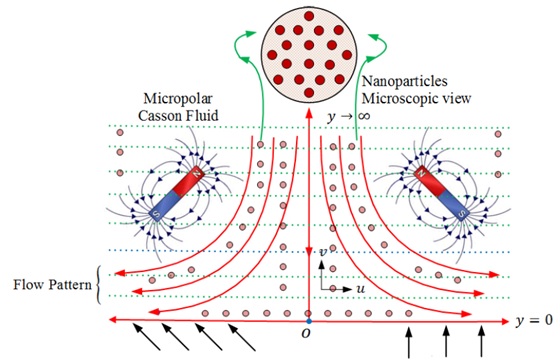
Figure 1: Physical flow diagram
2.4 Investigating the Impact of Velocity Slip and Dissipation due to Viscosity on CCMF
The analysis of the mathematical equations that control the flow, by considering viscous dissipation, can provide insights into the temperature distribution and transfer characteristics due to heat energy of the CMF.
The results of investigation reveal that the motion rate of the substance is impacted by various factors including the differential rate of motion, Grashof numerical value, Casson coefficient, and Prandtl numerical value. When the fractional parameter is enhanced, it causes a subsequent augmentation in rate of flow motion as well as its temperature over a substantial span of time. The slip parameters, encompassing both velocity and fluid concentration, play an instrumental role in determining the flow characteristics as evidenced by the analysis of the numerical values derived from the formulated equations. Furthermore, it is crucial to emphasise the velocity slip’s significant influence on flow behaviour close to the boundary layer, especially in the setting of a convective CMF, underlining the crucial nature of this slip parameter.
The emergence of this specific occurrence can be observed when the fluid, while in its dynamic state, traverses through narrow passageways or encounters barriers that impede its flow. These restrictions and hindrances consequently lead to the transmutation of the fluid’s inherent displacement energy into potential heat, giving rise to a noteworthy increase in its temperature. This rise in temperature has a significant impact on the overall attributes that define the heat transfer within the fluid. Moreover, the phenomenon of viscous dissipation, which is intricately intertwined with the aforementioned conversion process, has garnered substantial attention and investigation within the realm of scientific research focused on comprehending the intricacies of fluid flow and the fundamental properties that govern the transfer of heat. The exploration of this phenomenon has been fundamental in unraveling the underlying mechanisms and principles at play in fluid dynamics and heat transfer.
The numerical analysis of the impact of velocity slip and concentrated dissemination on the convective behavior of a CMF can be effectively carried out through the utilization of computational techniques, such as the highly reliable and widely employed RK-Fehlberg method [6].
2.5 A Steady and Incompressible MHD Flow of CMF:
Numerous works have examined the flow influenced by MHD of a CMF resulting from the axial movement of a stretched sheet. A sheet is stretched horizontally while being exposed to a magnetic field in the transverse direction. A fluid that carries electricity, classified as an electrically conducting CF, flows across the sheet. The behaviour of this fluid, which deviates from the normal behaviour of Newtonian fluids, can be described by the state of viscosi-metric equation as explained by the model defined by the CF. Upon conducting an analysis of this system, it becomes evident that only unique similarity solutions are observed when the stretching sheet is accompanied by the injection of mass, and the existence of a flux expands the region in which a unique solution can be found. Within this particular region of unique solutions, if the magnitudes of slip induced by mass suction and the slip parameters of first and second order are increased, it causes a reduction in stress value due to the wall shear that the sheet experiences during expansion or contraction. The research might have practical implications in systems which work on the basis of fluid including power generation, microelectronics, automated cooling systems, and stretchable/shrinkable objects [7].
Numerous variables, including the material specifications, diffusivity ratio, among others, can have an impact on how a CMF affects the flow field on an expanding sheet. The acknowledgement of the existence of the Casson parameter is of paramount importance as it undoubtedly has a noticeable and noteworthy effect on the flow properties of the fluid. Consequently, this alteration significantly impacts the overall behavior of the fluid that is being studied. Additionally, the material parameter, which is a critical element in this investigation, plays a profound and substantial role in influencing both the microrotation and velocity profiles of the fluid. As a result, it shapes and molds the entirety of the flow field. Additionally, the variable with ratio due to diffusivity, assumes a pivotal and crucial role in ascertaining and determining the temperature distribution within the fluid under consideration. It is undeniable that these factors work in unison to bring about intricate and complex changes in the flow field, further emphasizing the need for comprehensive analysis and understanding of their interplay. In conclusion, the influence of the various parameters including Casson, material and diffusivity ratio number on the flow field of a CMF on a stretching sheet is a topic of great significance and warrants thorough examination and investigation [8].
The force exerted upon the fluid by the magnetic field is responsible for creating a resistance against the flow. This resistance ultimately leads to a reduction in the overall rate of flow. Therefore, it is clear that the existence of a field of magnetic attraction does affect the features of the fluid’s flow. Particularly when examining the propagation of a CMF across a stretched sheet, this influence becomes more obvious as the magnetic field’s strength rises. The fluid flow therefore drastically slows down as a result. This indicates that the behaviour of magnetic waves when interacting with the flow of fluid directly causes the impact of the field’s magnetism on the flow rate [9].
2.6 Effect of Velocity slip parameter on Casson viscoelastic micropolar fluid
The amplitude, depth of the peripheral layer, and coefficient value of the fluid’s flow are all impacted by the slip situation due to the drag effect. The fluid’s momentum value may be changed by adjusting the slip parameter.
Slip variable, a crucial element in the equation, plays a crucial role in changing the micropolar fluid’s velocity profile. This adjustment will consequently result in further alterations to the fluid’s flow properties. The slip parameter further amplifies the effect it has on the overall behaviour of the system by exerting significant effects upon the coefficient value due to local drag effect and the stress due to wall couple of the fluid flow. It is crucial to mention that the slip parameter is a vital component that must be meticulously examined in order to thoroughly understand the intricate dynamics of the micropolar fluid and its flow properties [10].
It can be inferred that the flow behavior and characteristics of Casson viscoelastic micropolar fluid could potentially be influenced by the parameters associated with velocity slip. As a result of the slip condition being introduced, the velocity profile is altered, which has the potential to change the value of drag effect as well as the stress value between velocity of fluids due to wall. It is also important to note that the ratio of heat exchange exhibits a correlation with the various factors, including the slip parameters. It becomes clear that in order to determine the flow characteristics and heat transfer characteristics of the Casson viscoelastic micropolar fluid, the slip condition is crucial and critical. Consequently, the understanding and analysis of the aforementioned slip condition is of utmost importance in comprehending the intricate nature of the fluid propagation mode and transfer of thermal energy phenomena. Therefore, further investigation and research are warranted to explore the implications and ramifications of these slip parameters on the overall behavior and performance of the Casson viscoelastic micropolar fluid [11].
The alteration of the velocity profile caused by the occurrence of velocity slip possesses the capability to induce changes in the coefficient due to local skin drag effect and the stress due to varying velocities of the fluid flow between walls, which consequently exert an influence on the comprehensive behavior and characteristics of the fluid flow [6].
The property of viscoelasticity has the capacity to disturb specific symmetries that are frequently witnessed in the flow field surrounding a particle, which are otherwise present in the case of a fluid with “Newtonian” property. It is important to mention that when the slip coefficient undergoes an augmentation, the velocity due to slip effect on the outer layer of the particle also experiences a corresponding increase. However, it is worth noting that the impact of viscoelasticity on the slip velocity seems to be relatively insignificant. Thus, when contemplating the overall influence of viscoelasticity, it becomes apparent that it is accountable for the generation of intricate flow structures in the vicinity of the particle, particularly in the wake region [12].
2.6.1 Impact of governing parameters on Casson viscoelastic micropolar fluid
- The results show that the conductivity effects as well as heat generation due to non-uniformity of fluid in a micropolar fluid are less important than in a Newtonian fluid.
- The findings indicated that different parameters, such as density, the spin effect, the magnetization effect, and stress during the initiation phase, had varied effects on the micropolar thermo-viscoelastic medium.
- The findings show that an increase in the CF parameter slows fluid flow with just a slight increase in viscosity owing to plasticity, but significantly raises stress value during fluid propagation.
- The research discovered that a stretched sheet-induced non-Newtonian micropolar fluid’s velocity and microrotation are positively impacted by the material parameter.
- The study’s results show that when the sheet is stretched nonlinearly, CFs outperform Newtonian fluid at controlling temperature and nanoparticle concentration. [13].
2.7 Effect of viscosity dissipation parameter on Casson viscoelastic micropolar fluid
The dissipation of viscosity plays a substantial role in the behaviour of CF with respect to its flow effect.
The quantitative evaluation of the flow demonstrates that the mobility of the CF is augmented by the existence of electric as well as mixed transmission attributes, while factors such as viscosity and slip velocity obstruct the flow. As a result, in the event that the dissipation parameter of viscosity was to escalate, it is likely that the progression of the Casson viscoelastic fluid would be additionally impeded [17].
The investigation into the effects of viscosity dissipation brought about by the magnetization effect due to inclination on the motion of a micropolar CF not only demonstrates the alteration in the viscosity dissipation parameter but also resulting in a reduction of both velocity and temperature for low and high concentrations of micro elements. It also establishes that this decrease in velocity and temperature becomes more pronounced in both cases of low and high concentrations of micro elements as the values of the viscosity dissipation parameter increases [18]. Additionally, the impact of the augmented viscosity dissipation parameter is observed as crucial and noteworthy in terms of its influence on the velocity and temperature, irrespective of the concentration level of the micro elements present in the fluid. Hence, it can be concluded that the inclined magnetic field and its impact on viscosity dissipation has a significant effect in shaping of the micropolar CF behaviour, particularly in relation to its speediness and change in its calescence characteristics.
The temperature of the CF drops as the viscosity dissipation value rises. Furthermore, the viscosity dissipation has no impact on the pace of heat exchange at the surface or the skin friction coefficient. A higher viscosity dissipation value leads to a quicker rate of heat transfer. The CF parameter likewise affects the wall skin-friction coefficient, with a spike in this parameter leading to a rise in the coefficient. Viscosity dissipation is one of the factors that influences the characteristics of heat exchange in the MHD stalling region flow of a CF over a sheet that stretches non-linearly [19,20].
2.8 Characterization of nanofluid convection and its thermal transfer
Through the implementation of an inquiry of hybrid nanofluid using water for its thermal exchange property in a convective channel within a square conducting medium employing MHD, it was ascertained that an enhancement in the conductivity and thickness of the empty cylinder yielded an amplification of flow intensity, accompanied by a decline in the pace of thermal energy transfer [14].
The kind and concentration of nanoparticles, the characteristics of the base fluid, and external circumstances like temperature, pressure, and flow velocity are unlikely to have any predominant effect because of fluid propagation and thermal transfer characteristics of a hybrid nanofluid. The movement of a hybrid nanofluid across a system or medium includes both the fluid and any dispersed nanoparticles. It has been found through research into the thermal transfer and fluid propagation of a hybrid nanofluid on a dramatically elongating/contracting sheet that takes into account both convection and heating by Joules that the temperature and thickness of the thermal boundary layer are directly correlated with the Ec in both solutions. The rate of heat transmission at the surface and the stress due to shear are both influenced by the Ec. Hybrid nanofluids have applications in a variety of disciplines, such as thermal management, energy systems, and improved cooling technologies, hence it is crucial to comprehend their flow and heat transmission behaviour. [15].
Increasing the external forces (EF) in the nanofluid system leads to an increase in the maximum density (D), maximum velocity (V), and maximum temperature (T) of the atomic behaviour. Magnetic fields can be utilized as an effective method to enhance the speed of exchange of thermal energy in various geometries and physical conditions. They are employed to augment heat transfer rates in heat exchangers, especially in situations involving nanofluids [16].
2.8 Analysis of CMF over an infinite sheet due to viscous dissipation and slip velocity:
Using a number of computational techniques, the numerical solution for a CF without any “Newtonian” behaviour on a vertically stretched sheet are effectively found by accounting for the consequences stemming from slip velocity and dissipation of viscosity. A highly complex mathematical model has been meticulously built in order to undertake a thorough examination of the effect of mixed convection on the flow of CF due to MHD on a stretched sheet with nonlinear permeability.
This model encompasses a wide range of pivotal factors, including but not limited to usual variables such as dissipation with respect to viscosity, thermal and chemical characteristics, suction, etc. By utilizing the Buogiorno’s type Nanofluid model, it has been established that the implementation of suction plays an absolutely crucial role in significantly enhancing the transfer characteristics due to thermal processes. This finds has a significant implications for optimizing the efficiency of thermal along with mass transfer processes in a myriad of engineering applications [21].
The inclusion of multiple errors in the analysis of the magnetic CF over a stretched region, coupled with a calescence effect and radiation, has presented significant empirical support for the notion that slips have the capacity to exert control over the movement of the boundary layer. This phenomenon has been clearly demonstrated through the utilization of numerical solutions employing the RK-Fehlberg method. [22]. The study examined the movement of a viscoplastic CF via an elongating surface and discovered that both the injection and suction parameter may regulate the flow’s intensity and direction [23]. The comprehensive investigation and analysis of the MHD flow with slip effect and the thermal transmittance in the framework of nanofluid with Casson properties over an infinitely stretching sheet with porous that possesses slips at the boundary, while simultaneously by considering the transmittance due to thermal behaviour and random movement by micro granules in fluid, is widely acknowledged to hold immense potential in facilitating the production and advancement of intricate fluids as well as assisting in the elimination of oil contaminants from various surfaces [24].
The investigation carried out confirmed that the material parameter, which indicates a quantitative measurement of the properties of the substance under investigation, has a positive impact on both the velocity and micro-rotation characteristics of the non-Newtonian micropolar fluid, which is a complex fluid that exhibits pseudoplastic property and is materialized using rotational degrees of freedom, which are induced by the application of a stretched sheet, thus indicating a direct relationship between the material parameter and the resulting fluid dynamic phenomena [25].
The flow of micropolar Casson nanofluid has been analyzed using mathematical models and numerical techniques, such as transforming the controlling mathematical PDE to an ODE and solving them using popular schemes like the RK-4, etc.,
2.9 Research problem:
The purpose of this research model is to investigate how a micropolar fluid which possesses Casson viscoelastic behaviour when subjected to treatment using hydrothermal effect over an elongated sheet affects the parameter relating to slip due to velocity. All the controlling mathematical PDEs are disclosed using the RK-4 method. The study relating to transmission and transference of thermal energy of any fluid through an elongated surface in the presence of various externalities is documented in the literature. The authors have researched the influence of slips due to velocity parameter on a micropolar fluid having Casson viscoelastic behaviour with a wide range of other fluid regulating parameters for the characteristics relating to thermal exchange, since they are not yet known to exist.
2.10 Mathematical Model and Governing Equations
Figure 1 shows the representation of physical flow of CMF influenced by MHD over an infinite sheet.
The uniform velocity for a sheet which is elongated in linear manner can be given as
a = A(x) = ux.
Let’s consider that the stretched sheet’s linear motion causes a constant, indestructible MHD flow of CMF. On imposing to plain surface with the a strong magnetic field whose strength be represented as D0,
(1)
where stress due to shear be given as δ; and rate of shear be given as.
The following conservation laws of mass, momentum, thermal energy, and angular momentum are established by the previous assumptions (Iqbal et al., 2017; Devi et al., 2020; Beg et al., 2020),
(2)
(3)
(4)
(5)
The expression for the boundary conditions can be given as,
(6)
(7)
Where,
Where,
variable which represents the concentration at the boundary region can be given as n,
the value of n as 0 represents strong concentration at boundary region,
the value of n as 1 represents weak concentration at boundary region.
By presenting the variables of similarity,
(8)
All the above variables of similarity can be restructured using transformations of similarity by,
(9)
(10)
(11)
The conditions of boundary can be given as:
(12)
(13)
By using local Nusselt number to define the rate of exchange of heat over the plain region, and it is given as,
(14)
Here and skin friction coefficient
(15)
Here y=0
The resulting expression for skin friction from above derivation can be given as,
(16)
The resulting expression for local Nusselt number from above derivation can be given as,
(17)
Here
2.11. Numerical Solution, Results and Discussion
A boundary value of nonlinear issue is formed from the dimensionless equations (9) through (11). The implicit method is used to solve all the nonlinear ODE along with boundary value solver. Major drawback on employing such approach is that each repeated step requires expensive processing effort since the higher derivative must be substituted for the first derivative, which allows the derivatives of order 2 to be expressed as a system of two derivatives of order 1. Such technique achieves exceptional accuracy and is highly stable.
The impact of various limitations is thoroughly studied computationally in this section. While one controlling parameter is changed, the other parameters are kept the same. By enclosing the controlling factors due to temperature and propagation of fluid, calculation of incompressible flows of fluids, constant pressure gradient along the flow, magnitude of the fluid’s velocity, friction due to Drag effect, thermal and its transfer ratio have all been thoroughly evaluated. The stream function profiles are shown in Figures 2, 3, 4, 5, and 6 for large values of the controlling factors. There occurs a rise in thickness of the boundary layer in accordance with a rise in magnetization value, first and second sort slip-parameters (γ and δ), whereas there occur a fall when rising the values of CF parameter (ε) and material parameter (C), which is thoroughly explained in computational figures.
The effects of the C, ε, the magnetic parameter (W), and the γ and δ based on profile representing velocity for the fluid are shown in Figures 7, 8, 9, 10, and 11. The considerable deceleration is noticed for profile representing velocity by an increasing value of the “ε, W, γ and δ”, while the velocity profile becomes more intense with rising “C” values. The “C” also rise by strengthening the “γ and δ”, the depth of the profile due to velocity is reduced, and the velocity of fluid is raised.
Figures 12, 13, 14, and 15 depict the angular flow (micro rotational) profiles influenced by “γ and δ, ε, and W”. The graphs demonstrate that when the weightage of the “ε and the W” parameter grow, the thickness of the boundary layer with respect to angular momentum decreases.
All the graphical representations from figures 16 to 22 illustrate the influence of controlling fluid regulating variables such as the “ε, W, C, viscous dissipation (Lc), and the parameters using slip due to velocity and on temperature profile changes. These figures show that the factor which defines the Fourier transform of an electric charge distribution in space, the level of “Lc, ε, γ and δ”, the with a rise in boundary thermal layer thickness.
Additionally, when K rises, there is a fall in boundary thickness, but as the value of n rises, the temperature profile rises (Figure 22). The local Nusselt number changes due to factors including fluids viscosity, magnetization effect, its flow and also with both the velocity slip parameters are demonstrated from analysis of figures from 23 to 27. The rate of heat transfer has reduced with improved values of the “velocity slip, γ and δ, W, and Ec parameters”, demonstrating how the ratio of heat transfer across a barrier varies.
Figure 2: The f field plot is observed for different values of Γ, while keeping the Pr, M, K, β, δ, Ec, and n constants at 1, 0.5, 2, 0.2, -1, 0.3, and 0.5 respectively.
Figure 3: The graphical illustration of f field for different values of δ, while keeping the parameters Pr, M, K, β, γ, Ec, and n constant at 1, 0.5, 2, 0.2, 1, 0.3, and 0.5 respectively.
Figure 4: The f field plot is evaluated across variable K values while keeping the values of Pr, M, δ, β, γ, Ec, and n constant.
Figure 5: f field plot for Pr = 1, M = 0.5, δ = -1, K = 2, γ = 1, Ec = 0.3, and n = 0.5 for various values.
Figure 6: ‘f’ field versus ‘M’ plot of variable values with Pr = 1, K = 2, δ = -1, = 0.2, γ = 1, Ec = 0.3, and n = 0.5.
Figure 7: “f” versus γ of different values plot, while keeping Pr =1, M = 0.5, K = 2, β = 0.2, δ = -1, Ec = 0.3, and n = 0.5, reveals interesting patterns.
Figure 8: Variable ‘f’ field plot examined over different values of δ, while keeping Pr = 1, M = 0.5, K = 2, β = 0.2, γ = 1, Ec = 0.3, and n = 0.5.
Figure 9: Plot of the ‘f’’ field for different values Pr = 1, M = 0.5, δ = -1, β = 0.2,γ = 1, Ec = 0.3, n = 0.5
Figure 10: The field “ f’ ” versus different values of β repersentation, while keeping the parameters Pr, M, δ, K, γ, Ec, and n constant at 1, 0.5, -1, 2, 1, 0.3, and 0.5 respectively.
Figure 11: The ‘f’ field observation for different M values while keeping Pr at 1, β at 0.2, δ at -1, K at 2, γ at 1, Ec at 0.3, and n at 0.5.
Figure 12: The “g” field analyzes w.r.t diverse range of values of γ, while holding constant Pr at 1, M at 0.5, K at 2, β at 0.2, δ at -1, Ec at 0.3, and n at 0.5.
Figure 13: “g” field illustration with respect to variable “δ” values when Pr =1, γ = 1, M = 0.5, Ec = 0.3, β = 0.2, n = 0.5, K = 2,
Figure 14: The plot of the gfield can be observed for a multitude of values of β, while keeping Pr constant at 1, M at 0.5, δ at -1, K at 2, γ at 1, Ec at 0.3, and n at 0.5.
Figure 15: The graphical representation of the g field is depicted for different magnitudes of M, while keeping Pr fixed at 1. The values of δ, K, γ, β, n, and Ec remain constant at -1, 2, 1, 0.2, 0.5, and 0.3 respectively.
Figure 16: The diagram illustrates the distribution of the θ field for different values of γ under the conditions of Pr = 1, M = 0.5, K = 2, β = 0.2, δ = -1, Ec = 0.3, and n = 0.5.
Figure 17: The “θ” field at differential values of δ comparison plot, while maintaining Pr =1, M = 0.5, K = 2, β = 0.2, γ = 1, Ec = 0.3, and n = 0.5.
Figure 18: The “θ” field observation for various K values, while keeping Pr = 1, M = 0.5, δ = -1, β = 0.2, γ = 1, Ec = 0.3, and n = 0.5.
Figure 19: The plot of the θ field is observed for different values of β, while keeping the parameters Pr, M, δ, K, γ, Ec, and n constant at 1, 0.5, -1, 2, 1, 0.3, and 0.5 respectively.
Figure 20: The plot of the θ field is shown for different values of Ec, while maintaining Pr = 1, M = 0.5, δ = -1, K = 2, γ = 1, β = 0.2, and n = 0.5.
Figure 21: Graphical illustration for various M values with Pr = 1, δ = -1, K = 2,γ = 1, = 0.2, and n = 0.5. Ec = 0.3.
Figure 22: Plotting “θ” field against variable n values with Pr =1, β = 0.2, δ = -1, M = 0.5. Ec = 0.3, K = 2, γ = 1
Figure 23: Graphical representation of Local Nusselt number for various “n” values with Pr = 1,δ = -1, K = 2, γ = 1, β = 0.2, M = 0.5. Ec = 0.3.
Figure 24: Graphical representation of Local Nusselt number with Pr = 1,δ = -1, K = 2, γ = 1, β = 0.2, and n = 0.5 for various values of M. Ec = 0.3.
Figure 25: Graphical representation of Local Nusselt number for γ with Pr = 1, δ = -1, K = 2, β = 0.2, and M & n = 0.5 and also for Ec = 0.3.
Figure 26: Graphical presentation of Local Nusselt number for variable δ values, with Pr = 1, γ = 1, K = 2, β = 0.2, M = n = 0.5, and Ec = 0.3, will be investigated.
Figure 27: Examination of Local Nusselt number for various values of Ec, while keeping Pr, γ, K, β, M, n, and δ constant at 1, 1, 2, 0.2, 0.5, 0.5, and -1 respectively.
2.12 Conclusions
In this work, the CMF fluid flow over the stretching sheet of linear motion with layer of laminar boundary is explored in relation to slips flow of second order momentum equations and magnetic field due to dissipation of viscosity. According to the investigation, it has been found that and, and K have a significant impact on the non-Newtonian flow rate. The depth of boundary layer due to thermal effect grows in accordance to dissipation of viscosity values, along with a significant increase in slip parameters of order 1 & 2. Local Nusselt number falls when accurate values of the parameter which tends to rise the velocity and thermal effect of the fluid, along with rise in magnetization property, and variables due to slip and viscosity.
References:
- Wakif, A., 2020. A novel numerical procedure for simulating steady MHD convective flows of radiative CFs over a horizontal stretching sheet with irregular geometry under the combined influence of temperature-dependent viscosity and thermal conductivity. Mathematical Problems in Engineering, 2020, pp. 1-20.
- Nadeem, Abbas., Wasfi, Shatanawi. (2022). Heat and Mass Transfer of Micropolar-Casson Nanofluid over Vertical Variable Stretching Riga Sheet. Energies, Available from: 10.3390/en15144945
- K., V., Prasad., Hanumesh, Vaidya., Kuppalapalle, Vajravelu. (2016). Convective heat transfer in a micropolar fluid over an unsteady stretching surface. International Journal of Applied Mechanics and Engineering, Available from: 10.1515/IJAME-2016-0025
- H., A., M., Al-Sharifi., Abdul, Rahman, Mohd, Kasim., Abid, Hussanan. (2023). Numerical investigation of Casson micropolar fluid over a stretching sheet with convective boundary condition. Nucleation and Atmospheric Aerosols, Available from: 10.1063/5.0114702
- Nadeem, Abbas., Wasfi, Shatanawi., Kamaleldin, Abodayeh. (2022). Computational Analysis of MHD Nonlinear Radiation Casson Hybrid Nanofluid Flow at Vertical Stretching Sheet. Symmetry, Available from: 10.3390/sym14071494
- Usman, Ali., Muhammad, Irfan. (2022). Thermal aspects of multiple slip and Joule heating in a Casson fluid with viscous dissipation and thermo-solutal convective conditions. International Journal of Modern Physics B, Available from: 10.1142/s0217979223500431
- Jitender, Singh., A., B., Vishalakshi., U., S., Mahabaleshwar., Gabriella, Bognár. (2022). MHD Casson fluid flow with Navier’s and second order slip due to a perforated stretching or shrinking sheet. PLOS ONE, Available from: 10.1371/journal.pone.0276870 —–(R4 also in c-1)
- H., A., M., Al-Sharifi., Abdul, Rahman, Mohd, Kasim., Abid, Hussanan. (2023). Numerical investigation of Casson micropolar fluid over a stretching sheet with convective boundary condition. Nucleation and Atmospheric Aerosols, Available from: 10.1063/5.0114702
- M., C., Kemparaju., B., Lavanya., Mahantesh, M., Nandeppanavar., N., Raveendra. (2022). Casson MHD Nano Fluid Flow with Internal Heat Generation and Viscous Dissipation of an Exponential Stretching Sheet. International Journal of Heat and Technology, Available from: 10.18280/ijht.400315
- P., K., Pattnaik., D., K., Moapatra., S., R., Mishra. (2021). Influence of Velocity Slip on the MHD Flow of a Micropolar Fluid Over a Stretching Surface. Available from: 10.1007/978-981-15-9817-3_21
- Ahmed, M., Megahed. (2015). MHD viscous Casson fluid flow and heat transfer with second-order slip velocity and thermal slip over a permeable stretching sheet in the presence of internal heat generation/absorption and thermal radiation. European Physical Journal Plus, Available from: 10.1140/EPJP/I2015-15081-9
- Gkormpatsis, S.D., Gryparis, E.A., Housiadas, K.D. and Beris, A.N., 2020. Steady sphere translation in a viscoelastic fluid with slip on the surface of the sphere. Journal of Non-Newtonian Fluid Mechanics, 275, p. 104217.
- Ullah, I., Khan, I., & Shafie, S., 2016. MHD Natural Convection Flow of Casson Nanofluid over Nonlinearly Stretching Sheet Through Porous Medium with Chemical Reaction and Thermal Radiation. Nanoscale Research Letters, 11. https://doi.org/10.1186/s11671-016-1745-6.
- Tayebi, T. and Chamkha, A.J., 2020. Entropy generation analysis due to MHD natural convection flow in a cavity occupied with hybrid nanofluid and equipped with a conducting hollow cylinder. Journal of Thermal analysis and Calorimetry, 139(3), pp. 2165-2179. –(R6)
- Yashkun, U., Zaimi, K., Ishak, A., Pop, I. and Sidaoui, R., 2021. Hybrid nanofluid flow through an exponentially stretching/shrinking sheet with mixed convection and Joule heating. International Journal of Numerical Methods for Heat & Fluid Flow, 31(6), pp. 1930-1950.
- Davood, Domairry, Ganji., Amir, Malvandi. (2016). External Forces Effect on Intensification of Heat Transfer. Available from: 10.1016/B978-0-323-43139-2.00005-8
- Mohamed, M., Khader., M.M., Babatin., Ahmed, M., Megahed. (2023). On the numerical evaluation for studying Ohmic dissipation and thermal conductivity impacts on the flow of Casson fluid. Case Studies in Thermal Engineering, Available from: 10.1016/j.csite.2023.103192
- Zahid, Iqbal., Rashid, Mehmood., Ehtsham, Azhar., Zaffar, Mehmood. (2017). Impact of inclined magnetic field on micropolar Casson fluid using Keller box algorithm. European Physical Journal Plus, Available from: 10.1140/EPJP/I2017-11443-7
- Muhammad, Nawaz., Rahila, Naz., Muhammad, Awais. (2017). Magnetohydrodynamic axisymmetric flow of Casson fluid with variable thermal conductivity and free stream. alexandria engineering journal, Available from: 10.1016/J.AEJ.2017.05.016
- Monica, Medikare., Sucharitha, Joga., Kishore, Kumar, Chidem. (2016). MHD Stagnation Point Flow of a Casson Fluid over a Nonlinearly Stretching Sheet with Viscous Dissipation. American Journal of Computational Mathematics, Available from: 10.4236/AJCM.2016.61005
- Ibrahim, S., Lorenzini, G., Kumar, P., & Raju, C., 2017. Influence of chemical reaction and heat source on dissipative MHD mixed convection flow of a Casson nanofluid over a nonlinear permeable stretching sheet. International Journal of Heat and Mass Transfer, 111, pp. 346-355. https://doi.org/10.1016/J.IJHEATMASSTRANSFER.2017.03.097.
- Gopal, D., Kishan, N., & Raju, C., 2017. Viscous and Joule’s dissipation on Casson fluid over a chemically reacting stretching sheet with inclined magnetic field and multiple slips. Informatics in Medicine Unlocked, 9, pp. 154-160. https://doi.org/10.1016/J.IMU.2017.08.003.
- Hussanan, A., Salleh, M., Khan, I., & Shafie, S., 2018. Analytical solution for suction and injection flow of a viscoplastic Casson fluid past a stretching surface in the presence of viscous dissipation. Neural Computing and Applications, 29, pp. 1507-1515. https://doi.org/10.1007/s00521-016-2674-0.
- Ghosh, S., & Mukhopadhyay, S., 2017. MHD slip flow and heat transfer of Casson nanofluid over an exponentially stretching permeable sheet. International Journal of Automotive and Mechanical Engineering, 14, pp. 4785-4804. https://doi.org/10.15282/IJAME.14.4.2017.14.0375.
- Sarojamma, G., Lakshmi, R., Sreelakshmi, K., & Vajravelu, K., 2020. Dual stratification effects on double-diffusive convective heat and mass transfer of a sheet-driven micropolar fluid flow. Journal of King Saud University – Science, 32, pp. 366-376. https://doi.org/10.1016/J.JKSUS.2018.05.027.
- Beg, O. A., Venkatadri, K., Ramachandra Prasad, V., Beg, T. A., Kadir, A., and Leonard, H.J. (2020). Numerical simulation of hydromagneticMarangoni convection flow in a Darcian porous semiconductor melt enclosure with buoyancy and heat generation effects. Materials Science and Engineering: B, 261,114722.https://doi.org/10.1016/j.mseb.2020.114722
- Devi, T.S., Lakshmi, C.V., Venkatadri, K., Prasad, V.R., Bég, O.A. and Reddy, M.S., 2020. Simulation of unsteady natural convection flow of a Casson viscoplastic fluid in a square enclosure utilizing a MAC algorithm. Heat Transfer, 49(4), pp. 1769-1787.
- Iqbal, Z., Mehmood, R., Azhar, E. and Mehmood, Z., 2017. Impact of inclined magnetic field on micropolar Casson fluid using Keller box algorithm. The European Physical Journal Plus, 132, pp. 1-13.

Academic Master Education Team is a group of academic editors and subject specialists responsible for producing structured, research-backed essays across multiple disciplines. Each article is developed following Academic Master’s Editorial Policy and supported by credible academic references. The team ensures clarity, citation accuracy, and adherence to ethical academic writing standards
Content reviewed under Academic Master Editorial Policy.




