
Introduction
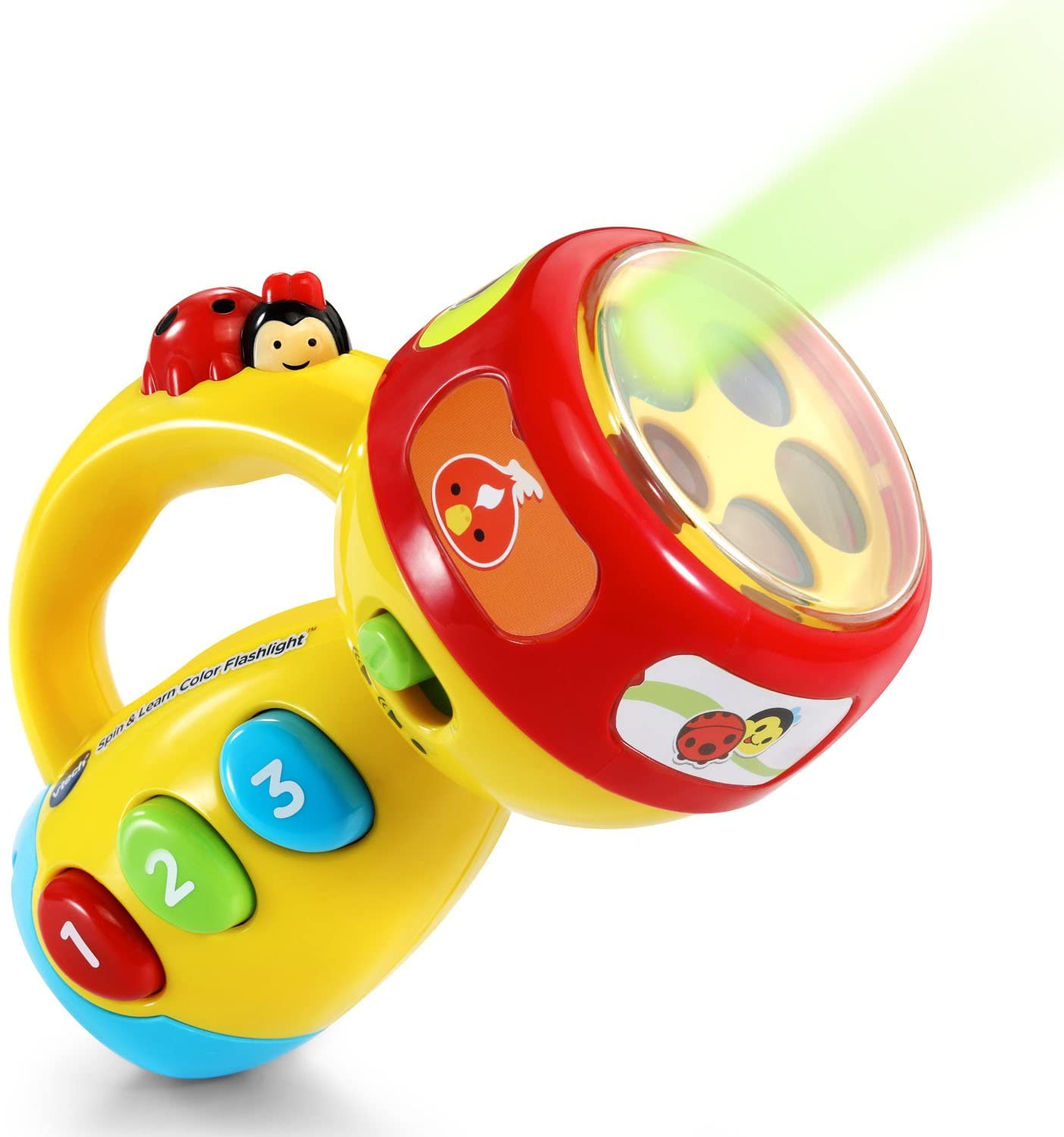
The VTech Spin & Learn Color Flashlight is an electronic learning toy designed for toddlers and built around a familiar object that children can hold, point, rotate, and activate. VTech has sold more than one version of the product, so feature descriptions should be matched to the model being discussed rather than combined as though every version were identical. The photographed version on this page uses a chunky handle, a rotating color ring, a speaking ladybug control, and three numbered side buttons; VTech identifies this model as intended for children aged twelve to thirty-six months and describes it as teaching colors, animals, numbers, songs, and basic cause-and-effect interaction (VTech, 2026a). A newer model uses a turtle button, six colors, letters, nature sounds, and an interactive game (VTech, 2026b). From a developmental perspective, the toy is most useful not because it can independently “teach” a toddler, but because its lights, sounds, rotation, buttons, and pretend-play possibilities invite repeated exploration that adults can extend through language and shared attention.
Design, Cause and Effect, and Motor Practice
The product’s physical design encourages several kinds of early motor and cognitive activity. A toddler must grasp the handle, stabilize the object, press buttons, and rotate the ring, coordinating vision with hand movements while learning that specific actions produce predictable responses. This is a basic cause-and-effect relationship: pressing a button triggers a phrase or number, and turning the ring changes the light or associated sound. Repetition can strengthen fine-motor control and help the child anticipate outcomes. The flashlight form also supports gross-motor exploration because children can carry it while moving through a room or point the beam toward objects. These actions are developmentally more valuable when they remain voluntary and exploratory rather than being turned into performance tests. Piagetian approaches describe early cognitive development as strongly grounded in action on the environment, and later developmental research has refined rather than abandoned the importance of active exploration (Barrouillet, 2015). The toy therefore offers an accessible sequence of manipulation, feedback, prediction, and repetition that can support learning through play.
Colors, Numbers, Animals, and Language
The photographed version introduces five colors, animal sounds, numbers one through three, songs, melodies, and short phrases, according to VTech’s current support description for that model (VTech, 2026a). These features can expose toddlers to vocabulary and category labels, but hearing a label from a toy is not the same as mastering the concept. A child learns “red,” for example, more robustly when the word is connected to many real objects, social interactions, and repeated experiences rather than only to one illuminated ring. The same principle applies to counting. Pressing a button marked “2” can introduce the number word, but meaningful number knowledge develops when adults connect words to quantities: two blocks, two shoes, or two apples. Animal sounds can likewise become opportunities for imitation, naming, and conversation. The electronic prompts are therefore best understood as invitations to interaction. When a caregiver repeats the word, points to another example, asks a simple question, and follows the child’s attention, the toy becomes part of a wider language-learning exchange instead of functioning as a closed instructional device.
Sensory Exploration, Attention, and Imaginative Play
Lights, music, spoken prompts, and tactile controls can attract a toddler’s attention because they provide immediate multimodal feedback. That stimulation can encourage repeated exploration, particularly when the child discovers that rotating or pressing changes what happens next. The toy also supports pretend play because a flashlight has an understandable real-world function. A child can search for a toy, “inspect” a room, imitate an adult using a torch, pretend to camp, or create simple games involving colors and objects. Such play is developmentally different from passively listening to programmed songs because the child supplies the goal and narrative. Adult participation can deepen this process by suggesting a search game, naming objects illuminated by the beam, or taking turns. At the same time, more stimulation is not always better. Some toddlers may lose interest when a device produces too many sounds or may repeatedly press controls without extending play. Caregivers can therefore alternate electronic play with blocks, books, drawing, outdoor activity, and open-ended objects that permit a wider range of child-created uses rather than programmed responses.
Developmental Value and the Role of Adults
The toy’s strongest educational value appears when an adult uses it as a shared object rather than expecting it to replace conversation or play. A caregiver can follow the child’s interest, name the color produced, count the buttons, imitate an animal sound, and connect the flashlight to everyday experiences. This type of responsive interaction supports joint attention and allows the adult to adjust language to the child’s current ability. The toy can also provide opportunities for turn-taking: one person selects a color and another finds an object with a similar color, or the child shines the light while the adult names what is visible. Electronic prompts have fixed responses, whereas adults can respond to unexpected questions, frustration, humor, or new discoveries. This distinction matters because toddler learning is social as well as cognitive. A toy can organize attention and motivate action, but meaning develops through relationships and context. The product should therefore be considered one resource among many, useful for brief interactive play but not a substitute for human communication, physical exploration, books, and unstructured imaginative activity.
Safety, Accessibility, and Practical Use
Age guidance and product-specific instructions should be followed because toddlers explore objects physically and may mouth, drop, or throw toys. The photographed model is marketed for ages twelve to thirty-six months and uses two AAA batteries; caregivers should keep the battery compartment secured and replace batteries according to the manufacturer’s instructions (VTech, 2026a). The newer model listed by VTech uses three AAA batteries, illustrating why the exact product number matters when consulting a manual (VTech, 2026b). Adults should also check for cracked plastic, loose parts, battery leakage, excessive volume, or damaged controls. Accessibility varies. Large buttons and a thick handle may help some children with developing motor skills, while children with sensory sensitivities may find bright lights or repeated sounds uncomfortable. A child with hearing or vision differences may use the product in a different way than intended. Educational evaluation should therefore consider the individual child’s response rather than assuming that a feature is beneficial simply because it is labeled “learning.” Safe, enjoyable engagement is the priority.
Conclusion
The VTech Spin & Learn Color Flashlight can support toddler development when its physical and electronic features are used as prompts for active, social play. Grasping the handle, pressing buttons, and rotating the ring provide motor practice and clear cause-and-effect feedback, while colors, numbers, animal sounds, songs, and phrases create opportunities for language exposure. The flashlight form also encourages imaginative exploration because children can use it as a familiar real-world object rather than only as an electronic device. Its limitations are equally important. Programmed responses cannot adapt to a child’s questions, assess genuine understanding, or replace the open-ended possibilities of social interaction and non-electronic play. Adults can increase the toy’s value by naming, counting, taking turns, connecting prompts to real objects, and following the child’s interests. Product details should be checked against the correct model because VTech has marketed different versions with different controls, battery requirements, and learning content (VTech, 2026a; VTech, 2026b). Used in moderation and with supervision, the toy can be a useful complement to broader toddler play.
References
Barrouillet, P. (2015). Theories of cognitive development: From Piaget to today. Developmental Review, 38, 1–12.
VTech. (2026a). Spin & Learn Color Flashlight. Product 80-124000. https://www.vtechkids.com/product/detail/12330/Spin_and_Learn_Color_Flashlight
VTech. (2026b). Spin & Learn Color Flashlight. Product 80-185900. https://www.vtechkids.com/product/detail/16933/Spin_and_Learn_Color_Flashlight/
Cite This Work
To export a reference to this article please select a referencing stye below:

Academic Master Education Team is a group of academic editors and subject specialists responsible for producing structured, research-backed essays across multiple disciplines. Each article is developed following Academic Master’s Editorial Policy and supported by credible academic references. The team ensures clarity, citation accuracy, and adherence to ethical academic writing standards
Content reviewed under Academic Master Editorial Policy.





