
Creation stories are more than explanations of how the universe began because they also reveal how communities understand humanity, nature, divine power, responsibility, and the limits of knowledge. The original article compares “The Song of Creation” from the. Rig Veda, the K’iche’ Maya Popol Vuh, a Zulu or amaZulu creation tradition, and a Native American story attributed to the Mohawk people. These accounts do not tell identical versions of one event, even though they share images of darkness, water, earth, divine beings, and the gradual appearance of life. The Vedic hymn approaches creation as a philosophical mystery and ends without providing a completely certain answer. The Popol Vuh presents creator beings who form the earth and make several attempts before producing human beings from maize. Zulu traditions connect human origins with reeds, ancestry, and uNkulunkulu, while documented Kanien’kehá:ka and broader Haudenosaunee accounts describe Sky Woman’s descent and the creation of Turtle Island. A respectful comparison should identify similarities without removing the cultural meanings that make each story distinct. The following questions retain the structure and ideas of the original article while correcting its grammar, terminology, and historical claims.
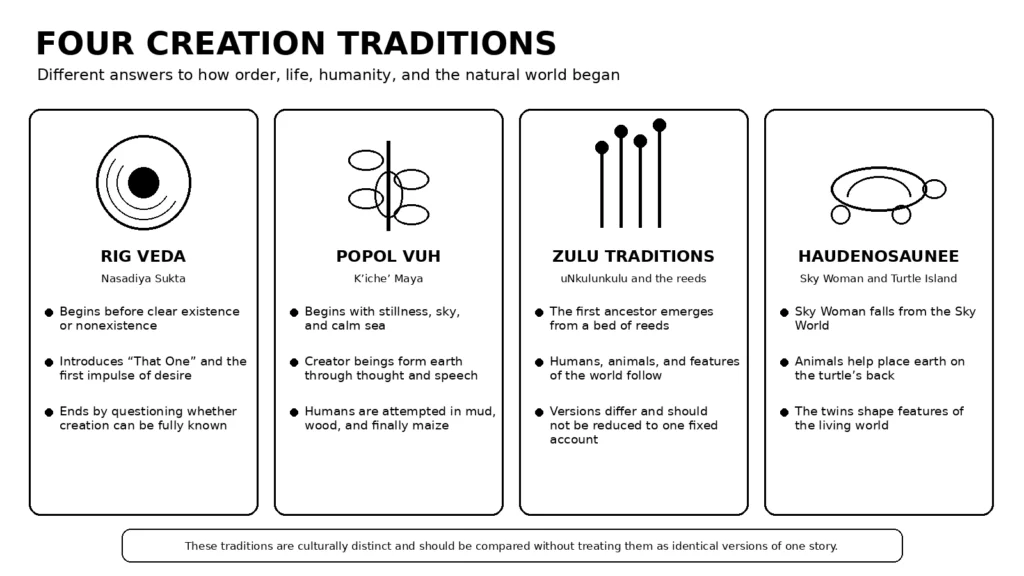
What Are the Titles and Cultures Associated with Each Excerpt?
“The Song of Creation” is a common English title for the Nāsadīya Sūkta, or Hymn of Creation, found in Book 10, Hymn 129 of the Rig Veda. The Rig Veda is the earliest surviving collection of Vedic Sanskrit hymns and is foundational to the religious and literary traditions that later developed within Hinduism. The creation hymn belongs to Vedic culture, but it should not be treated as the only Hindu explanation of creation because Indian religious traditions contain several different cosmological accounts. Unlike a straightforward narrative, the hymn asks whether existence emerged from nonexistence, what power produced creation, and whether even the highest divine observer fully knows its origin. The second excerpt comes from the Popol Vuh, a sacred and historical work of the K’iche’ Maya people of the Guatemalan highlands. Its title is commonly translated as “Book of the Community” or “Book of Counsel,” rather than “The Epic Creation of Maya,” although the text contains one of the best-known Maya creation accounts. The work also includes the adventures of the Hero Twins, the origins of K’iche’ lineages, migrations, political claims, and the history of important communities. It is therefore more extensive than a single story about the creation of the earth (Christenson, 2007; Jamison & Brereton, 2014).
The African excerpt discussed in the original article belongs to Zulu oral tradition, although it is more accurate to refer to the amaZulu people than to describe them simply as a tribe. One widely recorded tradition states that uNkulunkulu, an ancient or first ancestor, emerged from reeds and became connected with the appearance of human beings, animals, and features of the natural world. However, Zulu religious traditions contain several versions, and later missionaries sometimes treated uNkulunkulu as though the figure were identical to the single creator God of Christianity. Modern scholarship warns that this interpretation can oversimplify the older relationship between ancestors, political authority, creation, and the divine in Zulu thought (Weir, 2005). The Native American excerpt is attributed to the Mohawk people, who are one of the nations of the Haudenosaunee Confederacy. Kanien’kehá:ka and other Haudenosaunee creation accounts commonly describe Sky Woman falling from the Sky World, animals helping her, earth being placed on the back of a turtle, and later generations shaping the natural world. Because oral traditions may vary by nation, family, storyteller, language, and period, one version should not automatically be treated as the only correct account. Each title should therefore be connected carefully with the particular people, text, and source from which it was taken.
Where Do Both the Rig Veda and the Popol Vuh Begin?
The original answer correctly observes that the Rig Veda and the Popol Vuh begin before the ordinary world has taken its familiar form. In the Nāsadīya Sūkta, the poet imagines a condition in which neither existence nor nonexistence can be clearly identified. There is no recognizable sky, atmosphere, death, immortality, day, or night, and darkness appears hidden within darkness. The hymn refers to “That One,” which breathes without ordinary breath through its own power, but it does not provide a simple description of a personal creator making the world in a fixed sequence. Desire then appears as an early impulse or seed of thought, and sages search within themselves for the relationship between being and nonbeing. The hymn finally asks who truly knows where creation came from, since even the gods are said to have appeared after the world’s production. Its conclusion leaves open the possibility that the highest observer knows the answer, but it also makes the remarkable suggestion that perhaps even that being does not know. The beginning is therefore characterized not only by emptiness and stillness but also by philosophical uncertainty about whether the origin of reality can ever be fully understood (Jamison & Brereton, 2014).
The Popol Vuh also opens with silence, stillness, darkness, and the absence of the completed earth. The original article accurately remembers that only the sky and a calm sea are present before mountains, animals, forests, and human beings appear. However, it is incorrect to say that no creators exist at this stage because the narrative identifies divine beings such as the Framer and Shaper, the Plumed Serpent, and Heart of Sky. These beings come together in thought and speech, consider how the world should be formed, and bring the earth into existence through their word. The landscape then emerges as mountains rise from the water and valleys, forests, streams, and other features take shape. The creators produce animals, but the animals cannot speak the divine names or offer the praise expected of them. This failure leads to repeated attempts to make suitable human beings, first from mud, then from wood, and finally from maize. The opening of the Popol Vuh therefore, shares the atmosphere of stillness found in the Vedic hymn, but it offers a more definite account of purposeful creator beings shaping an ordered world (Christenson, 2007).
The two beginnings are similar because both ask readers to imagine reality before ordinary distinctions such as land and sky, movement and stillness, or life and death have become established. Both accounts also use poetic language rather than presenting creation as a scientific description of physical events. Nevertheless, their intellectual purposes differ significantly. The Nāsadīya Sūkta emphasizes uncertainty and asks whether the beginning can be known at all. The Popol Vuh describes creators who communicate, plan, experiment, and seek beings capable of remembering and honoring them. The Vedic hymn does not narrate several failed attempts to create humanity, whereas repeated creation is central to the Maya account. The Popol Vuh also connects successful humanity with maize, a crop fundamental to Maya life, identity, and cosmology. A careful comparison should therefore recognize the shared movement from an undifferentiated beginning toward order while preserving the different religious questions asked by each text.
What Element or Substance Appears in Each of the Four Stories?
In “The Song of Creation,” the most striking early images are darkness, possible water, heat, desire, and “That One” that breathes without wind or ordinary breath. The original article states that the One came first and then created everything else, but the hymn itself is less definite about agency and sequence. It asks whether there was an unfathomable depth of water, rather than stating with certainty that water already existed in the familiar sense. It also describes heat or creative energy as part of the movement through which unity emerges. Desire becomes the first seed of mind, connecting creation with consciousness rather than only with physical matter. The hymn’s most important “substance” may therefore be the mystery connecting existence with nonexistence. Its language repeatedly resists a literal explanation in which one identifiable material is transformed into the complete universe. This uncertainty distinguishes the hymn from creation stories that give soil, clay, plants, or bodily material a more concrete role (Jamison & Brereton, 2014).
In the Popol Vuh, water, sky, earth, mud, wood, and maize all appear at different stages of creation. The calm sea and empty sky form the opening setting, while divine speech brings mountains, valleys, forests, and rivers into their proper places. Mud is used during an unsuccessful attempt to make human beings because the resulting figures are weak, unstable, and unable to endure. Wood is then used to create a later generation, but these beings lack the proper understanding and remembrance expected by their makers. The final successful humans are formed from white and yellow maize, which gives the story a close connection with. Maya agriculture and cultural identity. Maize is not merely an available building material because it represents nourishment, ancestry, community, and the basis of human life. The movement from mud and wood to maize also suggests that true humanity requires more than physical shape. Human beings must posses awareness, speech, memory, and a meaningful relationship with the sacred world (Christenson, 2007).
In one well-known Zulu account, reeds or a bed of reeds provide the place from which uNkulunkulu and the earliest people emerge. The original article preserves this important image by stating that uNkulunkulu sprang forth from reeds and that other forms of life appeared with him. Some collected versions describe uNkulunkulu as bringing forth people, cattle, animals, mountains, streams, fire, agriculture, and essential human knowledge. However, the tradition should not be reduced to a single fixed story because the meanings of uNkulunkulu, uHlanga, Umvelinqangi, ancestry, and creation vary across sources. Early European missionaries and collectors sometimes reorganized Zulu beliefs into categories that resembled biblical monotheism. Scholars therefore distinguish between the original oral traditions and later interpretations that made uNkulunkulu into a universal creator in a specifically Christian sense. Reeds remain an important image because they connect the beginning of human life with vegetation, water, growth, and a shared source. The story presents creation as emergence from a living environment rather than as the manufacture of an entirely separate world (Callaway, 1870; Weir, 2005).
In documented Kanien’kehá:ka and Haudenosaunee accounts, water, soil, seeds, animals, and the back of a great turtle are central to creation. Sky Woman descends from the upper world toward a lower world initially covered by water. Birds support her fall, while water animals attempt to dive beneath the surface and obtain a small amount of earth. The soil is placed on the turtle’s back, and the land expands as Sky Woman moves, sings, or dances upon it. Seeds brought from the Sky World allow plant life to grow on the newly formed earth. Later figures, including twins in several versions, shape animals, plants, rivers, daylight, darkness, and other features of the world. The turtle therefore provides support, while soil and seeds provide the physical beginning of the land and its living systems. This account explains North America as Turtle Island and emphasizes cooperation between human, animal, spiritual, and environmental life (Mohawk Language Custodian Association, 2016; Oneida Indian Nation, n.d.).
Does the Mohawk Tale Explain Natural Phenomena?
Yes, documented Mohawk and broader Haudenosaunee creation accounts explain many features of the natural and moral world. They describe why the land is called Turtle Island, how earth came to rest above the original waters, and why animals occupy an important place in the relationship between human beings and the environment. In some versions, Sky Woman or her descendants are connected with the appearance of plants, seeds, food, and the cycles that sustain life. Creator twins later shape rivers, flowers, animals, day, night, and other contrasting features of existence. Their cooperation, rivalry, or opposition may explain why the world contains both beneficial and dangerous conditions. The story also teaches that humans are not separate from creation because their survival depends upon animals, soil, water, plants, and spiritual responsibility. Natural phenomena are therefore explained through relationships and moral balance rather than through modern scientific processes. The account gives cultural meaning to the landscape and to the obligations people hold toward the living world (Mohawk Language Custodian Association, 2016).
The original article instead states that differences in human skin color are explained by clay figures being left in a fire for different lengths of time, producing Black, White, and Native American people. This claim should not be presented as an authentic Mohawk explanation unless the writer can identify a reliable Mohawk source containing that exact story. The documented Kanien’kehá:ka creation account consulted for this revision does not use the different baking times of clay figures to explain racial categories. An official Oneida version does include the creation of a man from red clay, but it does not present the underbaked and overbaked racial hierarchy described in the original answer. Stories about differently baked human beings have circulated in several popular and colonial contexts, often carrying insulting assumptions about race. Attaching such an account to an Indigenous nation without evidence can misrepresent that nation’s beliefs and repeat stereotypes as though they were traditional knowledge. The corrected answer should therefore focus on Sky Woman, Turtle Island, animals, soil, plants, twins, daylight, darkness, and the shaping of the environment. Where a classroom excerpt differs from these documented accounts, the article should identify it as the version found in that particular source rather than treating it as representative of all Mohawk tradition.
What Similarities Exist Between These Stories and the Creation Account in Genesis?
The original article identifies several broad similarities between the four traditions and the creation account in Genesis. In Genesis 1, the opening world is formless and dark, with a divine wind or spirit moving over the waters. God creates light, separates day from night, establishes the sky, gathers the waters, reveals dry land, produces vegetation, places lights in the heavens, creates animals, and finally creates human beings. The Popol Vuh also begins with stillness, darkness, sky, and sea before the land rises and living creatures appear. Both works describe creation through purposeful divine activity and give speech an important role in bringing order into existence. Both also place human creation after major features of the world and other living creatures have been formed. The Zulu and Haudenosaunee accounts similarly connect human beings with the earth, animals, plants, water, and an already developing natural order. These shared motifs reflect common human questions about why the world has order, where life originated, and what responsibilities human beings possess within creation (Coogan et al., 2018).
However, the claim that all stories follow the same sequence of sky, sea, day, night, earth, and finally humanity is too general. The Nāsadīya Sūkta does not provide a detailed series of separate creative acts comparable to the seven-day structure in. Genesis. Instead, it explores the uncertainty surrounding existence, nonexistence, desire, divine knowledge, and the first origin of creation. The Popol Vuh contains multiple attempts to create beings capable of speech and remembrance, which has no direct equivalent in the first chapter of. Genesis. Its successful humans are formed from maize, whereas. Genesis 2 describes the human being as formed from the dust of the ground. The Zulu account emphasizes emergence from reeds and the role of a first ancestor, while Haudenosaunee tradition describes creation unfolding on a turtle’s back through the assistance of animals and the work of Sky Woman’s descendants. Genesis presents one sovereign God whose commands reliably produce creation, while the other narratives contain different divine structures, uncertainties, experiments, ancestors, or cooperative relationships. The similarities are therefore meaningful, but they should not be used to imply that the stories are interchangeable or that one is simply a rewritten version of another.
Another similarity is that the stories place human beings within a moral and relational universe rather than describing them only as biological organisms. In Genesis, humans are made in the image of God and receive responsibilities involving the earth and other living beings. In the Popol Vuh, the creators seek humans capable of speaking, remembering, and sustaining a relationship with the divine. Haudenosaunee creation teachings emphasize balance, gratitude, cooperation, and the connection among animals, plants, land, spiritual beings, and human communities. Zulu traditions connect people with ancestry, shared emergence, social knowledge, livestock, food production, and the life of the community. The Vedic hymn approaches morality less directly, but its ending encourages intellectual humility by acknowledging that the ultimate beginning may exceed both human and divine knowledge. Each tradition therefore uses creation to explain not only where the world came from but also how people should understand their place within it. This shared ethical function may be more important than superficial similarities in the order of created objects.
What Are the Main Differences Among the Four Creation Stories?
The most important difference is the degree of certainty each story expresses about the origin of existence. The Nāsadīya Sūkta is unusual because it questions whether anyone can truly know how creation began. Even the gods cannot provide an obvious answer because the hymn says that they came after the world’s production. The Popol Vuh, by comparison, names creator beings and describes their deliberate efforts to form the earth and suitable human beings. Zulu narratives connect origins with uNkulunkulu, reeds, ancestry, and the appearance of social knowledge, although the meanings and relationships differ across versions. Haudenosaunee accounts explain creation through the movement from the Sky World to the water world, the cooperation of animals, the formation of Turtle Island, and the creative actions of later generations. Genesis presents a more orderly account in which the commands of one God reliably establish distinct parts of creation. The different levels of certainty reflect different literary purposes rather than different attempts to provide the same type of explanation.
The stories also differ in their treatment of humanity and the natural environment. In the Popol Vuh, human creation involves repeated failure because physical form alone does not produce beings capable of proper memory and sacred speech. The final maize people are closely connected to the crop that sustained Maya communities. Haudenosaunee tradition gives animals an active role in making human life possible, since birds, water animals, and the turtle cooperate in the creation of land. Zulu traditions link humans and other living things through a shared emergence from reeds or a common ancestral source. The Vedic hymn does not focus on the manufacture of the first man or woman, but instead reflects on the relationship between mind, desire, existence, and the unknown beginning of the cosmos. These differences show that creation stories preserve the social and environmental knowledge of the communities that tell them. Maize, reeds, water animals, turtles, darkness, breath, speech, and divine command carry meanings that arise from particular histories and ways of life.
Why Should Creation Stories Be Compared Carefully?
Comparing creation stories can reveal meaningful similarities, but it can also create problems when cultural differences are ignored. A comparison is useful when it helps readers identify recurring human concerns such as water, darkness, divine power, the origin of land, the creation of humanity, and the relationship between people and nature. It becomes misleading when every story is forced into the structure of Genesis or judged according to whether it resembles modern science. Sacred narratives may serve religious, historical, political, educational, ceremonial, and moral purposes at the same time. The Popol Vuh, for example, preserves creation traditions but also records K’iche’ history and lineage claims. The Nāsadīya Sūkta offers a meditation on uncertainty rather than a complete chronological account. Haudenosaunee creation stories remain part of living Indigenous cultures and should be approached through sources connected with those communities. Respectful comparison therefore requires accurate names, reliable translations, acknowledgement of variations, and care not to repeat stereotypes or unsupported claims.
These stories remain valuable because they show that people across different times and places have asked profound questions about existence. They ask what came before the visible world, whether creation had a purpose, how humans became different from other beings, and what obligations accompany human life. Their answers are not identical, but each reflects a serious effort to connect people with the universe around them. The Vedic hymn teaches humility before the unknown, while the. Popol Vuh emphasizes speech, memory, repeated creation, and maize-based humanity. Zulu traditions connect life with reeds, ancestry, community, and the emergence of practical knowledge. Haudenosaunee accounts emphasize cooperation, Turtle Island, balance, and the interdependence of human and nonhuman life. Genesis describes ordered creation through divine command and places human beings within a relationship of responsibility toward God and the earth. Studying these narratives together can deepen cultural understanding when their differences are treated as sources of knowledge rather than errors that must be removed.
References
Callaway, H. (1870). The religious system of the AmaZulu. J. A. Blair.
Christenson, A. J. (2007). Popol Vuh The sacred book of the Maya. University of Oklahoma Press.
Coogan, M. D., Brettler, M. Z., Newsom, C. A., & Perkins, P. (Eds.). (2018). The New Oxford annotated Bible with Apocrypha New Revised Standard Version (5th ed.). Oxford University Press.
Jamison, S. W., & Brereton, J. P. (2014). The Rigveda The earliest religious poetry of India (Vols. 1–3). Oxford University Press.
Mohawk Language Custodian Association. (2016). Kanienkehá:ka creation story.
Oneida Indian Nation. (n.d.). The Haudenosaunee creation story.
Weir, J. (2005). Whose Unkulunkulu? Africa, 75(2), 203–219. doi:10.3366/afr.2005.75.2.203
Cite This Work
To export a reference to this article please select a referencing stye below:

Academic Master Education Team is a group of academic editors and subject specialists responsible for producing structured, research-backed essays across multiple disciplines. Each article is developed following Academic Master’s Editorial Policy and supported by credible academic references. The team ensures clarity, citation accuracy, and adherence to ethical academic writing standards
Content reviewed under Academic Master Editorial Policy.





