
Introduction
Learning about economic growth and development changed how I interpret national performance because I no longer treat a rising gross domestic product as synonymous with progress. GDP remains an important measure of economic activity, but it answers a narrower question than development. Economic growth usually refers to an increase in real output, especially real output per person, while economic development asks whether people actually gain better health, education, security, productive opportunities, and freedom. A country can become richer in aggregate while large groups experience little improvement, just as a country with modest growth can make meaningful progress through effective public services and institutions. This distinction is consistent with the Stiglitz-Sen-Fitoussi commission, which emphasized that measurement of economic performance should not be confused with measurement of social progress (Stiglitz, Sen, & Fitoussi, 2009). The capability approach also helped me understand that income is primarily a means: development concerns what people are genuinely able to be and do with the resources, institutions, and opportunities available to them (Sen, 1999).
Reading Indicators Beyond the Headline Number
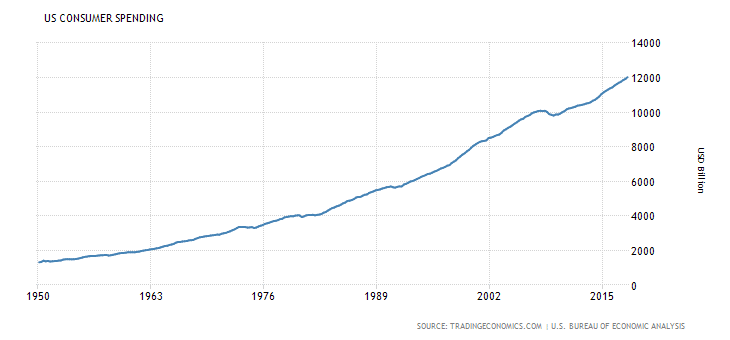
Economic indicators became more useful once I learned to ask what each one includes and excludes. Nominal GDP changes when output or prices change, whereas real GDP attempts to remove inflation; total GDP can also rise while real output per person changes little if population grows quickly. Inflation has similarly unequal effects because households devote different shares of income to food, housing, energy, transport, and savings. Employment data require context as well. A low unemployment rate says little about wage levels, job security, underemployment, working hours, or labor-force participation. Consumer spending can also mislead when a long nominal series is interpreted as evidence of rising welfare without accounting for inflation and population. The historical U.S. consumer-spending chart below is therefore useful only as a starting point. To evaluate household well-being, I would compare real consumption per person and examine saving, debt, income distribution, and the composition of expenditure rather than treating one upward nominal line as proof that living standards improved (U.S. Bureau of Economic Analysis).
Growth, Capabilities, and Distribution
The distinction between growth and development became clearest when I considered health, education, poverty, and inequality. Higher national income can create fiscal capacity for hospitals, schools, sanitation, infrastructure, and social protection, but those outcomes depend on institutions and distribution rather than appearing automatically. A country may spend more on education without improving literacy or numeracy if teaching quality, attendance, safety, or language access remain weak. Health outcomes similarly depend on public-health systems, clean water, vaccination, maternal care, prevention, and affordable treatment. The Human Development Index captures part of this wider perspective by combining income, education, and life expectancy, while UNDP’s human-development framework emphasizes people’s opportunities and choices rather than production alone (UNDP, 2025). Inequality changes the meaning of averages because rising per-capita income can coexist with stagnant real incomes for many households. Poverty measures add another layer: monetary thresholds are useful, but multidimensional deprivation can persist through inadequate housing, unsafe water, weak schooling, health barriers, insecurity, or exclusion from public services.
Trade, Investment, and Domestic Linkages
Trade and investment taught me that policies can produce aggregate gains while distributing costs unevenly. Comparative advantage explains why countries can benefit from specialization and exchange, and trade can lower prices, expand markets, increase competition, and improve access to technology and inputs. Those gains do not eliminate adjustment costs for workers or regions exposed to import competition. Tariffs may protect particular producers and generate revenue, but they can also raise input prices, reduce consumer purchasing power, or provoke retaliation. Exchange-rate movements likewise create mixed effects: depreciation can support exporters while increasing the local cost of imported fuel, machinery, medicine, or foreign-currency debt. Foreign direct investment can contribute capital, technology, employment, management knowledge, and export connections, yet its development impact depends on local linkages. An investment creates broader capability when firms train workers, purchase from domestic suppliers, transfer knowledge, pay taxes, and support related industries rather than operating as isolated enclaves. Institutions, infrastructure, education, competition policy, and tax administration therefore determine how effectively international economic activity becomes domestic development.
Policy, Institutions, and Sustainability
Macroeconomic policy and sustainability added another layer to my understanding because short-term stabilization and long-term development are related but not identical. Fiscal policy influences demand through taxation and public spending, while monetary policy affects credit conditions and inflation through interest rates and other tools. The quality of spending matters as much as the amount: two governments can allocate similar shares of GDP to infrastructure or education and achieve very different results because of procurement, maintenance, corruption, administrative capacity, and project selection. Environmental sustainability must also be included in the assessment. GDP can rise while forests are depleted, pollution damages health, or resource extraction reduces future livelihoods. Climate-related heat, flooding, drought, crop loss, and disaster damage can reverse gains in income and health, making resilience part of economic development rather than an external environmental concern. If I were evaluating a country today, I would therefore use a dashboard that includes real GDP per capita, productivity, household income, employment quality, poverty, inequality, education, health, infrastructure, institutions, and environmental resilience (World Bank, 2026).
Conclusion
The most practical skill I gained from studying economic growth and development is learning to interrogate economic claims rather than accept impressive numbers at face value. When I encounter a statistic, I now ask whether it is nominal or real, total or per capita, preliminary or revised, and which population or time period it represents. I also ask what alternative explanations could account for the pattern. Growth after a policy change does not prove that the policy caused it; global demand, commodity prices, interest rates, demographics, earlier investment, or external shocks may also matter. This framework changes how I read development news. Inflation can fall while the overall price level remains high, foreign investment can increase without strong technology transfer, and consumer spending can rise while household debt also expands. Economic growth still matters because societies need productive capacity, income, and fiscal resources. Development, however, concerns whether that capacity creates durable opportunities for people to live healthier, safer, more productive, and more meaningful lives without sharply reducing the choices available to future generations (Sen, 1999; UNDP, 2025).
Works Cited
Sen, Amartya. Development as Freedom. Alfred A. Knopf, 1999.
Stiglitz, Joseph E., Amartya Sen, and Jean-Paul Fitoussi. Report by the Commission on the Measurement of Economic Performance and Social Progress. 2009.
United Nations Development Programme. Human Development Report 2025: A Matter of Choice—People and Possibilities in the Age of AI. 2025.
World Bank. World Development Indicators. 2026.
U.S. Bureau of Economic Analysis. Consumer Spending.
Cite This Work
To export a reference to this article please select a referencing stye below:

Academic Master Education Team is a group of academic editors and subject specialists responsible for producing structured, research-backed essays across multiple disciplines. Each article is developed following Academic Master’s Editorial Policy and supported by credible academic references. The team ensures clarity, citation accuracy, and adherence to ethical academic writing standards
Content reviewed under Academic Master Editorial Policy.





