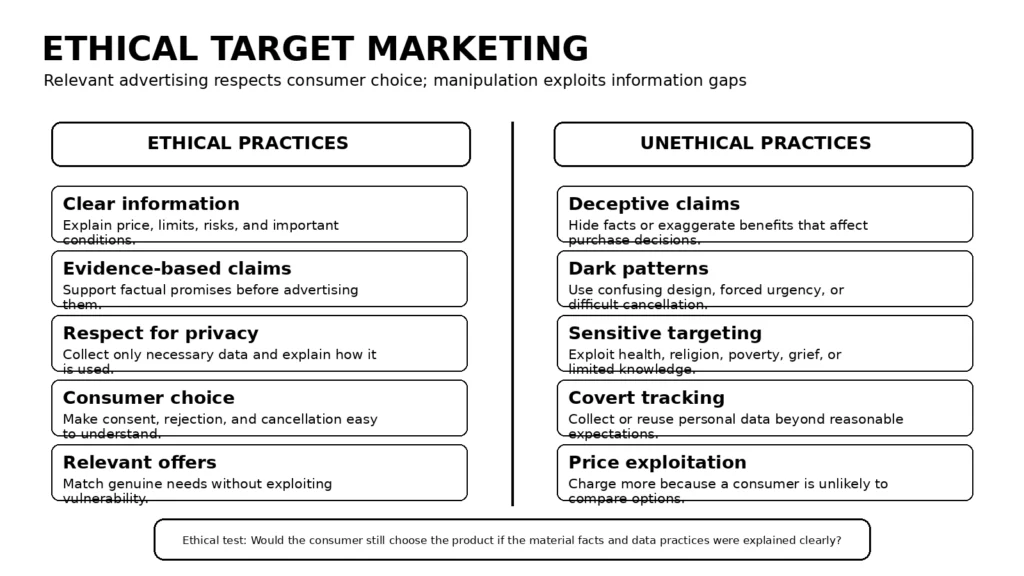
Increasing the customer base is one of the primary objectives of nearly every company, but businesses use different methods to achieve this goal. Some companies focus on digital marketing strategies to reach the large audiences available through search engines, websites, mobile applications, and social media platforms. Other businesses continue to use conventional methods, including printed advertisements, telephone calls, direct mail, and door-to-door promotion. With the growth of social media and online shopping, consumer information has become increasingly accessible to businesses that can target customers according to demographics, cultural preferences, interests, location, and buying behavior. As a result, target marketing has become an efficient tool for companies seeking to promote products and enter new markets. At the same time, the ability to identify and influence specific consumers has created an important debate about whether targeting people who lack information is ethical. Target marketing itself is not automatically ethical or unethical because its moral acceptability depends on the information provided, the methods used, the vulnerability of the audience, and whether consumers retain a meaningful ability to make their own decisions.

What Is Target Marketing
Target marketing is the process of identifying a group of consumers who are likely to need, prefer, or purchase a particular product or service. Companies may divide a broad market according to age, income, location, occupation, lifestyle, interests, family status, or previous purchasing behavior. A business then designs its advertising, product features, prices, and communication methods around the needs of the selected group. For example, a company selling affordable educational software may direct its advertisements toward students, parents, schools, and teachers rather than promoting the product equally to every member of the public. This approach can prevent businesses from wasting resources on audiences that have little interest in the product. It can also help consumers discover services that are genuinely relevant to their needs. Targeting becomes ethically questionable, however, when a company uses its knowledge of a group not to serve its needs but to exploit its lack of knowledge, emotional condition, financial hardship, or inability to compare alternatives.
Who Is an Uninformed Consumer
An uninformed consumer is not necessarily unintelligent or careless. A consumer may be uninformed because product quality is difficult to evaluate, important conditions are hidden, technical language is confusing, or information is available only after a purchase has been made. People may also lack time, experience, internet access, financial knowledge, medical knowledge, or the ability to compare several complicated offers. A first-time buyer may know less about a product than a company that has designed, tested, priced, and promoted it for years. This difference creates what economists describe as an information imbalance between the seller and buyer. Buehler and Schuett (2014) explain that markets may contain both informed and uninformed consumers when buyers cannot easily observe the quality of a product. The ethical responsibility of a company should therefore be to reduce harmful information gaps through clear explanations, reliable evidence, and fair comparisons rather than deliberately taking advantage of those gaps.
Why Target Marketing Can Be Ethical
In my view, target marketing can be both ethical and useful for companies seeking sustainable growth, although it is not the only method of entering a new market. Businesses need to understand the people they intend to serve because a product designed without knowledge of consumer needs may be irrelevant, inaccessible, or wasteful. When companies study the genuine needs and demands of a particular community, they can develop products that are more suitable for local income levels, languages, customs, and practical conditions. Targeted communication can then explain how the product works and why it may be useful to the intended audience. This method can benefit consumers by reducing the time required to search for relevant goods and services. It can also benefit small businesses that cannot afford to advertise to an entire national or international population. Ethical target marketing therefore creates a connection between a legitimate consumer need and a product capable of meeting that need without hiding material information or pressuring the buyer.
Educating Consumers About Useful Products
The original article correctly argued that target marketing can educate a community about new and useful products. Advertising is not always designed simply to persuade people to buy something they do not need. It can inform consumers that a product exists, describe its features, explain its price, and show how it differs from available alternatives. A rural community, for example, may benefit from targeted information about a new transportation service, affordable internet program, agricultural tool, or local health clinic. Similarly, people with disabilities may benefit when companies advertise products specifically designed to improve accessibility. The ethical value of this communication depends on whether the information is accurate, balanced, and understandable. Buehler and Schuett (2014) show that certification and minimum quality standards may improve outcomes when some consumers cannot directly observe product quality. Businesses can support informed choice by using trustworthy certification, transparent labeling, demonstrations, warranties, and clear explanations rather than assuming that an uninformed audience may be told anything.
Competition and Consumer Benefits
The original content also noted that target marketing can increase competition among companies, which may lead to lower prices and improved product quality. When several businesses identify the same consumer need, they may compete by offering better service, stronger warranties, more useful features, or more affordable prices. Consumers can benefit when advertising gives them enough information to compare these competing offers. Fishman (1988), however, demonstrates that competition does not automatically protect every uninformed buyer, because sellers may still discriminate between people who search carefully and those who do not. A consumer who compares prices may receive a better offer than another consumer who accepts the first advertisement presented. Digital platforms can make this difference even greater because companies may personalize prices, promotions, or messages according to what they know about an individual. Competition is therefore beneficial only when consumers can recognize alternatives and understand the important differences between them. Ethical companies should make comparisons easier rather than building a profitable strategy around the assumption that some customers will remain uninformed.
Deceptive Marketing Is Unethical
Target marketing becomes unethical when companies use deceptive ways of marketing or provide manipulative information to influence consumers. Unfortunately, some organizations focus on immediate profit while ignoring the social and financial consequences of their advertising. A deceptive advertisement may exaggerate a product’s benefits, hide important limitations, misrepresent its price, or create the false impression that independent experts support it. Other advertisements may use carefully selected statistics without explaining the conditions under which those results were obtained. A claim does not have to contain an obvious lie to be misleading because the omission of a material fact may also change how a reasonable consumer understands the offer. The Federal Trade Commission requires advertising claims to be truthful, not misleading, and supported by appropriate evidence before they are published (Federal Trade Commission, n.d.-a). Targeting an uninformed group with deceptive information is especially unethical because the seller is intentionally using a knowledge advantage to prevent consumers from making a reasonable decision.
Manipulative Digital Design
Modern target marketing involves more than the wording of advertisements because website and application design can also influence consumer behavior. Companies may use countdown timers, hidden charges, preselected options, confusing buttons, repeated notifications, or subscription processes that are much easier to enter than to cancel. These techniques are often described as dark commercial patterns because they direct consumers toward choices that may not reflect their genuine intentions. The Federal Trade Commission (2022) has identified practices such as disguised advertisements, difficult cancellation processes, hidden terms, and misleading interface designs as methods that may trick or trap consumers. The OECD (2022) similarly explains that dark patterns can cause financial loss, privacy violations, and psychological harm. An uninformed consumer may believe that a purchase must be completed immediately because a false timer suggests that an offer is about to expire. Ethical marketing should make important choices clear and should not depend on confusion, fatigue, or accidental consent.
Cultural and Religious Manipulation
The original essay argued that companies act unethically when they misuse the cultural beliefs and religious affiliations of a community to sell products. Culture can be considered ethically when a company adapts language, packaging, customer service, or product design to meet genuine community needs. The problem begins when businesses use sacred symbols, religious authority, cultural fears, or community identity in misleading ways. A company may falsely suggest that a product has been approved by a respected religious figure or that purchasing it is necessary to prove loyalty to a group. It may also create advertisements that reinforce harmful stereotypes because those stereotypes attract attention. These practices are manipulative because they transform personal identity and community trust into tools for commercial pressure. Ethical cultural marketing requires consultation, accuracy, respect, and an understanding that a community is not simply a profitable category in a database. Businesses should ask whether their message serves the audience or merely uses its beliefs to weaken independent judgment.
Privacy and Consumer Data
The growth of digital marketing has made consumer privacy an essential part of the ethical debate. Social media platforms, websites, applications, and data brokers may collect information about searches, purchases, locations, interests, relationships, devices, and online activity. This information can help companies show more relevant advertisements, but consumers may not understand how much information has been collected or how many organizations can access it. Boerman et al. (2017) explain that online behavioral advertising can produce different consumer responses depending on the level of personalization, knowledge, and perceived control. Martin and Murphy (2017) also emphasize that privacy is not simply a legal issue because ethical data practices influence trust between consumers and businesses. A company should not assume that clicking an unclear consent button gives unlimited moral permission to collect, combine, retain, and sell personal information. Ethical targeting requires understandable privacy notices, reasonable data collection, effective security, and genuine choices about whether personal information may be used for advertising.
Targeting Vulnerable Consumers
The ethical risk becomes greater when marketing is directed toward people whose circumstances make them unusually vulnerable. These groups may include children, older adults with cognitive limitations, people in financial distress, individuals with serious illnesses, or consumers experiencing grief, addiction, loneliness, or desperation. A company may know that a person has searched for debt relief, cancer treatment, gambling services, or emergency loans and can use that knowledge to present highly persuasive advertisements. The product may sometimes be legitimate and useful, but the marketer must recognize that the consumer’s ability to evaluate risks may be affected by fear or urgency. Targeting should never exploit vulnerability by promising guaranteed results, hiding fees, creating false hope, or discouraging consumers from seeking independent advice. The ethical standard should become stronger rather than weaker when the audience has limited information or reduced bargaining power. Businesses should consider whether they would regard the advertisement as fair if it were directed toward a vulnerable member of their own family.
Price Discrimination and Uninformed Buyers
Target marketing can also raise ethical concerns when companies use consumer data to determine who is likely to pay a higher price. Not every difference in price is unfair because discounts may be based on quantity, timing, membership, location, or the cost of providing a service. The ethical problem arises when a company charges more simply because it believes a particular consumer is unlikely to compare prices or understand the normal value of the product. Fishman’s (1988) analysis is relevant because it shows how dynamic sales practices can disadvantage uninformed consumers even within a competitive market. A customer who receives a personalized offer may assume that the price is favorable when another person has been offered a lower amount for the same product. Such practices reduce transparency and make it difficult for consumers to judge whether they are being treated fairly. Businesses using personalized pricing should clearly explain the basis for meaningful price differences and should avoid exploiting consumers who have limited information about available alternatives.
The Importance of Consumer Choice
Ethical marketing should support consumer choice rather than secretly replace it with manipulation. A person should be able to understand what is being offered, why a particular advertisement is being shown, and what important conditions apply to the purchase. Consumers should also be able to reject targeted advertising, withdraw consent, decline optional services, and cancel subscriptions without unnecessary difficulty. This does not mean that every advertisement must explain every minor product detail. It means that facts likely to influence the purchasing decision should be presented clearly before the consumer becomes committed. Transparency is especially important when marketing involves recurring payments, personal data, health claims, financial services, or long-term contracts. A useful ethical test is to ask whether the consumer would still choose the product if the material facts and data practices were explained in plain language. If the sale depends on the consumer not understanding the offer, the strategy is not ethical target marketing.
Responsibilities of Companies
Companies should develop internal standards that go beyond asking whether a marketing practice is technically possible. Managers should review how customer data was collected, whether advertising claims are supported, and whether particular groups may be harmed by the campaign. Marketing teams should avoid describing consumers as targets in a way that encourages them to ignore the people behind the data. Legal review is important, but legal compliance should be treated as the minimum standard rather than the complete definition of ethical behavior. A practice may comply with a narrow rule and still damage trust if consumers reasonably feel watched, pressured, or misled. Companies should also monitor complaints, refund requests, cancellation difficulties, and differences in how campaigns affect vulnerable groups. Long-term sustainable growth is more likely when customers believe that a business is helping them make a suitable choice rather than trying to defeat their judgment.
Responsibilities of Consumers and Regulators
Consumers also benefit from developing habits that reduce information disadvantages. They can compare prices, read independent reviews, examine return policies, question urgent offers, and avoid relying on one advertisement for complex health or financial decisions. However, responsibility cannot be placed entirely on consumers because companies usually possess more information, technical knowledge, and control over how offers are presented. Regulators therefore have an important role in enforcing truth-in-advertising standards, privacy requirements, product safety rules, and protections against unfair or deceptive practices. Certification bodies and industry associations can also help by creating meaningful quality standards and investigating misleading claims. Schools, libraries, consumer organizations, and public agencies can improve digital and financial literacy without suggesting that victims are responsible for sophisticated deception. A fair marketplace requires informed consumers, responsible businesses, and effective oversight rather than expecting individuals to defend themselves against every possible form of manipulation. The purpose of regulation should be to preserve legitimate marketing while preventing companies from earning profit through avoidable consumer confusion.
Conclusion
In conclusion, target marketing itself is not unethical as long as companies do not deceive consumers, spread false information about their products, misuse cultural beliefs, or hide facts that would affect purchasing decisions. It can be an efficient and ethical method when businesses seek to understand the needs of a community and provide relevant information about useful goods and services. Target marketing may also increase competition and help consumers discover products that better match their preferences. However, targeting becomes unethical when the success of the campaign depends on consumers remaining uninformed. Deceptive claims, hidden fees, dark patterns, covert data collection, unfair personalized pricing, and exploitation of vulnerable groups violate the consumer’s ability to make a free and informed choice. Companies should use consumer information to improve relevance, service, and product quality rather than to identify weaknesses that can be exploited. The central ethical question is therefore not whether a company targets a particular audience, but whether it respects that audience as a group of people capable of making decisions when given honest and understandable information.
References
Boerman, S. C., Kruikemeier, S., & Zuiderveen Borgesius, F. J. (2017). Online behavioral advertising A literature review and research agenda. Journal of Advertising, 46(3), 363–376. doi: 10.1080/00913367.2017.1339368
Buehler, B., & Schuett, F. (2014). Certification and minimum quality standards when some consumers are uninformed. European Economic Review, 70, 493–511. doi: 10.1016/j.euroecorev.2014.06.007
Federal Trade Commission. (2022). Bringing dark patterns to light.
Federal Trade Commission. (n.d.-a). Advertising and marketing basics.
Federal Trade Commission. (n.d.-b). Advertising FAQs A guide for small business.
Fishman, A. (1988). Dynamic sales discriminate against uninformed consumers in a competitive market. Economics Letters, 27(1), 23–25. doi: 10.1016/0165-1765(88)90213-3
Martin, K. D., & Murphy, P. E. (2017). The role of data privacy in marketing. Journal of the Academy of Marketing Science, 45(2), 135–155. doi: 10.1007/s11747-016-0495-4
Organisation for Economic Co-operation and Development. (2022). Dark commercial patterns. OECD Publishing.
Cite This Work
To export a reference to this article please select a referencing stye below:

Academic Master Education Team is a group of academic editors and subject specialists responsible for producing structured, research-backed essays across multiple disciplines. Each article is developed following Academic Master’s Editorial Policy and supported by credible academic references. The team ensures clarity, citation accuracy, and adherence to ethical academic writing standards
Content reviewed under Academic Master Editorial Policy.

- This author does not have any more posts.