
Interoperability between health systems means more than sending information electronically. A system is interoperable when information can move across organizations, retain its meaning, reach the correct patient record, and be used safely within the receiving workflow. In the United States, this requires a combination of technical standards, common data definitions, identity management, privacy, cybersecurity, governance, and clinical responsibility. Current federal policy continues to rely heavily on HL7 FHIR, US Core, SMART on FHIR, and the United States Core Data for Interoperability (USCDI) as building blocks for standardized exchange (Assistant Secretary for Technology Policy/Office of the National Coordinator for Health Information Technology [ASTP/ONC], 2026a, 2026b).
The original proposal correctly emphasizes the need to connect clinicians, laboratories, pharmacies, hospitals, specialists, and patients. The problem is that these areas should not be designed as isolated interfaces. The architecture should follow the patient journey: registration creates the identity record; clinicians document and order; laboratories and imaging services return results; pharmacies process medication orders; specialists receive referrals; and patients access information through portals or applications. Interoperability succeeds when these exchanges form a coherent clinical process rather than a collection of technical connections.
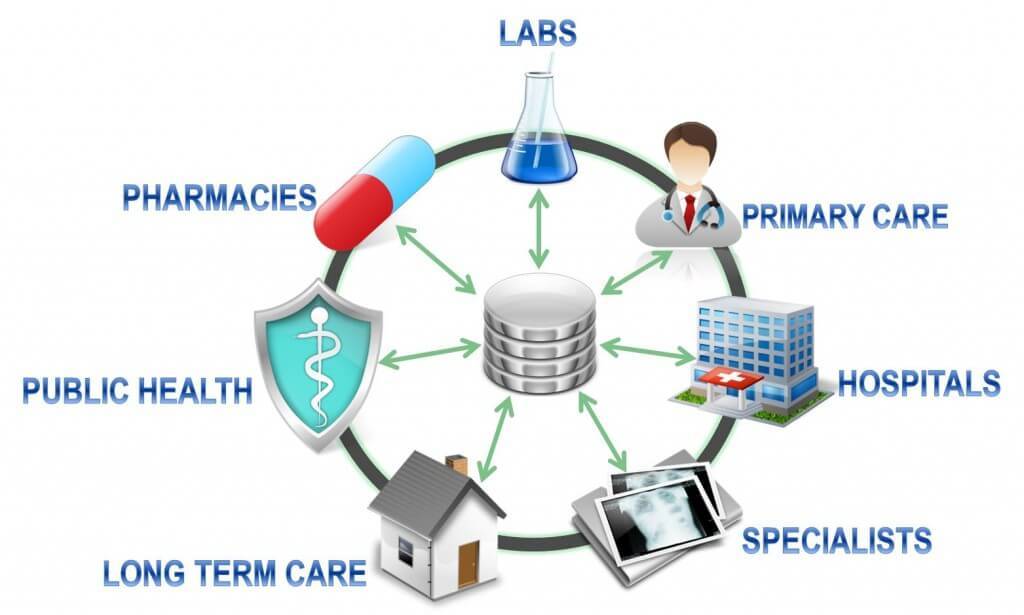
Data Architecture
A modern interoperability design should begin with common data models and exchange standards. HL7 FHIR represents health information as modular resources such as Patient, Observation, Medication, Condition, Encounter, DiagnosticReport, and CarePlan (HL7 International, 2023). In the United States, the federal interoperability ecosystem continues to use FHIR Release 4 as the mature foundational version for certified health IT, while US Core implementation guides define minimum constraints aligned with nationally standardized data elements (ASTP/ONC, 2026b).
USCDI provides a baseline set of data classes and elements intended for nationwide exchange. USCDI Version 6 was released in July 2025 and expanded the standard with additional elements such as care plans, portable medical orders, and unique device identifiers. However, federal certification requirements and voluntary advancement pathways do not always use the newest USCDI version immediately. For that reason, an organization should identify the regulatory version it is required to support, any newer version it chooses through an approved pathway, and the implementation guide corresponding to that version rather than assuming “latest” automatically means “required” (ASTP/ONC, 2025, 2026c).
| Exchange Area | Key Standards | Main Purpose |
|---|---|---|
| Clinical APIs | HL7 FHIR, US Core, SMART App Launch | Structured patient and population data exchange and application access |
| Core data | USCDI | Defines nationally standardized data classes and elements |
| Laboratory data | LOINC, UCUM | Identifies tests and standardizes units |
| Clinical terminology | SNOMED CT | Represents clinical concepts consistently |
| Medications | RxNorm | Normalizes medication names and identifiers |
| Imaging | DICOM | Supports medical-image exchange and metadata |
Standards alone do not guarantee semantic interoperability. A laboratory value can be transmitted successfully and still become unsafe if the unit is missing, the specimen type is unclear, or a local test code maps incorrectly. The receiving system must understand the data in the same clinical sense as the sending system. Terminology governance, mapping review, version control, and conformance testing are therefore necessary parts of implementation.
Patient identity is equally important. Duplicate records can split one person’s history, while an incorrect merge can combine information from two people. Registration systems should use multiple demographic attributes, clear duplicate-resolution procedures, and human review for uncertain matches. Identity processes must accommodate name changes, cultural naming conventions, newborns, patients without standard identification, and other situations that make simple exact matching unreliable.
Clinical Workflow
Interoperability creates value only when exchanged information supports a clinical task. Laboratory exchange, for example, should begin with an electronic order linked to the correct patient and specimen. The laboratory returns a coded result with value, unit, reference range, time, and status. Critical results need an acknowledgement process; simply delivering a message to the record does not prove that someone acted on it.
Medication interoperability should support prescribing, dispensing, allergies, medication history, reconciliation, and administration. A pharmacy may receive a prescription electronically, check the product and interactions, clarify questions, and return dispensing information. Yet the presence of a prescription does not prove that the patient takes the drug. Nurses, pharmacists, and prescribers still need medication reconciliation because records can be outdated or incomplete.
Referral workflows demonstrate why organizational interoperability matters. A referral should communicate the clinical question, urgency, relevant findings, medication list, and supporting results. The receiving specialist then returns conclusions and recommendations. A closed-loop system tracks whether the patient was scheduled, seen, and followed up. Without this operational responsibility, technical transmission may occur while the clinical task remains unfinished.
Patient access should be part of the architecture as well. Portals and standardized APIs can allow people to view, download, and share information, but access must be understandable. A raw code or unexplained laboratory result does not automatically create meaningful participation. Language, disability, caregiver access, adolescent privacy, proxy rules, and digital inequality should be considered during design.
Interoperability can also create information overload. Copying an entire external record into a local chart may increase duplication and make important changes harder to find. Systems need source attribution, reconciliation, filtering, and clinically useful summaries. The goal is not maximum data volume. It is reliable access to relevant information with enough provenance to know where it came from.
Governance and Risk
Technical exchange depends on organizational agreements. Leaders must decide which information is shared, how identity is matched, who can correct errors, which consent rules apply, how outside data are incorporated, and who is accountable when an exchange fails. This kind of cross-organizational coordination depends on leadership that can align professional roles, technology, governance, and institutional responsibility (Ledlow & Coppola, 2013). Two systems can both support FHIR and still fail operationally if the organizations have no agreed workflow or trust relationship.
Privacy becomes more complex as information moves across more organizations and applications. Role-based access, auditing, authentication, authorization, consent management, and minimum-necessary principles should be built into workflows. Sensitive information may require additional segmentation or legal review depending on jurisdiction. Patients should also have a practical mechanism for requesting correction when inaccurate information is propagated across connected systems.
Cybersecurity is part of interoperability because APIs and exchange networks increase the number of interfaces that can be attacked. Secure design includes modern authentication, encrypted transport, logging, patching, monitoring, incident response, vendor management, backup, and recovery. Availability matters as much as confidentiality; an interface outage can delay care even when no information is stolen.
The federal interoperability environment also continues to evolve. The HTI-1 final rule updated certification requirements for standardized APIs, algorithm transparency, and information sharing, while 2026 ASTP/ONC guidance continues to clarify the standards used in certified health IT. Organizations therefore need standards governance capable of tracking regulatory deadlines and approved version changes rather than implementing an interface once and assuming it will remain current indefinitely (ASTP/ONC, 2026a, 2026c).
Artificial-intelligence tools introduce another governance issue. Data arriving through interoperable systems may feed predictive models or clinical decision support. A model can only be as reliable as the information it receives. Duplicate patients, outdated medication lists, inconsistent terminology, and missing demographic data can distort algorithmic output. Interoperability quality is therefore increasingly linked with responsible AI and data governance.
Implementation Plan
A hospital or health system should begin with a limited clinical use case rather than attempt to connect every department at once. A strong first project might be structured laboratory exchange, closed-loop referral, or medication reconciliation across a defined group of organizations. The team should document the current workflow, identify the safety problem, define the data required, select standards, and establish success measures before building the interface.
Testing must evaluate meaning as well as transmission. Engineers can confirm that a FHIR resource passes schema validation, but clinicians should also confirm that the result appears in the correct patient record, uses the correct units, displays source and status appropriately, and triggers the intended workflow. Test cases should include amended results, duplicate patients, missing fields, unexpected codes, system downtime, and delayed messages.
A controlled pilot allows problems to be corrected before broad deployment. Staff training should be role-specific: registration staff need identity-management procedures; nurses need reconciliation and documentation workflows; laboratory staff need result status and correction processes; pharmacists need medication exchange; privacy teams need access rules; and technical staff need monitoring and conformance tools.
Success should be measured using outcomes tied to the use case. Useful measures can include duplicate-test rates, referral closure, medication discrepancies, time to result availability, patient-match errors, user satisfaction, security incidents, portal use, and downtime. Message volume alone is not evidence of better care.
Continuity planning is also essential. Hospitals must be able to operate when exchange networks or interfaces fail. Downtime procedures should explain how orders, results, medications, and referrals are handled manually and how those transactions are reconciled after recovery. The restoration process must avoid duplicate orders or results generated during the outage.
Interoperability between health systems is therefore a clinical and organizational capability supported by technology, not a technical feature by itself. FHIR, USCDI, terminology standards, identity management, and secure APIs provide a foundation. Clinical workflow, governance, privacy, cybersecurity, patient participation, and measurement determine whether that foundation actually improves care. The objective is simple to state but difficult to achieve: the correct information about the correct patient should reach the correct authorized person in a form that can be safely used at the moment it is needed.
References
Assistant Secretary for Technology Policy/Office of the National Coordinator for Health Information Technology. (2025). ONC Standards Bulletin: USCDI Version 6.
Assistant Secretary for Technology Policy/Office of the National Coordinator for Health Information Technology. (2026a). HTI-1 Final Rule and Certification Updates.
Assistant Secretary for Technology Policy/Office of the National Coordinator for Health Information Technology. (2026b). Interoperability Standards Platform: FHIR Ecosystem.
Assistant Secretary for Technology Policy/Office of the National Coordinator for Health Information Technology. (2026c). ONC Standards Bulletin 2026-1.
HL7 International. (2023). FHIR Release 5.
Ledlow, G. J. R., & Coppola, M. N. (2013). Leadership for Health Professionals. Jones & Bartlett Learning.
Cite This Work
To export a reference to this article please select a referencing stye below:

Academic Master Education Team is a group of academic editors and subject specialists responsible for producing structured, research-backed essays across multiple disciplines. Each article is developed following Academic Master’s Editorial Policy and supported by credible academic references. The team ensures clarity, citation accuracy, and adherence to ethical academic writing standards
Content reviewed under Academic Master Editorial Policy.





