
Francisco Goya and Spanish Art History
Francisco Goya has been known as one of the greatest painters in Spanish and international art. The total number of artworks by Francisco Goya is 389, consisting of different genres like mythological, religious, historical, and the Disaster of War. The period from 1794 to 1815 is the French invasion period. The art of Francisco depicts what happened during the war. In this era, most of Northern Europe was under French rule. The French invasion began with the occupation of northern Europe in 1794 (Museo Nacional del Prado, n.d.).
The Third of May 1808 and Historical Commemoration
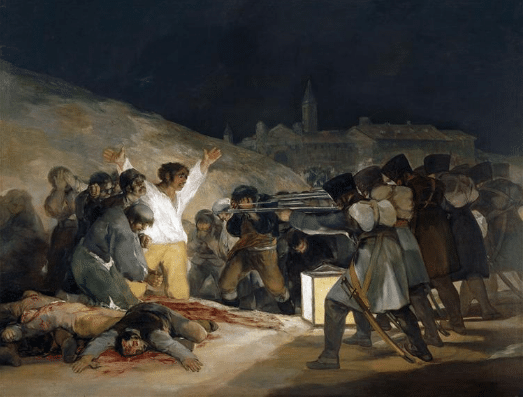
The execution of the defenders of Madrid (1808) was one of the amazing masterpieces made by Francisco Goya. The painting was commissioned by the provisional government of Spain. Goya made a request to the provisional government to be allowed to make a painting that would commemorate the invasion by Napoleon’s troops in 1808. The time at which this painting was painted was considered revolutionary and groundbreaking. The painting represents a horrifying scene of war that had never been openly illustrated. The scene takes place at night and is illuminated by a lantern. The painting focuses on one man who is shown as the central figure among others in the light of a lantern. The man’s arms are raised as he faces the French troops holding rifles in front of him. All the other companions are on the ground. A style that is used in this painting is romanticism. In the painting, the bodies of others lie on the ground, and the man about to be executed raises his hands while posed like the crucified Christ. Goya makes us sympathize with the peasants by focusing on their anguish as they await their fate. The firing squad, on the other hand, is faceless as they carry out their brutal attack.
Napoleonic Warfare and Political Revolution
Warfare is generally undertaken for political reasons. The French Revolutionary Wars were exceptional in terms of political considerations. The Napoleonic Wars were characterized by the extent to which they extended and retained the social and political innovations of revolutionary France. The political situation of France impelled the newly established government to wage wars against the neighboring states. The leaders of the French Revolution expanded the French foreign policy. In the period from 1793 to 1799, there was no certainty by any means that France would have waited for Europe to be pacified before defeating the British. During the first few years, the French did have some advantage over British naval supremacy. By 1796, 60,000 troops had fallen in the battles with the British.
Representation of Violence and Civilian Suffering
The subject of the painting depicts the war scenario during the invasion. It shows how French troops brutally assaulted the people. The picture reveals the troops holding rifles and firing at people who do not have any weapons in their hands. The riot of the people of Madrid against the army of Napoleon was savagely punished by executions and arrests that continued from 2nd May till the next day. Goya saw the scene from his window, went directly to that particular spot, and captured the moment in his painting in the light of a lantern. The gestures and postures of the soldiers facing the people, with rifles in their hands pointed toward them, show the horrifying nature of the scene. The execution of innocent people gave French troops a sense of happiness as though they had achieved something significant, showing the barbarism and cruelty of the troops.
Symbolism and the Artist’s Emotional Perspective
There is symbolism in the painting as it depicts Francisco’s inner subjectivity. The painting shows the synthesis of the painter’s feelings and forms and how he used his feelings in his painting. What feelings did he have while painting this masterpiece at the point where this scene happened? Francisco believed that art should reflect an idea or emotion that represents the natural world in an objective manner embodied by realism (The Metropolitan Museum of Art, n.d.).
Composition Colour and Visual Balance
The layout of the composition we see in the painting is exceptional. The focus and balance of the painting are remarkable. One can clearly see that the painting is not heavy on just one side but is equally balanced on both sides. The use of colors depicts how the rhythm of the painting leads one’s eye to view the artwork in a certain place. All parts of the painting are linked together; there is nothing in the painting that is out of place. A perfect proportion of the things in the painting is present, showing the cleanliness of the painting. All the paintings that Francisco painted during the period of the French invasion give an observer the idea of how things have changed, how things have happened, and how people were slaughtered and executed (Encyclopaedia Britannica, n.d.).
Goya’s Court Career and Legacy of War Art
Goya was successful when he was appointed as a court painter, and he started painting on themes other than religious themes. Although the paintings he made during the French invasion and during the disaster of wars depict what he saw at that time, he was never convinced by his paintings. He always wanted to paint more religious themes than other themes. Toward the end of his life, he was not able to cope with the things he had seen during the war, so he started painting again on religious themes to give himself some sort of relief. The prints of his last work do not depict that he turned his back on religion. Rather, he focused his mind on how far time had shaped the need for reform.
References
Museo Nacional del Prado. (n.d.). Goya. https://www.museodelprado.es/en/the-collection/artist/goya-y-lucientes-francisco-de/39568a17-81b5-4d6f-84fa-12db60780812
The Metropolitan Museum of Art. (n.d.). Francisco de Goya (1746–1828) and the Spanish Enlightenment. https://www.metmuseum.org/toah/hd/goya/hd_goya.htm
Encyclopaedia Britannica. (n.d.). Francisco Goya. https://www.britannica.com/biography/Francisco-Goya
Cite This Work
To export a reference to this article please select a referencing stye below:

Academic Master Education Team is a group of academic editors and subject specialists responsible for producing structured, research-backed essays across multiple disciplines. Each article is developed following Academic Master’s Editorial Policy and supported by credible academic references. The team ensures clarity, citation accuracy, and adherence to ethical academic writing standards
Content reviewed under Academic Master Editorial Policy.





