
Economics and Finance
Introduction
In an article by John Carney, Basics of Banking: Loan Creates a Lot More Than Deposits, the author demonstrates the basic ideas of broad capital creation as well as an overview of how both customers and the bank’s balance sheet are likely to be affected by the creation of money. However, this article is not correct in all the opinions presented. Therefore, this essay is aimed at focusing on the correct analysis of the article.
Part I
Loans create deposits
Most historians, in the olden days, claim that it is always better for most citizens to stay in the dark about how the banking system functions. This is because if they knew, an uprising and revolution would take place almost instantly. A few economists have acknowledged that most of the assumptions made regarding how the banking system functions are wrong. To acquire a perception of how the new position held by banks is radical, people must first take into consideration the traditional perspective, which persistently continues to act as the ground for all the rational debates relating to public policy. People tend to save their money in banks. The money saved tends to be lent out to other individuals and corporations at a given interest.
The borrowers range from consumers to entrepreneurs and business people who, in most instances, are willing to make investments using the money to accrue gains from some profitable enterprises. In truth, banks are permitted by the fractional reserve system to lend out considerably more money than the amounts held in their reserves. It is also a fact that in cases where the savings do not suffice, private banking institutions are at liberty to seek to borrow larger amounts from the central bank.
The central bank has the mandate to print as much money as it wishes. However, it is careful and cautious to avoid printing a lot of cash. In fact, this is one of the significant explanations as to why independent central banks exist in the first place. Too much money could be put out if the federal government could print money itself. The resultant effect of this move would be inflation, which would consequently push the economy into chaos. Institutions such as the US Federal Reserve and the Bank of England were carefully established with the objective of regulating the supply of money to prevent or curb inflation. This explains why such institutions are restricted from funding the government directly through activities such as purchasing treasury bonds. Instead, the institutions tend to support the private sector or the economy in their actions since it is the field in which the government usually taxes (Banks, risk, and economic growth: a theoretical analysis, 2007).
With this kind of understanding and equipped with this kind of information, talks and debates regarding money are likely to persist, just as is the case with limited resources such as petroleum and bauxite. Usually, it is contended that there is little money to facilitate the funding of social programs and initiatives. This further explains the immorality associated with the public expenditure or government debt, thus crowding out the private sector. Most banks, such as the Bank of England, however, admit that none of these allegations is real or true. In summary, instead of the banks receiving deposits once households make savings and later lending them out, the lending done by banks creates deposits. In truth, the central bank rarely fixes or dictates the amount of cash released into circulation, and neither is the money from the central bank multiplied up into more loans and deposits (Dilley, n.d.).
In another explanation, everything people know is not merely wrong, but, in other words, it is backward. As the banks make loans, they tend to create money. This is because money, in this case, is just an IOU. The functions and roles of the central bank are to preside over the legal orders that tend to efficiently grant other banks the exclusive responsibilities and rights to establish IOUs of a particular nature, the ones that are recognizable by governments as legal tender because of their willingness to acknowledge and accept them in payment of fees and taxes (Press, 2010).
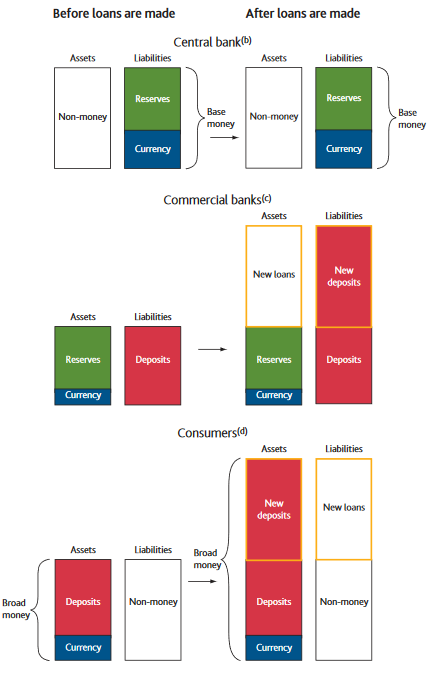
In reality, there are no limits as to the amount of money the banks can create so long as they acquire a person or an entity that is willing to borrow it. In such cases, they are unlikely to get caught short or inadequate, for a simple explanation that the borrowers do not typically take the money and put it in their homes or place it under their mattresses. Consequently, any amount of cash lent out by the banks as loans will ultimately come back to the bank sometime again. For the entire banking system, every credit given out becomes a deposit. Insofar as the banks are concerned, all they are required to do is to obtain the money from the central bank; they can borrow as much money as they wish. All the central bank needs to do is set and indicate the interest rates payable, which are the cost of the cash rather than its quantity. Since the start of the recession, the British and U.S. central banks have cut costs to nearly nothing. With quantitative easing, there is an active and efficient pumping and supplying of as much cash as they possibly can into the financial institutions, with the absence of a likelihood of creating any inflationary implications (Banks, risk, and economic growth: a theoretical analysis, 2007).
What is meant by this is that the actual limit on the amounts of capital inflow is not the amount that the central banks could be willing to lend, but instead, it is the amount that the ordinary citizens, federal governments, and firms are willing to borrow. Government expenditure is the key driver in this concept. Even economists and financial bloggers such as John Carney acknowledge that the government is funded by the central bank. This, therefore, gets rid of the question as to whether public spending tends to crowd out the private sector. Notably, the situation is exactly the opposite (Dilley, n.d.).
This has been admitted by some banks as it is the truth. One of the roles and responsibilities of the bank is actually to run and govern the system. However, it has been noted that the system has been experiencing hitches. There is a possibility that the system decided and concluded that the maintenance of the fantasy-world type of economics proved to be only a convenience to the wealthy and prosperous and is a luxury that, to them, is no longer unaffordable. However, from a political perspective, this move entails a significant risk. One should take into consideration what is likely to happen to the mortgage holders in case it comes to their attention that the money they borrowed from various banks is not, in an actual sense, the savings made by the thrifty pensioners but instead is something whisked into existence by the bank by means of a magic wand that the public handed over to it (Banks, risk, and economic growth: a theoretical analysis, 2007).
If people take lightly the capital limitations put into place by the financial institutions themselves or by the country, then, in that case, they can lend as much as they wish. While banks cannot give out more money than they possess, they can raise the money they have at will. In terms of accounting, when banks lend money, they do not go for the cash stored in their vaults; instead, the borrower’s account is merely credited (depositing the money from thin air), and the same amount of money is then added to their account to ensure that the credit and debit match. The main reason why it is impossible to lend out infinite amounts of cash is that once money is borrowed, the person tends to spend it, and thus, the deposit or credit funds are transferred to another person’s account in another bank. In a case where the borrower uses the money in an unsuccessful business, the financier or lender is unlikely to get their money back (Cranston, Avgouleas & Zwieten, n.d.).
A Bank L+E
Loan: + 500 Deposit: +500
A Customer L+E
Deposit: +500 Loan: +500
The element of default normally restrains bank lending. It is worth mentioning that the deposit multiplier tends to work once the money is limited to coins. This is because its physical limitations usually restrict the supply. However, also in times of moneychangers and goldsmiths during the pre-modern era, the bankers lent out money from thin air by the use of their accounts rather than the coins held in the vaults. They faced challenges in the sense that they were required to transfer capital to a person who needed a loan when paying for something. In such instances, the coins were not required for the inter-bank payment, which did not balance out (Press, 2010).
An increase in the supply of money does not lower the interest. Capital is not like other consumable goods. For instance, when a person buys an apple, they eat it, but in cases where a person obtains money, the money is reflected in the supply as an individual’s deposit. The supply and demand of funds usually match in totality, which is a concept applied by the central banks in keeping the system solvent. However, the central bank has the ability to set the interest rates they desire at interbank loan markets since it can establish inflation or scarcity at will, which is not tied to the total money supply (Burton & Brown, n.d.).
Part II
Positive Countercyclical Capital Buffer
Canada is one of the various nations that practice a positive countercyclical capital buffer. As learned from the global financial crisis, regulatory capital necessities are an essential source of procyclicality that can amplify the credit cycle in periods of bust and boom. For instance, before the crisis, during the good times, when risks were analyzed to be low, there were also small capital requirements, which enhanced the ease of the lending conditions as well as credit expansion. However, in the downturn, the assessed vulnerability of the bank assets increased, which led to an increase in the capital requirement levels at a time when raising funds was expensive and challenging due to the losses. In such cases, money regulations led to increased pressures on the financial institutions to decrease their balance sheets, bearing significant adverse repercussions for the provision of credit as well as economic activity (Kalatie, Laakkonen & Tölö, 2015).
The reduction of the bank’s procyclicality in lending can assist in the sustenance of economic development in times of stress. One method of attaining this is through the establishment of a countercyclical capital buffer, which can increase the needed bank capital level during the boom period and permit it to be drawn down during periods when the cycle turns. The Basel Committee on Banking Supervision (BCBS), on July 16th, 2010, released a buffer proposal that outlined the aims and underlying decision-making framework applicable to setting a buffer. It also provided a numerical guideline capable of serving as an original information source when making such decisions. The oversight entity for the BCBS, known as the Group of Governors and Heads of Supervision, on September 12th, affirmed the buffer as part of the reform initiatives for global capital regulations (Countercyclical capital buffer proposal, 2010). The Basel III capital conservation and countercyclical buffer regimes were phased in from January 1, 2016, and became fully effective on January 1, 2019.
In a report, the GHOS outlined the essential elements of the framework for the countercyclical money buffer as proposed by the BCBS. The components indicated some flexibility regarding how the shield would be implemented in each jurisdiction. This was followed by some examples of the types of information that could be applied in informing the application of the Buffer by the Canadian government, authorities, and banking systems (Banks, risk, and economic growth: a theoretical analysis, 2007).
The BCBS was inclusive of the methodologies that could be used in the calculation of the globally consistent reference guides to assist in the establishment of the countercyclical buffer. The outline would be a part of the information set applied by each jurisdiction in the decision-making of the programs relating to the barriers. It is significant to stress, however, that the government could dictate the size of the buffer on the grounds of its judgment by using a broad array of information obtained on macro-financial situations rather than on the basis of a simple fixed quantitative regulation (Countercyclical capital buffer proposal, 2010).
The data used in the establishment of the countercyclical financial buffer would require obtaining both upswings and downswings present in the economic cycle. Periods during which system-wide vulnerabilities are mounting would correspond to the buildup phase of the buffer, while eras of sharp contraction, when risks begin to materialize, would correspond to the buffer’s release phase. However, it is unlikely that an individual measure would be capable of reliably capturing both the buildup and release phases since the former needs a sound leading-signal property while the latter ought to be a reliable contemporaneous indicator. Consequently, a variable used as a proxy for the buildup phase varies considerably from its long-run pattern during boom periods. However, it sufficiently dictates the requirements, such as non-functioning loans, which are normally bounded at zero and may restrict the contents of the information in credit spreads. The latter variables, in contrast, may serve as information sources on the timing of the release session (Countercyclical capital buffer proposal, 2010).
In this case, the indicators may be more informative when combined than when used singly. When the numerous indicators show the emergence of increased credit growth and increasing system-wide vulnerabilities, the officials can decide to activate the buffer or make more forceful adjustments to its settings.
Conclusion
Conclusively, the article was an outline of major money creation concepts applied in modern banks. The author has exhibited decent illustrations and arguments for understanding the creation of money. However, the writer has some wrong opinions leading to a misunderstanding and misconception regarding the banking principles and systems. The most prominent mistakes concern the balance sheet of the bank, specifically that a bank does not go to its reserves to source money to loan out.
References
Banks, risk, and economic growth: a theoretical analysis. (2007).
Burton, M., & Brown, B. The financial system and the economy.
Countercyclical capital buffer proposal. (2010). [Basel, Switzerland].
Cranston, R., Avgouleas, E., & Zwieten, K. Principles of banking law.
Dilley, D. Essentials of banking.
Kalatie, S., Laakkonen, H., & Tölö, E. (2015). Indicators used in setting the countercyclical capital buffer. Helsinki: Bank of Finland.
Press, W. (2010). Congo, Dem. Rep. of Money and Banking. Petaluma: World Trade Press.
Cite This Work
To export a reference to this article please select a referencing stye below:

Academic Master Education Team is a group of academic editors and subject specialists responsible for producing structured, research-backed essays across multiple disciplines. Each article is developed following Academic Master’s Editorial Policy and supported by credible academic references. The team ensures clarity, citation accuracy, and adherence to ethical academic writing standards
Content reviewed under Academic Master Editorial Policy.





